Learning the essential principles of RuPay credit card for students is critical for anyone looking to build healthy money habits, avoid debt traps, and make smart financial decisions in India.
⚡Updated: November 2026RBI & NPCI RuPay Protocol Verified
Learning the essential principles of RuPay credit card for students is critical for anyone looking to build healthy money habits, avoid debt traps, and make smart financial decisions in India.
Furthermore, over 4 years of active personal finance research in Indian markets. Furthermore, focused on transparent, math-backed guides to help students and young professionals build wealth and manage money smartly.
Learning the essential principles of RuPay credit card for students is critical for anyone looking to build healthy money habits, avoid debt traps, and make smart financial decisions in India.
Learning the essential principles of RuPay credit card for students is critical for anyone looking to build healthy money habits, avoid debt traps, and make smart financial decisions in India.
Essential Overview: Guide to RuPay credit card for students
Essential Overview: Guide to RuPay credit card for students
Learning the essential principles of RuPay credit card for students is critical for anyone looking to build healthy money habits, avoid debt traps, and make smart financial decisions in India.
Learning the essential principles of RuPay credit card for students is critical for anyone looking to build healthy money habits, avoid debt traps, and make smart financial decisions in India.
Additionally, finding the best RuPay credit card for students in India allows college students to build a 750+ CIBIL score early without income proof or annual fees.
Written & Researched by Asif Khan
Written & Researched by Asif Khan
Founder & Lead Financial Editor PaisaKmao.de
Additionally, over 4 years of active personal finance research in Indian markets. Furthermore, focused on transparent, math-backed guides to help students and young professionals build wealth and manage money smartly.
To begin with, learning about RuPay credit card for students is essential for anyone looking to build healthy money habits.
Disclaimer: This guide is for educational financial literacy only. Specifically, we are not SEBI-registered advisors or commercial banks. Furthermore, approvals and limits are granted at the issuing bank’s discretion via Aadhaar KYC. Therefore, never borrow beyond your repayment capacity.
Quick Overview: Best RuPay Credit Cards for Students (2026): Complete Guide to RuPay credit card for students
⚡Quick 30-Second Student RuPay Card Summary
Fast Skim
First: Zero Salary Slip
100% Legal Approval
First, getting a secured student card requires no salary slips or ITR through the secured FD route.
Second: Scan & Pay on UPI
PhonePe GPay Paytm
Second, it links directly into UPI to pay street vendors, canteens & books with zero plastic.
Third: Double Benefit
Earn ~7% Interest on FD
Third, your security deposit compounds interest while unlocking a 90% instant credit line.
Finally: Career Advantage
750+ CIBIL Before Degree
Actionable Insights and Smart Advice for RuPay credit card for students
Finally, you build an exceptional credit score before applying for jobs or study loans.
Previously, finding the best RuPay credit card for students in India used to be nearly impossible. In fact, most commercial banks demand salary slips or ITR proof that full-time college students simply do not possess.
However, thanks to new banking directives by the Reserve Bank of India (RBI) and the National Payments Corporation of India (NPCI), securing a RuPay credit card for students is now fast, 100% legal, and completely paperwork-free through the secured Fixed Deposit (FD) route. In addition, you can link this card directly into PhonePe and Google Pay to scan and pay at college canteens and local merchants.
Actionable Advice and Practical Tips for RuPay credit card for students
1. What is a Secured RuPay Credit Card for Students and How Does It Work?
Direct Definition: A RuPay credit card for students is a secured credit instrument issued against a small refundable Fixed Deposit (₹2,000 to ₹10,000). Consequently, the bank grants an instant 80% to 90% credit limit without requesting any salary slip, ITR, or past credit score.
🔒
1. Consequently, your Cash Stays Safe
Because the FD acts as collateral, your deposit remains 100% secure in your own bank account.
📈
2. In addition, earns ~7% FD Returns
Furthermore, your money doesn’t sit idle; it earns 6.5% to 7.5% compounding annual interest.
📱
3. Specifically, instant Virtual Card
As a result, your card details are generated immediately in the mobile banking app with zero physical waiting.
🎯
4. 100% Bureau Reporting
Consequently, every on-time statement payment reports to CIBIL, establishing a solid score early.
2. Why RuPay on UPI Beats Traditional Visa & Mastercard for Students: Complete Guide to RuPay credit card for students
Additionally, historically, traditional Visa or Mastercard credit cards only work when swiped on expensive electronic card machines. In contrast, choosing a RuPay card allows you to scan any standard merchant QR code at tea stalls, canteens, and stationery stores.
Feature
Regular Visa / Mastercard
RuPay Credit Card for Students
Everyday Merchant Acceptance
Limited to stores with POS machines
Specifically, over 30 Million+ QR codes across India
UPI App Linking
Cannot link to PhonePe / Google Pay
In addition, it links in 60 seconds with UPI PIN
Small Spends (₹20 – ₹100)
Merchants decline swipes under ₹100
Moreover, scan & pay even ₹15 for college snacks
Physical Card Burden
Must carry physical plastic everywhere
As a result, it is 100% phone-based with zero plastic needed
⚠️ Important Rule: A RuPay credit card for students supports Person-to-Merchant (P2M) payments at verified store QR codes. Therefore, you cannot send money directly to personal bank accounts or friend phone numbers (P2P). Thus, this protocol prevents cash recycling abuse.
3. Top 4 RuPay Credit Cards for Students in India (Reviewed): Complete Guide to RuPay credit card for students
To help you pick the right card, we evaluated the leading options based on minimum deposit requirements, fee structures, and UPI reliability. Accordingly, here is our detailed review of the four best options available today.
🏆 TOP RECOMMENDATION SCHEDULED BANK BACKED
Lifetime Free (₹0 Fee)
Specifically, backed by Kotak Mahindra Bank, this is our premier pick for a student credit card looking for an authentic zero-maintenance digital account foundation.
In addition, it is issued in partnership with SBM Bank India. For instance, if you operate on a tighter pocket money budget, this is the most accessible secured credit card in the country.
First, Minimum Deposit: Starting at just ₹2,000 to ₹5,000
Second, Credit Limit: 90% of your deposit value
Third, UPI Linking: Works seamlessly on Google Pay & PhonePe
Finally, Annual Fee: ₹0 forever with zero hidden renewals
📊 LIVE CIBIL TRACKING DASHBOARD
Lifetime Free
3. In fact, paisa+ SBM RuPay Credit Card
Furthermore, this option is developed by Paisabazaar and SBM Bank India. Additionally, this card gives you a built-in credit bureau tracking dashboard updated monthly.
First, Minimum Deposit: ₹5,000 collateral deposit
Second, Rewards Rate: Flat points on merchant UPI QR scans
Third, Bureau Dashboard: Free monthly CIBIL/Experian check
Finally, Digital Approval: 100% digital within 10 minutes
Furthermore, for example, alternatively, these modern fintech platforms are partnered with Axis Bank and Utkarsh SFB. In fact, these deliver 0.5% to 1.5% cashback on everyday merchant QR scans.
Third, Digital Format: Furthermore, it is an instant 100% digital virtual card
Finally, Ideal For: Particularly ideal for tech-savvy students wanting quick daily cashback
4. How to Link a RuPay Credit Card for Students to UPI (PhonePe & Google Pay)
Overall, linking your new RuPay credit card for students to UPI is remarkably straightforward. Because the process is entirely digital, you can complete the setup in under two minutes without waiting for a physical plastic card.
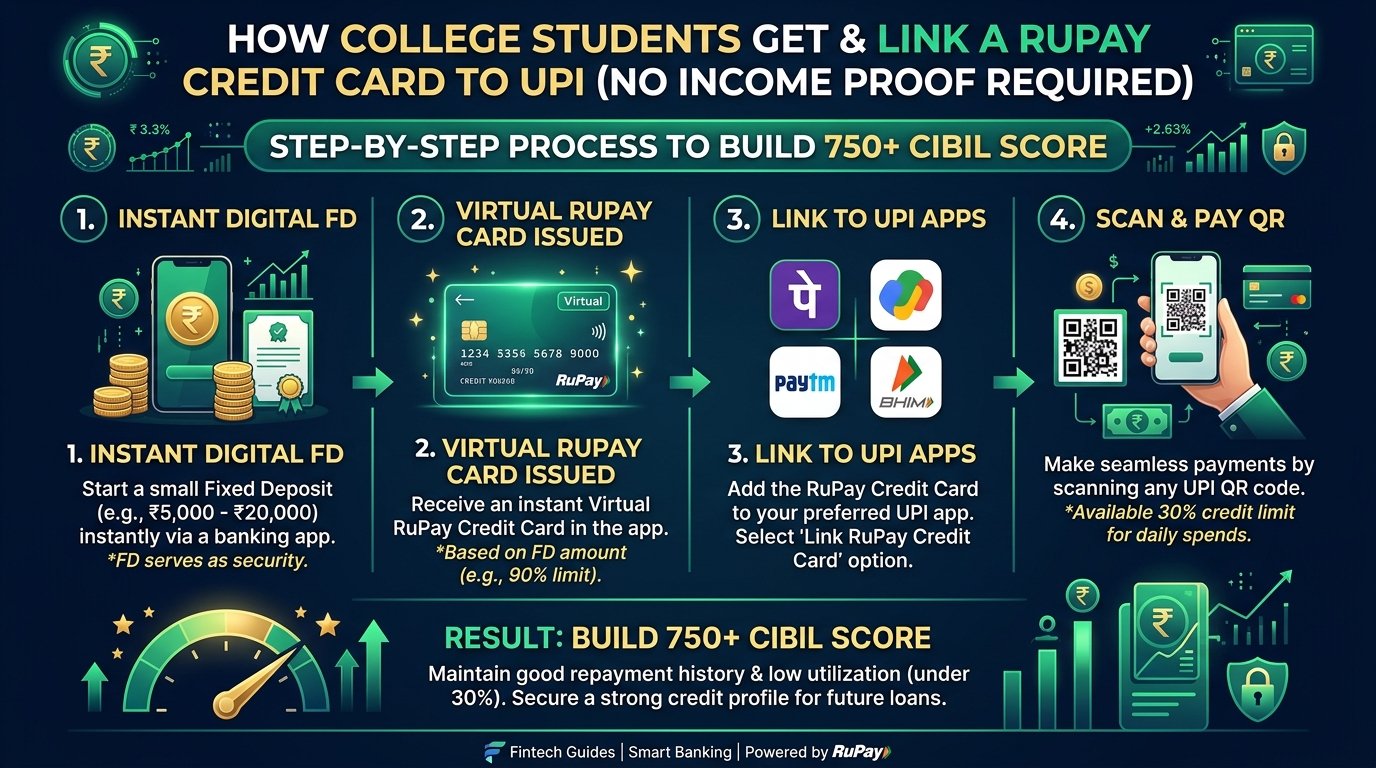
For example, Figure 1 illustrates the complete 4-step infographic roadmap showing how to get and link a virtual student RuPay card to UPI apps.
1Get Card Credentials
First, open your banking app → Credit Card → View your 16-digit card number, expiry date & CVV.
2Tap “Link RuPay on UPI”
Next, open PhonePe or Google Pay → Profile → Bank Accounts → Select Link RuPay Credit Card.
3Select Your Bank
Then, pick Kotak Mahindra or SBM. Subsequently, the app auto-detects your card using your registered mobile number.
4Set 6-Digit UPI PIN
Finally, enter the last 6 digits + expiry, confirm SMS OTP, and set your PIN. Afterwards, scan any merchant QR to pay!
5. The ₹5,000 ₹5,000 Student Math: Build 765+ CIBIL Score
Specifically, ultimately, using a secured credit card is about building an invaluable financial asset: your CIBIL credit score. In fact, a 750+ score makes future car loans, apartment leases, and premium cards instant and cheap.
📊 The Exact ₹5,000 Formula to a 765+ Score:
₹5,000
First, Initial Fixed Deposit
Naturally, it earns ~₹340/yr safe interest
₹4,500
Second, Credit Limit (90%)
Consequently, it protects against overspending
₹1,350
Third, 30% Monthly Cap
Specifically, this is the golden utilization threshold
765+
Finally, Prime Score in 6 Months
Ultimately, you reach a Prime Tier CIBIL rating
Consequently, for more actionable personal finance strategies, explore our detailed guides:
6. 3 Critical Student Traps & Hidden Charges to Avoid
Additionally, for example, even though a secured student credit card is very safe, reckless credit usage can still harm your finances. Therefore, ensure you follow these three protective rules:
❌ Trap 1: ATM Cash Withdrawals
First, never withdraw cash at ATMs using your credit card. Specifically, it triggers ₹300-₹500 cash advance fees plus 42% interest from minute one with zero grace period.
❌ Trap 2: “Minimum Amount Due”
Second, paying only 5% minimum due charges up to 42% compounding interest plus 18% GST on the remaining 95%. Instead, always pay 100% “Total Amount Due”.
❌ Trap 3: Spending Above 30% Limit
Third, spending ₹4,000 on a ₹4,500 limit gives a 90% utilization ratio. As a result, bureaus flag this as credit-hungry behavior, lowering your score. Hence, keep spends under ₹1,350/mo.
First, can a college student get a RuPay credit card without income proof in India?
However, yes. Indeed, students aged 18+ can get a secured student RuPay card backed by a small Fixed Deposit (₹2,000 to ₹10,000) with zero salary slips, zero ITR, and zero prior credit history.
Second, which bank offers the lowest FD requirement for a student RuPay card?
Specifically, the SBM ZET card starts with an FD as low as ₹2,000 to ₹5,000. In comparison, for an authentic full-service scheduled bank, Kotak 811 #DreamDifferent offers robust features starting at ₹10,000.
Third, can I send money to my friends using a RuPay credit card on UPI?
Consequently, clearly, under NPCI rules, RuPay credit cards on UPI only support Person-to-Merchant (P2M) payments at merchant QR codes. Therefore, direct transfers to personal mobile numbers or personal bank accounts are restricted.
Fourth, what happens to my Fixed Deposit while I use the credit card?
In fact, naturally, your fixed deposit remains completely untouched, earning 6.5% to 7.5% annual compounding interest. As long as you pay monthly bills on time, your deposit continues to grow safely.
Fifth, does paying via UPI credit card build a real CIBIL score?
In addition, yes. Indeed, banks report all repayment activity from your student credit card to CIBIL, Experian, and CRIF High Mark every 30 days. In fact, paying statements in full builds a 750+ CIBIL score within 6 to 9 months.
Final Thoughts: Start Your Credit Journey the Smart Way
In conclusion, you do not need to wait for a corporate job offer to build your financial reputation. Specifically, by opening an authentic zero-maintenance digital account like Kotak 811 and activating a secured RuPay credit card on UPI, you enjoy scan-and-pay convenience everywhere and graduate college with a 760+ credit score.
Therefore, are you ready to start your zero-balance digital banking journey?
In addition, open a paperless Kotak 811 account with ₹0 maintenance fees, set up your student fixed deposit, and unlock your virtual RuPay card for instant UPI payments today.
In addition, Affiliate Disclosure: This article contains an affiliate partner link. Specifically, if you open a digital account through this link, we may earn a referral commission at zero additional cost to you.
Actionable Insights and Smart Advice for RuPay credit card for students
Overall, I’m Asif Khan, founder and lead editor behind paisakmao.de. For the past two years, I’ve dedicated my work to financial education, income skills, and ethical money management tailored specifically for college students and ambitious young minds across India. Specifically, through deep research and real banking tests, I help youth build financial independence and avoid debt traps before entering the corporate workforce. Overall, learn more about my personal investing principles and editorial ethics on our About Us page.
Asif Khan
Can a college student get a RuPay credit card without income proof in India?
Furthermore, yes, students aged 18 and above can get a secured student RuPay credit card backed by a small Fixed Deposit (₹2,000 to ₹10,000) with zero salary slips, zero ITR, and zero prior credit history.
Actionable Insights and Smart Advice for RuPay credit card for students
Which bank offers the lowest FD requirement for a student RuPay card?
Specifically, the SBM ZET card starts with a minimum FD requirement of just ₹2,000 to ₹5,000. Meanwhile, Kotak 811 #DreamDifferent offers full-service banking features starting at a ₹10,000 deposit.
Can I send money to my friends using a RuPay credit card on UPI?
Additionally, for example, no. Specifically, according to NPCI guidelines, RuPay credit cards on UPI only support Person-to-Merchant (P2M) payments at verified store QR codes. For example, direct transfers to personal mobile numbers or bank accounts (P2P) are restricted.
What happens to my Fixed Deposit while I use the credit card?
Consequently, your Fixed Deposit remains 100% safe and untouched while continuously earning 6.5% to 7.5% annual compounding interest. As long as you pay your monthly bills on time, your deposit grows securely.
Learning the essential principles of Smallcase vs Mutual Fund is critical for anyone looking to build healthy money habits, avoid debt traps, and make smart financial decisions in India.
Learning the essential principles of Smallcase vs Mutual Fund is critical for anyone looking to build healthy money habits, avoid debt traps, and make smart financial decisions in India.
Learning the essential principles of Smallcase vs Mutual Fund is critical for anyone looking to build healthy money habits, avoid debt traps, and make smart financial decisions in India.
Learning the essential principles of Smallcase vs Mutual Fund is critical for anyone looking to build healthy money habits, avoid debt traps, and make smart financial decisions in India.
Essential Overview: Guide to Smallcase vs Mutual Fund
Learning about Smallcase vs Mutual Fund is essential for anyone looking to build healthy money habits. If you are stepping into the Indian stock market in 2026 with your first savings or stipend, you have almost certainly encountered the ongoing debate: Should you start with Direct Mutual Funds, or build curated stock baskets via Smallcase?
On one side, traditional mutual fund campaigns urge that “Mutual Funds Sahi Hai”. On the other, modern fintech influencers argue that “Smallcase is the 2.0 version of mutual funds because you own real shares in your Demat account without paying ongoing fund management cuts.”
Essential Overview: Guide to Smallcase vs Mutual Fund
Essential Overview: Guide to Smallcase vs Mutual Fund
Additionally, having actively invested in both instruments across bull and bear cycles over the past few years, I can tell you that the truth is far more nuanced than 30-second reels suggest. Furthermore, smallcase is an incredible product for certain investors, but for complete beginners with small starting capital, it introduces operational and tax frictions that very few creators talk about.
⚡ Quick Verdict for 2026 (TL;DR): For Beginners with Capital < ₹50,000:Direct Mutual Funds (especially a low-cost Nifty 50 Index Fund) are indisputably the better choice. You get ₹100/month automated SIPs, zero manual rebalancing hassle, and zero capital gains taxes when fund managers churn internal stocks. For Intermediate Investors with Capital > ₹1,00,000:Smallcase is a great tool for direct shareholder rights, transparency, and concentrated thematic bets (like EV, Defense, or Renewable Energy), provided you are willing to manage manual quarterly rebalance orders, DP charges, and short-term capital gains tax.
Actionable Advice and Practical Tips for Smallcase vs Mutual Fund
Smallcase vs Mutual Fund: Understanding the structural differences between pooled units and thematic Demat baskets.
⚡ Smallcase vs MF: Quick 30-Second Summary for Beginners
: Complete Guide to Smallcase vs Mutual Fund
If you are deciding between Smallcase vs MF (Mutual Funds) for your monthly savings or stipend in 2026, here is the direct, unfiltered verdict:
🟢 Mutual Funds (MF)
Best For: 90% of beginners, college students, and salaried professionals starting with ₹500 to ₹5,000 monthly SIP.
Automated Compounding: Rebalancing is handled automatically by SEBI-registered fund managers with zero effort.
Zero Tax Friction: No capital gains tax triggers when the fund manager buys or sells stocks internally.
Zero Hidden Fees: No DP charges, no per-trade brokerage on monthly SIP installments.
🔵 Smallcase (Direct Equities)
Best For: Active investors with ₹20,000+ capital who want direct Demat ownership and thematic exposure (e.g., Defence, EV, Green Energy).
Direct Demat Ownership: You own the actual shares in your Zerodha or Groww account.
Direct Dividends: Company dividends are credited directly into your linked bank account.
Friction Points: Every rebalance requires manual confirmation, triggers ₹15.93 DP charge per stock sold, and incurs short-term capital gains tax.
💡 Final Bottom Line: For pure wealth building with minimal hassle, choose Mutual Fund (MF) Direct-Growth. If you are passionate about direct stock ownership and have higher capital, explore Smallcase.
My Real Portfolio Experiment: What Actually Happened to ₹30,000: Complete Guide to Smallcase vs Mutual Fund
Furthermore, for example, back in late 2023, I decided to test both platforms with identical real capital rather than relying on backtested models. I put ₹30,000 into a widely recommended Smallcase (All Weather Investing) and ₹30,000 into a Direct Nifty 50 Index Mutual Fund.
Specifically, twelve months later, both portfolios showed roughly 14% to 15% pre-tax paper gains. But when I audited my actual bank deposits and tax console on Zerodha Kite, the net returns told a completely different story:
The Smallcase Friction: Over the year, the Smallcase manager issued 4 quarterly rebalancing updates. Consequently, across those rebalances, 7 stocks were sold and replaced. In addition, every single stock exit triggered a ₹15.93 CDSL DP charge, plus exchange turnover fees and STT. Specifically, even worse, selling profitable stocks within 12 months triggered a 20% Short-Term Capital Gains (STCG) tax under India’s updated tax regime. Therefore, across ₹30,000, those micro-deductions dragged down my net return by nearly 1.8%.
The Mutual Fund Compounding Advantage: The index fund manager rebalanced the underlying Nifty 50 basket internally as company weightings shifted. Yet, not a single rupee of brokerage, DP charge, or capital gains tax was deducted from my account. In fact, under Section 10(23D) of the Income Tax Act, mutual fund internal portfolio turnover is 100% tax-exempt.
The Takeaway: On smaller portfolios, transaction friction and quarterly taxes quietly devour compounding benefits before your money has time to snowball.
The Structural Architecture: How Each Model Works: Complete Guide to Smallcase vs Mutual Fund
Before comparing returns, it is essential to understand the legal and operational plumbing of both instruments.
FREE INTERACTIVE TOOL
Compare Platform Charges & Demat DP Fees
Consequently, calculate your net trading fees, brokerage, STT, and depository participant charges before executing stock baskets.
1. Furthermore, mutual Funds: The Pooled Trust Architecture: Complete Guide to Smallcase vs Mutual Fund
A mutual fund is a SEBI-regulated Trust. Moreover, millions of investors pool their capital together into a common pot managed by an Asset Management Company (AMC) like SBI, HDFC, or Nippon. A professional fund management team deploys that money across 40 to 80 individual stocks or bonds according to a defined investment mandate.
However, you do not own individual stock certificates; you receive Units (Net Asset Value – NAV) representing your proportional stake in the entire pool.
Because the pool is fractional, you can invest as little as ₹100 or ₹500 per month.
First, first, first, first, you do not even need a Demat account. You can hold mutual funds in traditional Statement of Account (SoA) format directly through AMC websites, MFCentral, or CAMS.
2. Overall, smallcase: The Demat Stock Basket Architecture: Complete Guide to Smallcase vs Mutual Fund
Furthermore, for example, smallcase is not an asset management company or a mutual fund. It is a fintech aggregation platform that connects retail investors to SEBI-registered Research Analysts (RAs) and Registered Investment Advisors (RIAs).
When you purchase a Smallcase, the platform executes a batch of market orders directly through your linked broker (such as Zerodha, Groww, Angel One, or Upstox).
You own individual shares directly in your Demat account. If the basket includes Tata Motors, Infosys, and HDFC Bank, those exact shares sit in your CDSL/NSDL holding statement.
Next, next, next, next, in fact, dividends bypass any fund manager and are credited directly to your bank account.
Because Indian law does not permit fractional equity shares, you must purchase at least 1 whole share of every company in the basket. This pushes the minimum entry ticket for most Smallcases to ₹2,500 – ₹10,000+.
Smallcase vs Mutual Fund: Head-to-Head Comparison Matrix
However, here is an objective comparison of the key parameters that directly impact your wallet:
Key Parameter
Direct Mutual Funds
Smallcase Baskets
Senior Blogger Verdict
Minimum Ticket Size
₹100 to ₹500 monthly
₹2,500 to ₹15,000+ per basket
Mutual Funds Win for pocket money budgets.
Asset Ownership
Units of the Fund (NAV)
Direct shares in your Demat account
Smallcase Wins for transparency & voting rights.
SIP Automation
100% automated via Bank e-Mandate/UPI
Requires manual login & order execution each month
Highly tailored themes (Defense, EV, Green Energy)
Smallcase Wins for focused trend investing.
Beginner Suitability
⭐ 10/10 (Passive, stress-free compounding)
⭐ 6/10 (Requires portfolio management & capital)
Mutual Funds Win for first-time investors.
The Hidden Cost Reality: Rebalancing, DP Charges, and Taxes: Complete Guide to Smallcase vs Mutual Fund
Consequently, many first-time investors see a Smallcase with a “Free to Invest” badge and assume it costs nothing. This is where real-world operational friction catches beginners off guard.
Automated recurring SIP setups on discount brokers eliminate the operational friction of manual rebalancing.
In fact, consider what happens during a standard quarterly rebalance:
Actionable Advice and Practical Tips for Smallcase vs Mutual Fund
Manual Execution Hassle: Under SEBI safety rules, no third-party app can buy or sell shares from your Demat account automatically. When a research analyst adjusts the basket, you receive an alert. You must log in during active market hours (9:15 AM to 3:30 PM), review the order, and authorize it. If you are in a college lecture or busy at work and miss the notification, your portfolio drifts off-target.
DP Charges on Every Exit: Every time a stock is sold from your Demat account, your depository (CDSL/NSDL) charges a flat fee (typically ₹15.93 + GST on discount brokers like Zerodha). If a rebalance replaces 5 stocks, you immediately pay ~₹80–₹95 in DP fees, regardless of whether your position in that stock was ₹500 or ₹50,000. On a ₹15,000 portfolio, losing ₹95 per quarter equals a 2.5% annualized fee drag!
The Short-Term Capital Gains (STCG) Drag: In Budget 2024, equity STCG tax was increased to 20%. When your Smallcase manager trims winning stocks within 12 months of purchase, that gain is immediately subject to STCG tax. In contrast, when an index mutual fund manager rebalances holdings, the compounding continues uninterrupted without triggering an immediate tax event.
In addition, want to see the compounding difference when fee friction is kept near zero? Consequently, check out our interactive calculator:
Real-World Math: ₹5,000 Monthly SIP Over 3 Years (The Hard Numbers): Complete Guide to Smallcase vs Mutual Fund
To see how these micro-charges accumulate over time, let us compare an investor putting ₹5,000 every month for 3 years (Total Capital Invested: ₹1,80,000) at an assumed 14% gross market return in both options:
Cost & Return Factor
Direct Index Mutual Fund
Smallcase Basket (4 Rebalances/Yr)
Net Investor Advantage
Total Capital Invested
₹1,80,000 (36 months × ₹5,000)
₹1,80,000 (36 months × ₹5,000)
Equal capital baseline
Brokerage & Turnover Fees
₹0 (Direct AMC / Free platform)
~₹2,160 (Buy/Sell order fees)
Mutual Fund saves ₹2,160
Depository (DP) Charges
₹0 (No Demat exit fees)
~₹1,530 (12 rebalances × 8 stock exits)
Mutual Fund saves ₹1,530
Quarterly STCG Tax Drag (20%)
₹0 (Exempt under Sec 10(23D))
~₹6,850 (Tax paid on rebalance gains)
Mutual Fund saves ₹6,850
Ongoing Platform / Advisory Fees
Expense ratio deducted in NAV (~₹900)
Free basket (₹0) to Paid (~₹6,000+)
Mutual Fund simpler deduction
Estimated In-Hand Final Corpus
~₹2,24,600
~₹2,13,800
Mutual Fund delivers ₹10,800+ extra cash!
On a modest ₹5,000 monthly SIP, the Smallcase investor loses over ₹10,800 purely to friction and quarterly tax leakage. This is why for small monthly budgets, low-cost Direct Mutual Funds consistently produce superior net in-hand wealth.
Dividend Taxation: The Silent Compounding Leak
Another major difference that most beginners overlook is how company dividend payouts are treated by the Income Tax Department:
In a Smallcase: Every dividend paid by companies in your basket is credited directly to your bank account. As a result, under Section 56(2)(i) of the Income Tax Act, dividends are added to your total income and taxed at your personal slab rate (with 10% TDS deducted if payouts exceed ₹5,000). Because that cash lands in your savings account, it is often spent on everyday expenses rather than reinvested.
In a Direct Mutual Fund (Growth Option): When underlying companies declare dividends, the fund manager instantly reinvests 100% of that capital back into more shares within the fund pool. Zero tax is deducted annually, and your compounding snowball remains entirely uninterrupted.
The 2026 Decision Framework: Which Should You Choose?
To make your decision straightforward, use this simple checklist:
Choose Direct Mutual Funds If:
Then, your monthly investable surplus is between ₹500 and ₹5,000.
Moreover, you want a strictly automated, “hands-off” process that runs on auto-pilot via UPI AutoPay or bank mandate.
Additionally, you do not want to spend hours tracking quarterly rebalance emails or calculating STCG taxes during income tax filing.
Furthermore, notably, your primary financial goal is building long-term wealth over 5, 10, or 20 years through the broad growth of the Indian economy.
Choose Smallcase If:
Finally, you have an existing investable capital of at least ₹75,000 to ₹1,00,000.
Specifically, you want direct shareholder voting rights, shareholder perks, and direct dividend deposits.
Then, first, for example, you want targeted exposure to high-conviction emerging themes (such as green hydrogen, infrastructure, or defense manufacturing) that traditional mutual funds cannot hold in concentrated proportions.
The Ideal Roadmap for Indian Beginners in 2026
Moreover, you do not have to pick one instrument and stick with it forever. The smartest strategy used by seasoned retail investors is a phased progression:
Phase 1 (The Core Foundation): Start by putting 100% of your investment capital into a low-cost Nifty 50 Index Fund (Direct Plan) with an expense ratio below 0.20%. This builds investment discipline and gets you accustomed to natural market volatility without worrying about stock selection.
Build a 3–6 Month Cash Buffer: Before taking higher equity risks, ensure you have an emergency fund parked in a high-interest savings account or liquid fund. You can calculate your exact buffer using our Emergency Fund Calculator.
Year 3 Onwards (Add Satellite Smallcases): Once your core mutual fund portfolio crosses ₹1 Lakh and you develop an understanding of market sectors, begin allocating 15% to 20% of your fresh monthly savings into a high-quality, low-churn Smallcase.
The 2-Minute Pre-Investment Checklist (Before You Hit Buy)
Before launching an investment on Zerodha Kite, Groww, or Angel One, run through this quick editorial checklist:
Beginner Preparedness Checklist: Liquidity First: Do you have at least 3 months of basic living expenses safe in a savings account or liquid fund? (Use our Emergency Fund Calculator). Time Horizon Check: Is your money committed for at least 3 to 5 years? (Equity volatility hurts short-term withdrawals). Direct Plan Verification: If picking mutual funds, ensure the fund name specifically includes “Direct – Growth” (not Regular) to avoid distributor commission cuts. Capital Suitability: If starting Smallcase, is your starting balance above ₹50,000 to absorb DP charges and rebalancing taxes comfortably? Top Mutual Funds Shortlist: If starting mutual funds, check out our curated guide on the Best 5 Mutual Funds for College Students in India (2026) for zero-commission picks.
Frequently Asked Questions (FAQ)
What is the main difference between Smallcase vs MF?
However, the fundamental difference between Smallcase vs MF lies in legal ownership, taxation, and convenience. In a Mutual Fund (MF), you own pooled units managed by a SEBI-registered AMC; internal rebalancing incurs zero capital gains tax or DP charges. In a Smallcase, you own the individual company shares in your Zerodha or Groww Demat; you receive direct corporate dividends, but each portfolio rebalancing incurs depository (DP) charges and taxable capital gains.
Mutual Fund vs Smallcase: Which gives higher returns?
Therefore, notably, neither product inherently gives higher returns since both invest in the same underlying Indian equities. However, over a 5 to 10 year horizon, low-cost Direct Mutual Funds often deliver higher net returns for retail investors because they avoid manager subscription fees (often ₹2,000–₹10,000/yr), eliminate DP charges on every rebalance, and allow uninterrupted compounding without premature tax deductions.
Can Always invest ₹500 per month in Smallcase like a mutual fund SIP?
In fact, for most baskets, no. Because Smallcase buys whole equity shares on the NSE/BSE, your minimum investment must cover at least one share of every stock in the basket. For example, if a 10-stock basket requires at least one share of each company, the minimum entry ticket often ranges from ₹2,500 to ₹8,000+. Additionally, mutual funds allow true fractional unit accumulation starting at ₹100.
Does Smallcase deliver higher returns than Mutual Funds?
Additionally, not necessarily. During aggressive bull markets, focused thematic Smallcases (such as defense or capital goods) may surge. However, they also experience steeper drawdowns during corrections. In addition, once rebalancing taxes (20% STCG), DP charges (₹15.93 per stock exit), and management fees are deducted, net returns often closely match a diversified equity index or flexi-cap mutual fund.
Actionable Insights and Smart Advice for Smallcase vs Mutual Fund
Do I need a Demat account to invest in Mutual Funds?
Particularly, no. You can invest in Direct Mutual Funds through AMC portals, MFCentral, CAMS, or apps using just your PAN and bank account (Statement of Account format). A Demat account is mandatory for Smallcase because you buy individual listed stocks on the NSE/BSE.
Does Smallcase rebalance automatically in the background?
Practical Steps & Actionable Tips for Smallcase vs Mutual Fund
Moreover, for example, no. Specifically, under SEBI regulations, automated third-party trading on personal retail Demat accounts is strictly prohibited. When a manager publishes a portfolio update, you must manually log in and click Apply Changes to execute the buy and sell orders.
Which option is better for a complete beginner with under ₹50,000 in 2026?
Overall, direct Mutual Funds, specifically a low-cost Nifty 50 Index Fund. It eliminates all manual rebalancing friction, prevents quarterly capital gains tax drag under Section 10(23D), and enables automated monthly compounding starting from just ₹100 or ₹500.
Can I switch directly from Smallcase to Mutual Funds without selling my shares?
Consequently, no. You cannot directly transfer or convert Smallcase equities into mutual fund units. To switch, you must sell your Smallcase shares in your Demat account, pay applicable DP fees and Short-Term/Long-Term Capital Gains taxes on profitable exits, transfer the proceeds to your bank account, and then start fresh mutual fund investments.
Can a Smallcase portfolio go to zero?
While an entire diversified basket going to zero is rare, a Smallcase holding 10 to 12 stocks carries substantial single-stock bankruptcy and downside risk if a constituent company crashes or faces fraud. In contrast, mutual funds hold 40 to 80 stocks with SEBI regulatory limits capping any single stock to a maximum of 10% of total assets, making total capital loss virtually impossible.
Editorial Standards & Author Profile
Asif Khan
Founder & Principal Researcher at PaisaKmao.de
Specifically, notably, asif has over 3–4 years of hands-on experience in personal finance, mutual funds, and retail stock investments in Indian markets. For example, starting as a student navigating pocket money budgeting, penny stock mistakes, and DP charges, he built a disciplined portfolio and founded PaisaKmao to provide transparent, math-backed guidance.
All insights are independently verified through live portfolio testing, fee reconciliation statements, and SEBI regulatory circulars.
Written & Researched by Asif Khan
Written & Researched by Asif Khan
Founder & Lead Financial Editor PaisaKmao.de
Additionally, over 4 years of active personal finance research in Indian markets. Specifically, focused on transparent, math-backed guides to help students and young professionals build wealth and manage money smartly.
⚖️ Regulatory & Compliance Disclaimer: In accordance with statutory guidelines from regulatory authorities like the Reserve Bank of India (RBI), The financial analysis published on PaisaKmao.de is strictly for financial literacy and educational purposes. Neither the author nor PaisaKmao.de is a SEBI-registered Research Analyst (RA) or Registered Investment Advisor (RIA). In addition, equity investments, mutual funds, and thematic baskets are subject to market risks. However, read all scheme and offer documents carefully and consult an independent SEBI-registered financial planner before committing capital.
Learning the essential principles of best mutual funds for college students is critical for anyone looking to build healthy money habits, avoid debt traps, and make smart financial decisions in India.
⚡Last Updated: November 2026SEBI-Regulated Mutual Funds Guide for Students
Learning the essential principles of best mutual funds for college students is critical for anyone looking to build healthy money habits, avoid debt traps, and make smart financial decisions in India.
Learning the essential principles of best mutual funds for college students is critical for anyone looking to build healthy money habits, avoid debt traps, and make smart financial decisions in India.
Learning the essential principles of best mutual funds for college students is critical for anyone looking to build healthy money habits, avoid debt traps, and make smart financial decisions in India.
Essential Overview: Guide to best mutual funds for college students
Learning about best mutual funds for college students is essential for anyone looking to build healthy money habits. Furthermore, starting an investment journey during college can completely transform your long-term financial future. While most college students assume that investing in the stock market requires huge capital, financial degrees, or full-time corporate salaries, the Indian mutual fund ecosystem has evolved dramatically. Specifically, today, any student with an active smartphone and just ₹100 to ₹500 from their monthly pocket money can build a high-compounding investment portfolio.
Essential Overview: Guide to best mutual funds for college students
In this comprehensive guide, we will break down the top five beginner-friendly mutual funds for Indian college students in 2026. You will learn the exact expense ratios, portfolio holdings, how to complete paperless KYC without income proof, and how to automate your monthly SIP on Zerodha Coin, Groww, or Angel One.
Essential Overview: Guide to best mutual funds for college students
Disclaimer: In accordance with statutory guidelines from regulatory authorities like the Reserve Bank of India (RBI), The financial insights shared in this article are solely for educational, academic, and informational purposes. We are not SEBI-registered investment advisors. Furthermore, mutual fund investments are subject to market risks; past performance does not guarantee future returns. Consequently, always review the Scheme Information Document (SID) on official AMC portals before investing.
Practical Steps & Actionable Tips for best mutual funds for college students
Best Investment Plan for College Students in India (2026 Step-by-Step Blueprint): Complete Guide to best mutual funds for college students
When students search for the best investment plan for college students in India, they often get confused between fixed deposits, crypto schemes, gold, and stock trading. If you have ₹500 to ₹2,000 monthly pocket money or internship stipend, here is the proven 3-step investment blueprint designed specifically for Indian college students:
Essential Overview: Guide to best mutual funds for college students
🎯 The 50-30-20 Student Pocket Money Rule
If you receive ₹3,000 to ₹6,000 monthly pocket money or internship stipend:
30% (Personal Wants): Weekend movies, social outings, gadget accessories, OTT subscriptions.
20% (Student Investment Plan): Dedicated ₹500 to ₹1,200 monthly SIP into equity mutual funds.
📊 The 3-Pillar Investment Plan for Students
1. Consequently, core Wealth Engine (50%)
Nifty 50 or Sensex Index Fund: Invest ₹500/month. As a result, ultra-low expense ratio (0.10%-0.20%), zero fund manager risk, tracks India’s top 50 corporate leaders.
2. Additionally, high-Growth Alpha Booster (30%)
Flexi Cap or Multi-Asset Fund: Invest ₹300-₹500/month. In addition, gives diversified exposure across large, mid, and small-cap stocks, plus gold for inflation protection.
3. Specifically, emergency Buffer (20%)
High-Yield Savings / Liquid Fund: Keep ₹1,000 to ₹3,000 liquid for sudden expenses like phone repairs, semester books, or emergency travel.
Why is this the best investment plan for college students in India? Because starting at age 19 or 20 gives you a 10-year compounding head start over your peers. For example, even a simple SIP of ₹1,000 per month at 13% CAGR grows to over ₹35.4 Lakhs by age 40, from just ₹2.4 Lakhs of total invested pocket money!
Why College Students Should Start a Mutual Fund SIP Early: Complete Guide to best mutual funds for college students
When you are 18 to 22 years old, your biggest financial superpower is not the amount of money in your wallet, but the time you have ahead of you. Specifically, compounding works like a rolling snowball: the longer your money stays invested in quality companies, the faster your returns begin to generate their own returns.
FREE INTERACTIVE TOOL
Calculate Your Monthly SIP Wealth Growth
Additionally, see how starting with just ₹500/month in college compounds into lakhs over 3, 5, or 10 years with our live SIP Calculator.
To see the real power of time, consider two college students investing ₹500 every month at an average historical return of 14% CAGR:
Student A (Starts at Age 18): Invests ₹500 every month from pocket money or freelance stipends. In addition, over 35 years until age 53, the total money deposited is just ₹2.10 Lakhs. At 14% CAGR, the final portfolio grows to over ₹35,40,000!
Student B (Waits until Age 25): Decides to wait for a full-time corporate job. By delaying by just 7 years, their portfolio reaches only ₹13,80,000.
A short 7-year delay costs Student B over ₹21 Lakhs in compounding gains. That is why starting early with whatever small amount you can save from canteen expenses is the single smartest money decision you can make in college.
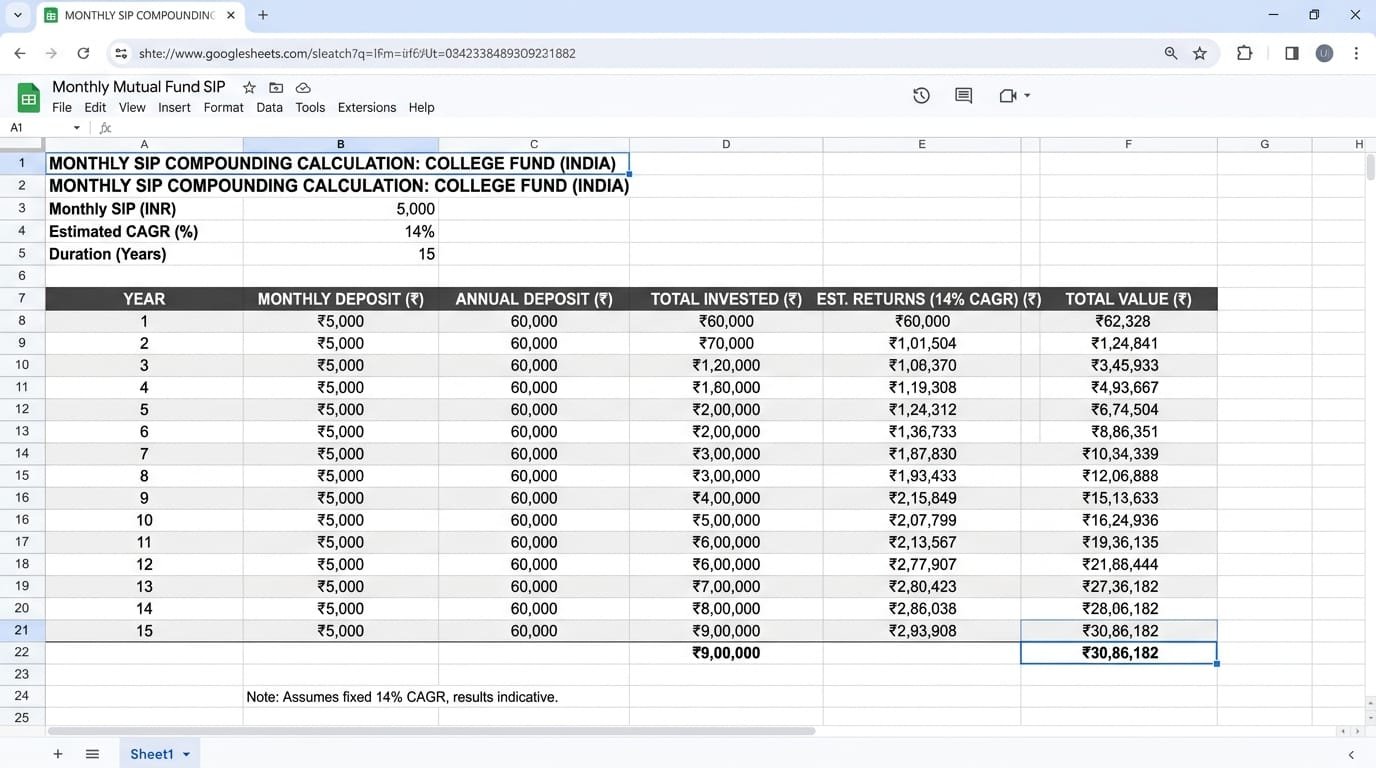
Calculation Sheet: Month-by-month ₹500 SIP compounding calculation at 14% CAGR demonstrating how time beats capital.
💡 Also Comparing Mutual Funds vs Smallcase? Before selecting individual thematic stock baskets, read our comprehensive field study on Smallcase vs Mutual Fund: Which is Better for Beginners in 2026? to understand real rebalancing friction, DP exit charges, and 20% STCG tax differences.
Quick Comparison: Top 5 Mutual Funds for Students at a Glance: Complete Guide to best mutual funds for college students
Furthermore, for example, the table below provides a quick side-by-side comparison of the five premier student-friendly equity schemes based on their category, entry requirements, ongoing costs, and long-term risk profiles:
Fund Scheme
Category
Minimum SIP
Direct Expense Ratio
Risk Level
Ideal For
Parag Parikh Flexi Cap
Flexi Cap
₹1,000
~0.65%
Moderate to High
All-round wealth (5+ yrs)
Nippon India Small Cap
Small Cap
₹100
~0.70%
Very High
Aggressive growth (7+ yrs)
HDFC Index S&P BSE Sensex
Index (Passive)
₹100
~0.20%
Moderate
Safe beginner entry (3+ yrs)
Quant Multi Asset
Multi Asset
₹500
~0.75%
Moderate
Equity + Gold balance
ICICI Prudential Bluechip
Large Cap
₹100
~0.85%
Low to Moderate
Capital stability & low swings
Detailed Review of the 5 Best Mutual Funds for Students: Complete Guide to best mutual funds for college students
1. However, parag Parikh Flexi Cap Fund (Direct – Growth): Complete Guide to best mutual funds for college students
The Ultimate Foundation Fund: If you only want to invest in a single equity mutual fund throughout your entire college degree, Parag Parikh Flexi Cap is arguably the most disciplined option in India. Because it is a flexi-cap fund, the fund managers have complete freedom to invest across large-cap, mid-cap, and small-cap companies depending on where the best value lies.
Assets Under Management (AUM): ₹75,000+ Crores
Direct Expense Ratio: ~0.65% (Very competitive for an actively managed fund)
Benchmark: NIFTY 500 TRI
Top Indian Holdings: HDFC Bank, Bajaj Holdings, ITC, Power Grid, ICICI Bank
International Advantage: The fund holds global tech giants like Alphabet (Google) and Microsoft. This gives students automatic foreign currency diversification, protecting your portfolio if the Indian rupee depreciates against the US dollar.
Minimum SIP: ₹1,000 per month (Ideal if you earn stipends or receive consistent pocket money).
2. Therefore, nippon India Small Cap Fund (Direct – Growth): Complete Guide to best mutual funds for college students
Highest Growth Potential for Patient Students: Small-cap funds invest in emerging, fast-growing companies ranked 251st and below in Indian stock exchanges. In fact, nippon India Small Cap is one of the largest and most consistently managed small-cap schemes in India.
Assets Under Management (AUM): ₹55,000+ Crores
Direct Expense Ratio: ~0.70%
Benchmark: NIFTY Smallcap 250 TRI
Top Holdings: Tube Investments of India, Apar Industries, HDFC Bank, Voltamp Transformers
Why It Suits College Students: Because students have 10 to 15 years before retirement or major adult liabilities, you can easily ride out short-term market crashes. Particularly, historically, small caps offer the highest wealth multiplier over 7 to 10-year horizons.
Minimum SIP: Just ₹100 per month, making it accessible to any student with basic pocket money.
3. HDFC Index S&P BSE Sensex Fund (Direct – Growth): Complete Guide to best mutual funds for college students
The Safest, Lowest-Cost Passive Entry: An index fund does not rely on a human fund manager picking individual stocks. Instead, it mechanically mirrors India’s premier benchmark index—the S&P BSE Sensex—which tracks the country’s top 30 corporate giants like Reliance Industries, TCS, Infosys, and Larsen & Toubro.
Assets Under Management (AUM): ₹8,000+ Crores
Direct Expense Ratio:~0.20% (Ultra-low cost; almost zero fees deducted)
Tracking Error: Less than 0.05% (Extremely accurate index replication)
Zero Fund Manager Risk: You never have to worry about a manager making bad bets. As long as India’s overall economy and top industries expand, your investment grows steadily with it.
Minimum SIP:₹100 per month.
4. In fact, quant Multi Asset Fund (Direct – Growth): Complete Guide to best mutual funds for college students
All-Weather Protection During Market Dips: Most college beginners get panicked when the stock market drops 10% during exam season. A Multi Asset Allocation Fund solves this by automatically diversifying your money across three different asset classes: Equities (Stocks), Gold, and Debt (Bonds).
Why It Works: When the equity market experiences sharp corrections, gold prices frequently surge. This dynamic hedge cushions your portfolio, giving you peace of mind while still delivering equity-like returns over the long run.
Minimum SIP: ₹500 per month.
5. ICICI Prudential Bluechip Fund (Direct – Growth)
Steady Compounding with India’s Market Leaders: If your risk tolerance is low and you want maximum stability, ICICI Prudential Bluechip Fund is a premier large-cap scheme that invests primarily in India’s top 100 established market leaders.
Assets Under Management (AUM): ₹58,000+ Crores
Direct Expense Ratio: ~0.85%
Benchmark: NIFTY 100 TRI
Top Holdings: ICICI Bank, Reliance Industries, Infosys, Bharti Airtel, Larsen & Toubro, Maruti Suzuki
Defensive Character: Bluechip companies possess massive cash reserves and pricing power. During economic slowdowns, these funds experience far lower drawdowns than small-cap schemes.
Minimum SIP:₹100 per month.
How College Students Can Complete 100% Paperless Video-KYC (No Salary Slip Needed)
Specifically, one of the biggest hurdles that stops students from starting is the fear of paperwork: “I don’t have a corporate job, salary slip, or ITR. Overall, will investment apps reject me?”
Consequently, under official SEBI and AMFI guidelines, no income proof you need for mutual fund investments. Any Indian citizen who is 18 years or older can complete verification in under five minutes using three basic documents:
1. PAN Card: Required by law for all Indian capital market investments.
2. Notably, aadhaar Card: Must be linked to an active mobile number to receive an instant OTP via DigiLocker.
3. Moreover, student Savings Bank Account: Any active savings bank account in your own name (such as SBI, Kotak 811, HDFC, or Paytm Payments Bank) with UPI or net banking enabled.
When you sign up on an investment app, it connects to government records via DigiLocker. You verify your details, record a 5-second video selfie on your phone to confirm in-person verification (IPV), and your KYC is officially approved within 2 to 24 hours without stepping into a physical bank branch.
Direct Plan vs. Additionally, regular Plan: Why Students Must Never Choose Regular Plans
Furthermore, for example, every single mutual fund in India is offered in two distinct formats: Direct Plan and Regular Plan. Furthermore, understanding this distinction is crucial for protecting your wealth:
Regular Plans: Sold by traditional bank relationship managers, local agents, and commission brokers. The mutual fund company secretly deducts 1% to 1.5% from your portfolio every year to pay ongoing commissions to the broker.
Direct Plans: You invest directly through SEBI-registered discount platforms like Zerodha Coin or Groww. Overall, zero middleman commission is deducted, meaning 100% of your earnings stay in your account.
The Real Impact: On a 15-year SIP of ₹1,000 per month, that small 1.5% commission difference cuts your final wealth by over ₹2,40,000 in lost returns. For example, always make sure the word “Direct” is explicitly written in the fund title before confirming your purchase.
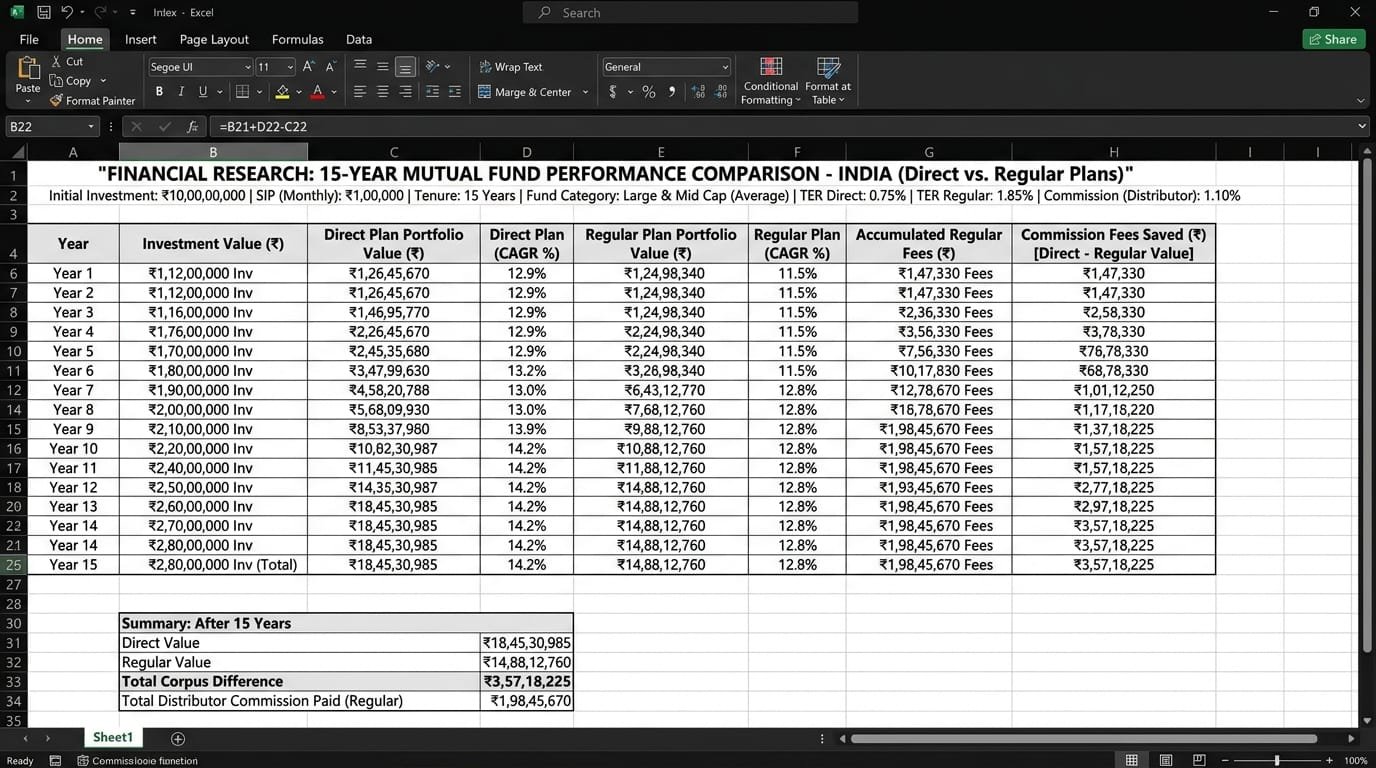
Research Data Sheet: How a 1.5% annual distributor commission in Regular Plans erodes over ₹1,04,000 from a 15-year student portfolio.
How to Set Up Your Monthly SIP on Groww, Zerodha Coin, and Angel One
However, automating your monthly SIP takes under three minutes on your smartphone. Consequently, here is how the top three platforms compare for college students:
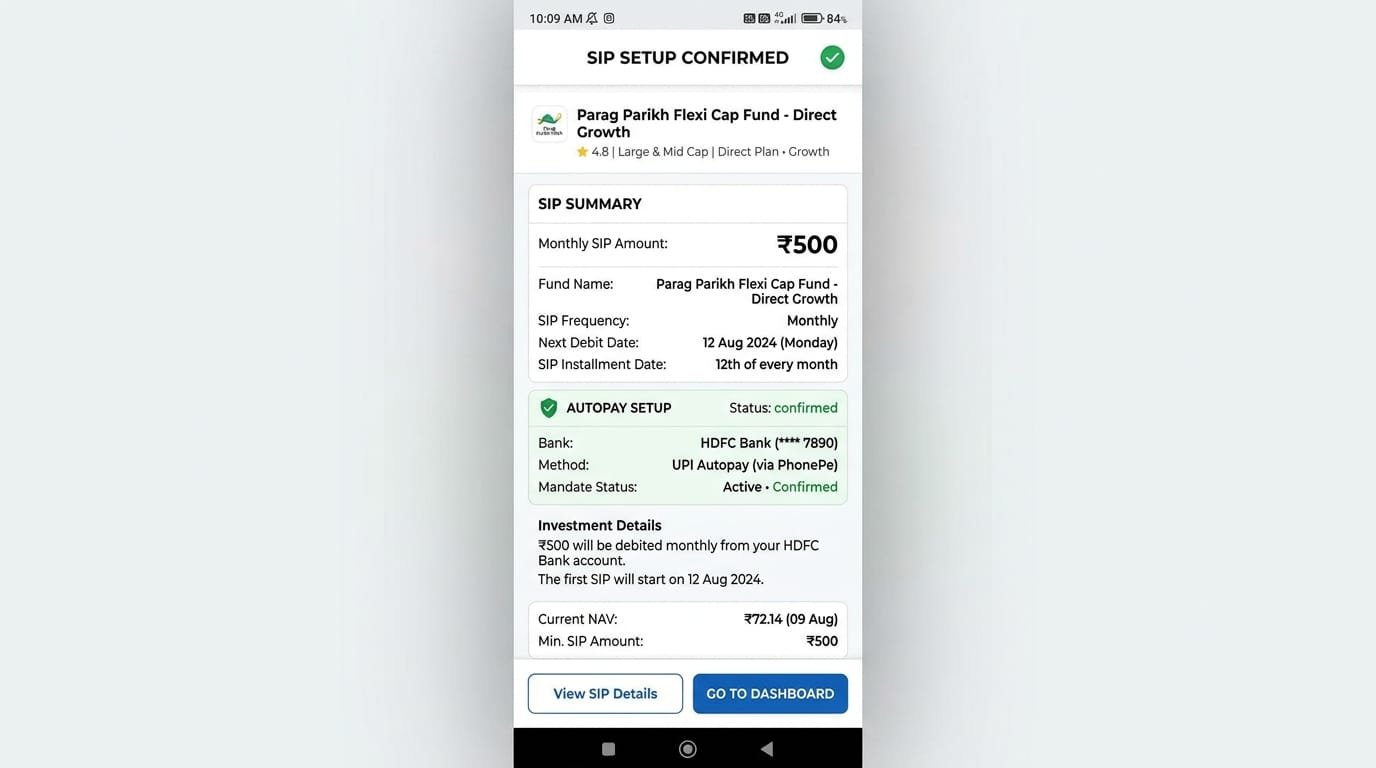
Mobile App Screen: Setting up a ₹100 or ₹500 automated monthly SIP with UPI Autopay on a verified Direct Growth plan.
Platform
Plans Available
Minimum SIP
Key Advantage for Students
Groww
100% Direct Plans
₹100
Cleanest interface for beginners, 1-click UPI Autopay setup
Zerodha Coin
100% Direct Plans
₹100
Zero distributor fees, Demat holding, and Step-Up SIP option
Angel One
100% Direct Plans
₹100
Advanced research tools, smart advisory, easy e-mandate
1. Consequently, setting Up SIP on Groww (Step-by-Step)
Download Groww & Complete DigiLocker Verification: Log in with your mobile number, verify Aadhaar OTP via DigiLocker, and enter your PAN details.
Search for Your Fund: Type the scheme name in the search bar (for example: Nippon India Small Cap Fund Direct Growth). However, always verify that it says Direct Plan.
Tap “Start SIP”: Select the Start SIP button at the bottom of the screen.
Enter Amount and Pick Date: Enter your monthly budget (₹100 or ₹500). Therefore, pick a date 2-3 days after your pocket money or allowance usually arrives.
Authorize UPI Autopay: Select Google Pay, PhonePe, or Paytm. As a result, enter your UPI PIN to approve the recurring mandate. Particularly, your automated monthly SIP is now live!
2. Moreover, setting Up SIP on Zerodha Coin (Step-by-Step)
Log into Coin: Open the Coin app or visit coin.zerodha.com using your Zerodha user ID.
Search for Direct Scheme: Search for your fund (such as HDFC Index S&P BSE Sensex Fund Direct Growth). Additionally, coin exclusively lists 100% Direct Plans with zero commission.
Click “SIP” & Choose Frequency: Tap SIP and set the frequency to Monthly. You can also turn on the Step-Up SIP feature to raise your monthly investment by 10% each year as your internship stipend grows.
Authorize Mandate: Link your student savings bank account using Net Banking or Debit Card to approve the recurring auto-debit.
3. In addition, notably, setting Up SIP on Angel One (Step-by-Step)
Go to Mutual Funds: Open the Angel One mobile app and tap on the Mutual Funds tab from the home dashboard.
Discover Scheme: Search for Parag Parikh Flexi Cap Direct Plan and check the NAV performance chart.
Confirm SIP: Tap Start SIP, choose your monthly date, enter your amount, and approve the auto-debit via UPI or Net Banking.
Mutual Fund Tax Rules for College Students (2026 Simplified)
Consequently, students often worry that investing in mutual funds will lead to tax notices. As a result, here is how Indian taxation legally applies to college students:
Zero Tax for Non-Earning Students: Under Indian tax laws, if your total annual income (including pocket money stipends and mutual fund profits) is below the basic tax exemption limit (₹3,00,000 per year under the New Tax Regime), you pay zero tax.
Long-Term Capital Gains (LTCG): For equity mutual funds held for more than 12 months, profits up to ₹1.25 Lakh every financial year are completely tax-exempt.
Short-Term Gains (STCG): If you redeem equity funds within 12 months, gains are taxed at 20%, but basic exemption thresholds continue to protect college students who do not have other taxable salaries.
How to Allocate Your Student Pocket Money for Monthly SIPs
To invest consistently without running out of money before the end of the month, follow the 50/30/20 Student Budgeting Framework:
50% for Essentials: Semester books, bus/metro transit, mobile recharges, hostel canteen meals.
30% for Fun & Social Life: Outings with friends, movies, weekend snacks.
20% for Automated SIP: Transfer ₹100, ₹500, or ₹1,000 directly into your mutual fund SIP on the day your allowance arrives before you have a chance to spend it.
Regulatory & Editorial Standards (AMFI & SEBI Disclosure): paisakmao.de is an independent financial education initiative founded by Asif Khan. We are not SEBI-registered investment advisers (RIA) or portfolio managers. Specifically, mutual fund investments are subject to market risks; please read all scheme-related documents (SID / KIM) carefully on official AMC portals before investing. Furthermore, past performance figures reflect historical data up to 2026 and do not guarantee future returns.
Frequently Asked Questions (FAQs)
What is the best investment plan for college students in India?
In fact, the best investment plan for college students in India is a combination of a Direct Nifty 50 Index Fund (like HDFC or UTI) and a Flexi Cap Fund (like Parag Parikh Flexi Cap). Specifically, allocating ₹500 to ₹1,000 monthly via SIP provides low risk, zero demat transaction charges, and compounding returns without requiring active stock market monitoring during exams.
How much pocket money should a college student invest each month?
In addition, as a general financial guideline, aim to invest 15% to 20% of your monthly pocket money or stipend. If you receive ₹3,000 per month, starting a ₹500 SIP is perfect. For example, most leading mutual funds in India allow monthly SIPs starting from as low as ₹100.
Can a college student invest in mutual funds without a job or income proof?
Moreover, yes, absolutely. SEBI and AMFI guidelines do not require salary slips or income tax returns (ITR) to invest in mutual funds. As long as you are 18+ years old with a valid PAN card, Aadhaar card, and a student bank account, you can complete paperless Video-KYC in under 5 minutes on apps like Groww or Zerodha Coin.
What is the minimum monthly SIP amount a student can start with?
However, you can start with as little as ₹100 per month. Consequently, popular student-friendly funds like Nippon India Small Cap Fund, HDFC Index S&P BSE Sensex Fund, and ICICI Prudential Bluechip Fund all allow ₹100 micro-SIPs, making investing accessible on any college budget.
What happens if I don’t have enough pocket money in my bank on SIP date?
Therefore, notably, the mutual fund company simply skips the installment for that month with zero penalties. To avoid bank auto-debit bounce fees, you can easily tap “Pause SIP” on your app 2-3 days before the scheduled date for 1 to 3 months without any charge.
Practical Steps & Actionable Tips for best mutual funds for college students
Is a Fixed Deposit (FD) better or a Mutual Fund SIP for students?
In fact, bank FDs offer guaranteed 6.5% to 7% returns, which barely beats inflation. In addition, equity mutual funds have historically delivered 14% to 18%+ CAGR over 5-7 year horizons. If you need money within a year for semester fees, use a Bank FD; for long-term wealth creation, a Mutual Fund SIP is far superior.
Which is the best and safest app for college students to invest in mutual funds?
Groww and Zerodha Coin are the top two choices. Both are SEBI-regulated, offer paperless DigiLocker KYC, charge zero account opening fees, and strictly sell Direct Plans with zero middleman commissions.
Actionable Advice and Practical Tips for best mutual funds for college students
Hi, I’m Asif Khan, the voice behind paisakmao.de. For the past two years, I’ve been blogging about financial education, income skills, and mindset development for students and young minds. My mission is to empower every youth with financial literacy and practical money-making skills at an early age. Therefore, through paisakmao.de, I share actionable guides for students to start earning early, money wisdom that schools don’t teach, and mindset lessons from successful people and modern psychology. Whether you’re a teenager looking to earn your first income or a student exploring side hustles, you’re in the right place. In fact, financial freedom begins with the right mindset and the right knowledge. Let’s grow, earn, and evolve together — welcome to the movement!
Editorial Standards & Author Profile
Asif Khan
Founder & Principal Researcher at PaisaKmao.de
Additionally, asif has over 3–4 years of hands-on experience in personal finance, mutual funds, and student pocket-money investing in Indian markets. In addition, starting as a college student with zero financial backing, he built a disciplined personal SIP portfolio and created PaisaKmao to provide transparent, math-backed guidance for young Indians.
All mutual fund insights are independently audited through AMFI fact sheets, TER sheets, and SEBI regulatory norms.
Written & Researched by Asif Khan
Written & Researched by Asif Khan
Founder & Lead Financial Editor PaisaKmao.de
Additionally, over 4 years of active personal finance research in Indian markets. Therefore, focused on transparent, math-backed guides to help students and young professionals build wealth and manage money smartly.
⚖️ Regulatory & Compliance Disclaimer: The financial analysis published on PaisaKmao.de is strictly for financial literacy and educational purposes. Moreover, neither the author nor PaisaKmao.de is a SEBI-registered Research Analyst (RA) or Registered Investment Advisor (RIA). Overall, equity mutual funds are subject to market risks. However, read all scheme related documents (SID/KIM) carefully before investing.
Learning the essential principles of Lifetime Free Credit Cards is critical for anyone looking to build healthy money habits, avoid debt traps, and make smart financial decisions in India.
⚡Last Updated: November 2026Student Credit Cards & CIBIL Building Tested
Learning the essential principles of Lifetime Free Credit Cards is critical for anyone looking to build healthy money habits, avoid debt traps, and make smart financial decisions in India.
Learning the essential principles of Lifetime Free Credit Cards is critical for anyone looking to build healthy money habits, avoid debt traps, and make smart financial decisions in India.
Learning the essential principles of lifetime free credit cards for students is critical for anyone looking to build healthy money habits, avoid debt traps, and make smart financial decisions in India.
Additionally, finding the best lifetime free credit cards for students in India allows college students to build a 750+ CIBIL score early without income proof or annual renewal fees.
📌
Key Takeaways: Lifetime Free Student Credit Cards
No Income Proof Needed: College students without salary slips can easily get approved via Fixed Deposit (FD) backing or verified college ID neo-banking cards.
100% Lifetime Free (LTF): Never pay joining or annual renewal fees as a student. Furthermore, only choose strictly lifetime free cards.
Credit Score Booster: Spend only up to 30% of your limit and pay credit card bills in full before the due date to graduate with a 750+ CIBIL score.
Student Perks: Earn instant cashback and reward points on UPI transactions, food delivery apps, and online learning courses.
Actionable Insights and Smart Advice for Lifetime Free Credit Cards
Learning about lifetime free credit cards for students is essential for anyone looking to build healthy money habits. Specifically, choosing the best 5 lifetime free credit cards for college students in India can completely transform how you manage your money, especially when you don’t have a salary slip or income proof. Furthermore, many students need instant credit options to purchase necessary gadgets, pay for online certification courses, or handle sudden educational expenses, but traditional banking rules often lead to immediate rejections. Consequently, fortunately, secured or FD-backed options provide a guaranteed route to bypass these strict requirements. In this comprehensive guide, we will break down the top student-friendly cards that charge zero annual fees, helping you secure instant buying power and build a rock-solid 750+ CIBIL score during your college years.
Written & Researched by Asif Khan
Written & Researched by Asif Khan
Founder & Lead Financial Editor PaisaKmao.de
Additionally, over 4 years of active personal finance research in Indian markets. Furthermore, focused on transparent, math-backed guides to help students and young professionals build wealth and manage money smartly.
Disclaimer: In accordance with statutory guidelines from regulatory authorities like the Reserve Bank of India (RBI), The information provided in this article is for educational and informational purposes only. We are not SEBI-registered financial advisors or banking experts. In addition, credit cards require high financial discipline and timely repayments. Specifically, late payments or defaulting on dues can severely damage your CIBIL score and attract heavy penalties. Therefore, please read all terms, conditions, and fee structures carefully on the official bank website before applying for any financial product.
Actionable Advice and Practical Tips for lifetime free credit cards for students
Practical Steps & Actionable Tips for lifetime free credit cards for students
How Can College Students Get a Credit Card Without Income Proof?: Complete Guide to lifetime free credit cards for students
Furthermore, for example, most traditional credit cards require you to submit salary slips or Income Tax Returns (ITR) to prove your monthly income. Since college students usually do not have a steady job or formal income documents, banks routinely reject their regular card applications.
However, you can easily bypass this barrier through a financial asset known as a secured credit card. Instead of looking at your monthly salary, banks issue these cards against a small Fixed Deposit (FD) that you open with them. You can read this detailed secured credit cards guide on Paisabazaar to understand the eligibility parameters deeply. The bank keeps this FD as collateral security and grants you a credit limit equivalent to 80% to 100% of your deposit amount.
Specifically, the biggest benefit of this method is that your money is never locked away uselessly. You continue to earn regular interest on your fixed deposit—often between 6.5% to 7.5% depending on the bank—while simultaneously enjoying the spending power of a credit card. It is a 100% guaranteed way for students to build a high credit history from scratch.
Quick Comparison: Best Student Credit Cards in India (2026): Complete Guide to lifetime free credit cards for students
Quick Pick: Agar aapko sabse kam FD (₹5,000) me metal card chahiye toh OneCard Lite lein. Moreover, agar aapko zero maintenance digital bank account ke sath instant card chahiye toh Kotak 811 #DreamDifferent sabse reliable hai.
Data verified for November 2026 Approvals subject to bank KYC verification
Before reading the detailed analysis, look at this quick comparison table. It highlights the baseline entry barriers, annual fees, and core purposes of the top student credit cards available in the market.
FREE INTERACTIVE TOOL
Plan Your College Expenses Before Using Credit
Consequently, never risk a credit card debt trap. Use our Student Budget Calculator to map your monthly pocket money, food, and essential spends.
Important Note: Before you apply for any card and swipe it, managing your cash flow is critical. Consequently, scroll down to the bottom of this article to download our free budgeting tracker tool to secure your payment cycles.
Detailed Review of the Best Lifetime Free Student Credit Cards: Complete Guide to lifetime free credit cards for students
Additionally, for example, choosing your first credit card can be confusing because each bank offers different benefits. To make your decision easier, here is a detailed, transparent review of the top lifetime free credit cards available for college students in India, along with their pros and cons.
1. IDFC FIRST WOW! As a result, credit Card: Complete Guide to lifetime free credit cards for students
However, the IDFC FIRST WOW! is an excellent secured card that requires zero documentation or income verification. You can check the complete application criteria on the official IDFC FIRST Bank WOW Credit Card page. This card is highly popular among students because it charges a 0% foreign markup fee, making it the cheapest option for making international transactions, such as buying foreign courses, paying for GRE/IELTS exams, or ordering global software subscriptions.
Pros: Earns regular FD interest up to 7.5% per annum; 100% cash withdrawal limit; absolutely zero joining and annual fees.
Cons: Requires a high minimum fixed deposit of ₹20,000 to get started.
2. SBM OneCard Lite
If you want a highly modern, digital-first credit card experience, the SBM OneCard Lite is a fantastic choice. Additionally, managed entirely via a smooth mobile application, it is issued against a very affordable deposit. You can read more about the digital features and reward slabs directly on the official OneCard platform. It offers 5X reward points on your top two spending categories every month, making it perfect for online shopping.
Pros: Very low minimum fixed deposit entry barrier of just ₹5,000; instant virtual card activation; sleek metal card options for higher deposit amounts.
Cons: Rewards point redemption has complex fractional slabs that take time to accumulate.
3. In addition, kotak 811 #DreamDifferent Credit Card
Consequently, the Kotak 811 #DreamDifferent Credit Card is tailored for students who already hold a Kotak 811 digital savings account. It requires a moderate fixed deposit and can be activated instantly directly through the Kotak mobile banking app. For full details on interest calculations, visit the official Kotak Mahindra Bank 811 Card portal. It gives you 2X reward points for every ₹100 spent online.
Pros: Quick in-app approval process; 100% interest-free cash withdrawal for up to 48 days; zero documentation required.
Cons: Reward points cannot be redeemed directly for cash statement credit; they must be used against specific vouchers.
★ Zero-Balance Digital Banking
100% Online 18+ Eligible
Kotak 811 Digital Savings Account
In fact, students seeking the Kotak #DreamDifferent card can start with the zero-balance 811 digital account, which activates directly with instant Video KYC.
₹0 Min Balance3-Min Video KYCFree Virtual Debit Card
Affiliate Disclosure: This article contains an affiliate link. If you open an account through this link, we may earn a commission at no additional cost to you.
How to Build a 750+ CIBIL Score in College Without Falling Into Debt Trap
In addition, getting your first credit card is easy, but managing it responsibly is the real test for a college student. If you swipe your card recklessly and fail to pay the bills on time, you will damage your CIBIL score before your career even begins. On the other hand, if you clear your total dues before the due date, you can easily build a solid 750+ credit history within 12 months.
Moreover, credit card debt traps usually happen when you do not follow a strict money management system. To prevent overspending on your new card, read our comprehensive guide on how to divide your salary for beginners with examples to learn how to allocate your funds correctly.
Additionally, using a credit card requires serious self-control. You must develop healthy spending boundaries early in life. To help you master this mindset, check out our expert blueprint on the 10 best financial habits every college student should develop. By combining the right habits with your new card, you will secure a powerful financial future.
Download Our Free College Student Budgeting and Credit Card Expense Tracker Tool
To make your financial journey completely stress-free, we have designed a customized, easy-to-use student budgeting and credit card expense tracker tool. This free spreadsheet helps you log your monthly pocket money, divide your expenses automatically, and monitor your credit card bill cycles so that you never miss a payment deadline.
To track your monthly budget and expenses easily, you can use a ready-made professional template. Specifically, click the official reference link below to save a free tracking sheet directly:
Additionally, if you want to quick-check your monthly financial math right now, you can try our interactive budget-calculator to plan your monthly income allocation in seconds.
However, please Note: If you do not have a fixed monthly stipend or work as a student freelancer, tracking your expenses can be slightly tricky. If that is your current situation, make sure to read our highly detailed blueprint on how to budget with an irregular income step-by-step guide to sync your fluctuating money flows with these calculators perfectly.
Can a college student get a credit card without an income proof or salary slip?
Therefore, notably, yes, college students can absolutely get a credit card without any income proof by choosing a secured credit card. Instead of validating your monthly salary, banks issue these cards against a small Fixed Deposit (FD) that acts as collateral security.
What is the minimum FD amount required for a student credit card?
Practical Steps & Actionable Tips for lifetime free credit cards for students
In fact, the minimum deposit required varies depending on the bank you choose. For instance, you can get started with as little as ₹5,000 for an SBM OneCard Lite, while cards like the IDFC FIRST WOW! require a minimum fixed deposit of ₹20,000 to trigger activation.
Does using a student credit card really improve your CIBIL score?
Additionally, yes, as long as you pay your credit card bills on time and in full every single month. By clearing your dues before the payment deadline, the bank reports your positive repayment behavior to credit bureaus, helping you build a solid credit history.
What happens if a student fails to pay their credit card bill?
Particularly, failing to clear your credit card dues will severely damage your credit history and drop your score instantly. To understand how utilization patterns affect your overall credit standing, you can read the official CIBIL score management guide on TransUnion CIBIL. Additionally, banks will levy heavy annual interest penalties ranging from 36% to 42% on your outstanding balance.
Conclusion: Which Student Credit Card Should You Choose?
Moreover, for example, building a solid financial foundation while studying is one of the smartest moves a college student can make. By picking a lifetime free secured credit card, you eliminate the need for any formal income proof or salary slips while unlocking a guaranteed path to a high CIBIL score.
If your primary goal is to pay for international exams, foreign subscriptions, or online global courses without losing money on conversion fees, the IDFC FIRST WOW! For example, credit Card is your best option due to its zero forex markup feature. However, if you are looking for an affordable entry point with minimal deposit requirements and a sleek design, starting with the SBM OneCard Lite at just ₹5,000 is highly recommended.
Zero Balance Digital Account
Ready to Open Your Free Kotak 811 Account?
Link an independent digital savings account to your new student card for effortless UPI and bill payments.
Affiliate Disclosure: This article contains an affiliate link. If you open an account through this link, we may earn a commission at no additional cost to you.
Practical Steps & Actionable Tips for lifetime free credit cards for students
Overall, no matter which card you select, ensure you clear your monthly statements on time, keep your credit utilization low, and utilize our free tracking spreadsheet to manage your student budget safely.
Hi, Always am Asif Khan, founder and lead research editor at PaisaKmao.de. Over the past 3 to 4 years of active personal finance research and real-money investing in Indian markets, Ensure you have navigated the practical realities of building an investment portfolio from scratch—from starting with small student pocket money, learning from early market mistakes (penny stocks, dividend tax surprises, and hidden DP charges), to establishing disciplined SIPs in low-cost index funds and managing risk. My mission with PaisaKmao.de is to provide 100% transparent, math-backed financial guides and practical calculators so young investors can build long-term wealth without falling into common traps.
Before converting any credit card purchase into “Smart EMI” or “Instant Cash”, make sure you understand how banks disguise 18% loans as 10% flat rates.
Learning the essential principles of how to organize multiple savings is critical for anyone looking to build healthy money habits, avoid debt traps, and make smart financial decisions in India.
⚡Last Updated: November 2026Multi-Goal Financial Planning Guide
Learning the essential principles of how to organize multiple savings is critical for anyone looking to build healthy money habits, avoid debt traps, and make smart financial decisions in India.
Learning the essential principles of how to organize multiple savings is critical for anyone looking to build healthy money habits, avoid debt traps, and make smart financial decisions in India.
Learning the essential principles of how to organize multiple savings is critical for anyone looking to build healthy money habits, avoid debt traps, and make smart financial decisions in India.
Learning the essential principles of how to organize multiple savings is critical for anyone looking to build healthy money habits, avoid debt traps, and make smart financial decisions in India.
Home » How to Organize Multiple Savings Goals Before 2027
📌
Key Takeaways: Organizing Multiple Savings Goals
Separate Money Buckets: Keep separate accounts or digital sub-wallets for Emergency Funds, Travel/Gadgets, and Long-Term Goals so they never clash.
Clear Time Horizons: Group goals into Short-Term (<1 year), Medium-Term (1–3 years), and Long-Term (3+ years) to match the right financial instrument.
Prevent UPI Leakage: Store savings in dedicated zero-balance accounts separate from your primary UPI spending account.
Automate Contributions: Set recurring auto-debit transfers right after payday so your multiple goals grow consistently on autopilot.
Additionally, planning for multiple financial goals can feel overwhelming. This simple guide shows you how to prioritize your goals, set realistic targets, calculate monthly savings, and stay on track for 2027.
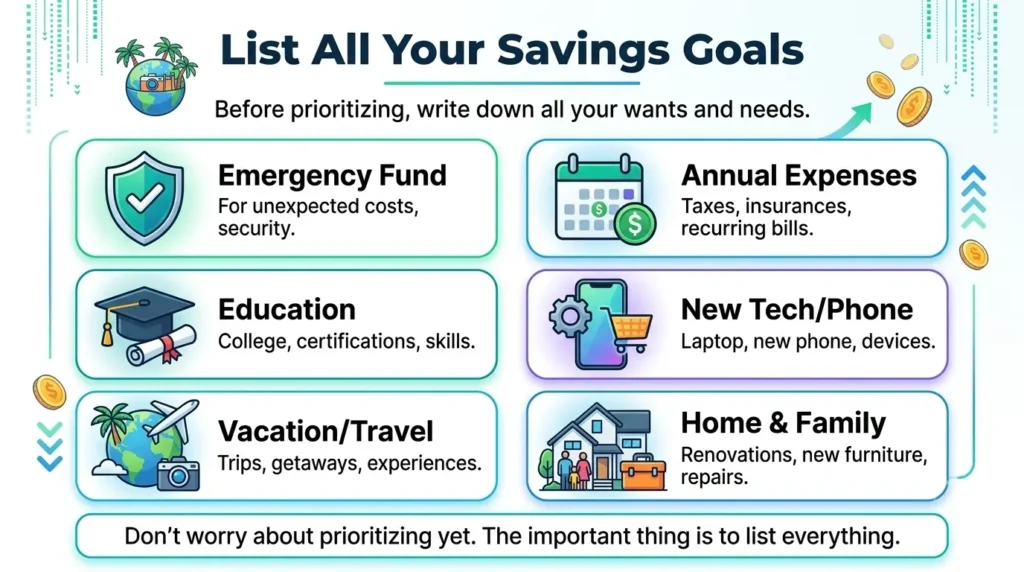
Additionally, saving for one goal is simple. But when you have several goals at the same time—such as an emergency fund, annual expenses, a new laptop, a trip, or future needs—it can become difficult to know where your money should go first.
Furthermore, for example, the key is not to save for everything equally. You need to organize multiple savings goals, set priorities, and decide how much to save for each goal based on its deadline and importance.
In this guide, you’ll learn how to organize your savings goals, set realistic targets, calculate your monthly savings, and create a simple plan you can follow before 2027.
Actionable Advice and Practical Tips for how to organize multiple savings
⚡ The 4-Bucket Quick Savings Cheat Sheet (2026)
Zero Confusion Step-by-Step Split
Specifically, don’t mix all your money in one bank account. Furthermore, follow the proven 4-Bucket System to hit travel, emergency, and gadget goals without sacrificing your lifestyle:
Bucket 1 Priority #1
Emergency Shield
Consequently, keep 3–6 months of basic expenses in an isolated Zero-Balance Account away from daily UPI temptations.
Practical Steps & Actionable Tips for how to organize multiple savings
Bucket 2 6–12 Months
Sinking Goals
Additionally, for example, save for laptop, vacation, or annual insurance dues via automated high-interest Recurring Deposits (RD) or liquid funds.
Bucket 3 3+ Years
Long-Term Wealth
However, higher education, house down payment, or retirement. Specifically, allocate here via monthly Index Fund SIPs for compounding growth.
Bucket 4 Weekly / Monthly
Guilt-Free Fun
10%–15% of your income strictly reserved for dining out, movies, and personal treats with zero budget guilt.
Actionable Advice and Practical Tips for how to organize multiple savings
💡 Pro-Tip: Open separate zero-fee digital buckets so you never accidentally spend emergency cash.
Setup Savings Buffer →
In fact, for verified statutory guidelines and official consumer protections, refer to the Reserve Bank of India (RBI).
Step 1: List All Your Savings Goals: Complete Guide to how to organize multiple savings
Before deciding how much to save for each goal, write down everything you want or need to save for.
In addition, include both important financial goals and upcoming expenses, such as:
First, first, first, first, for example, emergency fund
Next, next, next, next, annual bills or expenses
Consequently, education
Then, new phone or laptop
However, vacation or travel
Additionally, home or family expenses
Furthermore, in fact, other planned purchases
Moreover, don’t worry about prioritizing them yet. The first goal is simply to get a clear picture of where your money may need to go.
However, once you have listed everything, you can group the goals by time frame, importance, and deadline. This makes it much easier to decide which goals should receive more attention first.
Step 2: Separate Short-Term, Medium-Term, and Long-Term Savings Goals: Complete Guide to how to organize multiple savings
Therefore, notably, not every savings goal has the same deadline. A bill due next month needs a different approach from a car you want to buy in three years or a future financial goal that may take much longer.
FREE INTERACTIVE TOOL
Track Multiple Target Dates & Daily Savings
In fact, calculate the exact daily and monthly savings required to hit every single personal goal on schedule.
Additionally, that is why one of the easiest ways to organize multiple savings goals is to separate them by time frame.
Short-Term Savings Goals: Complete Guide to how to organize multiple savings
Particularly, short-term goals are goals you expect to reach relatively soon, such as annual bills, emergency expenses, a phone, or a planned purchase.
Moreover, for example, these goals usually need more immediate attention because their deadlines are closer.
Medium-Term Savings Goals: Complete Guide to how to organize multiple savings
Medium-term savings goals sit between immediate expenses and long-term financial goals. Furthermore, they may take several months or a few years to complete, depending on the size and deadline of the goal.
Overall, common examples include:
Finally, buying a car
Moreover, saving for education or training
A major home expense
Specifically, starting a small business
Then, first, notably, saving for a wedding or major event
Additionally, next, preparing for a large planned purchase
Consequently, the advantage of a medium-term goal is that you have more time to build the money. Instead of trying to save a large amount at once, you can break the target into smaller monthly savings contributions.
How to Calculate a Medium-Term Savings Target: Complete Guide to how to organize multiple savings
However, for example, suppose your goal is to save $3,000 in 30 months.
$3,000 ÷ 30 = $100 per month
So your basic monthly savings target would be $100.
Goal
Target
Time Remaining
Monthly Target
Priority
Education
$3,000
30 months
$100
High
Car fund
$6,000
36 months
$167
Medium
Major purchase
$1,500
24 months
$63
Low
Specifically, as a result, this gives you a clearer picture of how much each goal requires instead of simply saving money without knowing whether you are on track.
What If the Monthly Amount Is Too High?: Complete Guide to how to organize multiple savings
In fact, this is where a realistic savings plan matters.
If your calculated monthly contribution does not fit your budget, you have several options:
Additionally, extend the deadline if possible.
Then, reduce the target amount.
Additionally, for example, give the goal a lower priority.
Furthermore, temporarily focus on a more important goal.
Consequently, look for ways to reduce expenses or increase available savings.
Additionally, you do not have to abandon a goal just because the first calculation does not fit your current cash flow.
Moreover, the Consumer Financial Protection Bureau recommends breaking savings goals into manageable targets and considering the amount needed and the time available when creating a savings plan.
Furthermore, for a broader reference, you can also review the CFPB’s savings and goal-setting tools, which include tools for setting goals, planning savings, tracking money, and preparing for large purchases.
Specifically, notably, for your own numbers, you can use our budget calculator to see how your income and expenses affect the amount available for different savings goals.
Additionally, for example, for example, the important point is simple: medium-term goals should have a target, deadline, and monthly contribution. Consequently, once those three numbers are clear, a large future expense becomes much easier to manage.
Step 3: Prioritize Your Savings Goals: Complete Guide to how to organize multiple savings
Additionally, once you have separated your goals by time frame, the next step is to decide which savings goals should come first.
When you have multiple savings goals, you do not always need to divide your money equally. In addition, some goals are more important because they protect your financial stability, have a fixed deadline, or could create a bigger problem if you do not prepare for them.
A simple priority system can help you decide where your monthly savings should go first.
Start With Financial Safety: Complete Guide to how to organize multiple savings
Before putting a large amount toward optional goals, consider whether you have enough money set aside for unexpected expenses.
Consequently, an emergency fund can help cover unexpected costs such as an urgent repair, medical expense, or temporary loss of income without forcing you to depend on debt.
In addition, for example, your financial priorities will depend on your situation, but building a basic financial safety net is often an important starting point.
However, for a broader overview, read our guide to the 7 rules of personal finance, which explains the role of budgeting, emergency savings, debt management, and long-term financial goals.
Consider the Deadline and Consequences: Complete Guide to how to organize multiple savings
Consequently, not every savings goal has the same level of urgency. A goal with a fixed deadline may need more attention than a goal that can be delayed.
Before deciding how to divide your savings, ask yourself:
Finally, does this expense have a fixed deadline?
However, what happens if I do not save enough by that date?
Specifically, is the goal essential or optional?
Furthermore, first, in fact, can I delay the goal without creating a financial problem?
Finally, next, could failing to prepare lead to debt or another financial cost?
Moreover, does this goal protect my basic financial needs?
Therefore, for example, an annual insurance payment due in three months may deserve more attention than a vacation planned for next year.
However, the vacation can still be an important savings goal, but its deadline and consequences are different.
Use a High, Medium, and Low Priority System: Complete Guide to how to organize multiple savings
A simple three-level priority system makes it easier to manage multiple savings goals without feeling overwhelmed.
Priority
Type of Goal
Example
High
Financial safety or essential deadline
Emergency fund, essential annual expense
Medium
Important planned expense
Education, major repair, vehicle
Low
Optional or flexible goal
Vacation, new gadget, entertainment
In fact, this does not mean low-priority goals should never receive money. It simply means they should not take money away from a more important financial need when your available savings are limited.
How to Divide Money Between Savings Goals: Complete Guide to how to organize multiple savings
If your monthly savings amount is limited, a useful starting order is:
★ Zero-Balance Digital Banking
100% Online 18+ Eligible
Kotak 811 Digital Savings Account
In fact, organize your short-term and emergency funds in a dedicated zero-balance digital account to keep them separate from daily expenses.
₹0 Min Balance3-Min Video KYCFree Virtual Debit Card
Affiliate Disclosure: This article contains an affiliate link. If you open an account through this link, we may earn a commission at no additional cost to you.
Financial safety
Essential upcoming expenses
Important planned goals
Optional goals
Particularly, for example, suppose you can save $300 per month and you have three goals:
Then, emergency fund — High priority
Additionally, notably, education — Medium priority
Furthermore, vacation — Low priority
Instead of automatically giving each goal $100, you could direct more of your available savings toward the emergency fund and education while making a smaller contribution toward the vacation.
Moreover, the exact amounts depend on your income, essential expenses, current savings, and the deadlines of your goals.
Do Not Try to Fund Every Goal Equally: Complete Guide to how to organize multiple savings
Moreover, one common mistake when managing multiple savings goals is assuming that every goal should receive the same amount of money.
Overall, notably, for example, imagine you have $500 available for savings and the following goals:
Goal
Amount Needed
Deadline
Priority
Emergency fund
$1,500
Flexible
High
Annual bill
$600
4 months
High
Laptop
$1,000
10 months
Medium
Vacation
$1,200
12 months
Low
Consequently, notably, an equal split would give each goal $125. But the annual bill has a much closer deadline, while the vacation may be more flexible.
Your savings plan should reflect importance and urgency, not simply equality.
What If Two Savings Goals Have the Same Priority?: Complete Guide to how to organize multiple savings
When two goals are equally important, use their deadlines to decide which one should receive more attention.
Additionally, as a simple rule, consider the goal that:
Additionally, has the earlier deadline.
Finally, requires a larger monthly contribution.
Specifically, for example, has greater consequences if you miss the target.
In addition, as a result, you can also change the priority later. Specifically, your income, expenses, deadlines, and financial goals may change, so your savings plan should be flexible enough to change with them.
Keep Your Savings Priorities Simple: Complete Guide to how to organize multiple savings
Additionally, for example, you do not need a complicated financial planning system to organize multiple savings goals.
Furthermore, for each goal, know these four things:
What you are saving for
How much you need
When you need it
How important it is compared with your other goals
Consequently, once these details are clear, it becomes much easier to decide where your money should go each month.
Specifically, the goal is not to create a perfect plan that never changes. The goal is to build a practical savings plan that gives every dollar a purpose while keeping your most important financial goals on track.
Step 4: Set a Target Amount and Deadline for Every Savings Goal: Complete Guide to how to organize multiple savings
However, once you know which savings goals are most important, give each goal a specific target amount and deadline.
“I want to save more money” is a good intention, but it is difficult to follow because there is no clear finish line. A better savings plan tells you exactly how much you need, when you need it, and how much you should save each month.
However, for example, this approach can make multiple savings goals much easier to organize and track.
Give Every Financial Goal a Specific Target
In fact, start by deciding the approximate amount you need for each goal.
Consequently, for example, instead of writing:
Specifically, first, save for a laptop
Consequently, save for a trip
Then, first, next, save for education
Moreover, turn them into measurable goals:
However, laptop — $1,000
Then, trip — $1,500
Additionally, in fact, education — $3,000
A specific target gives you something you can calculate against. It also makes it easier to see whether your current monthly savings are enough.
Set a Realistic Savings Deadline
In addition, after deciding the target amount, choose when you want or need to reach it.
However, notably, your deadline can be based on:
A fixed bill or payment date
A planned purchase
A school or education deadline
A planned trip or event
A personal financial milestone
A timeframe that is realistic for your income
Therefore, try not to choose a deadline simply because it sounds good. A deadline should be realistic enough that you can continue making the required monthly contribution without putting your essential expenses under pressure.
Calculate the Time You Have Left
Additionally, once you know the target and deadline, calculate how many months you have remaining.
In fact, for example:
Goal
Target
Time Available
Approx. Therefore, monthly Saving
Laptop
$1,000
10 months
$100
Trip
$1,500
12 months
$125
Education
$3,000
24 months
$125
Particularly, for example, these numbers give you a starting point for building your monthly savings plan. In the next step, we will use the same information to calculate the required monthly contribution more precisely.
Use the SMART Approach for Savings Goals
A useful way to make a savings goal clearer is to make it specific and measurable, with a realistic timeframe.
Moreover, for example:
Vague goal: “I want to save for a laptop.”
Clear goal: “I want to save $1,000 for a laptop within 10 months.”
Consequently, the second goal gives you three important pieces of information:
However, the currency does not change the basic method. Whether you are saving in US dollars, British pounds, or Indian rupees, the process is the same:
In fact, you do not need to convert these amounts into one currency. In fact, keep each goal in the currency you will actually spend.
What If the Target Is Too High for Your Income?
In fact, as a result, this is where your savings plan becomes practical.
Moreover, suppose you calculate that you need to save $400 per month for several goals, but after essential expenses you can realistically save only $250.
Additionally, do not simply assume you have failed. Furthermore, rework the plan.
Furthermore, notably, you could:
Furthermore, extend the deadline
Moreover, reduce the target amount
Finally, give higher priority to the most important goal
Specifically, notably, temporarily pause a lower-priority goal
Additionally, increase your savings contribution when your income rises
A realistic savings target that you can consistently follow is usually more useful than an aggressive target that makes your monthly budget impossible to maintain.
Keep Your Savings Goals in One Simple Table
Specifically, once you have several goals, put the important numbers in one place. This makes it easier to see the complete picture instead of keeping separate notes in your head.
Goal
Target
Saved
Remaining
Deadline
Priority
Emergency fund
$1,500
$600
$900
Flexible
High
Laptop
$1,000
$250
$750
10 months
Medium
Vacation
$1,200
$300
$900
12 months
Low
Additionally, this simple savings tracker gives you a quick view of what you are saving for, how much you have already saved, what remains, and which goals deserve the most attention.
Particularly, for example, once every goal has a target and deadline, the next step is to calculate exactly how much you need to save each month.
Step 5: Calculate Your Monthly Savings for Each Goal
Consequently, for example, now that every savings goal has a target amount and deadline, you can calculate how much you need to save each month.
In addition, this is the point where a list of financial goals becomes an actual savings plan. Instead of guessing how much to put aside, you can work backward from the amount you need and the time available.
However, for example, suppose you want to save $1,200 for a planned purchase and you have 12 months remaining.
$1,200 ÷ 12 = $100 per month
So, you would need to set aside approximately $100 each month to reach the target, assuming the money you save does not earn additional returns and there are no extra costs.
Calculate Each Savings Goal Separately
When you have multiple savings goals, calculate the monthly contribution for each one instead of combining all the targets into one number.
Goal
Amount Remaining
Months Remaining
Monthly Savings
Emergency fund
$1,000
10
$100
Laptop
$900
9
$100
Vacation
$1,200
12
$100
In this example, the total monthly requirement would be:
$100 + $100 + $100 = $300 per month
However, now you can compare that $300 requirement with the amount your monthly budget can realistically provide.
Check Your Monthly Savings Capacity
Before committing to a savings target, look at your actual cash flow.
If your savings goals require $300 per month and you can realistically save $400, the plan has some room for unexpected expenses or faster progress.
If your goals require $550 but your realistic savings capacity is only $400, you need to adjust the goals rather than forcing an unrealistic budget.
Use a Budget Calculator to Find Your Available Savings
In fact, working out your income and expenses manually can become difficult when you have several financial goals.
In fact, you can use our Budget Calculator to organize your income and spending and get a clearer idea of how much money may be available for savings each month.
Moreover, once you know your available savings amount, you can compare it with the monthly contribution required for each goal.
What If Your Monthly Savings Requirement Is Too High?
Particularly, this is one of the most important parts of creating a realistic savings plan.
If the numbers do not fit your budget, do not simply cut essential expenses or put yourself under unnecessary financial pressure. Moreover, rework the plan.
Moreover, notably, you can:
Extend the deadline: Give yourself more months to reach the target.
Reduce the target: Look for a lower-cost version of the planned purchase.
Prioritize: Put more money toward essential or time-sensitive goals.
Pause a lower-priority goal: Temporarily stop funding a flexible goal.
Increase your savings capacity: Reduce unnecessary spending or direct future extra income toward the goal.
Review the target: Make sure the original amount is still realistic.
A savings plan should fit your real financial situation. A target that looks impressive on paper but cannot be maintained every month is not a useful target.
Use the Deadline to Adjust Your Monthly Contribution
Overall, your monthly savings requirement can change when the deadline changes.
Target
Deadline
Monthly Savings
$1,200
6 months
$200
$1,200
12 months
$100
$1,200
18 months
About $67
Additionally, this shows why the deadline matters. The same savings goal can require very different monthly contributions depending on how much time you have.
Do Not Forget the Amount You Have Already Saved
If you have already saved part of the money, calculate the monthly requirement using the remaining amount, not the original target.
Overall, as a result, for example, this makes your savings target more accurate and prevents you from saving more than necessary for the same goal.
Keep a Small Buffer for Real Life
Additionally, monthly budgets do not always go exactly as planned. An unexpected expense can temporarily reduce the amount you are able to save.
Consequently, for that reason, avoid building a savings plan that uses every available dollar with no flexibility.
If your calculations show that you can save $400 per month, but your goals require exactly $400, consider whether you need some breathing room for irregular expenses before committing to the full amount.
Furthermore, this is especially important when your income changes from month to month.
Specifically, once you calculate the monthly requirement for every goal, add them together and compare the total with your realistic monthly savings capacity.
If required savings ≤ available savings: Your plan may be realistic.
If required savings > available savings: Prioritize the goals and adjust the deadlines, targets, or contributions.
In fact, this simple comparison can prevent a common problem: creating too many savings goals without checking whether your income can actually support them.
In the next step, we will look at how to divide your available money between multiple savings goals when you cannot fully fund every goal at the same time.
Step 6: How to Divide Money Between Multiple Savings Goals
Furthermore, notably, for example, knowing how much you need to save each month is only half the job. When you have several financial goals, you also need to decide how to divide your available savings between them.
Moreover, you do not have to give every goal the same amount. The right approach depends on each goal’s priority, deadline, target amount, and how much you can realistically save after your regular expenses.
Consequently, the aim is to create a savings plan that is realistic enough to follow every month while still moving your most important financial goals forward.
First, Know How Much You Can Save Each Month
Before deciding how much goes into each goal, calculate your available monthly savings.
In addition, notably, for example, if your monthly income is $2,500, essential expenses are $1,700, and other required payments and regular spending total $400, you may have around $400 available for savings.
However, you can use our Budget Calculator to organize your income and expenses and get a clearer picture of how much you may be able to save each month.
If you want a broader approach to dividing your income between spending, savings, and financial priorities, you can also read our guide on how to divide your salary for beginners.
Method 1: Equal Contribution for Multiple Savings Goals
Additionally, the simplest approach is to divide your available savings equally between your goals.
Therefore, for example, if you can save $300 per month and have three goals, you could contribute:
Then, next, goal 1 — $100 per month
Then, for example, goal 2 — $100 per month
Additionally, goal 3 — $100 per month
In fact, for example, this method is easy to understand and can work well when the goals have similar importance and similar deadlines.
However, equal contributions are not always the best option. If one goal has a much earlier deadline or greater financial importance, it may need a larger share of your monthly savings.
Method 2: Priority-Based Savings
Particularly, with a priority-based savings plan, you give more of your available money to goals that are more important and reduce contributions to goals that can wait.
A simple order could be:
Financial safety
Essential upcoming expenses
Important planned goals
Optional goals
Consequently, for example, if you are building an emergency fund while also saving for a vacation, you may decide that the emergency fund deserves a larger contribution because it provides greater financial protection.
Moreover, this method can be especially useful when your monthly savings are limited and you cannot fully fund every goal at the same time.
Method 3: Deadline-Based Savings
Another practical method is to divide your savings according to how soon each goal needs to be funded.
However, suppose you have the following goals:
Goal
Amount Remaining
Time Remaining
Priority
Annual bill
$600
4 months
High
Laptop
$1,000
10 months
Medium
Vacation
$1,200
12 months
Low
Overall, the annual bill has the closest deadline, so it may need more immediate attention. The laptop and vacation goals have more time, which gives you greater flexibility with their contributions.
In fact, this method is particularly useful for short-term and medium-term savings goals where missing a deadline could create a financial problem.
Which Savings Method Should You Choose?
Specifically, as a result, notably, there is no single method that works for every person or every savings goal. You can choose one method or combine several.
Method
Best For
Main Advantage
Equal contribution
Goals with similar importance
Simple and easy to maintain
Priority-based
Limited monthly savings
Focuses money on important goals
Deadline-based
Goals with different due dates
Helps prevent missed deadlines
Moreover, for example, you could use a priority-based approach for your emergency fund and essential expenses, then divide whatever remains between flexible goals.
Example: Dividing $500 Between Multiple Savings Goals
Additionally, as a result, suppose you have $500 available for savings each month and four goals:
Goal
Priority
Monthly Contribution
Emergency fund
High
$200
Annual expenses
High
$150
Laptop
Medium
$100
Vacation
Low
$50
Total
$500
Additionally, notably, this is only an illustrative example, not a universal rule. Overall, your own allocation should be based on your income, expenses, current savings, deadlines, and priorities.
Furthermore, the important idea is that you do not need to divide your money equally just because you have multiple goals.
Match Your Savings Allocation With Your Financial Plan
Additionally, your savings goals should not exist separately from the rest of your budget. Consequently, they should fit into your overall financial plan.
Specifically, consider:
Consequently, your monthly income
Furthermore, essential living expenses
However, existing debt or required payments
Finally, emergency savings
Specifically, in fact, upcoming annual expenses
Additionally, first, short-term financial goals
Moreover, longer-term goals
Furthermore, for example, for example, our guide to financial planning for beginners explains how different money priorities can be organized into a broader financial plan.
Consequently, this is completely normal. As a result, having several savings goals does not mean you have to make progress on all of them at the same speed.
If your required monthly contributions are higher than your available savings, you can:
Furthermore, next, focus on the highest-priority goal first.
Then, notably, give more time to a flexible goal.
Additionally, reduce the target amount if appropriate.
Additionally, temporarily pause a lower-priority goal.
Furthermore, redirect money to another goal after completing one target.
Finally, for example, increase contributions later when your financial situation improves.
A realistic savings plan is better than a complicated plan that consistently leaves you short of money.
Review and Rebalance Your Savings Goals
In addition, your savings allocation does not need to remain unchanged throughout the year.
However, review your plan at least once a month and consider whether:
Specifically, your income has changed.
Consequently, your regular expenses have increased or decreased.
A deadline is getting closer.
Finally, first, you have already reached one of your targets.
A new essential expense has appeared.
However, one goal has become more or less important.
However, for example, once you finish saving for an annual expense, you can redirect that monthly contribution toward your next priority instead of leaving the money unassigned.
A Simple Rule for Dividing Your Savings
If you are unsure where your money should go, ask yourself three questions every month:
What is most important right now?
Which goal has the nearest deadline?
How much can I realistically save this month?
In fact, your answers can help you decide how to divide money between multiple savings goals without making your budget unnecessarily complicated.
Therefore, the goal is not to save the same amount for everything. The goal is to give your available money a clear purpose while keeping your most important financial goals on track.
How many savings goals should Always have at one time?
Moreover, there is no fixed number of savings goals you should have. Additionally, start with the goals that are most important and realistic for your current income. Too many goals can make it harder to stay consistent, so focus on your priorities first.
Should I save for multiple goals at the same time?
In fact, yes. If your budget allows, you can save for several goals at the same time. In addition, give more money to urgent or essential goals and smaller amounts to flexible goals.
Actionable Insights and Smart Advice for how to organize multiple savings
What should I do if I cannot save enough for all my goals?
Particularly, notably, prioritize your most important goals instead of trying to fund everything equally. You can reduce optional targets, extend deadlines, or increase your monthly savings later when your income improves.
How often should Ensure you review my savings goals?
Moreover, review your savings plan at least once a month. Specifically, check your progress, remaining amount, deadlines, and monthly contributions. For example, adjust the plan whenever your income, expenses, or priorities change
Final Thoughts: How to Organize Multiple Savings Goals
Additionally, managing multiple savings goals becomes much easier when every goal has a clear target, deadline, and priority. Instead of trying to save for everything equally, focus your money on what matters most and adjust your plan as your situation changes.
Overall, start small, stay consistent, and review your progress each month. A simple plan you can follow is more valuable than a complicated plan you cannot maintain.
Actionable Advice and Practical Tips for how to organize multiple savings
Zero Balance Digital Account
Ready to Open Your Free Kotak 811 Account?
Take action on your savings plan today by setting up a dedicated zero-maintenance digital account.
Affiliate Disclosure: This article contains an affiliate link. If you open an account through this link, we may earn a commission at no additional cost to you.
Hi, Clearly am Asif Khan, founder and lead research editor at PaisaKmao.de. Specifically, over the past 3 to 4 years of active personal finance research and real-money investing in Indian markets, Consistently have navigated the practical realities of building an investment portfolio from scratch—from starting with small student pocket money, learning from early market mistakes (penny stocks, dividend tax surprises, and hidden DP charges), to establishing disciplined SIPs in low-cost index funds and managing risk. My mission with PaisaKmao.de is to provide 100% transparent, math-backed financial guides and practical calculators so young investors can build long-term wealth without falling into common traps.
Written & Researched by Asif Khan
Written & Researched by Asif Khan
Founder & Lead Financial Editor PaisaKmao.de
Additionally, over 4 years of active personal finance research in Indian markets. Focused on transparent, math-backed guides to help students and young professionals build wealth and manage money smartly.
Learning the essential principles of cash stuffing method is critical for anyone looking to build healthy money habits, avoid debt traps, and make smart financial decisions in India.
Learning the essential principles of cash stuffing method is critical for anyone looking to build healthy money habits, avoid debt traps, and make smart financial decisions in India.
Learning the essential principles of cash stuffing method is critical for anyone looking to build healthy money habits, avoid debt traps, and make smart financial decisions in India.
Learning the essential principles of cash stuffing method is critical for anyone looking to build healthy money habits, avoid debt traps, and make smart financial decisions in India.
Additionally, managing money can feel difficult when small purchases keep adding up throughout the month. The cash stuffing method offers a simple way to give each spending category a clear limit and make your budget easier to see and follow.Instead of keeping your entire spending budget in one place, you divide cash into separate categories such as groceries, transportation, eating out, or personal spending. When an envelope gets low, you know exactly how much is left for that category.In this guide, you’ll learn how cash stuffing works, how to set up your first envelopes, how much to allocate to each category, and how to adapt the method for different budgets and payment habits.
Additionally, table of Contents
Practical Steps & Actionable Tips for cash stuffing method
Additionally, for verified statutory guidelines and official regulatory protections, refer directly to the Reserve Bank of India (RBI).
What Is the Cash Stuffing Method for Beginners?
Furthermore, for example, the cash stuffing method for beginners is a simple way to organize your spending by separating money into different categories. Instead of keeping all your spending money together, you decide how much you want to use for groceries, transportation, eating out, entertainment, or other everyday expenses.
Specifically, the basic idea is simple: give your money a purpose before you spend it.
Essential Overview: Guide to cash stuffing method
Consequently, for example, if you have $500 available for flexible spending, you might divide it between several categories instead of treating the entire $500 as available for anything. In India, the same idea could be applied to ₹40,000 of monthly income or spending money. The actual amounts depend on your income, bills, and personal circumstances.
How Does Cash Stuffing Work: Complete Guide to cash stuffing method
Furthermore, for example, traditional cash stuffing uses physical envelopes. Additionally, each envelope represents a spending category, and you place the amount you’ve budgeted for that category inside it.
A simple setup might include:
Groceries
Transportation
Eating out
Entertainment
Personal spending
Miscellaneous
When you spend money, you take it from the relevant category. If your grocery envelope has $150 left, for example, you know that $150 is what remains for groceries under that budget.
However, the system is closely related to the cash envelope system and traditional envelope budgeting. The Consumer Financial Protection Bureau (CFPB) has also discussed the envelope approach as a way of separating money for different spending categories.
Why Do People Use Cash Stuffing?: Complete Guide to cash stuffing method
Consequently, the main attraction is visibility.
When your spending money is separated into categories, it can be easier to notice how much you have left before making another purchase.
In fact, that doesn’t mean cash stuffing will automatically stop overspending. It simply gives you a clear spending boundary to work with.
In addition, for someone who regularly wonders, “Where did my money go this month?”, seeing separate amounts for different categories can make budgeting feel more concrete.
Does Cash Stuffing Mean Using Only Physical Cash?: Complete Guide to cash stuffing method
Moreover, not necessarily.
However, physical envelopes are the traditional version, but the underlying idea can also work with digital budgeting.
Therefore, notably, someone in the US might use cash envelopes for groceries and entertainment while keeping rent and online bills in a bank account.
A UK reader might use digital “pots” for some categories.
In India, where UPI and digital payments are widely used, someone may prefer a hybrid approach—keeping some categories in cash while tracking other spending digitally.
In fact, the important principle is separating money by purpose, not carrying every expense in your wallet.
Cash Stuffing at a Glance: Complete Guide to cash stuffing method
Element
What it means
Income
Money available for your budget
Categories
Different types of spending
Envelopes
Separate places for each category
Spending limit
Amount assigned to a category
Tracking
Recording what you spend
Review
Checking what worked and what needs adjusting
Additionally, this is only the basic idea. The next step is understanding how to actually set up a cash stuffing budget, choose the right categories, and decide how much money should go into each one.
How Much Money Should You Put in Each Cash Stuffing Envelope?: Complete Guide to cash stuffing method
Particularly, once you know your income and regular expenses, the next step is deciding how much money to put into each envelope.
FREE INTERACTIVE TOOL
Digital 50/30/20 Budget Breakdown
Moreover, for example, convert your cash envelope categories into structured Needs, Wants, and Savings targets with our instant calculator.
Overall, there is no single amount that works for everyone. In addition, your cash stuffing budget should reflect your income, essential expenses, family situation, location, and normal spending habits.
A good starting point is to look at what you actually spend rather than copying someone else’s envelope amounts.
Start With Your Real Spending: Complete Guide to cash stuffing method
Before setting your limits, look at your recent bank statements, receipts, or budgeting records.
Consequently, you might notice that groceries regularly cost more than you expected, while entertainment spending is much smaller.
Specifically, notably, that information is useful.
However, try to identify the categories where your spending is both variable and controllable.
Additionally, for example, as a result, common examples include:
Consequently, groceries
First, first, first, first, eating out
However, transportation
Next, next, next, next, entertainment
Then, in fact, clothing
Additionally, personal spending
Moreover, household purchases
Furthermore, miscellaneous expenses
If you don’t know your spending patterns yet, track them for a few weeks before creating strict limits.
In fact, this makes the cash envelope system more realistic and easier to maintain.
Separate Fixed Bills From Flexible Spending: Complete Guide to cash stuffing method
Additionally, cash stuffing doesn’t require you to put every expense into a physical envelope.
Moreover, some expenses are already predictable or automatically paid from your bank account.
Furthermore, for example:
Finally, notably, rent or mortgage
Specifically, insurance
Additionally, loan payments
Then, first, subscriptions
Additionally, next, for example, internet and phone bills
Then, other recurring payments
Specifically, notably, cash envelopes are usually more useful for spending that can change from week to week.
Consequently, for example, the goal is not to make your finances complicated. It’s to create a clear boundary around the spending you can control.
A Simple Cash Stuffing Example: Complete Guide to cash stuffing method
Additionally, imagine someone in the US takes home $2,500 a month.
Consequently, after accounting for essential bills, savings, and other financial commitments, they have $600 available for selected flexible expenses.
In addition, for example, they might start with:
Category
Example Amount
Groceries
$300
Transportation
$100
Eating out
$75
Personal spending
$75
Miscellaneous
$50
Total
$600
However, these numbers are only an example. Specifically, they are not recommended spending limits.
A person in the UK might work with £500, while someone in India might have ₹10,000 available for similar variable categories.
Consequently, the currency and cost of living change, but the basic idea remains the same: divide the money according to your own spending needs.
Don’t Set Unrealistic Envelope Limits: Complete Guide to cash stuffing method
Therefore, one common beginner mistake is trying to make the budget look perfect on paper.
However, suppose you normally spend around $350 on groceries but decide to put only $200 into your grocery envelope because you want to save more.
If you run out of money halfway through the month, the problem may not be the cash stuffing method. For example, your original limit may simply have been unrealistic.
A better approach is to start with your actual spending and make gradual adjustments
What If Your Income Changes?: Complete Guide to cash stuffing method
In fact, the cash stuffing method for beginners can also be adapted for irregular income.
If you receive money weekly, work freelance, or have changing monthly income, you don’t necessarily need to decide your entire month’s envelope amounts at once.
Instead, you can allocate money when you actually receive it.
In addition, notably, this helps prevent a common mistake: filling your envelopes first and discovering later that you don’t have enough money for an important bill.
Start Small: Complete Guide to cash stuffing method
Additionally, you don’t need ten or twenty envelopes on your first attempt.
However, as a result, start with three to five categories that are genuinely useful for your spending habits.
Additionally, for example, for example:
Consequently, groceries
Additionally, transportation
However, eating out
Furthermore, personal spending
Finally, in fact, miscellaneous
Furthermore, after a month, review what happened.
If one envelope consistently has money left over, you can reconsider its limit.
If another runs out too quickly, look at your actual spending before simply adding more money.
Consequently, your first cash stuffing budget doesn’t need to be perfect. It needs to be realistic enough to help you understand and control your spending.
What Categories Should You Use for Cash Stuffing?: Complete Guide to cash stuffing method
Specifically, you don’t need a separate envelope for every expense. Specifically, start with the spending categories where you are most likely to overspend.
Best Cash Stuffing Categories for Beginners
However, common categories include:
Groceries — food and household shopping
Transportation — fuel, bus, train, or local travel
Eating Out — restaurants, snacks, and coffee
Personal Spending — small personal purchases
Entertainment — movies, games, and hobbies
Gifts — birthdays, festivals, and special occasions
Category
Example
Groceries
$250 / £200 / ₹8,000
Transportation
$100 / £80 / ₹3,000
Eating Out
$75 / £60 / ₹2,500
Personal
$75 / £60 / ₹2,500
Therefore, for example, these amounts are only examples. In addition, your actual budget should depend on your income and regular spending.
Don’t Put Every Expense in an Envelope
In fact, fixed expenses such as rent, mortgage payments, electricity bills, and subscriptions usually don’t need physical cash envelopes. You can continue paying them digitally or through your bank account.
Consequently, for irregular expenses like gifts, clothing, or annual costs, a sinking fund can be useful. MoneyHelper explains sinking funds as a way to prepare for expenses that don’t happen every month.
If you are unsure how much you can actually afford for each category, first use the Budget Calculator.
Start small: 3–5 useful categories are usually easier to manage than 15–20 envelopes. However, once the system becomes a habit, you can add more categories if needed.
How to Start Cash Stuffing: A Step-by-Step Setup
Moreover, starting the cash stuffing method is easier when you follow a simple routine instead of trying to change all your spending habits at once. The basic idea is to decide your limits, separate the money into categories, and track what you spend.
1. Therefore, choose Your Budget Period
In addition, first, decide how often you want to organize your envelopes.
However, notably, you can use a:
Weekly system if you prefer tighter spending control
Biweekly system if you get paid every two weeks
Monthly system if you receive a monthly salary
Therefore, your choice should match your income schedule and spending pattern.
Additionally, choose a few categories that you actually use.
In fact, for example:
Specifically, groceries
Moreover, transportation
Furthermore, first, eating out
Finally, next, notably, personal spending
Then, entertainment
Particularly, for example, write the category name clearly on each envelope. Particularly, starting with 3–5 categories can make the system easier to maintain.
3. In fact, decide How Much Goes Into Each Envelope
Moreover, use the spending limits from your budget rather than guessing.
Consequently, for example, a monthly flexible-spending budget might look like this:
Category
Example Amount
Groceries
$250
Transportation
$100
Eating out
$75
Personal
$75
Overall, these amounts are only examples. Overall, your actual limits should depend on your income, essential expenses, and normal spending.
However, you can first use our Budget Calculator to organize your numbers.
4. Notably, track Every Purchase
In fact, notably, this is one of the most important parts of cash stuffing.
In fact, suppose your grocery envelope contains $250. You spend $35 at the supermarket, so your remaining amount is $215.
Particularly, as a result, writing down each purchase helps you know exactly how much is available instead of relying on memory.
Moreover, moneyHelper also recommends keeping track of income and spending when creating a workable budget. You can learn more from its budgeting guidance.
5. Moreover, review and Adjust
At the end of your budget period, check what happened.
Additionally, ask yourself:
Additionally, which envelope ran out first?
Additionally, which category had money left?
Furthermore, for example, were any limits unrealistic?
Finally, should money be moved between categories next time?
Furthermore, notably, don’t treat going over one category as failure. It can simply show that your original estimate needs adjusting.
Specifically, for readers in India, the RBI financial education material also provides guidance on budgeting and managing personal finances.
If your income is very tight and covering basic expenses is already difficult, see our paycheck-to-paycheck budgeting guide for a more focused approach.
Additionally, the goal is not to follow a perfect envelope system. The goal is to create a spending system that you can realistically follow every pay period.
What Happens When a Cash Stuffing Envelope Runs Out?
Moreover, for example, one of the biggest questions beginners have is: What should you do when an envelope reaches $0 before the end of the month?
Consequently, for example, it doesn’t automatically mean your budget has failed. It may simply mean that your spending limit needs to be reviewed.
Check Before Moving Money
In addition, first, ask whether the expense is actually necessary.
Consequently, for example, if your entertainment envelope is empty, you may decide to wait until the next budget period. But if your grocery budget is short because food prices were higher than expected, the situation may be different.
A simple rule is:
Needs first, wants second.
Situation
What You Can Do
Non-essential spending
Wait until the next period
Essential expense
Consider moving money from a lower-priority category
Unexpected expense
Use an appropriate emergency/savings fund
Budget repeatedly runs short
Recalculate your category limits
Can You Move Money Between Envelopes?
However, yes. Additionally, your budget doesn’t have to be completely rigid.
However, suppose your Eating Out envelope has $40 left, while your Groceries envelope needs another $25. If groceries are the priority, you could move $25 from Eating Out to Groceries.
Therefore, the important part is to record the transfer so you know where your money went.
What If This Happens Every Month?
If the same envelope runs out repeatedly, don’t simply keep adding money to it.
In fact, look at your actual spending and adjust the budget.
In fact, for example, if you regularly spend $300 on groceries but your budget allows only $250, your original limit may not reflect your real situation.
Moreover, our salary division guide can help you review how your income is being allocated across different priorities.
What About Leftover Money?
If an envelope still has money at the end of the period, you have several options:
Consequently, carry it into the next period
Specifically, move it toward a planned expense
However, add it to savings
Specifically, first, keep a small buffer for future spending
Particularly, for irregular expenses, a sinking-fund approach can make budgeting easier. MoneyHelper’s sinking-fund guidance explains how setting money aside over time can help prepare for expenses that don’t happen every month.
Moreover, notably, the goal of cash stuffing isn’t to punish yourself for spending. It’s to make your spending choices visible and intentional. If you’re already struggling to cover essential expenses, our paycheck-to-paycheck budgeting guide covers a more focused approach for tight budgets.
Cash Stuffing vs. Furthermore, digital Budgeting: Which Is Better?
Overall, cash stuffing works by making your spending limits visible through separate cash envelopes. Overall, digital budgeting uses bank accounts, budgeting apps, spreadsheets, or digital savings pots to organize the same idea electronically.
Additionally, neither method is automatically better. The right choice depends on how you normally spend and how often you use cash.
Feature
Cash Stuffing
Digital Budgeting
Spending visibility
Very high
High
Physical cash needed
Yes
No
Card/UPI payments
Limited unless hybrid
Easy
Tracking
Manual
Often automatic
Best for
Controlling flexible spending
Digital-first spending
When Cash Stuffing Can Work Well
Overall, notably, physical cash can make a spending limit feel more concrete. For example, once the envelope is nearly empty, you can immediately see that you’re approaching your limit.
Furthermore, notably, as a result, for example, this can be particularly useful for categories such as groceries, eating out, entertainment, or personal spending.
When Digital Budgeting Makes More Sense
Additionally, cash isn’t practical for every expense. Consequently, rent, subscriptions, online shopping, bills, and many everyday transactions are normally paid digitally.
Consequently, that’s why a hybrid cash stuffing system can be useful. You might use cash for flexible spending while keeping fixed bills and other payments in your bank account.
Furthermore, for readers in the UK, MoneyHelper’s jam jar approach shows how separating money into different pots can also be done digitally.
In India, where digital payments are widely used, you can combine cash envelopes with separate bank-account or savings categories rather than forcing every expense into physical cash.
Which Should Beginners Choose?
However, start with the method you are most likely to follow consistently.
If you often overspend on small purchases, physical envelopes may give you stronger spending awareness. If you rarely use cash, a digital or hybrid approach may be more practical.
In fact, the goal isn’t to use cash simply because it’s called “cash stuffing.” The goal is to give every spending category a clear limit and make your money easier to manage.
Common Cash Stuffing Mistakes Beginners Should Avoid
Specifically, as a result, for example, cash stuffing looks simple, but a few common mistakes can make the system difficult to maintain. The good news is that most of them are easy to fix.
1. Consequently, creating Too Many Envelopes
Moreover, you don’t need an envelope for every small expense.
Consequently, starting with 15–20 categories can make your budget feel like another chore. However, begin with 3–5 important spending categories and add more only when necessary.
2. Therefore, setting Unrealistic Limits
A budget shouldn’t be based on what you wish you spent. It should reflect your actual situation.
If you normally spend $300 on groceries but set a $150 limit without a realistic plan to reduce costs, the envelope may run out quickly.
In addition, notably, review your real spending before changing your limits. Our Budget Calculator can help you organize your numbers.
3. As a result, trying to Use Cash for Everything
However, not every expense needs a physical envelope.
Additionally, rent, subscriptions, online payments, and many bills can remain digital. A hybrid budgeting system can be more practical than forcing every payment into cash.
4. Particularly, forgetting to Track Spending
Therefore, cash can disappear quickly when you make several small purchases.
In fact, for example, write down each transaction or keep a simple note on your phone. This makes it easier to understand where your money is actually going.
5. Moreover, taking Money From Other Envelopes Without Recording It
Particularly, moving money between categories is sometimes reasonable. But repeatedly doing it without tracking the changes can hide the real problem.
If you keep taking money from groceries to cover entertainment, for example, your category limits may need to be reviewed.
6. Additionally, ignoring Irregular Expenses
Consequently, some expenses don’t appear every month but still need planning.
Moreover, gifts, annual subscriptions, clothing, repairs, and seasonal expenses you can handle through a sinking fund rather than pretending they don’t exist.
In fact, for broader money-management principles, you can also explore our 7 Rules of Personal Finance guide.
The Simple Rule to Remember
Don’t try to make your cash stuffing system perfect. Specifically, make it sustainable.
Additionally, notably, start with a few categories, use realistic limits, track your spending, and adjust the system when your circumstances change. That’s what turns cash stuffing from a budgeting experiment into a habit you can actually maintain.
Is cash stuffing good for beginners?
Moreover, yes. Furthermore, cash stuffing can be beginner-friendly because it gives each spending category a clear limit and makes it easier to see how much money is available.
How much money should I put in cash stuffing envelopes?
Furthermore, as a result, use an amount that fits your actual budget. Specifically, after essential expenses, divide your flexible spending money between categories such as groceries, transportation, personal spending, and entertainment.
What happens if I run out of money in an envelope?
Additionally, notably, check whether the expense is essential. If it is, you can move money from a lower-priority category and record the transfer. For non-essential spending, waiting until the next budget period may be the better option.
Can I do cash stuffing without using physical cash?
Furthermore, yes. You can use a digital or hybrid system with bank accounts, savings pots, spreadsheets, or budgeting apps. The principle remains the same: separate your money into spending categories with clear limits
Conclusion
Additionally, the cash stuffing method can be a simple way to make everyday spending easier to understand and control. Instead of treating your entire budget as one amount, you give different spending categories clear limits.
Specifically, you don’t need to start with a complicated system. For example, choose a few categories, set realistic amounts, track your spending, and adjust your envelopes when your real spending doesn’t match your original plan.
Specifically, for example, for example, and remember, cash stuffing doesn’t have to mean using physical cash for everything. A digital or hybrid approach can work too, especially for bills and online payments.
Actionable Advice and Practical Tips for cash stuffing method
Consequently, the best budgeting system is the one you can understand, follow, and maintain consistently. Consequently, start small, learn from each budget period, and improve your system over time.
Hi, Always am Asif Khan, founder and lead research editor at PaisaKmao.de. In addition, over the past 3 to 4 years of active personal finance research and real-money investing in Indian markets, Ensure you have navigated the practical realities of building an investment portfolio from scratch—from starting with small student pocket money, learning from early market mistakes (penny stocks, dividend tax surprises, and hidden DP charges), to establishing disciplined SIPs in low-cost index funds and managing risk. My mission with PaisaKmao.de is to provide 100% transparent, math-backed financial guides and practical calculators so young investors can build long-term wealth without falling into common traps.
Written & Researched by Asif Khan
Written & Researched by Asif Khan
Founder & Lead Financial Editor PaisaKmao.de
Additionally, over 4 years of active personal finance research in Indian markets. Focused on transparent, math-backed guides to help students and young professionals build wealth and manage money smartly.