
Managing money can feel difficult when small purchases keep adding up throughout the month. The cash stuffing method offers a simple way to give each spending category a clear limit and make your budget easier to see and follow.Instead of keeping your entire spending budget in one place, you divide cash into separate categories such as groceries, transportation, eating out, or personal spending. When an envelope gets low, you know exactly how much is left for that category.In this guide, you’ll learn how cash stuffing works, how to set up your first envelopes, how much to allocate to each category, and how to adapt the method for different budgets and payment habits.
What Is the Cash Stuffing Method for Beginners?
The cash stuffing method for beginners is a simple way to organize your spending by separating money into different categories. Instead of keeping all your spending money together, you decide how much you want to use for groceries, transportation, eating out, entertainment, or other everyday expenses.
The basic idea is simple: give your money a purpose before you spend it.
For example, if you have $500 available for flexible spending, you might divide it between several categories instead of treating the entire $500 as available for anything. In India, the same idea could be applied to ₹40,000 of monthly income or spending money. The actual amounts depend on your income, bills, and personal circumstances.
How Does Cash Stuffing Work
Traditional cash stuffing uses physical envelopes. Each envelope represents a spending category, and you place the amount you’ve budgeted for that category inside it.
A simple setup might include:
- Groceries
- Transportation
- Eating out
- Entertainment
- Personal spending
- Miscellaneous
When you spend money, you take it from the relevant category. If your grocery envelope has $150 left, for example, you know that $150 is what remains for groceries under that budget.
The system is closely related to the cash envelope system and traditional envelope budgeting. The Consumer Financial Protection Bureau (CFPB) has also discussed the envelope approach as a way of separating money for different spending categories.
Why Do People Use Cash Stuffing?
The main attraction is visibility.
When your spending money is separated into categories, it can be easier to notice how much you have left before making another purchase.
That doesn’t mean cash stuffing will automatically stop overspending. It simply gives you a clear spending boundary to work with.
For someone who regularly wonders, “Where did my money go this month?”, seeing separate amounts for different categories can make budgeting feel more concrete.
Does Cash Stuffing Mean Using Only Physical Cash?
Not necessarily.
Physical envelopes are the traditional version, but the underlying idea can also work with digital budgeting.
Someone in the US might use cash envelopes for groceries and entertainment while keeping rent and online bills in a bank account.
A UK reader might use digital “pots” for some categories.
In India, where UPI and digital payments are widely used, someone may prefer a hybrid approach—keeping some categories in cash while tracking other spending digitally.
The important principle is separating money by purpose, not carrying every expense in your wallet.
Cash Stuffing at a Glance
| Element | What it means |
|---|---|
| Income | Money available for your budget |
| Categories | Different types of spending |
| Envelopes | Separate places for each category |
| Spending limit | Amount assigned to a category |
| Tracking | Recording what you spend |
| Review | Checking what worked and what needs adjusting |
This is only the basic idea. The next step is understanding how to actually set up a cash stuffing budget, choose the right categories, and decide how much money should go into each one.
How Much Money Should You Put in Each Cash Stuffing Envelope?
Once you know your income and regular expenses, the next step is deciding how much money to put into each envelope.
There is no single amount that works for everyone. Your cash stuffing budget should reflect your income, essential expenses, family situation, location, and normal spending habits.
A good starting point is to look at what you actually spend rather than copying someone else’s envelope amounts.
Start With Your Real Spending
Before setting your limits, look at your recent bank statements, receipts, or budgeting records.
You might notice that groceries regularly cost more than you expected, while entertainment spending is much smaller.
That information is useful.
Try to identify the categories where your spending is both variable and controllable.
Common examples include:
- Groceries
- Eating out
- Transportation
- Entertainment
- Clothing
- Personal spending
- Household purchases
- Miscellaneous expenses
If you don’t know your spending patterns yet, track them for a few weeks before creating strict limits.
This makes the cash envelope system more realistic and easier to maintain.
Separate Fixed Bills From Flexible Spending
Cash stuffing doesn’t require you to put every expense into a physical envelope.
Some expenses are already predictable or automatically paid from your bank account.
For example:
- Rent or mortgage
- Insurance
- Loan payments
- Subscriptions
- Internet and phone bills
- Other recurring payments
Cash envelopes are usually more useful for spending that can change from week to week.
The goal is not to make your finances complicated. It’s to create a clear boundary around the spending you can control.
A Simple Cash Stuffing Example
Imagine someone in the US takes home $2,500 a month.
After accounting for essential bills, savings, and other financial commitments, they have $600 available for selected flexible expenses.
They might start with:
| Category | Example Amount |
|---|---|
| Groceries | $300 |
| Transportation | $100 |
| Eating out | $75 |
| Personal spending | $75 |
| Miscellaneous | $50 |
| Total | $600 |
These numbers are only an example. They are not recommended spending limits.
A person in the UK might work with £500, while someone in India might have ₹10,000 available for similar variable categories.
The currency and cost of living change, but the basic idea remains the same: divide the money according to your own spending needs.
Don’t Set Unrealistic Envelope Limits
One common beginner mistake is trying to make the budget look perfect on paper.
Suppose you normally spend around $350 on groceries but decide to put only $200 into your grocery envelope because you want to save more.
If you run out of money halfway through the month, the problem may not be the cash stuffing method. Your original limit may simply have been unrealistic.
A better approach is to start with your actual spending and make gradual adjustments
What If Your Income Changes?
The cash stuffing method for beginners can also be adapted for irregular income.
If you receive money weekly, work freelance, or have changing monthly income, you don’t necessarily need to decide your entire month’s envelope amounts at once.
Instead, you can allocate money when you actually receive it.
For example:
Paycheck arrives → cover priorities → allocate flexible spending → stuff envelopes → track spending
This approach can be easier when your income isn’t the same every month.
For UK readers, MoneyHelper’s budgeting guidance provides practical information on understanding income, expenses, and household budgeting.
For Indian readers, the Reserve Bank of India’s financial education resources also emphasize planning income and expenses and comparing planned spending with actual expenditure.
Use a Budget Calculator Before You Decide
If you’re not sure how much money is actually available after your regular expenses, you can first use our Budget Calculator to organise your numbers.
Think of the process like this:
Income → Essential expenses → Savings/debt goals → Flexible spending → Cash stuffing categories
This helps prevent a common mistake: filling your envelopes first and discovering later that you don’t have enough money for an important bill.
Start Small
You don’t need ten or twenty envelopes on your first attempt.
Start with three to five categories that are genuinely useful for your spending habits.
For example:
- Groceries
- Transportation
- Eating out
- Personal spending
- Miscellaneous
After a month, review what happened.
If one envelope consistently has money left over, you can reconsider its limit.
If another runs out too quickly, look at your actual spending before simply adding more money.
Your first cash stuffing budget doesn’t need to be perfect. It needs to be realistic enough to help you understand and control your spending.
What Categories Should You Use for Cash Stuffing?
You don’t need a separate envelope for every expense. Start with the spending categories where you are most likely to overspend.
Best Cash Stuffing Categories for Beginners
Common categories include:
- Groceries — food and household shopping
- Transportation — fuel, bus, train, or local travel
- Eating Out — restaurants, snacks, and coffee
- Personal Spending — small personal purchases
- Entertainment — movies, games, and hobbies
- Gifts — birthdays, festivals, and special occasions
| Category | Example |
|---|---|
| Groceries | $250 / £200 / ₹8,000 |
| Transportation | $100 / £80 / ₹3,000 |
| Eating Out | $75 / £60 / ₹2,500 |
| Personal | $75 / £60 / ₹2,500 |
These amounts are only examples. Your actual budget should depend on your income and regular spending.
Don’t Put Every Expense in an Envelope
Fixed expenses such as rent, mortgage payments, electricity bills, and subscriptions usually don’t need physical cash envelopes. You can continue paying them digitally or through your bank account.
For irregular expenses like gifts, clothing, or annual costs, a sinking fund can be useful. MoneyHelper explains sinking funds as a way to prepare for expenses that don’t happen every month.
If you are unsure how much you can actually afford for each category, first use the Budget Calculator.
Start small: 3–5 useful categories are usually easier to manage than 15–20 envelopes. Once the system becomes a habit, you can add more categories if needed.
How to Start Cash Stuffing: A Step-by-Step Setup
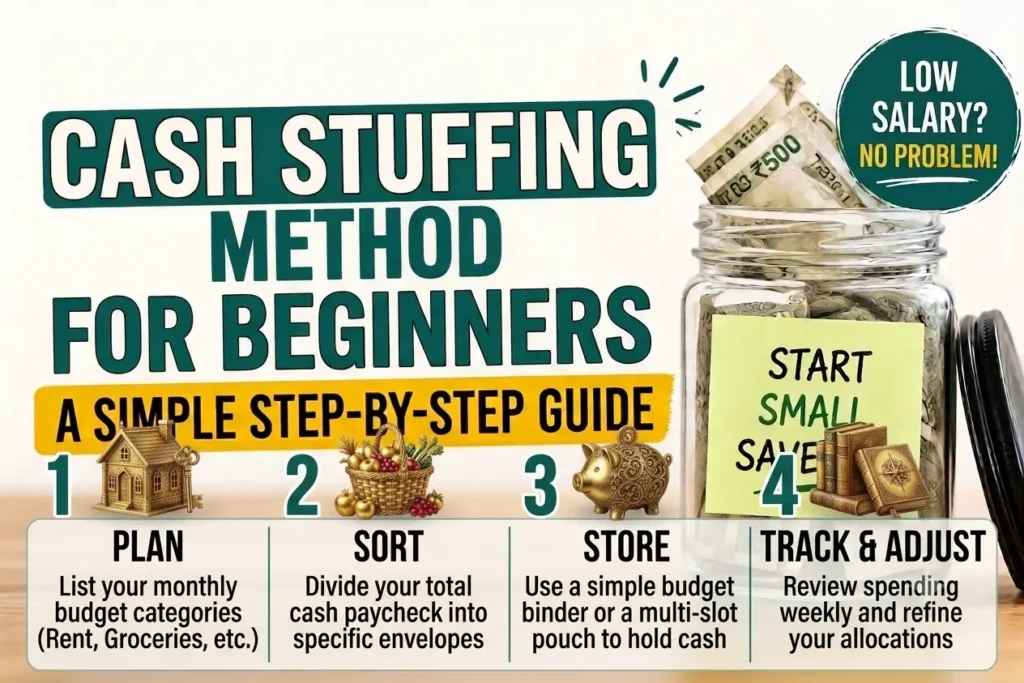
Starting the cash stuffing method is easier when you follow a simple routine instead of trying to change all your spending habits at once. The basic idea is to decide your limits, separate the money into categories, and track what you spend.
1. Choose Your Budget Period
First, decide how often you want to organize your envelopes.
You can use a:
- Weekly system if you prefer tighter spending control
- Biweekly system if you get paid every two weeks
- Monthly system if you receive a monthly salary
Your choice should match your income schedule and spending pattern.
If you want to understand how to divide your income before creating envelopes, read our How to Divide Your Salary for Beginners guide.
2. Prepare and Label Your Envelopes
Choose a few categories that you actually use.
For example:
- Groceries
- Transportation
- Eating out
- Personal spending
- Entertainment
Write the category name clearly on each envelope. Starting with 3–5 categories can make the system easier to maintain.
3. Decide How Much Goes Into Each Envelope
Use the spending limits from your budget rather than guessing.
For example, a monthly flexible-spending budget might look like this:
| Category | Example Amount |
|---|---|
| Groceries | $250 |
| Transportation | $100 |
| Eating out | $75 |
| Personal | $75 |
These amounts are only examples. Your actual limits should depend on your income, essential expenses, and normal spending.
You can first use our Budget Calculator to organize your numbers.
4. Track Every Purchase
This is one of the most important parts of cash stuffing.
Suppose your grocery envelope contains $250. You spend $35 at the supermarket, so your remaining amount is $215.
Writing down each purchase helps you know exactly how much is available instead of relying on memory.
MoneyHelper also recommends keeping track of income and spending when creating a workable budget. You can learn more from its budgeting guidance.
5. Review and Adjust
At the end of your budget period, check what happened.
Ask yourself:
- Which envelope ran out first?
- Which category had money left?
- Were any limits unrealistic?
- Should money be moved between categories next time?
Don’t treat going over one category as failure. It can simply show that your original estimate needs adjusting.
For readers in India, the RBI financial education material also provides guidance on budgeting and managing personal finances.
If your income is very tight and covering basic expenses is already difficult, see our paycheck-to-paycheck budgeting guide for a more focused approach.
The goal is not to follow a perfect envelope system. The goal is to create a spending system that you can realistically follow every pay period.
What Happens When a Cash Stuffing Envelope Runs Out?
One of the biggest questions beginners have is: What should you do when an envelope reaches $0 before the end of the month?
It doesn’t automatically mean your budget has failed. It may simply mean that your spending limit needs to be reviewed.
Check Before Moving Money
First, ask whether the expense is actually necessary.
For example, if your entertainment envelope is empty, you may decide to wait until the next budget period. But if your grocery budget is short because food prices were higher than expected, the situation may be different.
A simple rule is:
Needs first, wants second.
| Situation | What You Can Do |
|---|---|
| Non-essential spending | Wait until the next period |
| Essential expense | Consider moving money from a lower-priority category |
| Unexpected expense | Use an appropriate emergency/savings fund |
| Budget repeatedly runs short | Recalculate your category limits |
Can You Move Money Between Envelopes?
Yes. Your budget doesn’t have to be completely rigid.
Suppose your Eating Out envelope has $40 left, while your Groceries envelope needs another $25. If groceries are the priority, you could move $25 from Eating Out to Groceries.
The important part is to record the transfer so you know where your money went.
What If This Happens Every Month?
If the same envelope runs out repeatedly, don’t simply keep adding money to it.
Look at your actual spending and adjust the budget.
For example, if you regularly spend $300 on groceries but your budget allows only $250, your original limit may not reflect your real situation.
Our salary division guide can help you review how your income is being allocated across different priorities.
What About Leftover Money?
If an envelope still has money at the end of the period, you have several options:
- Carry it into the next period
- Move it toward a planned expense
- Add it to savings
- Keep a small buffer for future spending
For irregular expenses, a sinking-fund approach can make budgeting easier. MoneyHelper’s sinking-fund guidance explains how setting money aside over time can help prepare for expenses that don’t happen every month.
The goal of cash stuffing isn’t to punish yourself for spending. It’s to make your spending choices visible and intentional. If you’re already struggling to cover essential expenses, our paycheck-to-paycheck budgeting guide covers a more focused approach for tight budgets.
Cash Stuffing vs. Digital Budgeting: Which Is Better?
Cash stuffing works by making your spending limits visible through separate cash envelopes. Digital budgeting uses bank accounts, budgeting apps, spreadsheets, or digital savings pots to organize the same idea electronically.
Neither method is automatically better. The right choice depends on how you normally spend and how often you use cash.
| Feature | Cash Stuffing | Digital Budgeting |
|---|---|---|
| Spending visibility | Very high | High |
| Physical cash needed | Yes | No |
| Card/UPI payments | Limited unless hybrid | Easy |
| Tracking | Manual | Often automatic |
| Best for | Controlling flexible spending | Digital-first spending |
When Cash Stuffing Can Work Well
Physical cash can make a spending limit feel more concrete. Once the envelope is nearly empty, you can immediately see that you’re approaching your limit.
This can be particularly useful for categories such as groceries, eating out, entertainment, or personal spending.
When Digital Budgeting Makes More Sense
Cash isn’t practical for every expense. Rent, subscriptions, online shopping, bills, and many everyday transactions are normally paid digitally.
That’s why a hybrid cash stuffing system can be useful. You might use cash for flexible spending while keeping fixed bills and other payments in your bank account.
For readers in the UK, MoneyHelper’s jam jar approach shows how separating money into different pots can also be done digitally.
In India, where digital payments are widely used, you can combine cash envelopes with separate bank-account or savings categories rather than forcing every expense into physical cash.
Which Should Beginners Choose?
Start with the method you are most likely to follow consistently.
If you often overspend on small purchases, physical envelopes may give you stronger spending awareness. If you rarely use cash, a digital or hybrid approach may be more practical.
You can also combine this method with the broader budgeting principles in our Personal Finance for Beginners guide.
The goal isn’t to use cash simply because it’s called “cash stuffing.” The goal is to give every spending category a clear limit and make your money easier to manage.
Common Cash Stuffing Mistakes Beginners Should Avoid
Cash stuffing looks simple, but a few common mistakes can make the system difficult to maintain. The good news is that most of them are easy to fix.
1. Creating Too Many Envelopes
You don’t need an envelope for every small expense.
Starting with 15–20 categories can make your budget feel like another chore. Begin with 3–5 important spending categories and add more only when necessary.
2. Setting Unrealistic Limits
A budget shouldn’t be based on what you wish you spent. It should reflect your actual situation.
If you normally spend $300 on groceries but set a $150 limit without a realistic plan to reduce costs, the envelope may run out quickly.
Review your real spending before changing your limits. Our Budget Calculator can help you organize your numbers.
3. Trying to Use Cash for Everything
Not every expense needs a physical envelope.
Rent, subscriptions, online payments, and many bills can remain digital. A hybrid budgeting system can be more practical than forcing every payment into cash.
4. Forgetting to Track Spending
Cash can disappear quickly when you make several small purchases.
Write down each transaction or keep a simple note on your phone. This makes it easier to understand where your money is actually going.
5. Taking Money From Other Envelopes Without Recording It
Moving money between categories is sometimes reasonable. But repeatedly doing it without tracking the changes can hide the real problem.
If you keep taking money from groceries to cover entertainment, for example, your category limits may need to be reviewed.
6. Ignoring Irregular Expenses
Some expenses don’t appear every month but still need planning.
Gifts, annual subscriptions, clothing, repairs, and seasonal expenses can be handled through a sinking fund rather than pretending they don’t exist.
MoneyHelper’s guide to sinking funds explains how setting aside smaller amounts over time can help prepare for less frequent expenses.
7. Giving Up After One Bad Month
One difficult month doesn’t mean cash stuffing doesn’t work for you.
Your first budget is an estimate. After a few weeks, you’ll have better information about your actual spending habits.
If you’re managing a very tight income, our How to Budget When Living Paycheck to Paycheck guide can help you build a more realistic spending plan.
For broader money-management principles, you can also explore our 7 Rules of Personal Finance guide.
The Simple Rule to Remember
Don’t try to make your cash stuffing system perfect. Make it sustainable.
Start with a few categories, use realistic limits, track your spending, and adjust the system when your circumstances change. That’s what turns cash stuffing from a budgeting experiment into a habit you can actually maintain.
Is cash stuffing good for beginners?
Yes. Cash stuffing can be beginner-friendly because it gives each spending category a clear limit and makes it easier to see how much money is available.
Use an amount that fits your actual budget. After essential expenses, divide your flexible spending money between categories such as groceries, transportation, personal spending, and entertainment.
Check whether the expense is essential. If it is, you can move money from a lower-priority category and record the transfer. For non-essential spending, waiting until the next budget period may be the better option.
Yes. You can use a digital or hybrid system with bank accounts, savings pots, spreadsheets, or budgeting apps. The principle remains the same: separate your money into spending categories with clear limits
Conclusion
The cash stuffing method can be a simple way to make everyday spending easier to understand and control. Instead of treating your entire budget as one amount, you give different spending categories clear limits.
You don’t need to start with a complicated system. Choose a few categories, set realistic amounts, track your spending, and adjust your envelopes when your real spending doesn’t match your original plan.
And remember, cash stuffing doesn’t have to mean using physical cash for everything. A digital or hybrid approach can work too, especially for bills and online payments.
The best budgeting system is the one you can understand, follow, and maintain consistently. Start small, learn from each budget period, and improve your system over time.
- Emergency Fund vs Savings Account: Where to Keep Your Backup Cash in 2026?
- How to Organize Multiple Savings Goals Before 2027: A Simple Money Plan
- Cash Stuffing Method for Beginners: A Simple Step-by-Step Guide
- How to Budget When Living Paycheck to Paycheck
- How to Divide Your Salary for Beginners: Complete Guide With Examples