Imagine you suddenly need ₹10,000 for a medical bill, urgent travel, a job gap, or an unexpected repair. If all your money is sitting in the same account you use for everyday spending, you may end up using money meant for other goals—or worse, borrowing to cover the expense.
That’s where an emergency fund becomes important. But there’s one question many beginners have: should an emergency fund be kept in a regular savings account, or should you keep it somewhere else?
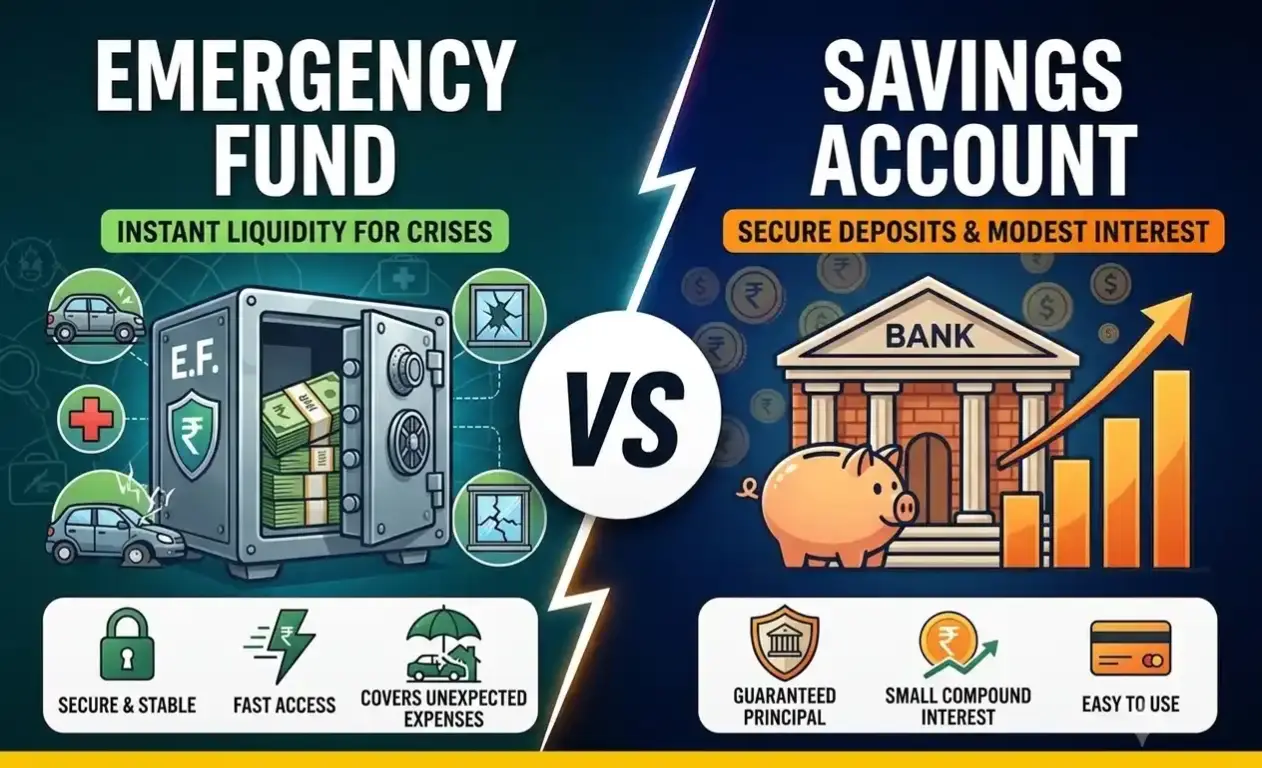
The important thing to understand is that an emergency fund and a savings account are not competing products. An emergency fund is money reserved for unexpected expenses, while a savings account is one of the places where you can keep that money.
In this guide, we’ll break down emergency fund vs savings account, how much you should keep aside, and the practical places where you can keep your emergency money in India—without sacrificing safety and easy access.
What You’ll Learn in This Guide
By the end of this guide, you’ll know:
Emergency fund vs savings account — dono mein kya difference hai aur emergency money ke liye kya purpose hai.
How much emergency fund you need — 3–6 months ke expenses ka target kaise calculate karein.
Risks of keeping all your money in one account — low returns aur everyday spending ka emergency savings par kya effect ho sakta hai.
Where to keep your emergency fund in India — savings account, sweep-in FD aur liquid mutual funds jaise options ko samjhenge.
How to build an emergency fund with a low or irregular income — fixed salary na hone par bhi backup fund kaise banayein.
Common emergency fund mistakes — PPF, ELSS ya ghar par bahut zyada cash rakhne jaise mistakes se kaise bachein.
Practical FAQs — credit card aur digital gold ko emergency backup ke liye use karna chahiye ya nahi.
What Is an Emergency Fund and Why Do You Need It?
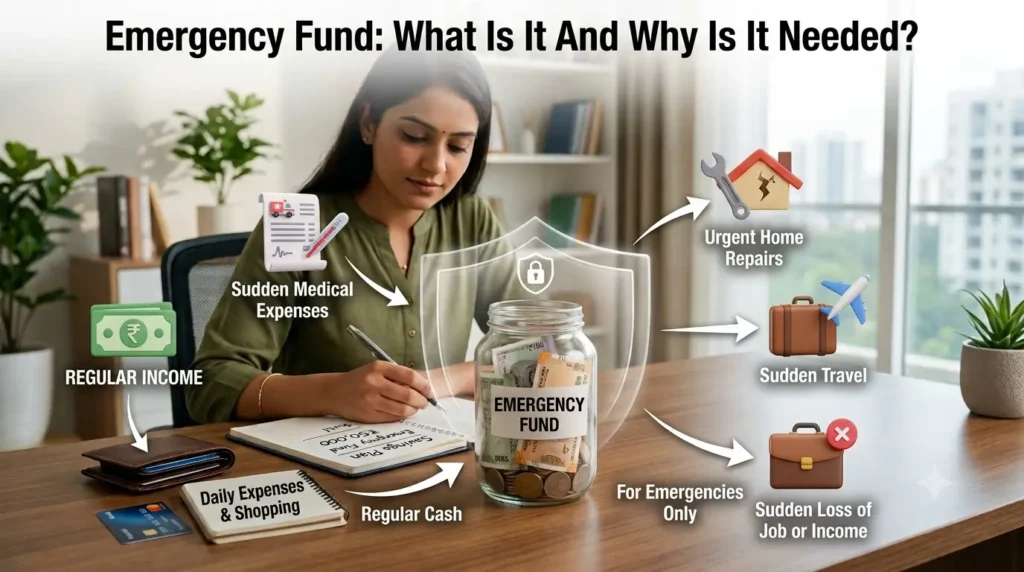
An emergency fund is money kept aside for unexpected expenses that can disturb your normal budget. It can help you handle things like a medical bill, urgent travel, essential repair, job loss, or a temporary income gap without immediately borrowing money.
Think of it as your financial safety net. Your regular income already has many jobs—food, rent, bills, transportation, savings and investments. An emergency fund is there for the expenses you didn’t see coming.
Emergency Fund vs Regular Savings: What’s the Difference?
The main difference between an emergency fund and regular savings is their purpose. Emergency savings are for unexpected problems, while regular savings are often used for planned expenses or goals.
For example, if you’re saving ₹40,000 for a laptop, that’s goal-based savings. But if you keep ₹60,000 aside in case your income stops temporarily or an unexpected expense appears, that’s your emergency fund.
Money Type
Purpose
Example
Emergency fund
Unexpected expenses
Medical bill, job gap, repair
Regular savings
General saving
Money you’re building up
Goal savings
Planned expense
Laptop, education, travel
Investments
Long-term goals
Retirement, wealth building
One important thing: an emergency fund doesn’t have to be a special financial product. You can keep it in a savings account. What makes it an emergency fund is the purpose you’ve given that money.
Can an Emergency Fund Be Kept in a Savings Account?
Yes, an emergency fund can be kept in a savings account, and a separate account can make it easier to avoid spending that money accidentally.
I learned this from my own saving habit too. Instead of keeping all my money in the account I used for everyday expenses, I started putting some money into a separate account. The amount wasn’t always big, but keeping it separate made me think twice before touching it.
Gradually, that separate balance became my backup money.
This is a simple idea that can work for beginners: when your income comes in, move a small amount into your emergency fund before you start spending on non-essential things.
For example, if you receive ₹25,000 and can comfortably save ₹2,000, you could move that ₹2,000 into your separate emergency savings account.
The U.S. Consumer Financial Protection Bureau also recommends keeping emergency savings specifically for unplanned expenses and notes that even a small amount can provide some financial security.
You can use our Budget Calculator to understand your monthly expenses and decide how much you can realistically save.
For eligible bank deposits in India, DICGC deposit insurance currently covers up to ₹5 lakh per depositor per bank, subject to its applicable rules.
How Many Months of Expenses Should You Save?
A common starting target is 3–6 months of essential expenses, but the right amount depends on your income, responsibilities and financial situation.
Use this simple formula:
Monthly essential expenses × Number of months = Emergency fund target
For example, if your essential expenses are ₹20,000 per month:
3 months = ₹60,000
6 months = ₹1,20,000
You don’t have to save ₹1.2 lakh immediately. Start with a smaller milestone:
₹10,000 → ₹25,000 → ₹50,000 → 3 months → 6 months
If your income is irregular, you may need a larger cushion because your monthly income can change. For example, if you earn ₹18,000 one month and ₹30,000 the next, you can save more during stronger months and a smaller amount during difficult months.
MoneyHelper in the UK also uses three to six months of essential outgoings as a common rule of thumb for emergency savings.
Why Is an Emergency Fund Important?
An emergency fund gives you money to fall back on when something unexpected happens, reducing the need to immediately borrow or disturb other financial goals.
Imagine you suddenly need ₹15,000.
Without an emergency fund, you might need to borrow, use a credit card, delay another payment, or sell an investment.
With an emergency fund, you can use part of your reserve and then rebuild it later.
That’s why the first priority of emergency money should be safety and accessibility, rather than chasing the highest possible return.
☐ I have started saving a separate emergency fund.
☐ I have calculated my initial target.
☐ I can access the money when a genuine emergency happens.
☐ I’m not treating the fund as normal spending money.
☐ I’m gradually working toward 3–6 months of essential expenses, if appropriate for my situation.
☐ I review the target when my income or expenses change.
You don’t need a huge amount to start. The important thing is to create the habit of keeping some money aside for the unexpected.
The Hidden Risks of Keeping All Your Emergency Cash in a Regular Savings Account
Keeping your emergency fund in a savings account is not automatically a bad idea. In fact, easy access and safety are more important than chasing high returns when it comes to emergency money.
The problem is usually not the savings account itself. The bigger issues are keeping your emergency money mixed with everyday spending money and ignoring how inflation affects its purchasing power.
If you’re still trying to understand where your money goes every month, you can first use our Budget Calculator to calculate your regular expenses.
Why Low Interest Rates Are Losing You Money to Inflation
When your savings earn less than the rate at which prices are rising, your money can lose purchasing power over time. Your account balance may stay the same or increase slightly, but the same amount may buy fewer things later.
For example, imagine you keep ₹1,00,000 in a savings account for several years.
If the interest you earn is lower than inflation, the ₹1,00,000 may not have the same purchasing power in the future. This is why simply looking at your account balance doesn’t tell the whole story.
The U.S. Bureau of Labor Statistics tracks changes in consumer prices through the Consumer Price Index (CPI), which is one way economists measure inflation.
But this does not mean you should put your emergency fund into risky investments just to beat inflation.
Your emergency fund has a different job.
Think about its priorities like this:
Safety
Easy access
Reasonable return
Higher return only when the first two aren’t compromised
The Consumer Financial Protection Bureau recommends keeping emergency savings somewhere safe and accessible because the money may be needed when an unexpected expense occurs.
So instead of asking only:
“Where can I get the highest return?”
Ask:
“Where can I keep this money safe and access it quickly when I actually need it?”
That question is much more useful when you’re dealing with an emergency fund.
The Temptation of Impulse Spending with Debit Cards
Keeping your emergency fund in the same account you use for everyday spending can make it easier to spend the money without realising it.
Suppose your bank balance shows ₹80,000.
You know that ₹50,000 of it is actually your emergency fund, but the entire amount is sitting in the same account you use for UPI payments, shopping, food and entertainment.
Then you see something you want to buy.
Your brain sees:
“I have ₹80,000.”
But your actual spending money is only ₹30,000.
This is one reason a separate emergency savings account can be useful. You can still access the money when there’s a genuine emergency, but it isn’t constantly sitting in front of you while you’re making everyday purchases.
The CFPB also discusses keeping emergency savings in a dedicated place that is safe and accessible while reducing the temptation to spend it on non-emergency purchases.
A simple setup could look like this:
Main account: salary, UPI, bills and daily expenses
Emergency fund: unexpected expenses only
Goal savings: laptop, education, travel or other planned purchases
Investments: long-term financial goals
This separation doesn’t have to be complicated.
For example, if you receive ₹25,000, you might decide that ₹2,000 goes toward your emergency fund, while the remaining money is used for your regular budget and other goals.
The exact amount will depend on your income and expenses. The important part is giving your emergency money a clear purpose.
If you’re managing several financial goals at the same time, our guide on How to Organize Multiple Savings Goals Before 2027 can help you separate different savings targets instead of mixing everything together.
How to Keep Your Emergency Fund Accessible Without Making It Easy to Spend
The simplest approach is to keep your emergency money separate from your everyday spending account while making sure you can still access it when a genuine emergency happens.
For example, suppose your essential expenses are ₹30,000 per month.
A 3-month starter target would be:
₹30,000 × 3 = ₹90,000
Instead of keeping that ₹90,000 mixed with your normal spending balance, you could keep it in a separate suitable account or another low-risk, accessible option.
Don’t choose an emergency-fund option only because it offers a higher return. Choose a place where your money is reasonably safe, accessible and less likely to be spent accidentally.
Your emergency fund isn’t designed to make you rich.
Its job is to make an unexpected financial problem easier to handle.
3 Best and Safest Places to Keep Your Emergency Fund in India
The best place for an emergency fund should give you two things: easy access and reasonable safety. You don’t necessarily need to keep the entire fund in one account. You can divide it between a regular savings account and another low-risk option depending on how much money you have.
1. Sweep-in Fixed Deposits: A Balance Between Liquidity and Returns
A sweep-in fixed deposit can be useful for keeping part of your emergency fund while still having relatively easy access to the money.
For example, suppose you have a ₹1 lakh emergency fund. You could keep ₹30,000 in a savings account for immediate expenses and place the remaining ₹70,000 in a sweep-in FD, depending on the bank’s rules and terms.
The advantage is that the FD portion may earn more interest than money sitting entirely in a normal savings account. When you need money, the linked sweep facility may automatically break the required portion of the FD, depending on the bank’s conditions.
However, don’t assume every sweep-in FD works the same way. Check the bank’s rules for minimum balance, premature withdrawal, sweep limits, interest calculation and how quickly the money becomes available.
Also, eligible bank deposits such as savings and fixed deposits are covered by DICGC deposit insurance up to ₹5 lakh per depositor per bank, subject to the applicable rules.
Best suited for: People who already have some emergency savings and want part of it to earn more while keeping access reasonably convenient.
2. A Separate Savings Account from a Scheduled Bank
A separate savings account is one of the simplest ways to keep an emergency fund away from your everyday spending money.
For example:
Main account → salary, UPI and regular expenses
Emergency account → medical bills, job gap and urgent repairs
Goal account → travel, education or a future purchase
This separation can make your emergency fund easier to protect because you are less likely to accidentally spend it on everyday purchases.
Before opening a separate account, compare things such as interest rate, minimum balance requirements, account charges, ATM/UPI access and withdrawal convenience.
If you’re keeping a larger amount in bank deposits, also understand the DICGC limit. Deposits in different accounts at the same bank and same ownership capacity are generally aggregated when calculating the ₹5 lakh insurance limit. Deposits held with different banks have separate coverage limits.
You can also use your Budget Calculator to estimate your monthly essential expenses and work out how much emergency money you need.
Best suited for: Beginners who want a simple, accessible and easy-to-manage emergency fund.
3. Liquid Mutual Funds: An Option to Understand Carefully
Liquid mutual funds can be considered for some short-term money, but they should not be treated as the same thing as a bank savings account or FD.
A liquid mutual fund invests in short-term money-market and debt instruments. Its value can change, and mutual funds are not covered by DICGC deposit insurance. DICGC specifically lists mutual funds among the products that are not covered by its deposit insurance scheme.
SEBI’s investor disclosures also make clear that mutual fund investments involve investment risks and that returns are not guaranteed.
So, if you’re building your first emergency fund, you don’t need to move everything into a liquid mutual fund just to chase a potentially higher return. The first priority should be having money available when you genuinely need it.
If you already have a well-built emergency fund and understand how liquid mutual funds work, you can decide whether they fit a portion of your short-term money.
Best suited for: Someone who understands mutual funds and wants to consider a separate short-term investment option—not someone looking for a guaranteed emergency-fund product.
Which Option Should You Choose?
Option
Access
Main Benefit
Important Limitation
Separate savings account
Very easy
Simple and accessible
Interest may be modest
Sweep-in FD
Relatively easy
Combines FD with linked access
Bank-specific conditions
Liquid mutual fund
Through redemption
Potential short-term return
Market-linked and not DICGC-insured
For most beginners, the important thing isn’t finding the option with the highest possible return. Your emergency money exists for one reason: to be available when something unexpected happens.
If you’re still building your first emergency fund, start small and make the habit automatic. You can later increase the amount as your income grows.
How to Connect Your Emergency Fund with Your Budgeting Strategy?
Your emergency fund works best when it is built into your regular budget instead of being treated as something you will save only when extra money is left over. Even a small amount saved consistently can gradually create a useful financial cushion.
The RBI’s financial education material recommends keeping an emergency fund in a separate, easily accessible savings account and building it gradually if you cannot fund the entire amount at once.
For example, if you earn ₹20,000 per month, you don’t have to wait until you can save ₹60,000 or ₹1 lakh. You could start with ₹500, ₹1,000, or whatever amount your budget can comfortably handle.
Applying the Cash Stuffing Method for Emergency Cash
The cash stuffing method can help you control everyday spending, but your main emergency fund does not need to be kept as physical cash at home.
Cash stuffing usually means dividing your spending money into separate categories so you know how much you can spend on things such as groceries, transport, entertainment and other expenses.
You can use the same idea digitally for your emergency fund.
For example:
Money Category
Example Amount
Monthly expenses
₹15,000
Emergency fund
₹2,000
Short-term goals
₹1,500
Flexible spending
₹1,500
Instead of putting ₹2,000 into an envelope and keeping it at home, you could transfer it to a separate savings account labelled for emergencies.
This gives you the psychological benefit of separating your money without keeping a large amount of cash physically at home.
The CFPB also recommends keeping emergency savings somewhere that is safe, accessible and less tempting to spend on non-emergency purchases.
If you want to learn the complete budgeting technique, you can also read our Cash Stuffing Method guide.
How to Build a Backup Fund with an Irregular Income
If your income changes every month, use a flexible savings target instead of forcing yourself to save the exact same amount every month.
For example, imagine your income looks like this:
January: ₹18,000
February: ₹25,000
March: ₹14,000
April: ₹30,000
Saving ₹5,000 every month may not be realistic. Instead, you could save a smaller amount during low-income months and put more aside when your income is higher.
For example:
Monthly Income
Possible Emergency Saving
₹14,000
₹500
₹18,000
₹1,000
₹25,000
₹2,000
₹30,000
₹3,000
These are only examples—not fixed rules. Your actual amount should depend on your essential expenses and what your budget can comfortably handle.
The CFPB specifically notes that people with fluctuating income can use cash-flow management and save more during periods when they have extra money available.
You can also use our Budget Calculator to estimate your monthly expenses and see how much you can realistically put toward your emergency fund.
If your income changes frequently, our guide How to Budget with an Irregular Income can also help you build a more flexible monthly plan.
A Simple Emergency-Fund Budget Rule
A simple approach is to treat your emergency fund as a regular budget category.
For example:
Income → Essential expenses → Emergency savings → Other goals → Flexible spending
You don’t have to start with a large amount. The important part is creating a system that you can repeat.
Once your emergency fund reaches your first target—perhaps ₹10,000 or ₹25,000—you can continue building it toward several months of essential expenses.
And if you ever need to use the fund, that’s exactly what it is there for. After the emergency is handled, make rebuilding the fund one of your next savings priorities.
This approach turns your emergency fund from a one-time goal into a habit that becomes part of your overall budgeting system.
Common Emergency Fund Mistakes to Avoid
Building an emergency fund is a great step, but where and how you keep the money matters too. Some common mistakes can make your emergency fund difficult to access when you actually need it.
Here are two mistakes beginners should avoid when setting up an emergency backup.
Locking Your Money in Long-Term Investments Like PPF or ELSS
Your main emergency fund should generally not be locked into long-term investments such as PPF or ELSS, because an emergency can happen before the money becomes easily accessible.
PPF is designed as a long-term savings scheme. The account has a 15-year maturity period, although certain withdrawals and other facilities are available under specific conditions. (indiapost.gov.in)
ELSS mutual funds have a 3-year lock-in period for each investment. That means you cannot simply redeem your ELSS investment whenever you want during the applicable lock-in period. SEBI also describes mutual funds as market-linked investments where returns are not guaranteed. (sebi.gov.in)
Imagine you suddenly need ₹30,000 for an urgent expense. If that money is sitting inside a product with access restrictions, you may have to find another source of money.
That’s why it helps to separate your financial goals:
Money
Suitable Purpose
Emergency fund
Unexpected expenses
PPF
Long-term savings
ELSS
Long-term investment/tax-saving goals
Goal savings
Planned expenses
Other investments
Long-term wealth building
Your emergency fund doesn’t need to generate the highest possible return. Accessibility and safety are more important for money you may need unexpectedly.
Keeping a small amount of cash for immediate needs can be practical, but your entire emergency fund should generally not be stored as physical cash at home.
For example, keeping ₹2,000–₹5,000 at home for situations where digital payments aren’t available may be different from keeping ₹1 lakh in cash at home.
Large amounts of physical cash can be exposed to risks such as theft, loss, fire or simply being forgotten or spent. It also doesn’t earn interest while sitting unused.
A better approach can be to keep a small cash buffer for immediate situations and store the larger emergency fund in an appropriate separate bank account or other suitable accessible option.
For bank deposits, DICGC provides deposit insurance up to ₹5 lakh per depositor per bank, subject to the applicable rules. This is another reason to understand how your bank deposits are covered rather than assuming every type of financial product has the same protection. (dicgc.org.in)
A Simple Way to Avoid Both Mistakes
You can keep your money organised into three simple buckets:
1. Immediate cash: A small amount for situations where cash is necessary.
2. Emergency fund: Money kept in an easily accessible, suitable savings option for unexpected expenses.
3. Long-term investments: Money invested for goals that are years away.
This separation makes your financial system easier to understand and reduces the chance of using long-term investments for short-term emergencies.
And remember, an emergency fund is not supposed to make you rich. Its job is to protect your financial plan when life doesn’t go according to plan.
How Much Emergency Fund Should I Have?
A common starting target is 3–6 months of essential living expenses. But you don’t have to reach that amount immediately.If your essential expenses are ₹20,000 per month, a 3-month emergency fund would be ₹60,000, while 6 months would be ₹1.2 lakh. If that feels too large, start with a smaller target such as ₹10,000 or ₹25,000 and build it gradually.
Where Should I Keep My Emergency Fund?
Keep your emergency fund somewhere safe and easily accessible, such as a separate savings account or another suitable low-risk option.The main goal is not to get the highest possible return. You want the money to be available when an unexpected expense happens without taking unnecessary investment risk.
Should I Keep My Emergency Fund in One Bank Account?
You don’t necessarily have to keep the entire emergency fund in one account. You can keep some money immediately accessible in a savings account and use another suitable option for the remaining amount, depending on your needs.For larger bank deposits, remember that DICGC deposit insurance has an applicable limit of ₹5 lakh per depositor per bank, subject to its rules.
Conclusion: Take the First Step Towards Financial Peace of Mind An emergency fund is one of the simplest ways to protect yourself from unexpected financial problems. Whether it’s a medical expense, urgent repair, sudden travel, or a temporary loss of income, having money set aside can help you handle these situations without immediately depending on credit or loans. The key is to understand that an emergency fund is different from your regular savings goals. Your emergency money should be kept separate, easily accessible, and in a place where you can use it when you genuinely need it. For many people, a separate savings account can be a simple starting point. A sweep-in FD can be considered for part of the fund, while liquid mutual funds are an option that should be understood carefully because they are market-linked and not the same as bank deposits. You also don’t need to build your emergency fund overnight. Start with whatever amount your budget allows and gradually work toward 3–6 months of essential expenses. If your income is irregular, adjust your contribution according to your income instead of forcing yourself to save the same amount every month. Most importantly, avoid common mistakes such as locking your emergency money into long-term investments or keeping a large amount of physical cash at home. Start small, keep it separate, and keep building it. A well-planned emergency fund may not feel exciting, but when an unexpected expense arrives, it can give you something much more valuable: financial breathing room.
Hi, I’m Asif Khan, the voice behind paisakmao.de. For the past two years, I’ve been blogging about financial education, income skills, and mindset development for students and young minds. My mission is to empower every youth with financial literacy and practical money-making skills at an early age. Through paisakmao.de, I share actionable guides for students to start earning early, money wisdom that schools don’t teach, and mindset lessons from successful people and modern psychology. Whether you’re a teenager looking to earn your first income or a student exploring side hustles, you’re in the right place. Financial freedom begins with the right mindset and the right knowledge. Let’s grow, earn, and evolve together — welcome to the movement!
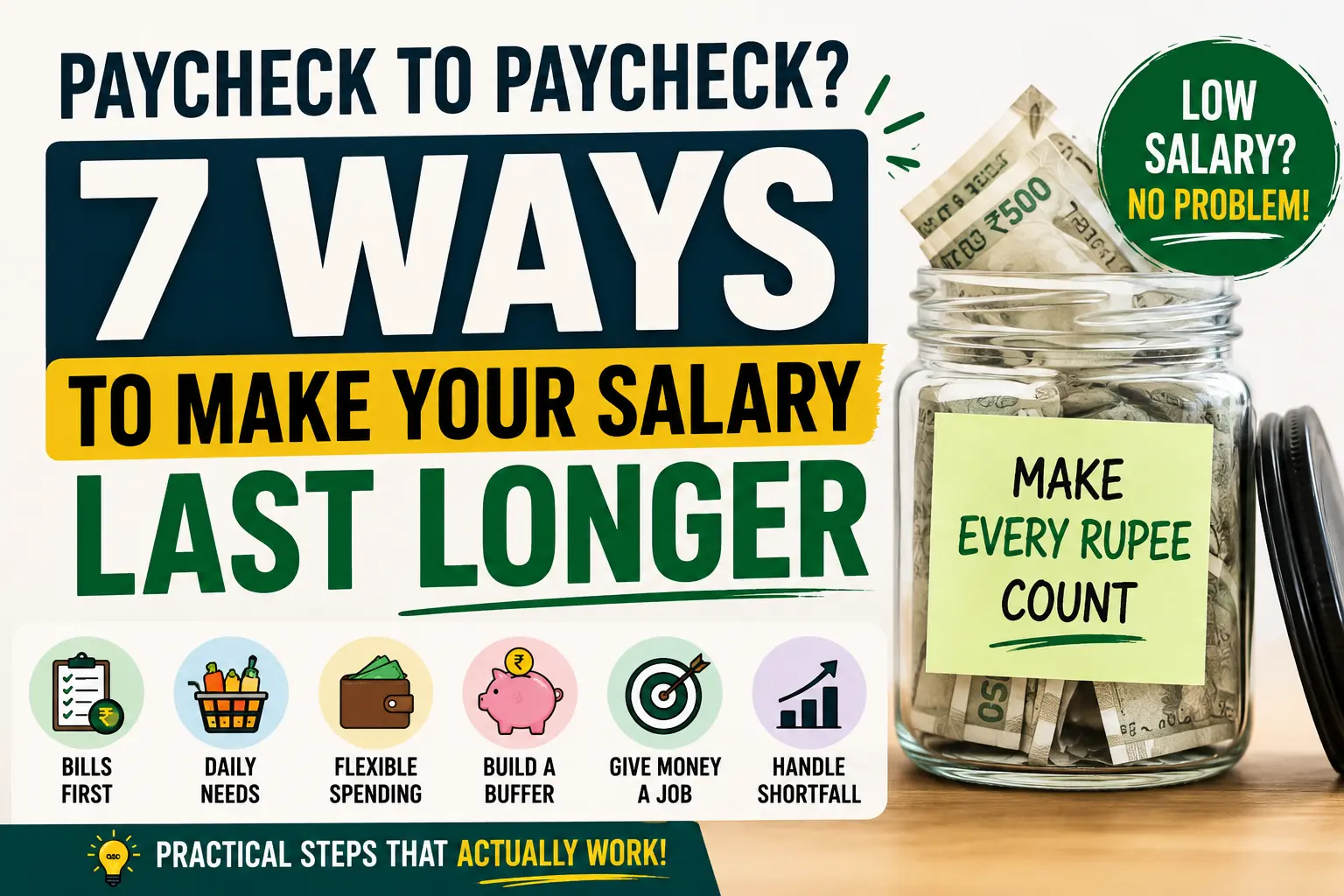
If your paycheck runs out before your next payday, budgeting can feel almost impossible—especially when your income is already low. The problem may not be unnecessary spending; your essential expenses may simply leave too little room.This guide explains how to budget when living paycheck to paycheck on a low income, find where your money is actually going, and create a practical plan to make each paycheck last longer.
Find Out Why Your Paycheck Runs Out Before Payday
Before changing your budget, first find out why your money is running out. If you don’t know where the shortage is coming from, cutting random expenses may not solve the problem.
Start with your take-home income for one pay period. Then list the expenses that must be paid before your next paycheck, such as housing, food, transportation, utilities, and required payments.
For example, if you receive ₹10,000 and need ₹4,000 for housing, ₹2,000 for food, ₹1,000 for transportation, and ₹1,500 for essential bills, you have ₹1,500 left.
Now ask yourself: Can that ₹1,500 realistically cover everything until your next payday?
If yes, the problem may be how the remaining money is being spent or when certain expenses occur. If no, your essential costs may already be leaving too little income available.
The same calculation works whether your paycheck is ₹10,000, $1,000, or £900. The amounts will differ, but the question stays the same: how much income is left after the expenses you cannot avoid?
This simple check helps you identify whether your main problem is spending, payment timing, or an income that is not enough to cover essential costs. Once you know the actual problem, you can build a budget around it instead of guessing where your money is going.
Calculate Your Minimum Amount Needed Until the Next Paycheck
Once you know why your paycheck is disappearing, calculate the minimum amount you actually need before the next payday. This gives you a clear spending limit instead of treating your whole paycheck as available money.
Start with the expenses that cannot reasonably be postponed until later. For example, if your next paycheck is 10 days away, include the food, transportation, bills, and other essential payments you need during those 10 days.
Suppose you receive ₹10,000 and your next paycheck is 10 days away:
Essential food: ₹2,000
Transportation: ₹1,000
Upcoming bill: ₹2,500
Other required expense: ₹1,000
Your minimum amount needed is ₹6,500.
That means the remaining ₹3,500 should not automatically be treated as spending money. It can become a buffer, cover an upcoming expense, or help reduce the pressure on your next paycheck.
The same method works with $1,000 or £900. The numbers will change depending on your location and expenses, but the principle remains the same: separate money you must use from money you can safely leave untouched.
This small calculation can change the way you look at each paycheck. Instead of asking, “How much money do I have?” you start asking, “How much of this money is actually available?”
Build a Paycheck Plan Around Your Essential Expenses
When you are living paycheck to paycheck, a budget should do more than divide your income into categories. It should help you control the timing of your money so that an expense due next week does not compete with today’s spending.
After calculating what you need until your next paycheck, give each important amount a specific job. This creates a simple cash-flow plan without forcing every household into the same percentage-based budget.
Reserve Money for Bills Before They Are Due
Start with bills that will need to be paid before your next paycheck arrives. These might include rent, utilities, phone bills, transportation payments, or other unavoidable commitments.
For example, suppose you receive ₹10,000 today and ₹3,500 of bills are due before your next payday. That ₹3,500 should be treated as committed money even though it is still sitting in your account.
The same idea applies to a $1,000 or £900 paycheck. The currency changes, but the problem is the same: money can look available simply because the bill has not arrived yet.
Once upcoming bills are protected, calculate what you need for essential day-to-day spending until payday.
Imagine you have 10 days remaining and expect to spend about ₹200 per day on necessary food and transportation:
₹200 × 10 days = ₹2,000
Instead of treating your whole account balance as spendable, ₹2,000 becomes the working amount for those essentials.
You can use the same calculation with dollars or pounds. For example, if your essential daily spending is $12 and you have 8 days until payday, your basic requirement would be $96.
This creates a useful distinction: your account balance shows what you have, while your spending limit shows what you can safely use.
Leave Room for Small Unplanned Expenses
A budget that leaves no flexibility can be difficult to follow. A small unexpected expense can force you to take money from a bill or another essential category.
After covering your required expenses, keep a modest flexible amount that fits your situation.
₹500 for a ₹10,000 example paycheck
$30 for a $1,000 example paycheck
£25 for a £900 example paycheck
These numbers are examples, not recommended percentages. Your flexible amount should depend on your actual income and expenses.
The important rule is simple: once this amount is used, do not automatically increase it by taking money reserved for essential expenses.
Give the Remaining Money a Specific Job
After protecting bills, essential daily spending, and a small flexible amount, look at what remains. Do not automatically label it as “extra money.” Decide what that money is supposed to do.
₹10,000 Paycheck
Amount
Purpose
Upcoming bills
₹3,500
Protect until due date
Food + transportation
₹2,000
10-day essentials
Flexible spending
₹500
Small unexpected needs
Remaining amount
₹4,000
Protect for the next financial need
The ₹4,000 remaining in this example should not automatically become shopping or entertainment money. It could help cover an upcoming expense, provide breathing room for the next pay period, or be directed toward another priority once your immediate needs are secure.
This is similar to the basic idea behind MoneyHelper’s jam-jar budgeting approach, where money is separated into different pots for different purposes so that spending money is less likely to interfere with money reserved for bills.
When Money Is Unassigned
When Money Has a Job
The full balance feels available
Only the appropriate amount feels available
Upcoming bills are easy to forget
Upcoming bills are protected
Daily spending can consume future money
Daily spending has a defined limit
Payday feels like a reset
Each paycheck is planned around the next one
If you want to understand broader salary allocation, you can also read your existing guide to dividing your salary. That article covers percentage-based allocation and salary budgeting; this section focuses specifically on protecting cash between paychecks, so the two articles serve different purposes.
The goal is not to make every paycheck fit a perfect formula. It is to make sure money needed for the next few days and weeks is protected before you decide what you can actually spend.
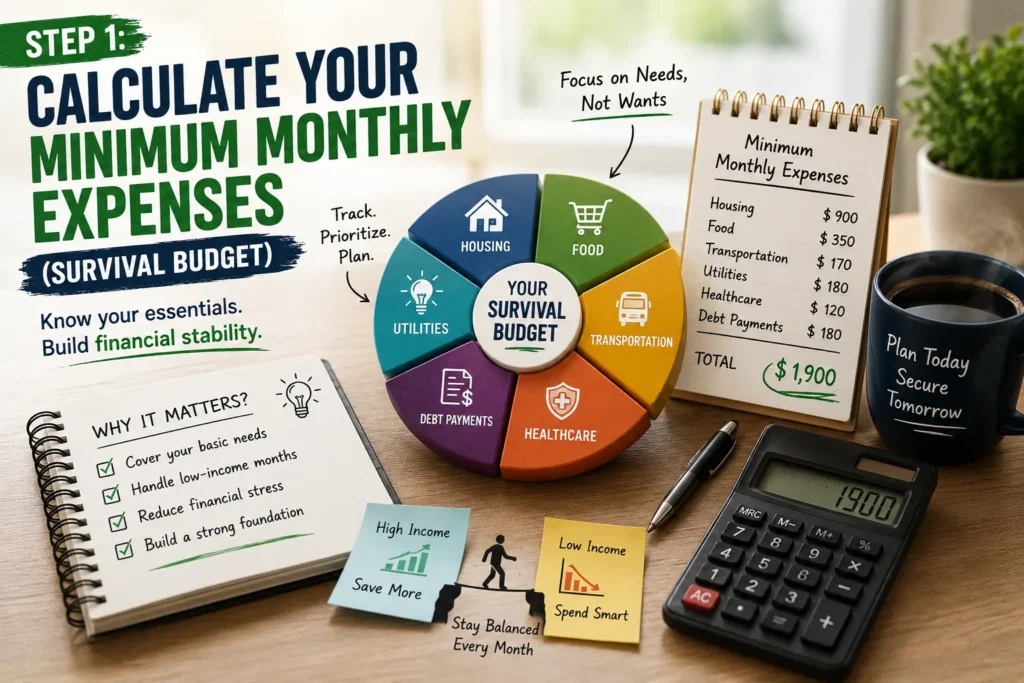
Create a Survival Budget for the Lowest-Income Weeks
When you live paycheck to paycheck, your budget cannot depend on every paycheck being the same. A week with fewer working hours, lower overtime, or an unexpected expense can leave you with much less money than usual.
Instead of rebuilding your entire budget whenever income falls, create a survival budget based on the minimum amount you need to keep your essential expenses covered.
Find Your Bare-Minimum Monthly Cost
Start by identifying the expenses you cannot reasonably stop or postpone when your income is lower.
Housing and essential household costs
Basic food
Necessary transportation
Essential utilities and communication
Required debt or other unavoidable payments
For example, if your normal monthly income is ₹20,000 but your essential expenses are ₹13,000, then ₹13,000 is much more important for your survival budget than your usual spending level.
A person earning $2,500 or £2,000 would use the same method: first identify the minimum cost of keeping essential needs covered, rather than copying someone else’s budget percentages.
Separate Fixed Costs From Expenses You Can Adjust
Not every expense has the same level of flexibility. When income falls, knowing which costs can actually be reduced is more useful than simply cutting everything by the same percentage.
Type of Expense
Usually Harder to Change Quickly
Often More Flexible
Housing
Rent or essential housing payment
Some optional housing-related spending
Food
Basic groceries
Takeaways and non-essential purchases
Transportation
Necessary travel to work
Optional trips
Subscriptions
Essential communication services
Entertainment subscriptions
This gives you a priority order. You are not trying to make every category smaller. You are protecting the expenses that keep your household functioning and adjusting the areas where you have genuine control.
What to Cut First When Your Paycheck Is Smaller
When a paycheck comes in lower than expected, make the adjustment based on priority rather than emotion.
For example, suppose your usual income is ₹20,000 but this month you receive only ₹15,000. If essential expenses remain around ₹12,000, you have only ₹3,000 available for everything else.
Monthly Situation
Income
Essential Costs
Amount Left
Normal month
₹20,000
₹12,000
₹8,000
Lower-income month
₹15,000
₹12,000
₹3,000
The lesson is not to spend the extra ₹8,000 simply because it was available in the normal month. Your flexible spending has to respond when your income changes.
The same principle applies if income falls from $2,500 to $2,000 or from £2,000 to £1,600. The actual figures differ by country and household, but the budgeting decision is the same: protect essential costs first, then reduce flexible spending.
What to Do When the Budget Still Doesn’t Balance
Sometimes cutting flexible spending is not enough. If your essential expenses are already higher than your income, the problem is no longer simply about better budgeting.
At that point, look at the gap itself.
Check whether any payment can be moved to a more suitable date.
Look for temporary reductions in non-essential commitments.
Review recurring expenses that are no longer necessary.
Consider realistic ways to increase income if the shortfall continues.
Contact the relevant provider early if you are struggling with an important payment rather than waiting until it becomes overdue.
Do not treat every low-income month as a failure. A temporary income drop requires a different spending plan. If the gap continues for several months, however, it is a signal that the underlying income-versus-expense problem needs to be addresse provide practical information for managing income and expenses. UK readers can also use MoneyHelper’s budgeting guidance for country-specific budgeting information.
If you already have a broader article about dividing your salary, use it as a supporting internal link for the normal-income budgeting side. This section has a different purpose: it explains how to adapt when your income falls below normal.
A survival budget is not meant to be your permanent lifestyle. It is a practical fallback system that helps you protect essential expenses during a low-income period without pretending that every month will look the same.
Build a Small Buffer Between Your Paychecks
When you are living paycheck to paycheck, even a small unexpected expense can create a problem because most of your income is already committed before the next payday arrives.
The solution is not to suddenly save a large amount. A more realistic approach is to create a small buffer between paychecks and increase it gradually as your cash flow improves.
Why Every Paycheck Should Not Be Fully Spent
If your entire paycheck is allocated before the next one arrives, there is no room for a small surprise expense. A transport problem, higher grocery bill, or unexpected household purchase can force you to reduce something else or depend on borrowing.
For example, if you receive ₹20,000 and normally spend almost all of it before the next payday, try leaving a small amount untouched instead of treating the full balance as available spending money.
The same idea applies to someone earning $2,000 or £1,600. The amount of the buffer will depend on local costs and income, but the purpose is the same: create a little space between what you earn and what you immediately spend.
Start With a Buffer You Can Actually Keep
Your first target does not need to be a large emergency fund. If money is already tight, setting an unrealistic target can make the system impossible to maintain.
Start with an amount that would make one small unexpected expense easier to handle.
Stage
Illustrative Buffer
Main Purpose
Starting point
₹300 / $5 / £5
Creates the first small cushion
Small cushion
₹1,000 / $25 / £20
Handles minor unexpected costs
Several days of essentials
Based on your actual costs
Provides more breathing room
Larger buffer
Based on your income and expenses
Reduces pressure between paychecks
These are illustrative examples, not recommended savings targets for every country or household. Your starting point should match what you can realistically leave untouched.
Turn Leftover Money Into Next-Paycheck Protection
One useful habit is to stop treating every leftover amount as permission to spend more.
Suppose you planned to spend ₹2,000 during a week but actually spent ₹1,750. Instead of automatically using the remaining ₹250, you can leave it available for the next pay period.
Over time, several small amounts can create a useful cushion without requiring one large contribution from a low income.
If you want a separate collection of practical saving strategies, you can read how to save money fast in 30 days. That article covers broader saving techniques; this section is specifically about creating protection between paychecks.
How a Buffer Changes Your Next Paycheck
Situation
Without a Buffer
With a Small Buffer
Small unexpected expense
May reduce money available for essentials
Can be covered from the cushion
Lower-than-usual paycheck
Immediate pressure on spending
Previous buffer provides some breathing room
Money left at the end of the week
May be spent automatically
Can remain available for the next period
Next payday
Starts with little or no flexibility
Starts with some money already protected
The goal is not to make your bank balance look bigger. The goal is to make your next payday less fragile.
Increase the Buffer Gradually
Once your first small cushion becomes easy to maintain, increase it only when your budget can support the change.
Keep the first small amount untouched.
Add a little more when you genuinely have money left over.
Use part of the buffer only for situations that actually need it.
Rebuild the buffer after using it.
Increase the target when your income becomes more stable.
This creates a simple cycle:
Paycheck → essential spending → controlled flexible spending → small amount protected → next paycheck starts with a cushion.
If you are still struggling to keep any money aside despite earning a reasonable income, the problem may be different from simply needing a larger buffer. In that situation, why you can’t save money despite earning a good salary is a more relevant supporting guide.
When a Buffer Is Not Enough
A small buffer can help with timing problems and minor unexpected expenses, but it cannot solve a permanent gap between income and essential costs.
If your essential expenses are consistently higher than your reliable income, calculate the shortfall instead of simply trying to save more.
Essential expenses − reliable income = monthly shortfall
For example, if essential expenses are ₹16,000 and reliable income is ₹14,000, there is a ₹2,000 monthly gap. A buffer can temporarily reduce pressure, but the underlying gap still needs to be addressed.
For broader personal-finance fundamentals, you can also use this beginner’s personal finance guide to review the wider system without repeating those topics here.
A buffer is not about becoming wealthy overnight. It is about creating a small gap between your income and your immediate spending so that one minor problem does not automatically become a next-paycheck problem.
Start small, protect the amount, rebuild it when you use it, and increase it only when your actual budget allows.
Handle a Shortfall Before It Becomes a Bigger Problem
Sometimes a low-income budget does not fail because of unnecessary spending. The real problem can be that your essential expenses are already close to, or higher than, your reliable income.
When that happens, the first step is not to cut random expenses. Find the exact size of the gap and determine whether it is temporary or happening repeatedly.
Calculate Your Exact Monthly Shortfall
Start with your reliable take-home income and subtract only the expenses you genuinely need to keep covered.
Reliable income − essential expenses = money available for everything else
For example, if your reliable income is ₹15,000 and essential expenses are ₹13,500, you have ₹1,500 available for flexible spending and other priorities.
But if essential expenses are ₹16,000, you already have a ₹1,000 shortfall before discretionary spending begins.
Situation
Income
Essential Expenses
Result
Expenses fit income
₹15,000
₹13,500
₹1,500 remaining
Small shortfall
₹15,000
₹16,000
₹1,000 gap
Larger shortfall
₹15,000
₹18,000
₹3,000 gap
The same calculation works for other currencies. Someone earning $2,000 with $2,200 of essential expenses has a $200 gap. Someone earning £1,600 with £1,750 of essential expenses has a £150 gap.
Separate a Temporary Gap From a Recurring Problem
Not every shortfall requires the same response.
Temporary Shortfall
Recurring Shortfall
Income was unusually low for one period
Income is regularly below essential costs
An unusual expense caused the problem
Basic monthly costs are structurally too high
Normal income may solve it next payday
The underlying income-expense gap needs attention
Small adjustments may be enough
Both expenses and income may need to change
This distinction matters because repeatedly using a credit card, borrowing money, or taking from your next paycheck can hide a recurring shortfall instead of solving it.
Decide What Can Be Delayed or Reduced
If the gap is temporary, review your expenses according to priority rather than cutting everything equally.
Reduce: flexible food spending, entertainment, shopping, and other non-essential categories.
Delay: purchases or goals that are useful but not urgent.
Review: recurring subscriptions and commitments that may no longer provide enough value.
The purpose is to create enough breathing room to get through the weaker income period without sacrificing expenses that keep your basic needs covered.
If the issue is connected to inconsistent income rather than a single low paycheck, your guide on budgeting with an irregular income is the more relevant supporting resource. It covers a different situation, so this section does not need to repeat that system.
When Cutting Expenses Is No Longer Enough
There is a point where reducing discretionary spending cannot solve the problem. If your essential expenses are already higher than your reliable income, the budget needs to address the gap itself.
For example, if your essential expenses are ₹18,000 and your reliable income is ₹15,000, cutting ₹500 of entertainment does not remove the entire ₹3,000 shortfall.
At that stage, consider both sides of the equation:
Can an essential cost be reduced or changed?
Can a payment date be adjusted where appropriate?
Is there a temporary expense that can be postponed?
Can reliable working hours or income be increased?
Is the shortfall temporary or likely to continue?
If debt payments are part of the problem, avoid treating new borrowing as income. A recurring gap financed by new debt can make future paychecks even harder to manage.
Know When Your Budget Needs a Structural Change
A budget is useful when it reflects reality. If your income repeatedly cannot cover your essential expenses, changing the spreadsheet without changing the underlying situation will not fix the problem.
Track the shortfall for several pay periods and look for a pattern. If the same gap keeps appearing, you have identified a structural problem rather than a one-time budgeting mistake.
For broader financial planning, you can refer to your financial planning guide for beginners. Keep this article focused on the paycheck-to-paycheck problem instead of repeating the full financial-planning framework.
official guidance on managing income and expenses. UK readers can use MoneyHelper’s budgeting guidance for additional country-specific information.
The key is to identify the problem early. A one-time ₹1,000, $100, or £100 shortfall can be handled differently from a gap that appears every month. Once you know which situation you have, you can choose the appropriate next step instead of repeatedly starting over on payday.
Create a Simple Weekly System That Keeps You Ahead of Payday
A budget only works when you can follow it after the planning is finished. If you are living paycheck to paycheck, you do not need to check your finances every hour. A short weekly routine can be enough to see what has been spent, what is still available, and what needs attention before the next payday.
The goal of this system is simple: make your money decisions before your balance becomes a problem.
Check Your Available Money Once a Week
Choose one fixed day each week to check your bank balance and recent spending. Sunday can work well, but the best day is the one you can repeat consistently.
Do not look only at your total balance. Separate the money that is already committed from the money you can actually use during the next few days.
Check your current balance.
Check essential payments due before the next review.
Check what you spent during the previous week.
Check how much flexible money remains.
Move any genuine leftover amount into your protected buffer when appropriate.
This five-minute check can reveal a problem while it is still small instead of waiting until the final days before payday.
Set a Spending Limit for the Next Seven Days
Once you know what money is already committed, give yourself a realistic limit for the coming week.
For example, if you have ₹2,800 available for flexible spending and four weeks remain in your planning period, you might initially work with a limit of around ₹700 per week. Your actual number should come from your own expenses rather than a fixed budgeting rule.
A US reader might work with a $150 weekly limit, while a UK reader might use £100. The currency does not matter as much as giving the remaining money a clear time period.
Weekly Check
Question to Ask
Action
Balance
How much money is available?
Record the amount
Upcoming bills
What must be paid before next week?
Protect that money
Recent spending
Where did last week’s money go?
Identify unusual spending
Flexible money
How much can I safely spend?
Set the week’s limit
Buffer
Did any money genuinely remain?
Keep it protected when possible
Check Upcoming Bills Before You Spend
A weekly spending limit is not enough if a large payment is due in the same week.
Before using your available balance, look at the next few days and check whether rent, utilities, transportation, insurance, debt payments, or another essential expense is approaching.
The Consumer Financial Protection Bureau’s bill-calendar guidance recommends putting income and bill dates together so you can see when money comes in and when payments leave your account. That cash-flow view is especially useful when the timing of your income creates pressure before payday. 1
This is different from simply asking, “How much money is in my bank account?” The better question is, “How much of that balance is actually available after the money I already need to protect?”
Adjust the Next Week Instead of Giving Up on the Budget
Suppose you planned to spend ₹700 during the week but ended up spending ₹900. Do not treat the entire monthly budget as failed.
First, identify why the extra ₹200 was spent. Was it a necessary expense, a one-time purchase, or something you could have avoided?
If the expense was genuinely necessary, adjust the following week’s flexible spending if your overall cash flow allows it. If it was avoidable, use the information to prevent the same pattern from repeating.
What Happened
Better Response
Necessary expense was higher
Adjust the next week’s flexible amount
One-time unexpected cost
Use the buffer if appropriate and rebuild it later
Repeated unnecessary spending
Identify the category and reduce it
Essential costs exceed income
Recalculate the shortfall instead of cutting random expenses
This makes the budget a feedback system rather than a punishment system.
Use a Simple Payday-to-Payday Checklist
At the beginning of each pay period, run through the same short checklist:
☐ Confirm your actual take-home income.
☐ Protect bills due before the next paycheck.
☐ Set aside the amount needed for essential daily spending.
☐ Decide your flexible spending limit.
☐ Keep your existing buffer protected.
☐ Check your finances once during each week.
☐ Review what changed before the next payday.
If your income changes from one pay period to another, use the lower reliable income as the safer starting point rather than assuming your best paycheck will arrive every time.
For a broader system covering salary management across the month, your Day 1 to Day 30 salary management guide can support the reader after this article. This article has a narrower purpose: keeping a low-income paycheck under control between paydays. 2
Make the System Easier Every Payday
You do not need a complicated spreadsheet or a new financial rule every week. The system becomes useful when the same few decisions become automatic.
Each payday, protect essential money. Each week, check your actual spending. When income falls, reduce flexible spending before essential needs. When money remains, protect part of it instead of automatically spending it.
Over time, this changes the way you experience payday. Instead of starting every pay period wondering how long your money will last, you start with a clear picture of what is committed, what is available, and what needs to happen next.
That is the real purpose of a paycheck-to-paycheck budget: not perfection, but enough control to make the next payday less stressful than the last one.
Can you budget if you
Yes. When your income baseline is low, structural percentage allocations become even more critical to safeguard your primary needs and prevent cascading high-interest debt cycles.
What is the 70/20/10 rule for low income?
This alternate budgeting blueprint allocates 70% of total funds for essential living needs, 20% to clear debts or build savings, and exactly 10% for variable personal lifestyle choices.
How do I start an emergency fund on a tight budget
Begin by automating microscopic milestones. Setting aside just $5 or ₹500 immediately on Day 1 establishes consistent behavioral habits without fracturing your day-to-day liquidity.
What is the fastest way to break the paycheck cycle
The fastest way is shifting to physical cash tracking via the envelope system for variable costs and performing a immediate subscription audit to reclaim lost margins.
Hi, I’m Asif Khan, the voice behind paisakmao.de. For the past two years, I’ve been blogging about financial education, income skills, and mindset development for students and young minds. My mission is to empower every youth with financial literacy and practical money-making skills at an early age. Through paisakmao.de, I share actionable guides for students to start earning early, money wisdom that schools don’t teach, and mindset lessons from successful people and modern psychology. Whether you’re a teenager looking to earn your first income or a student exploring side hustles, you’re in the right place. Financial freedom begins with the right mindset and the right knowledge. Let’s grow, earn, and evolve together — welcome to the movement!
7 Rules of Personal Finance? Managing money can be difficult, especially when you are just starting to take control of your finances. You may earn a regular income but still struggle to save, deal with unexpected expenses, manage debt, or know where to invest your money.
The problem is often not simply how much you earn, but how you manage the money you have. Without a clear system, it is easy to spend too much, delay saving, depend on debt, or make financial decisions without knowing what should come first.
So, what are the 7 rules of personal finance? These rules provide a simple framework for managing your money, from controlling spending and building an emergency fund to managing debt, investing, protecting your finances, and setting financial goals.
In this complete beginner’s guide, we’ll explain each rule with practical examples, common mistakes, and actionable steps so you can build a stronger financial foundation step by step.
Quick Answer: What Are the 7 Rules of Personal Finance?
The 7 rules of personal finance are:
Spend Less Than You Earn — Keep your expenses below your income so you can create room for saving and investing.
Create and Follow a Budget — Plan where your money should go and track your spending.
Build an Emergency Fund — Keep savings available for unexpected expenses or a temporary loss of income.
Manage High-Interest Debt — Pay attention to expensive debt because high interest can slow down your financial progress.
Save and Invest Consistently — Save for short-term needs and invest appropriately for long-term financial goals.
Protect Your Finances — Reduce major financial risks with appropriate insurance and other safeguards.
Set Financial Goals and Review Your Progress — Give your money clear goals and regularly check whether you are moving toward them.
These seven rules work together. The goal is not to follow them perfectly from day one, but to build each habit step by step and create a financial system that fits your income, expenses, priorities, and long-term goals.
Rule 1: Spend Less Than You Earn
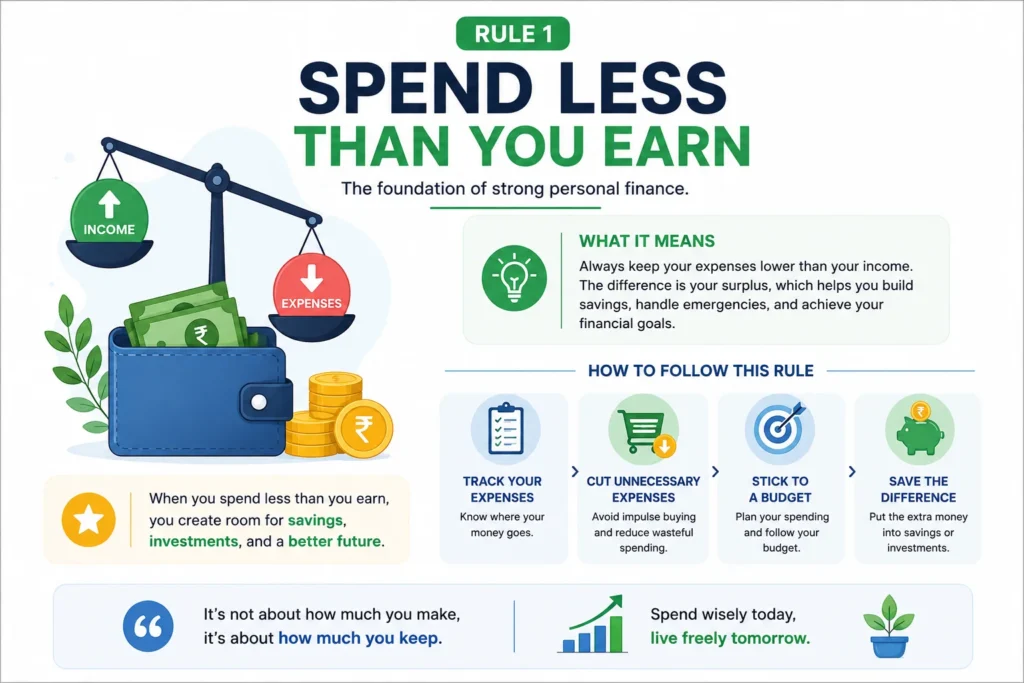
The first rule of personal finance is simple: spend less than you earn. It may sound obvious, but this basic habit creates the financial space you need to save money, handle unexpected expenses, repay debt, and work toward long-term goals.
If you earn ₹30,000 a month and spend ₹30,000, you have no financial surplus. But if you earn ₹30,000 and spend ₹25,000, you have ₹5,000 left that can be given a specific purpose.
The goal is not to stop enjoying your money. It is to make sure your spending does not consume everything you earn.
What Does “Spend Less Than You Earn” Mean?
At its simplest:
Income − Expenses = Financial Surplus
For example:
Monthly Money
Amount
Take-home income
₹30,000
Essential expenses
₹18,000
Lifestyle spending
₹5,000
Other expenses
₹2,000
Money remaining
₹5,000
That ₹5,000 is your financial surplus. Instead of allowing it to disappear through unplanned spending, you can direct it toward savings, an emergency fund, debt repayment, or an appropriate long-term financial goal.
Most important financial goals require money to remain after your regular expenses have been paid.
Saving requires a portion of your income to remain available.
An emergency fund requires regular contributions.
Debt repayment becomes easier when you have extra cash flow.
Investing requires money that you do not need for immediate expenses.
Financial goals become easier when your spending stays below your income.
Consider two people who both earn ₹30,000 per month.
Person A: earns ₹30,000 and spends ₹29,500, leaving ₹500.
Person B: earns ₹30,000 and spends ₹24,000, leaving ₹6,000.
They earn the same amount, but Person B has created much more financial breathing room.
This does not mean Person A is necessarily irresponsible. Their higher expenses could be caused by rent, healthcare, family responsibilities, transportation, or other essential costs. The important lesson is that income alone does not determine financial progress.
Spending Less Does Not Mean Living Miserably
A common misunderstanding about personal finance is that spending less means eliminating everything you enjoy.
That is not the goal.
You can still spend money on entertainment, hobbies, eating out, travel, or things that genuinely improve your quality of life. The important question is whether those expenses fit within your financial situation.
Before making a non-essential purchase, ask yourself:
Do I actually need this?
Does it provide enough value for its cost?
Is this purchase delaying an important financial goal?
Could I get similar value for less money?
Can I comfortably afford it without using debt?
Good personal finance is not about saying “no” to everything. It is about deciding what deserves your money.
Understand Needs, Wants, and Desires
One practical way to control spending is to separate your expenses into needs, wants, and desires.
Needs
Needs are essential expenses required for basic living and important responsibilities. Examples include food, housing, basic clothing, healthcare, and necessary transportation.
Wants
Wants are things that improve comfort or lifestyle but are not essential. Examples include dining out, entertainment, vacations, and some subscriptions.
Desires
Desires are stronger aspirations or luxury purchases that can usually be delayed, such as an expensive phone, luxury car, or high-end electronics.
The point is not to eliminate wants and desires. It is to make sure they do not consume money that should first go toward essential expenses and important financial priorities.
Track Your Spending Before Trying to Fix It
Many people know exactly how much they earn but cannot explain where most of their money goes.
That makes it difficult to improve your finances.
For the next 30 days, record every expense. You can divide your spending into categories such as:
Housing
Food and groceries
Transportation
Utilities and bills
Debt payments
Shopping
Entertainment
Subscriptions
Savings
Investments
Do not worry about changing everything while you are tracking. First understand your actual spending pattern. Once you can see where your money goes, you can decide what needs to change.
Create a Monthly Spending Gap
After tracking your expenses, calculate your monthly surplus.
For example:
Income = ₹35,000
Total expenses = ₹29,000
Surplus = ₹6,000
Now the ₹6,000 needs a purpose.
Depending on your situation, it might be used for an emergency fund, high-interest debt repayment, a short-term financial goal, or long-term investing.
There is no single percentage that works for everyone. Your income, responsibilities, debt, location, goals, and financial stability all matter.
What If You Spend More Than You Earn?
Suppose your income is ₹30,000 but your monthly expenses are ₹32,000.
₹30,000 − ₹32,000 = −₹2,000
You have a monthly deficit of ₹2,000.
Do not immediately try to remove every small expense. First identify the biggest causes of the deficit.
Calculate your actual take-home income.
List all your monthly expenses.
Identify your three largest discretionary expenses.
Review recurring payments and subscriptions.
Look for expenses that can realistically be reduced.
Consider whether your income needs to increase.
Use the money you free up to eliminate the deficit first.
One of the biggest challenges to spending less than you earn is lifestyle inflation.
Imagine your salary increases from ₹30,000 to ₹40,000. Instead of allowing some of that additional ₹10,000 to improve your savings or financial position, you increase your lifestyle by ₹10,000 as well.
Your income increased, but your financial surplus did not.
A better approach is to enjoy part of an income increase while directing another part toward savings, debt repayment, or other financial goals.
Build a System Instead of Depending on Willpower
Trying to remember every financial decision throughout the month can become exhausting. A simple system is easier to maintain.
You can think of your money flow like this:
Income → Essential expenses → Financial priorities → Flexible spending
When your financial priorities are decided in advance, you are less likely to spend the entire income before thinking about your future.
If your income changes from month to month, your system needs to be more flexible. In that situation, your existing guide on How to Budget with an Irregular Income can help you build a more suitable monthly approach.
Don’t Ignore Small Repeated Expenses
A single ₹100 expense may not look important. But repeated spending can become significant.
For example:
₹100 × 20 purchases = ₹2,000
This does not mean every ₹100 purchase is bad. The point is to identify spending patterns that happen automatically or provide very little value.
Investor.gov also highlights that small everyday expenses can add up over time, which is why tracking spending can reveal opportunities to save.
What Should You Do With the Money You Don’t Spend?
Creating a surplus is only the first step. The next step is giving that surplus a purpose.
Depending on your circumstances, your priorities might include:
Building an emergency fund
Paying down high-interest debt
Saving for short-term goals
Preparing for major future expenses
Investing for appropriate long-term goals
An emergency fund can be especially useful because unexpected expenses can otherwise force you to rely on credit or loans. The Consumer Financial Protection Bureau’s emergency-fund guide explains how dedicated emergency savings can help people handle unplanned expenses and financial shocks.
Common Mistakes Beginners Make
1. Saving Only What Is Left
If you spend first and save whatever happens to remain, saving may become inconsistent.
2. Increasing Spending Every Time Income Increases
A higher income can improve your financial position, but only if some of the increase remains available for financial goals.
3. Ignoring Recurring Expenses
Subscriptions, memberships, EMIs, and automatic payments can quietly reduce your monthly surplus.
4. Using Debt for Unnecessary Lifestyle Spending
Borrowing can make something affordable today while creating a financial obligation for the future.
5. Following Someone Else’s Budget Exactly
A budget that works for another person may not work for you. Your income, responsibilities, expenses, and goals are different.
A Simple 30-Day Action Plan
Week 1: Track
Record every expense without trying to judge or change your behaviour immediately.
Week 2: Analyze
Separate needs from wants and identify your largest spending categories.
Week 3: Reduce
Choose one or two realistic expenses that you can reduce without creating an unsustainable lifestyle.
Week 4: Redirect
Give the money you saved a specific purpose, such as emergency savings, debt repayment, or another financial goal.
The goal is not to become perfect in 30 days. The goal is to build a system you can continue every month.
Quick Checklist
☐ I know my actual monthly take-home income.
☐ I track my monthly expenses.
☐ My total spending is lower than my income.
☐ I understand the difference between needs and wants.
☐ I am aware of lifestyle inflation.
☐ I have a plan for my monthly surplus.
☐ I am building financial security instead of spending everything I earn.
Key Takeaway
Spending less than you earn is not about living a miserable or extremely restrictive life. It is about creating financial breathing room.
When you consistently maintain a gap between your income and expenses, that surplus can become savings, emergency protection, debt reduction, and long-term wealth.
Earn → Spend intentionally → Keep a surplus → Give the surplus a purpose.
Once you understand how to create that surplus, the next question is how to control and organize your monthly spending. That brings us to Rule 2: Create and Follow a Budget.
Rule 2: Build an Emergency Fund Before You Need It
An emergency fund is one of the most important foundations of personal finance for beginners. It is money kept aside specifically for unexpected expenses or financial emergencies, so you do not have to depend immediately on credit cards, loans, or money meant for other goals.
The purpose is not to make you afraid of unexpected expenses. The purpose is to make sure that an unexpected expense does not completely destroy your monthly budget.
What Is an Emergency Fund?
An emergency fund is a separate pool of money reserved for expenses that are unexpected, necessary, and difficult to postpone. Examples can include an urgent medical bill, essential home or vehicle repair, sudden job loss, or an unexpected period of reduced income.
The Consumer Financial Protection Bureau (CFPB) describes an emergency fund as a cash reserve specifically set aside for unplanned expenses and financial emergencies. It also notes that even a small amount of emergency savings can provide some financial security.
Without emergency savings, one unexpected expense can turn into a much larger financial problem. You may have to borrow money, use a credit card, sell investments at the wrong time, or delay important bills.
For example, imagine that you earn $2,000 a month and normally manage your expenses successfully. Then your car suddenly needs a $600 repair. If you have no emergency savings, that $600 may have to come from debt or money intended for rent, investing, or another financial goal.
With an emergency fund, the same problem can be handled using money that was already reserved for unexpected situations.
This is why an emergency fund is not simply another savings goal. It is a financial protection system.
How Much Should You Keep in an Emergency Fund?
There is no single emergency-fund amount that is perfect for everyone. Your target should depend on your essential monthly expenses, income stability, debt obligations, dependents, and how difficult it would be to replace your income.
A useful way to think about your target is in stages:
Starter fund: Build a small first layer that can handle common minor emergencies.
Basic emergency fund: Work toward several months of essential living expenses.
Higher safety buffer: Consider a larger reserve if your income is unstable, you have dependents, or replacing your income would take longer.
FDIC consumer guidance notes that a common recommendation is to keep around three to six months of expenses in emergency savings, while also emphasizing that the appropriate amount depends on factors such as income and expenses.
Calculate Your Emergency Fund From Essential Expenses
Do not automatically calculate your emergency fund from your total monthly spending. Start by identifying the expenses you would still need to pay if your income suddenly became limited.
Your essential monthly expenses might include:
Rent or housing costs
Basic groceries
Utilities
Essential transportation
Insurance premiums
Minimum debt payments
Essential medical expenses
Other necessary household costs
For example, if your essential expenses are $1,500 per month and you decide that your initial target is three months of essential expenses:
$1,500 × 3 = $4,500
Your target would therefore be $4,500 for a three-month emergency reserve.
This is only an example. Your actual target should reflect your own circumstances rather than blindly copying someone else’s number.
Start Small If You Cannot Save Thousands
One of the biggest mistakes beginners make is believing that an emergency fund is useless unless they can immediately save several months of expenses.
That mindset can prevent people from starting at all.
If your income is limited, begin with an amount that is realistic for you. Even a small reserve can be useful when an unexpected expense appears.
For example, you could create milestones such as:
First goal: build your first small emergency buffer.
Second goal: cover one common unexpected expense.
Third goal: build one month of essential expenses.
Long-term goal: gradually increase the fund toward several months of essential expenses.
The important principle is progress. Your emergency fund does not have to be perfect on day one.
Where Should You Keep Your Emergency Fund?
An emergency fund should be safe, accessible, and separated enough from everyday spending that you are not tempted to use it for unnecessary purchases.
A dedicated savings or bank account can make the purpose of the money clearer. The best place will depend on your country, available accounts, access requirements, fees, and applicable protections.
The CFPB recommends considering safety and accessibility when deciding where to keep emergency savings.
Keep Your Emergency Fund Separate From Everyday Spending
If your emergency money sits in the same account you use for shopping, entertainment, subscriptions, and daily spending, it can become very easy to spend it without realizing it.
A simple system is:
Everyday money: regular bills and daily expenses.
Emergency money: unexpected and necessary expenses only.
Goal-based savings: planned purchases and short-term goals.
Investment money: long-term wealth-building.
This separation makes the purpose of each dollar easier to understand and reduces accidental spending.
What Counts as a Financial Emergency?
Not every unexpected purchase is an emergency. A useful test is to ask three questions:
Was the expense genuinely unexpected?
Is it necessary or financially important?
Can the expense reasonably wait until it can be paid from normal income?
Examples that may qualify include:
Unexpected essential medical costs
Urgent home repairs
Necessary vehicle repairs
Unexpected loss or reduction of income
Essential emergency travel
Other major unplanned expenses that cannot reasonably be postponed
What Should You NOT Use an Emergency Fund For?
An emergency fund should not become a general-purpose spending account.
It is usually better not to use emergency savings for:
A new phone when your current phone works
Shopping during a sale
Planned vacations
Entertainment
Luxury purchases
Regular monthly bills that you already knew about
Investments that you simply want to make
Planned expenses should normally have their own savings category instead of being taken from your emergency reserve.
Emergency Fund vs. Regular Savings: What Is the Difference?
Regular savings and emergency savings both involve putting money aside, but they serve different purposes.
Emergency Fund
Regular Savings
Unexpected financial problems
Planned future expenses
Medical emergency or urgent repair
Vacation or new phone
Unexpected income loss
Planned purchase
Used only when necessary
Used according to your savings goal
Keeping these purposes separate helps you avoid spending your emergency reserve on expenses that could have been planned for in advance.
How Can You Build an Emergency Fund on a Low Income?
Building emergency savings on a low income can be difficult, but the strategy does not have to be complicated.
Start by choosing a small amount that you can consistently save. It could be a fixed amount from every paycheck or a percentage of your income.
For example, if you can comfortably save $25 from each paycheck, do not dismiss it because it seems small. Consistency turns small contributions into a growing financial buffer.
You can also direct occasional extra money toward the fund, such as bonuses, gifts, refunds, or income from temporary work, while still keeping enough money available for your essential needs.
The CFPB also recommends starting with what you can afford and building the emergency fund over time rather than waiting until you can save a large amount at once.
What If Your Income Is Irregular?
If your income changes from month to month, an emergency fund becomes even more useful because your financial risk is different from someone with a highly predictable paycheck.
Instead of depending on a fixed monthly savings amount, you can use a flexible system:
Save a minimum amount during low-income months.
Save more during stronger-income months.
Send part of unexpected extra income to your emergency fund.
Protect the fund from unnecessary withdrawals.
If your income is irregular, you can also learn more about creating a survival budget and managing variable income in your related guide:
Should You Build an Emergency Fund Before Investing?
For many beginners, building at least an initial emergency buffer before taking significant investment risk can make the overall financial system more stable.
The reason is simple: investments are designed for longer-term goals and can fluctuate in value. An emergency fund is designed for money you may need unexpectedly and should therefore prioritize accessibility and stability.
This does not mean every person must stop investing completely until they reach a large emergency-fund target. Your decision should consider your income, debt, financial responsibilities, and risk tolerance.
The key principle is to avoid putting money into investments that you may suddenly need for an emergency.
What Should You Do If You Have to Use Your Emergency Fund?
Using your emergency fund does not mean you failed.
That is exactly what the fund is designed for.
If a genuine emergency happens and you need to use the money, focus first on solving the emergency. After the situation is under control, make rebuilding your emergency fund your next financial priority.
For example:
Emergency → Use the fund → Stabilize your finances → Rebuild the fund → Return to normal saving and investing.
The CFPB specifically recommends rebuilding emergency savings after you have used it for an unexpected expense.
Common Emergency Fund Mistakes Beginners Make
1. Waiting Until You Can Save a Large Amount
Waiting for the perfect income level can delay your emergency savings for years. Start with what is realistic today.
2. Keeping the Money Too Easy to Spend
If emergency savings are mixed with everyday spending money, you may accidentally treat them as available spending money.
3. Using the Fund for Wants
A discount, vacation, gadget, or entertainment purchase is not automatically an emergency just because it was unexpected.
4. Never Rebuilding the Fund
After using emergency savings, some people simply continue with their normal budget. That leaves them exposed to the next unexpected expense.
5. Copying Someone Else’s Target
Your emergency-fund requirement depends on your own expenses, income stability, responsibilities, and financial situation. A target that works for one household may be too small or unnecessarily large for another.
A Simple Emergency Fund Building System
You can turn the rule into a simple system instead of relying on motivation.
Calculate essential monthly expenses.
Choose your first realistic savings milestone.
Create a separate place for emergency savings.
Automate or schedule contributions when possible.
Add extra money when your income allows.
Use the fund only for genuine emergencies.
Rebuild it after every major withdrawal.
Review the target whenever your income or responsibilities change.
Automatic transfers can make saving easier because the money is moved before you have an opportunity to spend it. FDIC consumer guidance also highlights automatic transfers as a practical way to build savings over time.
A Practical Example: Building an Emergency Fund Step by Step
Imagine a beginner has essential monthly expenses of $1,200.
Instead of thinking, “I need thousands of dollars immediately,” the person can create milestones.
Stage 1: Build a small starter buffer.
Stage 2: Increase the fund until it can handle a common unexpected expense.
Stage 3: Reach one month of essential expenses.
Stage 4: Continue building toward several months of essential expenses.
This approach makes a large financial goal feel more achievable because you are focusing on the next milestone rather than the entire journey at once.
Emergency Fund Quick Checklist
☐ I know my essential monthly expenses.
☐ I have a separate emergency savings location.
☐ I have chosen a realistic first savings target.
☐ I contribute regularly, even if the amount is small.
☐ I know what qualifies as an emergency.
☐ I avoid using emergency savings for wants.
☐ I increase my target when my financial responsibilities increase.
☐ I rebuild the fund after using it.
Key Takeaway
An emergency fund is not about predicting exactly when something will go wrong. It is about preparing before something goes wrong.
The strongest approach is to start with an amount you can realistically save, keep the money accessible and separate from everyday spending, use it only for genuine emergencies, and gradually increase the reserve as your financial situation improves.
Once you have a basic financial safety net, the next rule becomes important: protecting that progress by managing debt carefully and avoiding financial decisions that can push you backward.
Rule 3: Pay Off High-Interest Debt
One of the most important rules of personal finance is to control and pay off high-interest debt. Debt itself is not always bad, but expensive debt can quietly consume your income and make it much harder to save, invest, or build financial security.
If a large part of your monthly income goes toward interest and debt payments, you have less money available for your future. That is why understanding which debt deserves the most attention is an essential part of personal finance for beginners.
Why High-Interest Debt Can Hold You Back
Imagine you have ₹50,000 of debt carrying a very high interest rate. Even if you make regular payments, a significant portion of your money may go toward interest instead of reducing the amount you originally borrowed.
This creates a cycle:
Debt → Interest → Higher payments → Less money available for saving → More dependence on credit.
The problem becomes even worse when you continue borrowing while trying to repay the old debt.
Paying expensive debt down can therefore improve your monthly cash flow and give you more control over your money.
Not All Debt Is the Same
A common beginner mistake is treating every type of debt as equally dangerous.
Instead, look at three things:
Interest rate: How expensive is the debt?
Balance: How much do you still owe?
Purpose: What did the borrowed money pay for?
High-interest consumer debt generally deserves more urgent attention because the cost of carrying it can grow quickly.
Lower-cost debt used for an important long-term purpose may require a different strategy. The right decision depends on the interest rate, repayment terms, your cash flow, and your overall financial situation.
Find Your Most Expensive Debt First
Make a simple list of everything you owe.
Debt
Balance
Interest Rate
Priority
Credit card
₹40,000
High
High
Personal loan
₹80,000
Medium
Medium
Lower-rate loan
₹2,00,000
Lower
Lower
This simple comparison can reveal where your money is being lost most quickly.
Do not choose a repayment strategy based only on the size of the balance. A smaller debt with a much higher interest rate can sometimes be costing you more than a larger, lower-rate debt.
Two Popular Ways to Pay Off Debt
Once you know which debts you have, two common approaches are the debt avalanche and the debt snowball.
Debt Avalanche
With the avalanche method, you continue making required payments on all debts while directing extra money toward the debt with the highest interest rate.
After that debt is cleared, you move the extra payment toward the next-highest-rate debt.
Best suited for: people who want to focus primarily on reducing interest costs.
Debt Snowball
With the snowball method, you continue required payments on all debts but direct extra money toward the smallest balance first.
Once that debt disappears, you move the payment toward the next-smallest balance.
Best suited for: people who benefit from quick psychological wins and visible progress.
Neither method is automatically perfect for everyone. The most useful strategy is the one you can consistently follow while meeting all required payments.
Never Ignore Minimum Payments
While aggressively paying one debt, do not simply stop paying your other debts.
Your repayment system should first protect you from missed payments, penalties, and additional financial damage. Then any extra amount can be directed toward your priority debt.
A simple system is:
Pay required amounts on all debts → Choose one priority debt → Put extra money toward it → Clear it → Move to the next.
Should You Stop Saving While Paying Debt?
This is where many beginners make an extreme decision.
They either ignore debt completely while investing, or they put every available rupee into debt and keep absolutely no emergency savings.
A more balanced approach is often better.
Try to maintain at least a basic emergency buffer while aggressively dealing with expensive debt. Otherwise, one unexpected expense could force you to borrow again and undo your progress.
Your exact balance between debt repayment and saving depends on the interest rate, income stability, emergency needs, and financial responsibilities.
Stop the Debt From Coming Back
Paying off debt is only half the solution.
If the behaviour that created the debt continues, the balance can return.
Before using credit for a purchase, ask:
Can I afford this from my current income?
Is this purchase necessary?
Am I borrowing because I genuinely need it or because I want it immediately?
Will the repayment make next month’s budget harder?
If you repeatedly use debt to cover normal living expenses, the underlying problem may be that your spending is too high compared with your income. In that situation, return to the reasons you may be struggling to save money and identify the root cause instead of treating every new loan as a separate problem.
A Simple Debt-Payoff Plan
List every debt with its balance, interest rate, and required payment.
Protect your required payments so you do not create additional problems.
Choose one priority debt using the avalanche or snowball approach.
Put extra money toward that debt whenever your budget allows.
Avoid taking new unnecessary debt while paying the old debt.
Move the freed-up payment toward your next financial priority after the debt is cleared.
Quick Debt Checklist
☐ I know exactly how much I owe.
☐ I know the interest rate on each debt.
☐ I make all required payments on time.
☐ I have chosen a debt-payoff strategy.
☐ I am prioritising expensive debt.
☐ I am avoiding unnecessary new borrowing.
☐ I have a plan for the money freed after a debt is cleared.
Key Takeaway
Debt becomes dangerous when its cost prevents you from moving forward financially. The goal is not simply to become debt-free as quickly as possible at any cost. The goal is to reduce expensive debt while protecting your basic financial stability.
Know what you owe, understand the interest you are paying, choose a repayment strategy, and prevent unnecessary new debt from replacing the old debt.
Know your debt → Prioritise expensive debt → Pay consistently → Avoid new unnecessary borrowing → Redirect the freed-up money.
Rule 4: Save and Invest for Your Future
Saving money gives you financial stability today, but saving and investing for the future helps you prepare for tomorrow.
This is where personal finance starts moving beyond simply “spending less.” Once your basic expenses are under control and expensive debt is being managed, you need a plan for the money you want to keep for future goals.
You do not need to become an investing expert overnight. As a beginner, the first goal is to understand why you are saving, when you will need the money, and how much risk you can realistically handle.
Saving and Investing Are Not the Same Thing
Saving and investing are connected, but they serve different purposes.
Saving
Investing
Usually for short-term or near-term needs
Usually for longer-term goals
Focuses more on safety and accessibility
Focuses on potential long-term growth
Useful for emergencies and planned expenses
Useful for long-term wealth-building
Generally lower risk
Can involve market risk
For example, money you may need next month should not normally be treated the same way as money you do not expect to need for many years.
That simple difference can prevent a common beginner mistake: putting short-term money into something that can fluctuate significantly when you actually need it.
Give Every Saving Goal a Purpose
Instead of simply saying, “I want to save more money,” give your savings a specific job.
You might have separate goals for:
Emergency expenses
Upcoming purchases
Education or skill development
Travel
Major household expenses
Long-term financial independence
A goal becomes easier to act on when you know how much you need and when you need it.
For example, if you want ₹24,000 for a purchase in 12 months:
₹24,000 ÷ 12 = ₹2,000 per month
Now “save ₹24,000” becomes a simple monthly target of ₹2,000.
Start Investing Only After Understanding the Basics
Investing can help your money grow over long periods, but it is not a guaranteed way to make money quickly.
Different investments have different levels of risk. The value of market-linked investments can rise and fall, sometimes significantly.
That is why beginners should avoid choosing an investment simply because someone online says it will give high returns.
Before investing, understand at least these four things:
What are you investing in?
What risks are involved?
How long can you keep the money invested?
What fees or costs are involved?
SEBI’s investor education resources also emphasize understanding investments and their risks before making investment decisions.
Imagine you need ₹50,000 in six months for an important expense. Taking substantial market risk with that money may not make sense because you have very little time to recover if the investment falls.
Now imagine you are investing money for a goal that is decades away. You have much more time to handle short-term market fluctuations.
So instead of asking:
“Which investment gives the highest return?”
Start with:
“When will I need this money, and how much risk can I afford?”
That is a much healthier starting point for a beginner.
Use Compounding to Your Advantage
One reason people invest for the long term is the potential effect of compounding.
Compounding means that returns can themselves generate returns over time. The longer money remains invested and the more consistently you contribute, the more important this effect can become.
For example, suppose you invest ₹2,000 every month for many years. You are not only contributing your own money; over time, investment growth can also contribute to the value of the portfolio.
The exact result will depend on the investment, returns, fees, taxes, and market conditions. There is no guaranteed return.
The important lesson is simple:
Time can be one of an investor’s biggest advantages.
Do Not Wait for the “Perfect” Time to Start
Many beginners keep waiting.
“I will start when my salary increases.”
“I will invest after I understand everything.”
“I will start next year.”
Learning before investing is good. But waiting forever for perfect conditions can become another form of procrastination.
You do not need to know everything before beginning your financial education. Start by understanding basic concepts, building good money habits, and making decisions that match your situation.
What If You Can Only Invest a Small Amount?
Do not compare your beginning with someone else’s portfolio.
If you can invest only ₹500 or ₹1,000 per month right now, that does not make your effort meaningless.
Your first goal is to build the habit of consistently setting money aside while improving your income and financial knowledge.
As your income grows, your contribution can grow too.
The bigger mistake is not starting small. It is believing that small amounts do not matter and therefore never developing the habit at all.
Don’t Invest Money You May Need Soon
This is one of the simplest rules beginners can remember.
If money has an important short-term job, keep its risk appropriate to that job.
For example:
Emergency money → prioritise safety and accessibility.
Long-term goal money → consider suitable long-term investments after understanding the risks.
This separation makes your financial system much easier to manage because every pool of money has a clear purpose.
A Simple Saving and Investing System
You do not need a complicated portfolio or dozens of financial products.
Start with a simple sequence:
Control your monthly spending.
Build an emergency buffer.
Deal with expensive debt.
Define your financial goals.
Decide when you will need each goal’s money.
Choose saving or investing according to the goal and risk.
Contribute consistently and review your plan periodically.
The point is not to create the most complicated financial system. The point is to create one you can actually maintain.
Common Mistakes Beginners Make
1. Chasing High Returns
A higher potential return usually comes with higher risk. “High return with no risk” should immediately make you cautious.
2. Investing Without an Emergency Buffer
If every unexpected expense forces you to sell investments, your long-term plan can become difficult to maintain.
3. Copying Someone Else’s Portfolio
Another person’s income, goals, age, responsibilities, and risk tolerance may be completely different from yours.
4. Constantly Switching Investments
Changing investments every time you hear a new prediction can turn long-term investing into emotional decision-making.
5. Ignoring Fees and Taxes
Returns are not the only thing that matters. Costs and taxes can affect the amount of money you actually keep.
Quick Checklist
☐ I have clear financial goals.
☐ I know when I will need the money for each goal.
☐ I understand the difference between saving and investing.
☐ I understand the basic risks of what I am investing in.
☐ I am not investing emergency money unnecessarily.
☐ I am investing according to my time horizon.
☐ I am focusing on consistency rather than quick profits.
☐ I review my financial plan when my circumstances change.
Key Takeaway
Saving protects your financial stability, while appropriate long-term investing can help your money work toward future goals.
You do not need a huge salary or a complicated investment strategy to begin. Start with clear goals, understand your risk, keep short-term money appropriately safe, and build the habit of putting money aside consistently.
Save for near-term needs → Protect your emergency fund → Understand risk → Invest for appropriate long-term goals → Stay consistent.
Rule 5: Set Clear Financial Goals
Saving money without knowing why you are saving can make personal finance feel frustrating. You may put money aside every month, but after a while you may still wonder, “What am I actually working toward?”
That is why the fifth rule of personal finance is to set clear financial goals.
A financial goal gives your money a direction. Instead of simply trying to “save more,” you know what the money is for, how much you need, and when you want to reach it.
Turn “I Want to Save Money” Into a Real Goal
Compare these two statements:
Goal A: “I want to save more money.”
Goal B: “I want to save ₹60,000 for an emergency fund within the next 12 months.”
Goal B is much easier to act on because it gives you three important pieces of information:
What: ₹60,000
Why: Emergency fund
When: 12 months
Once a goal becomes specific, you can turn it into a monthly plan.
₹60,000 ÷ 12 months = ₹5,000 per month.
Now you are no longer simply “trying to save.” You have a measurable target.
Use Three Time Horizons
You do not need dozens of financial goals. A simple way to organise them is to divide them into three time horizons.
This separation matters because money needed soon should generally be managed differently from money you do not expect to need for many years.
It also prevents a common mistake: treating every financial goal as if it has the same deadline and the same risk requirements.
Give Your Goals a Number and a Deadline
A goal becomes much more useful when you can measure it.
For every important goal, write down:
Target amount
Target date
Current amount
Monthly contribution
Priority
For example:
Goal
Target
Deadline
Monthly Amount
Emergency fund
₹60,000
12 months
₹5,000
Education
₹36,000
12 months
₹3,000
Vacation
₹24,000
12 months
₹2,000
Now your money has a job instead of simply sitting inside a vague “savings” category.
Not Every Goal Should Be a Priority
This is where real-life personal finance becomes important.
You may want to build an emergency fund, buy a new phone, invest for retirement, repay debt, travel, and save for education—all at the same time.
But your income may not be large enough to fully fund everything simultaneously.
That is okay.
Instead of trying to do everything at once, rank your goals.
A simple priority order could be:
Essential financial stability
Emergency protection
Expensive debt reduction
Important short- and medium-term goals
Long-term wealth-building
Optional lifestyle goals
Your exact order can change depending on your circumstances. Someone with expensive debt may need a different priority from someone who has stable income and no significant debt.
Use the “Why” Behind the Goal
A number alone may not keep you motivated.
Knowing why the goal matters to you can make it easier to stay consistent.
For example:
“I want ₹50,000” is just a number.
“I want ₹50,000 so that an unexpected expense does not force me to borrow money” has a clear purpose.
The second version connects the financial target with a real problem you want to solve.
When you feel tempted to spend the money unnecessarily, that purpose can remind you what you are working toward.
Break Big Goals Into Small Wins
A ₹5 lakh goal can feel overwhelming when you look at the entire number.
Each milestone gives you something measurable to celebrate.
This is particularly useful when the final goal may take several years. You do not need to mentally carry the entire target every day. Focus on the next milestone.
What If Your Income Is Too Small for Your Goals?
This is a situation many beginners face.
You calculate your goals and realise that the required monthly amount is higher than what you can realistically save.
For example:
Required monthly saving = ₹10,000
Affordable monthly saving = ₹4,000
That does not mean the goal is impossible.
You have several options:
Extend the deadline.
Reduce the target amount.
Temporarily lower the priority of another goal.
Reduce unnecessary expenses.
Look for ways to increase income.
Combine several of these approaches.
A realistic goal that takes longer is usually better than an unrealistic goal that makes you give up after two months.
Keep Planned Goals Separate From Emergency Money
Suppose you are saving for a vacation and also building an emergency fund.
If you keep both amounts in one mental bucket, it becomes easy to spend emergency money on the vacation—or postpone your emergency savings because the vacation feels more exciting.
Give different goals different names and, where practical, separate them into different savings categories or accounts.
This simple separation makes it easier to see what money is actually available for each purpose.
Review Your Goals When Your Life Changes
A financial goal is not a contract that can never change.
Your income may increase. Your expenses may change. You may get married, move to another city, change jobs, start a business, or take on new responsibilities.
When your situation changes, your goals should be reviewed too.
A good habit is to review your major financial goals periodically and ask:
Is this goal still important?
Has the target amount changed?
Is the deadline still realistic?
Am I contributing enough?
Has another goal become more important?
Changing a goal does not mean you failed. It means your financial plan is adapting to your actual life.
A Simple Goal-Setting System
You can turn this entire rule into a simple five-step process:
Choose the goal. Decide exactly what you want your money to accomplish.
Put a number on it. Estimate the amount you will need.
Choose a deadline. Decide when you want to reach it.
Calculate the monthly contribution. Divide the required amount by the available time, while adjusting for your current savings.
Review and adjust. Increase, decrease, or extend the plan when your circumstances change.
For example:
Goal: ₹1,20,000
Current savings: ₹20,000
Remaining: ₹1,00,000
Time: 20 months
Required average contribution: ₹5,000 per month
Now the goal is no longer abstract. You know exactly what needs to happen.
Quick Goal-Setting Checklist
☐ I know what I am saving or investing for.
☐ Each important goal has a target amount.
☐ Each goal has a realistic deadline.
☐ I know how much I need to contribute regularly.
☐ I have prioritised my goals.
☐ I have separated emergency money from planned spending.
☐ I review my goals when my circumstances change.
Key Takeaway
Money becomes easier to manage when it has a clear destination.
You do not need twenty different financial goals. Start with the goals that matter most, give each one a number and a deadline, and turn the large target into smaller monthly actions.
Choose the goal → Give it a number → Set a deadline → Prioritise it → Take small consistent steps → Review and adjust.
The next step is to make sure your financial plan does not depend only on your current income. That brings us to Rule 6: Increase Your Income and Protect Your Financial Progress.
Rule 6: Increase Your Income and Protect Your Financial Progress
There is a limit to how much you can improve your finances by cutting expenses alone. You can cancel subscriptions, reduce unnecessary spending, and create a strict budget—but if your income stays too low while your responsibilities keep increasing, eventually you may feel stuck.
That is why an important part of personal finance for beginners is learning how to increase your earning power while protecting the financial progress you have already made.
The goal is not simply to earn more money and then spend more money. The real goal is to create a gap between what you earn and what you need, then use that gap to build savings, reduce debt, and invest for the future.
Why Increasing Income Matters
Imagine two people.
Person A earns ₹20,000 per month and spends ₹19,500.
Person B earns ₹40,000 per month and spends ₹25,000.
Person B has much more room to save, invest, handle emergencies, and work toward financial goals.
This does not mean earning more automatically makes someone financially successful. Someone can earn ₹1 lakh and still spend ₹1.1 lakh. The important number is the gap between income and spending.
Income − Essential and controlled spending = Money available for financial progress
Increasing that gap gives your financial plan more room to breathe.
Do Not Depend on Only One Income Strategy
When people hear “increase your income,” they often immediately think about starting a side hustle.
But there are several ways to improve your earning power:
Increase your main income: improve your skills, take on better responsibilities, negotiate when appropriate, or move toward better-paying work.
Add a second income stream: freelance work, services, digital products, or another legitimate source of income.
Monetise a useful skill: writing, design, programming, editing, research, teaching, or another skill people are willing to pay for.
Reduce income leaks: make sure money is not disappearing through unnecessary fees, poor financial decisions, or repeated avoidable expenses.
You do not need to pursue all of these at once. Choose the option that fits your current skills, available time, and situation.
Build Skills That Increase Your Earning Power
A useful long-term approach is to treat some of your time and money as an investment in your ability to earn more.
For example, learning a skill that helps you qualify for better work can have a much larger long-term effect than saving a few hundred rupees by cutting every small expense.
Ask yourself:
What skill could make me more valuable in my current work?
What skill could help me move into a better-paying role?
What service could I realistically offer to other people?
What skill can I practise consistently with the time I have available?
The best skill is not necessarily the trendiest one. It is the one you can actually learn, practise, demonstrate, and eventually use to create value.
Turn Extra Income Into Financial Progress
Suppose your income increases by ₹10,000 per month.
You now have a choice.
You could increase your lifestyle by the full ₹10,000, or you could use part of the increase to improve your financial position.
For example:
₹3,000 → emergency savings
₹3,000 → debt repayment
₹2,000 → long-term investing
₹2,000 → lifestyle improvement
The exact numbers do not matter. The principle does.
When income increases, do not automatically allow spending to increase by the same amount.
Give your extra income a job before it disappears into lifestyle spending.
Watch Out for Lifestyle Inflation
Lifestyle inflation happens when your spending rises as your income rises.
You get a raise, so you upgrade your phone. Then you move to a more expensive apartment. Then you start eating out more often. Soon your salary is higher, but your financial situation has barely improved.
This can create a frustrating situation where someone earns significantly more than before but still says:
“I don’t know where my money goes.”
You do not have to live exactly the same way forever. Enjoying some of your increased income is perfectly reasonable. The problem is allowing every income increase to become a permanent increase in expenses.
A useful rule is:
Let your lifestyle improve slower than your income.
That creates room for your savings, investments, and financial security to grow.
What If You Have Very Little Time?
You do not need to create a complicated second business after working all day.
If your available time is limited, focus on one realistic improvement instead of trying five different income ideas simultaneously.
For example:
Current situation: 1 hour available each evening.
Bad approach: Start freelancing, YouTube, blogging, trading, dropshipping, and five courses at the same time.
Better approach: Choose one skill, practise it consistently, create a few examples of your work, and gradually look for opportunities to earn from it.
Financial progress does not require doing everything. It requires doing the right things consistently.
Protect Your Higher Income
Earning more is useful only if the additional money actually improves your financial position.
Once your income rises, protect the progress by keeping a simple system:
Increase your savings rate.
Pay down expensive debt.
Continue building your emergency reserve.
Invest appropriately for long-term goals.
Allow some money for enjoyment.
This balance matters. A financial plan that gives you no room to enjoy your money can become so restrictive that you eventually abandon it.
A Simple Income-Growth Experiment
Instead of thinking about increasing your income as a huge life-changing project, try a 90-day experiment.
Days 1–30: Identify one skill that could increase your earning potential and start learning or improving it.
Days 31–60: Practise the skill and create something that demonstrates what you can do.
Days 61–90: Look for realistic opportunities to use that skill—additional work, freelance projects, clients, better job opportunities, or another legitimate route.
You may not double your income in 90 days. That is not the point.
The point is to create a repeatable process for increasing your earning ability instead of waiting for your income to magically improve.
When Your Income Increases, Ask These Questions
Before changing your lifestyle after a raise or new income source, stop for a moment and ask:
How much of this additional income will improve my financial security?
Do I have expensive debt that should receive more money?
Is my emergency fund strong enough?
What long-term goal could this money accelerate?
How much can I enjoy without damaging my financial plan?
These questions help you enjoy progress without accidentally spending all of it.
Quick Checklist
☐ I know how much money I earn each month.
☐ I know how much of my income is actually available after essential expenses.
☐ I am working on at least one skill that can improve my earning power.
☐ I am not depending entirely on lifestyle cuts to improve my finances.
☐ I avoid automatically increasing my lifestyle whenever my income increases.
☐ I give extra income a specific purpose.
☐ I balance saving, debt repayment, investing, and reasonable enjoyment.
☐ I am focusing on one realistic income-growth opportunity at a time.
Key Takeaway
Cutting unnecessary expenses can help you create financial breathing room, but increasing your earning power can expand that room much further.
The goal is not to chase money endlessly. It is to become more valuable, increase your income over time, and make sure that higher income actually improves your financial life.
Increase your skills → Increase your earning potential → Control lifestyle inflation → Give extra income a purpose → Build long-term financial strength.
Once your income, spending, saving, and investing systems are working together, the final rule is about bringing everything into one simple financial system you can maintain for years.
Rule 7: Create a Simple Financial System and Review It Regularly
Knowing the rules of personal finance is useful, but knowing them is not enough. The real difference comes from turning those rules into a system that works in your everyday life.
You can know how to budget, save, invest, manage debt, and increase your income—but if all of these things are happening randomly, your money can still feel difficult to control.
The seventh and final rule is therefore simple: create a financial system you can actually follow and review it regularly.
Put Your Money on a Simple Path
Think of your personal finances as a series of steps rather than seven completely separate rules.
Earn → Plan → Spend → Save → Protect → Invest → Review → Improve
Each part has a job.
Earn: Bring money into your financial system.
Plan: Decide where your money needs to go.
Spend: Cover your needs without consistently spending more than you earn.
Save: Build money for emergencies and planned goals.
Protect: Reduce the damage unexpected events can cause.
Invest: Put appropriate long-term money to work according to your goals and risk.
Review: Check what is working and what is not.
Improve: Make small changes as your income, expenses, and goals change.
This is much easier to maintain than trying to remember dozens of financial rules every day.
Give Every Part of Your Income a Job
When money comes into your account, you should have a basic idea of where it needs to go before you start spending it.
For example, your monthly income might be divided between:
Essential living expenses
Debt payments
Emergency savings
Financial goals
Long-term investing
Personal and entertainment spending
The exact percentages will depend on your income and circumstances. There is no universal formula that works perfectly for everyone.
The important idea is to give your money a purpose before your spending decides its purpose for you.
Automate What You Can
One of the easiest ways to make a financial system easier is to remove unnecessary decisions.
If you know that you want to save ₹3,000 every month, you can arrange an automatic transfer when your bank or financial service allows it.
Instead of thinking every month, “Should I save this month?” the system helps make saving part of your normal routine.
The same principle can apply to recurring bill payments and other predictable financial commitments.
Automation does not replace financial awareness. You still need to check your accounts and make sure the amounts are appropriate.
Use a Weekly Money Check
You do not need to spend hours analysing your finances every day.
A short weekly check can be enough to catch problems before they become bigger.
Once a week, look at:
How much money you spent
Whether any unusual expense appeared
Your upcoming bills
Your current account balance
Whether you stayed within your spending plan
This is not about judging yourself for every small purchase. It is about staying aware.
If you notice that you spent too much in one category, you can adjust early instead of discovering the problem at the end of the month.
Do a Deeper Monthly Review
Your weekly check keeps you aware. Your monthly review helps you make decisions.
At the end of each month, ask yourself:
Did I spend more or less than I earned?
Did my savings increase?
Did my debt decrease?
Did I invest according to my plan?
Did an unexpected expense change my budget?
Which spending category needs attention?
What worked well this month?
What should I change next month?
Keep the review simple. You are looking for patterns, not trying to create a complicated financial report.
Use a One-Page Personal Finance Dashboard
If you want to make your system even easier, keep your most important numbers in one place.
Metric
What to Track
Monthly income
Money coming in
Essential expenses
Money required for basic living
Debt
Total outstanding balance
Emergency fund
Current emergency savings
Financial goals
Progress toward important targets
Investments
Long-term portfolio value and contributions
Net worth
Assets minus liabilities
You do not need to check investment values every day. The purpose of a dashboard is to understand your overall direction.
Measure Progress With Net Worth, Not Just Income
A higher salary is useful, but income alone does not tell you whether your financial situation is improving.
Consider two people who both earn ₹50,000 per month.
One has ₹5 lakh in savings and investments with manageable debt. The other has large debt and almost no savings.
Their incomes are identical, but their financial positions are very different.
This is why tracking net worth can be useful.
Net worth = Total assets − Total liabilities
Assets can include savings, investments, and other things of financial value. Liabilities are amounts you owe.
Your net worth does not need to increase every single month. Markets fluctuate and life creates unexpected expenses. What matters is the long-term direction and whether your financial decisions are improving your position over time.
Make Your Financial System Flexible
A good financial system should not collapse because one month goes badly.
Maybe your income is lower than expected. Maybe your phone breaks. Maybe you have an urgent family expense. Maybe your work situation changes.
Your plan should have enough flexibility to handle real life.
For example, during a difficult month you may temporarily reduce optional spending or investing contributions while protecting essential expenses and required debt payments.
When your situation improves, you can return to your normal plan.
Flexibility is not failure. It is part of a realistic financial system.
Protect the Progress You Have Built
As your finances improve, protecting that progress becomes increasingly important.
That can mean maintaining an emergency fund, avoiding unnecessary high-cost debt, using appropriate insurance where relevant, keeping important financial documents organised, and being careful about scams or unrealistic investment promises.
Investor.gov, the U.S. Securities and Exchange Commission’s investor education website, also provides resources on avoiding investment fraud and making informed investment decisions.
The specific protections you need will depend on your country and personal circumstances, so treat this as a general principle rather than a one-size-fits-all checklist.
Build a Financial Routine You Can Maintain
You do not need to think about money constantly.
A simple routine might look like this:
Every payday: Check income, move planned savings, and cover important obligations.
Every week: Review spending and upcoming expenses.
Every month: Review savings, debt, goals, and cash flow.
Every few months: Review your financial goals and make adjustments.
Once a year: Take a broader look at your income, expenses, investments, insurance, debt, and long-term goals.
This routine turns personal finance from something you constantly worry about into something you manage systematically.
What to Do When You Make a Financial Mistake
You will probably make some.
You may overspend one month. You may buy something you later regret. You may choose an investment that does not work out as expected. You may miss a savings target.
The important thing is not to turn one mistake into a permanent habit.
Instead, ask:
What happened?
Why did it happen?
Was there a weakness in my system?
What can I change so it is less likely to happen again?
For example, if you repeatedly overspend because you use your main account for both bills and entertainment, the solution may not be “I need more discipline.” A better solution might be to separate spending money from money reserved for important obligations.
Good financial systems reduce the amount of willpower you need.
Put All Seven Rules Together
Now the seven rules can work as one system:
Spend less than you earn so you create financial breathing room.
Build an emergency fund so unexpected expenses do not immediately destroy your budget.
Pay off high-interest debt so expensive interest does not keep consuming your income.
Save and invest for the future so your money can support long-term goals.
Set clear financial goals so you know what your money is working toward.
Increase your income and protect your progress so your financial capacity can grow.
Create a simple financial system and review it regularly so all the other rules continue working together.
Notice that these rules are connected.
Spending less creates room. That room helps you build an emergency fund. A stronger emergency fund reduces the need for expensive debt. Lower debt gives you more money for goals and investing. Increasing your income can accelerate the entire process. Regular reviews keep the system from falling apart when life changes.
Your Complete Personal Finance Routine
If you are a beginner and all of this feels like a lot, do not try to change everything tomorrow.
Start with the basics:
Know your monthly income.
Know where your money is going.
Spend less than you earn whenever possible.
Build an emergency buffer.
Control expensive debt.
Set specific financial goals.
Learn before investing.
Work on increasing your earning power.
Review your money regularly.
Then improve one part at a time.
Your financial life does not need to become perfect. It needs to become more organised, more intentional, and more resilient over time.
Final Checklist: Are You Following the 7 Rules?
☐ I spend less than I earn or have a clear plan to fix the gap.
☐ I am building an emergency fund.
☐ I know what debts I owe and which ones are expensive.
☐ I save and invest according to my goals and risk.
☐ My important financial goals have amounts and deadlines.
☐ I am working on increasing my earning potential.
☐ I review my finances regularly.
☐ I adjust my plan when my circumstances change.
☐ I focus on progress instead of trying to become financially perfect.
Final Takeaway
The seven rules of personal finance are not seven separate tricks for becoming rich. They are a framework for making better decisions with the money you have today while building a stronger financial future.
You do not need a high salary to start. You do not need to understand every investment product. And you do not need to change your entire life overnight.
Start with one improvement. Then build the next one on top of it.
Earn → Spend intentionally → Save → Protect → Reduce expensive debt → Invest appropriately → Increase your income → Review → Repeat.
That is how personal finance becomes a system rather than a collection of random money tips.
The 7 rules of personal finance are to spend less than you earn, build an emergency fund, manage expensive debt, save and invest for the future, set clear financial goals, increase your income, and create a simple financial system that you review regularly. Together, these rules help you manage your money and build long-term financial stability.
What is the most important rule of personal finance for beginners?
For beginners, one of the most important rules is to spend less than you earn. This creates financial breathing room that can be used to build an emergency fund, reduce expensive debt, save for important goals, and invest appropriately for the future.
How can I start managing my money if I have a low income?
If you have a low income, start by understanding exactly how much you earn and where your money goes. Focus on essential expenses, avoid unnecessary debt, build a small emergency buffer, and set realistic savings goals. At the same time, work on developing skills or finding opportunities that can gradually increase your income.
How can I build good financial habits and become financially stable?
Build good financial habits by creating a simple system instead of relying only on willpower. Track your spending, save regularly, set specific financial goals, manage debt, invest according to your goals and risk, and review your finances regularly. Consistent small improvements can gradually strengthen your financial position.
conclusion
Personal finance does not have to be complicated. The 7 rules of personal finance give you a simple framework to take control of your money: spend less than you earn, build an emergency fund, manage expensive debt, save and invest for the future, set clear financial goals, increase your income, and review your financial system regularly.You do not need a high income or a perfect financial plan to start. Begin with the problem that matters most right now and improve one part of your finances at a time.The goal is not to become financially perfect overnight. It is to build better money habits, protect yourself from financial setbacks, and gradually create more freedom and stability.Start small, stay consistent, and let your financial system improve as your income, goals, and life change.
Hi, I’m Asif Khan, the voice behind paisakmao.de. For the past two years, I’ve been blogging about financial education, income skills, and mindset development for students and young minds. My mission is to empower every youth with financial literacy and practical money-making skills at an early age. Through paisakmao.de, I share actionable guides for students to start earning early, money wisdom that schools don’t teach, and mindset lessons from successful people and modern psychology. Whether you’re a teenager looking to earn your first income or a student exploring side hustles, you’re in the right place. Financial freedom begins with the right mindset and the right knowledge. Let’s grow, earn, and evolve together — welcome to the movement!
Managing money can feel confusing when you are just starting. You may earn money but still wonder where it goes, struggle to save consistently, or feel unsure about budgeting, debt, emergency funds, and investing.
The good news is that personal finance does not have to be complicated. You do not need a high income, advanced financial knowledge, or a perfect plan to begin. You only need to understand your current situation, make a few practical decisions, and build better money habits over time.
This Personal Finance for Beginners guide will help you understand the essential steps needed to take control of your money. You will learn how to track your income and expenses, create a realistic budget, build savings, prepare for emergencies, manage debt, and start investing according to your financial goals.
In this guide, we will break everything down into 10 practical steps. Each step includes clear explanations, realistic examples, and simple actions you can apply in your daily life. Whether you are a student, a beginner, a salaried employee, or someone trying to improve your financial situation, this guide will help you build a stronger financial foundation and create a clear plan for your money in 2026.
Step 1: Understand Your Current Financial Situation
Before creating a budget, building an emergency fund, paying off debt, or investing, you need to understand where you currently stand with your money. Many people know their monthly salary, but they do not know exactly where that money goes. They may feel that they are always short of money, even when their income seems reasonable.
For personal finance beginners, understanding your current financial situation is the foundation of good money management. You do not need advanced financial knowledge, expensive software, or complicated calculations. A notebook, a spreadsheet, your bank statements, and your UPI transaction history are enough to begin.
Your goal is not to judge yourself or feel guilty about past spending. The goal is to understand your financial reality. Once you know how much you earn, spend, save, and owe, you can create a financial plan that fits your actual life instead of following advice that may not work for your situation.
Start by reviewing these five areas:
Your monthly income
Your regular and flexible expenses
Your savings and emergency money
Your loans and other debts
Your monthly cash flow
SEBI explains that documenting income and expenses can help people understand their financial position, control spending, manage debt, save money, and work toward financial goals. You can read its official guide on financial goals and budgeting for additional financial education.
1. Calculate Your Actual Monthly Income
The first step is to calculate the money you actually receive during a normal month. Include your salary, wages, freelance income, business income, commissions, part-time earnings, rental income, or other regular sources.
If you have a fixed job, use your take-home income, not only the salary written in your employment agreement. Take-home income is the amount that actually reaches your bank account after deductions.
For example, if your monthly salary is ₹30,000 but ₹2,000 is deducted before payment, your usable monthly income is ₹28,000. Your budget should be based on ₹28,000 because that is the amount available for expenses, savings, and financial goals.
Income Source
Monthly Amount
Salary
₹25,000
Part-time work
₹3,000
Freelance work
₹2,000
Total Monthly Income
₹30,000
If your income changes every month, do not create your financial plan using your highest-income month. Review your income from the previous three to six months and calculate a realistic average. You can also use your lowest normal monthly income as a safer starting point for essential expenses.
If your earnings are irregular, read our detailed guide on how to budget with an irregular income. It explains how to calculate a minimum income level, prioritize essential expenses, and manage months when earnings are lower.
2. Track Your Monthly Expenses Before Creating a Budget
After calculating your income, review where your money is going. Do not depend only on memory because small expenses are easy to forget. A ₹100 snack, a ₹200 online purchase, or several small UPI payments may not seem important individually, but together they can affect your monthly savings.
Review your bank statements, UPI history, cash spending, and recurring payments. Record what you actually spent—not what you think you should have spent. An honest record gives you a useful starting point for improving your financial habits.
A practical way to organize expenses is to divide them into three groups.
Essential Expenses
Rent or housing
Groceries and basic food
Electricity, phone, and internet bills
Transport
Healthcare and medicines
Education expenses
Financial Commitments
Loan EMIs
Credit-card payments
Insurance premiums
Other required payments
Flexible Expenses
Eating out
Entertainment
Online shopping
Subscriptions
Impulse purchases
Optional lifestyle spending
You do not have to remove every flexible expense. The purpose of expense tracking is to understand your choices and identify spending that does not provide enough value. A good personal budget should be realistic and sustainable, not so restrictive that you abandon it after a few weeks.
SEBI’s official guide on managing income and expenses also recommends listing income sources, categorizing expenses, tracking spending, and allocating money toward savings and investments.
If you receive a regular salary, our Day 1 to Day 30 salary management plan can help you organize your income after payday and divide money between bills, savings, goals, and personal spending.
3. Calculate Your Monthly Cash Flow
Your monthly cash flow shows whether you are earning more than you spend. It is one of the simplest ways to understand your current financial health.
Monthly Cash Flow = Total Monthly Income − Total Monthly Expenses
Financial Item
Amount
Total monthly income
₹30,000
Essential expenses
₹17,000
Loan payments
₹4,000
Flexible expenses
₹5,000
Money Remaining
₹4,000
In this example, ₹4,000 remains after all monthly expenses. This amount could be used for savings, an emergency fund, additional debt repayment, investing, or another financial goal.
If your result is negative, it means your expenses are higher than your income. This is not a reason to panic. It is a signal that your current money system needs adjustment. You may need to reduce avoidable expenses, review recurring payments, increase income, or change the order of your financial priorities.
Do not try to fix everything at once. First, identify the largest reason for the negative cash flow. A single change—such as reducing an unnecessary recurring expense—may be more useful than making many small changes that are difficult to maintain.
4. Review Your Savings and Emergency Fund
Next, calculate how much money you have saved and how much is available for unexpected expenses. Include money in your savings account, a separate emergency fund, or another easily accessible account.
Ask yourself:
How much money can I access quickly if an emergency occurs?
Could I pay for an urgent medical bill or necessary repair?
How many months of essential expenses could my savings cover?
Is my emergency money separate from my everyday spending money?
For example, if your essential monthly expenses are ₹15,000 and you have ₹30,000 in accessible savings, your savings could cover approximately two months of essential expenses.
An emergency fund is generally meant for unexpected costs, such as urgent repairs, medical expenses, or a temporary loss of income. The amount you need depends on your income stability, responsibilities, expenses, and personal situation. The Consumer Financial Protection Bureau’s emergency-fund guide explains why emergency savings can reduce the need to depend on loans or credit when an unexpected expense occurs.
If you are starting from zero, you do not need to save a large amount immediately. You could begin with ₹500 or ₹1,000 per month and increase the amount when your income allows. Small, consistent savings can still create a useful financial cushion over time.
For practical ideas to create more room in your budget, read our guide on how to save money fast in 30 days. It includes realistic strategies for reducing unnecessary spending without making your daily life unnecessarily difficult.
5. List Your Debts and Monthly Payments
If you have a personal loan, education loan, credit-card balance, borrowed money, or another financial obligation, write down the details clearly. Avoiding debt information may temporarily feel easier, but it makes financial planning more difficult.
For each debt, record:
Total amount remaining
Interest rate, if known
Required monthly payment
Payment due date
Remaining repayment period
Debt
Amount Remaining
Monthly Payment
Personal loan
₹50,000
₹3,000
Credit-card balance
₹10,000
₹1,000
Once you can see all your debts in one place, you can compare the balances, interest rates, and payment requirements. Some people prefer paying the smallest debt first to build motivation, while others focus on higher-interest debt to reduce interest costs. The right approach depends on your financial situation and ability to make payments consistently.
Before taking a new loan, understand the total repayment responsibility, interest cost, fees, and repayment period. Borrowing can create long-term pressure if the monthly payment does not fit your income. For additional investor education, SEBI provides guidance on prioritizing needs, wants, and financial priorities.
6. Review Your Financial Habits and Spending Patterns
Your financial numbers show what is happening, but your habits often explain why it is happening. Two people with similar incomes may have very different financial results because their spending, saving, and decision-making habits are different.
Ask yourself:
Do I check my account balance before spending?
Do I save at the beginning of the month or only save what is left?
Do I make unplanned purchases because of discounts or social pressure?
Do I know how much I spend on subscriptions?
Do I review my finances regularly?
Do I compare prices before making a large purchase?
Good financial habits are usually built through small actions repeated over time. You do not need to change everything in one day. For example, reviewing your expenses every Sunday may help you notice problems before they become larger.
Students and young adults can also read our guide on financial habits every college student should develop. Many of these habits can help beginners build a stronger relationship with money before taking bigger financial decisions.
7. Use Financial Tools Carefully
Budgeting apps, expense trackers, banking tools, and AI-powered finance tools can help you organize expenses, monitor spending, set reminders, and understand financial information. However, a tool cannot automatically make the right financial decision for you. It should support your judgment, not replace it.
Before connecting an app to your financial accounts, review its privacy policy, permissions, security practices, and data-sharing rules. Avoid entering sensitive banking information into tools that you do not trust.
To explore useful options, read our guide on the best AI tools to manage personal finances. Choose a tool based on your actual needs instead of downloading many apps that you may never use.
A Simple Real-Life Example
Rahul earns ₹30,000 per month. He believes that he should be able to save ₹8,000, but his bank balance is almost empty before every payday.
After reviewing one month of transactions, Rahul discovers that ₹2,000 goes toward food delivery, ₹1,200 goes toward subscriptions he rarely uses, and ₹1,500 goes toward unplanned online purchases. None of these expenses seemed very large on their own, but together they were reducing his ability to save.
Rahul does not remove every enjoyable expense. Instead, he cancels unused subscriptions, sets a monthly limit for food delivery, and waits 24 hours before making non-essential purchases. These changes improve his monthly cash flow without making his budget too restrictive.
The lesson is simple: you cannot improve a financial problem until you understand what is causing it.
Common Mistake: Trying to Fix Everything at Once
A common mistake among personal finance beginners is trying to cut every expense, repay all debt, save a large amount, and start investing at the same time. This can create an unrealistic plan that is difficult to follow.
Instead, understand your current position first. Then choose one or two improvements that can make the biggest difference. For example, you could cancel one unused subscription, save ₹1,000 automatically, or pay an additional ₹500 toward a high-interest debt.
Review your bank statements, UPI history, and cash spending.
Track your expenses for at least 30 days.
Separate essential expenses from flexible spending.
Calculate your monthly cash flow.
Write down your savings and available emergency money.
List every debt and monthly payment.
Choose one financial habit to improve this month.
Quick Takeaway
Understanding your income, expenses, savings, debt, financial habits, and monthly cash flow gives you a strong foundation for managing money. You do not need to solve every financial problem today. First, understand your starting point. Once your numbers are clear, you can create realistic goals and build a financial plan that fits your actual situation.
Now that you understand your current financial position, the next step is to create a realistic budget that helps you control spending, protect your priorities, and make steady progress toward your financial goals.
2. Build an Emergency Fund to Protect Your Financial Future
Life does not always follow your monthly budget. A sudden medical bill, phone repair, job loss, family emergency, or unexpected travel expense can create financial pressure without warning. That is why building an emergency fund is one of the most important personal finance tips for beginners in 2026.
An emergency fund is money kept separately for genuine unexpected expenses. It is not money for shopping, entertainment, a planned vacation, or buying something just because it is on sale. Its main purpose is to give you financial breathing room when life becomes expensive unexpectedly.
According to the Consumer Financial Protection Bureau’s emergency fund guide, even a small amount of emergency savings can provide financial security and help people recover from unexpected expenses without immediately depending on credit or loans.
Why an Emergency Fund Matters in Personal Finance
Imagine that Rahul earns ₹25,000 per month. He spends almost all of his income and keeps no money aside. One day, his phone suddenly stops working, and the repair costs ₹6,000. Because Rahul has no emergency savings, he may need to borrow money, use a credit card, or delay another important payment.
Now imagine that Rahul had saved ₹500 every week. After several months, he would have built a useful financial cushion. The repair would still be inconvenient, but it would not automatically turn into debt.
This is the real value of an emergency fund. It may not make you rich, but it can stop a small financial problem from becoming a much larger one.
How Much Should You Keep in an Emergency Fund?
There is no single emergency-fund amount that is perfect for everyone. Your target should depend on your income, monthly essential expenses, job stability, family responsibilities, and how predictable your earnings are.
Financial Situation
Possible Emergency-Fund Goal
Student or beginner with limited income
Start with ₹5,000–₹10,000
Person with a stable monthly salary
Build 1–3 months of essential expenses
Freelancer or person with irregular income
Consider 3–6 months of essential expenses
Person supporting a family
Build a larger cushion based on responsibilities
For example, if your essential monthly expenses are ₹15,000, you could first aim for ₹15,000. After reaching that goal, you could gradually work toward ₹30,000 or more. You do not need to build the entire amount in one month.
If your income changes from month to month, your savings plan should also be flexible. You can learn a practical system for handling changing earnings in our guide on how to budget with an irregular income.
Start Small Instead of Waiting for the “Perfect Time”
Many people believe they must earn a high salary before they can start saving. In reality, waiting for the perfect income can delay the habit for years. A small and consistent contribution is often more useful than an ambitious plan that you stop after two weeks.
Save ₹20 or ₹50 whenever you receive money.
Set aside ₹100–₹500 every week if your budget allows.
Save a percentage of extra income, bonuses, or freelance payments.
Increase your contribution when your income grows.
For example, saving ₹50 per day could build approximately ₹1,500 in one month. Saving ₹500 per week could create around ₹26,000 in one year, before considering any interest. The amount may look small at first, but consistency creates momentum.
If saving feels difficult even when you earn a reasonable income, first identify where your money is quietly disappearing. Our article on why you can’t save money even with a good salary explains hidden spending patterns and practical ways to improve your savings.
Keep Your Emergency Money Separate
Keeping emergency money in the same account you use for daily spending can make it easier to spend accidentally. A separate savings account or another clearly labelled account can help create a mental boundary between everyday money and emergency money.
You could name the account “Emergency Fund” and avoid connecting it to routine shopping payments. The money should remain accessible when a genuine emergency happens, but it should not be so convenient that you spend it on ordinary wants.
Before choosing where to keep your emergency savings, consider three things:
Safety: The money should not be exposed to unnecessary risk.
Accessibility: You should be able to access it when a real emergency occurs.
Stability: The value should not fluctuate heavily when you may need the money soon.
Emergency money is different from long-term investment money. Investments may rise or fall in value, while an emergency fund is designed primarily for financial stability and quick access.
Use Your Emergency Fund Only for Real Emergencies
Before withdrawing money, ask yourself:
“Is this expense unexpected, necessary, and difficult to manage without using my emergency savings?”
A sudden medical expense, urgent home repair, essential vehicle repair, or temporary loss of income may qualify. A planned holiday, new gadget, festival shopping, or a discount offer usually does not.
After using the fund, begin rebuilding it gradually. You do not need to replace the entire amount immediately. Return to your normal saving routine and increase contributions when possible.
A Simple 30-Day Emergency-Fund Action Plan
Week
Action
Week 1
Calculate your essential monthly expenses.
Week 2
Open or choose a separate place for emergency savings.
Week 3
Save your first amount, even if it is only ₹100 or ₹500.
Week 4
Review your spending and choose a realistic monthly saving amount.
For a broader step-by-step money system, you can also read our guide on financial planning for beginners. It explains how budgeting, saving, debt management, and long-term goals can work together.
Key Takeaway
Building an emergency fund is not about saving a huge amount overnight. It is about creating a financial safety net one small contribution at a time. Start with a realistic target, keep the money separate, use it only for genuine emergencies, and rebuild it after you use it.
Among the most practical personal finance tips for beginners, this habit can reduce financial stress and help you avoid unnecessary debt when unexpected expenses appear.
Next: Once you have started building a financial safety net, the next step is to understand how to reduce expensive debt without damaging your monthly budget.
Step 3: Pay Off High-Interest Debt and Avoid Unnecessary Borrowing
Debt can help you pay for an important need, such as education, a home, or an emergency. However, debt can become difficult to manage when monthly payments take a large part of your income or when high interest causes the total amount to grow over time.
For personal finance beginners, learning how to manage debt is an important part of building financial stability. The goal is not always to become debt-free overnight. The goal is to understand what you owe, make payments on time, reduce expensive debt strategically, and avoid borrowing for expenses you may not be able to afford.
Before choosing a repayment strategy, create a clear list of every loan, credit-card balance, EMI, or other amount you owe. When all your debt is visible in one place, it becomes easier to decide what to pay first and how much you can realistically contribute each month.
Understand the True Cost of Your Debt
Many people focus only on the monthly EMI. However, the EMI does not always show the complete cost of borrowing. You should also understand the interest rate, repayment period, processing fees, late-payment charges, and total amount you may repay.
For example, two loans may have the same monthly payment but different interest rates or repayment periods. The loan with the higher interest rate may cost more over time, even if the monthly payment appears manageable.
Debt Type
Amount Remaining
Interest Rate
Minimum Monthly Payment
Credit-card balance
₹20,000
36% per year
₹2,000
Personal loan
₹50,000
16% per year
₹3,000
Education loan
₹1,50,000
9% per year
₹4,000
In this example, the credit-card balance has the highest interest rate. If all minimum payments are affordable and current, paying extra toward the highest-interest debt may reduce interest costs. However, your repayment plan should consider your complete financial situation.
Before borrowing, review the repayment responsibility carefully. SEBI’s official guide on thinking before you borrow money explains that borrowing creates financial responsibilities and should not be used for avoidable or unnecessary expenses.
Create a Complete Debt List
Write down every debt in one place. Do not rely only on memory because it is easy to forget due dates, fees, or small balances.
Your debt list should include:
The name of the lender
The total amount remaining
The interest rate
The minimum monthly payment
The payment due date
The remaining repayment period
Any late-payment fees or penalties
Once your list is complete, calculate the total amount you pay toward debt every month. Compare that number with your monthly take-home income and essential expenses.
If you have not created a clear monthly spending plan yet, review Step 2: Create a Realistic Budget before increasing your debt payments. A repayment plan should fit your budget so that you can continue paying consistently.
Choose a Debt-Repayment Method
Two popular debt-repayment methods are the debt avalanche and the debt snowball. Both can work, but they focus on different priorities.
Method 1: The Debt Avalanche
With the debt avalanche method, you continue making the required minimum payments on all debts. Any extra money is directed toward the debt with the highest interest rate.
After the highest-interest debt is paid off, you move the extra payment to the debt with the next-highest interest rate.
With the debt snowball method, you continue making the required payments on all debts and direct extra money toward the smallest balance first.
After paying off the smallest debt, you add that payment amount to the next-smallest debt. This creates a series of small wins that may help some people stay motivated.
The debt snowball may not always minimize total interest, but motivation can be valuable if it helps you continue the repayment plan.
Method
Priority
Possible Benefit
Debt avalanche
Highest interest rate first
May reduce total interest costs
Debt snowball
Smallest balance first
May create faster motivational wins
Choose the method that you can follow consistently. A mathematically efficient plan is less useful if it is too difficult to maintain.
Always Pay Required Amounts on Time
Even when you are focusing extra money on one debt, continue making the required payments on your other debts. Missing payments may result in late fees, additional interest, or other financial consequences.
Set reminders a few days before each due date. If your income arrives on a predictable schedule, you may also consider automatic payments, provided you keep enough money in your account.
RBI’s Financial Literacy Guide includes responsible borrowing and timely repayment as important financial education topics.
Do Not Borrow More While Paying Off Existing Debt
It is difficult to reduce debt if new borrowing continues to replace the amount you repay. Before taking another loan or using credit for a non-essential purchase, ask yourself:
Is this expense necessary?
Can I wait and save for it instead?
Can I afford the monthly payment after paying essential expenses?
What will the total borrowing cost be?
Will this new payment make my current debt harder to manage?
A new loan may be appropriate for some important needs, but it should not be treated as free money. Every borrowed amount has a repayment responsibility.
SEBI also advises investors not to borrow money for securities-market investments. You can review its official investment dos and don’ts before making investment decisions.
Use Extra Income Strategically
If you receive a bonus, freelance payment, tax refund, or other extra income, you do not have to use all of it for debt. However, allocating a planned portion toward high-interest debt may help you reduce the balance faster.
For example, imagine that you receive an extra ₹10,000:
Purpose
Amount
Emergency savings
₹3,000
Extra high-interest debt payment
₹5,000
Upcoming essential expense
₹2,000
This is only an example. If you have no emergency savings, keeping some money available may help you avoid borrowing again when an unexpected expense occurs.
Arman has three debts: a ₹5,000 credit-card balance, a ₹20,000 personal loan, and a ₹40,000 education loan. He pays the required amount on each debt but has an additional ₹2,000 available every month.
Using the debt avalanche method, Arman directs the extra ₹2,000 toward the debt with the highest interest rate while continuing the required payments on the other two debts. When the first debt is paid off, he adds its previous payment to the next priority.
Using the debt snowball method, he would pay the smallest balance first. Both approaches can create progress. The important part is that Arman has a clear plan and avoids adding unnecessary new debt.
Common Debt-Management Mistakes to Avoid
Looking only at the EMI and ignoring the interest rate
Taking a new loan to pay for avoidable expenses
Missing due dates because payments are not tracked
Paying extra toward one debt while missing required payments on another
Using new credit while trying to reduce existing debt
Ignoring fees, penalties, and the total repayment cost
Borrowing money to make high-risk investments
Step 3 Debt-Repayment Action Plan
List every debt, balance, interest rate, and due date.
Calculate your total required monthly debt payments.
Make a realistic budget before increasing repayments.
Choose the debt avalanche or debt snowball method.
Continue making required payments on all debts.
Direct extra money toward your chosen priority debt.
Avoid unnecessary new borrowing.
Review your progress once each month.
Quick Takeaway
Managing debt is not only about paying money faster. It is about understanding interest costs, making payments on time, choosing a realistic strategy, and avoiding unnecessary borrowing.
For personal finance beginners, a clear debt plan can reduce financial pressure and create more room for savings and future goals. Progress may be gradual, but consistent payments and better borrowing decisions can make a meaningful difference over time.
Now that you have started protecting yourself with savings and managing expensive debt, the next step is to automate your savings and build consistent financial habits.
Step 3: Pay Off High-Interest Debt and Avoid Unnecessary Borrowing
Debt can help you pay for an important need, such as education, a home, or an emergency. However, debt can become difficult to manage when monthly payments take a large part of your income or when high interest causes the total amount to grow over time.
For personal finance beginners, learning how to manage debt is an important part of building financial stability. The goal is not always to become debt-free overnight. The goal is to understand what you owe, make payments on time, reduce expensive debt strategically, and avoid borrowing for expenses you may not be able to afford.
Before choosing a repayment strategy, create a clear list of every loan, credit-card balance, EMI, or other amount you owe. When all your debt is visible in one place, it becomes easier to decide what to pay first and how much you can realistically contribute each month.
Understand the True Cost of Your Debt
Many people focus only on the monthly EMI. However, the EMI does not always show the complete cost of borrowing. You should also understand the interest rate, repayment period, processing fees, late-payment charges, and total amount you may repay.
For example, two loans may have the same monthly payment but different interest rates or repayment periods. The loan with the higher interest rate may cost more over time, even if the monthly payment appears manageable.
Debt Type
Amount Remaining
Interest Rate
Minimum Monthly Payment
Credit-card balance
₹20,000
36% per year
₹2,000
Personal loan
₹50,000
16% per year
₹3,000
Education loan
₹1,50,000
9% per year
₹4,000
In this example, the credit-card balance has the highest interest rate. If all minimum payments are affordable and current, paying extra toward the highest-interest debt may reduce interest costs. However, your repayment plan should consider your complete financial situation.
Before borrowing, review the repayment responsibility carefully. SEBI’s official guide on thinking before you borrow money explains that borrowing creates financial responsibilities and should not be used for avoidable or unnecessary expenses.
Create a Complete Debt List
Write down every debt in one place. Do not rely only on memory because it is easy to forget due dates, fees, or small balances.
Your debt list should include:
The name of the lender
The total amount remaining
The interest rate
The minimum monthly payment
The payment due date
The remaining repayment period
Any late-payment fees or penalties
Once your list is complete, calculate the total amount you pay toward debt every month. Compare that number with your monthly take-home income and essential expenses.
If you have not created a clear monthly spending plan yet, review Step 2: Create a Realistic Budget before increasing your debt payments. A repayment plan should fit your budget so that you can continue paying consistently.
Choose a Debt-Repayment Method
Two popular debt-repayment methods are the debt avalanche and the debt snowball. Both can work, but they focus on different priorities.
Method 1: The Debt Avalanche
With the debt avalanche method, you continue making the required minimum payments on all debts. Any extra money is directed toward the debt with the highest interest rate.
After the highest-interest debt is paid off, you move the extra payment to the debt with the next-highest interest rate.
With the debt snowball method, you continue making the required payments on all debts and direct extra money toward the smallest balance first.
After paying off the smallest debt, you add that payment amount to the next-smallest debt. This creates a series of small wins that may help some people stay motivated.
The debt snowball may not always minimize total interest, but motivation can be valuable if it helps you continue the repayment plan.
Method
Priority
Possible Benefit
Debt avalanche
Highest interest rate first
May reduce total interest costs
Debt snowball
Smallest balance first
May create faster motivational wins
Choose the method that you can follow consistently. A mathematically efficient plan is less useful if it is too difficult to maintain.
Always Pay Required Amounts on Time
Even when you are focusing extra money on one debt, continue making the required payments on your other debts. Missing payments may result in late fees, additional interest, or other financial consequences.
Set reminders a few days before each due date. If your income arrives on a predictable schedule, you may also consider automatic payments, provided you keep enough money in your account.
RBI’s Financial Literacy Guide includes responsible borrowing and timely repayment as important financial education topics.
Do Not Borrow More While Paying Off Existing Debt
It is difficult to reduce debt if new borrowing continues to replace the amount you repay. Before taking another loan or using credit for a non-essential purchase, ask yourself:
Is this expense necessary?
Can I wait and save for it instead?
Can I afford the monthly payment after paying essential expenses?
What will the total borrowing cost be?
Will this new payment make my current debt harder to manage?
A new loan may be appropriate for some important needs, but it should not be treated as free money. Every borrowed amount has a repayment responsibility.
SEBI also advises investors not to borrow money for securities-market investments. You can review its official investment dos and don’ts before making investment decisions.
Use Extra Income Strategically
If you receive a bonus, freelance payment, tax refund, or other extra income, you do not have to use all of it for debt. However, allocating a planned portion toward high-interest debt may help you reduce the balance faster.
For example, imagine that you receive an extra ₹10,000:
Purpose
Amount
Emergency savings
₹3,000
Extra high-interest debt payment
₹5,000
Upcoming essential expense
₹2,000
This is only an example. If you have no emergency savings, keeping some money available may help you avoid borrowing again when an unexpected expense occurs.
Arman has three debts: a ₹5,000 credit-card balance, a ₹20,000 personal loan, and a ₹40,000 education loan. He pays the required amount on each debt but has an additional ₹2,000 available every month.
Using the debt avalanche method, Arman directs the extra ₹2,000 toward the debt with the highest interest rate while continuing the required payments on the other two debts. When the first debt is paid off, he adds its previous payment to the next priority.
Using the debt snowball method, he would pay the smallest balance first. Both approaches can create progress. The important part is that Arman has a clear plan and avoids adding unnecessary new debt.
Common Debt-Management Mistakes to Avoid
Looking only at the EMI and ignoring the interest rate
Taking a new loan to pay for avoidable expenses
Missing due dates because payments are not tracked
Paying extra toward one debt while missing required payments on another
Using new credit while trying to reduce existing debt
Ignoring fees, penalties, and the total repayment cost
Borrowing money to make high-risk investments
Step 3 Debt-Repayment Action Plan
List every debt, balance, interest rate, and due date.
Calculate your total required monthly debt payments.
Make a realistic budget before increasing repayments.
Choose the debt avalanche or debt snowball method.
Continue making required payments on all debts.
Direct extra money toward your chosen priority debt.
Avoid unnecessary new borrowing.
Review your progress once each month.
Quick Takeaway
Managing debt is not only about paying money faster. It is about understanding interest costs, making payments on time, choosing a realistic strategy, and avoiding unnecessary borrowing.
For personal finance beginners, a clear debt plan can reduce financial pressure and create more room for savings and future goals. Progress may be gradual, but consistent payments and better borrowing decisions can make a meaningful difference over time.
Now that you have started protecting yourself with savings and managing expensive debt, the next step is to automate your savings and build consistent financial habits.
Step 4: Automate Your Savings and Investments for Consistent Growth
Creating a budget and building an emergency fund are important, but consistency is what turns good financial intentions into long-term progress. Many people plan to save money every month, yet they wait until the end of the month and discover that very little is left. Automating your money can help solve this problem.
For personal finance beginners, automation means setting up a planned transfer so that a portion of your income moves toward savings or investments automatically. Instead of depending only on memory, motivation, or willpower, you create a system that supports your financial goals every time you receive money.
Automation does not guarantee investment returns, and it does not replace financial planning. However, it can make saving more consistent and reduce the temptation to spend money that was intended for your future.
What Does Automating Your Finances Mean?
Financial automation means using your bank, investment platform, or payment system to complete selected money tasks automatically on a fixed date.
For example, if you receive your salary on the 5th of every month, you could arrange:
₹1,000 to move into your emergency savings account on the 6th
₹2,000 to be invested through a planned investment contribution on the 7th
Your regular EMI or bill payment to be scheduled before its due date
This approach follows a simple principle: save first and spend the remaining amount according to your budget. It is often easier than trying to save whatever remains after a month of spending.
Why Automation Can Improve Your Money Habits
People are busy, and financial tasks are easy to postpone. You may tell yourself that you will transfer money tomorrow, but an unexpected expense or an attractive purchase can change the plan.
Automation reduces the number of decisions you need to make each month. Once the system is set up correctly, your planned contribution can happen without requiring repeated effort.
Manual Saving
Automated Saving
You must remember to transfer money
The transfer follows a scheduled date
Saving may be delayed
Saving can happen soon after income arrives
Spending may happen before saving
Money is assigned to goals earlier
Progress may depend heavily on motivation
A system supports consistency
Automation is useful because it creates a repeatable process. However, you should still review your account balance and financial plan regularly. An automatic payment is helpful only when the amount and timing are appropriate for your income.
Start With a Small Automatic Savings Amount
You do not need to automate a large amount immediately. Start with an amount that fits your current budget and does not make it difficult to pay essential expenses.
For example, if your monthly income is ₹20,000, your first automated plan could look like this:
Financial Purpose
Monthly Amount
Transfer Date
Emergency fund
₹1,000
One day after income arrives
Long-term investment
₹2,000
Two days after income arrives
Future annual expenses
₹500
One day after income arrives
In this example, ₹3,500 is assigned to future goals. The remaining income can then be used for essential expenses, debt payments, and personal spending according to the budget.
If ₹3,500 is not affordable, start with ₹500 or ₹1,000. The purpose is to build a sustainable habit. You can increase the amount after reviewing your income and expenses.
Automate Savings Before Automating Investments
If you have no emergency savings and your financial situation is unstable, building a basic emergency fund may be more important than increasing investment contributions. Investment values can rise or fall, while emergency money is intended to remain available for unexpected essential expenses.
A practical order may be:
Pay essential bills and required debt payments.
Build a basic emergency fund.
Automate regular savings.
Begin long-term investing according to your goals and risk tolerance.
Increase contributions gradually as your financial position improves.
In India, many investors use a Systematic Investment Plan, commonly called a SIP, to invest a fixed amount at regular intervals in a mutual fund. A SIP is a method of investing regularly; it does not guarantee profits or protect against market losses.
According to the Association of Mutual Funds in India (AMFI), a SIP allows investors to invest a fixed amount periodically. Before investing, understand the fund’s objective, risk level, costs, and whether it matches your financial goals.
For example, someone may invest ₹2,000 per month through a SIP for a long-term goal. The investment amount remains fixed, but the value of the investment can move up or down depending on market performance.
If you are new to mutual funds, your article on best-performing FlexiCap funds can be linked here only if that is the exact working URL. Otherwise, search for the article inside WordPress and select the correct page before publishing.
Choose the Right Date for Automatic Transfers
The timing of automation matters. Setting a transfer date before your income arrives may cause a failed transaction or create pressure on your account balance.
A simple approach is to schedule savings one or two days after your salary, business income, or regular payment usually arrives.
For example:
Income arrives: 5th of the month
Emergency-fund transfer: 6th
Investment contribution: 7th
Bill and EMI payments: According to their due dates
Budget review: Last day of the month
If your income is irregular, avoid setting an automatic amount that could leave you short of money. You may prefer to transfer a percentage of each payment manually or automate a small base amount.
A Simple Automation Example
Meera earns ₹30,000 per month. She wants to save and invest but usually spends most of her money before the month ends.
She creates the following system:
Purpose
Amount
Emergency savings
₹2,000
Long-term investment
₹3,000
Future expenses
₹1,000
Every month, ₹6,000 is assigned automatically after she receives her income. She then manages the remaining ₹24,000 using her monthly budget.
After three months, Meera reviews the plan. Because her essential expenses are under control, she increases her savings contribution by ₹500. She does not make a large change all at once; she improves the system gradually.
Review Automated Payments Regularly
Automation should not become “set it and forget it.” Your income, expenses, goals, and financial responsibilities may change.
Review your automated transfers at least every three to six months and ask:
Is the savings amount still affordable?
Have my essential expenses increased?
Is my emergency fund progressing toward its target?
Does my investment still match my financial goal and risk tolerance?
Have any automatic payments become unnecessary?
Is there enough money in my account before each payment date?
The SEBI Investor Education portal provides educational information about investing and investor awareness. Before investing, understand the product instead of choosing it only because it is popular or has performed well recently.
Common Automation Mistakes to Avoid
Automating an amount that is too large for your budget
Scheduling transfers before income usually arrives
Ignoring account balances and payment failures
Investing emergency money in volatile assets
Increasing investment contributions while high-interest debt remains unmanaged
Choosing an investment without understanding its risks
Never reviewing old automatic payments or subscriptions
Step 4: 15-Minute Automation Action Plan
Review your monthly income and essential expenses.
Choose a realistic savings amount.
Select a separate account for emergency savings.
Schedule the transfer one or two days after income arrives.
Decide whether you are financially ready for long-term investing.
Set up investment contributions only after understanding the risks and product.
Turn on transaction alerts and check that payments are successful.
Review the entire system every three to six months.
Key Takeaway
Automating savings and investments can make financial progress more consistent because it turns a good intention into a repeatable system. Start with an affordable amount, protect your emergency savings, understand investment risks, and review your automatic payments regularly.
For personal finance beginners, the goal is not to automate the largest possible amount. The goal is to create a sustainable financial system that supports your needs today while helping you prepare for future goals.
Next: After creating a consistent savings system, the next step is to diversify your investments and manage risk instead of depending too heavily on a single asset or investment.
Step 5: Diversify Your Investments and Manage Risk Wisely
After building an emergency fund, managing expensive debt, and creating a regular saving habit, you may begin thinking about long-term investing. However, investing all your money in one company, one sector, one fund, or one type of asset can create unnecessary risk.
For personal finance beginners, diversification means spreading your investments instead of depending too heavily on a single investment. Diversification cannot guarantee profits or prevent all losses, but it may reduce the damage if one investment performs poorly.
A strong investment plan is not only about finding the investment with the highest recent return. It should also consider your financial goals, time horizon, risk tolerance, emergency savings, existing debt, and the purpose of the money you are investing.
What Does Investment Diversification Mean?
Diversification is often explained with the phrase, “Do not put all your eggs in one basket.” In personal finance, this means avoiding excessive dependence on one company, industry, asset class, or investment idea.
For example, imagine that Ravi invests his entire ₹1,00,000 in shares of only one company. If that company faces financial problems, the value of a large part of his investment may fall.
Now imagine that another investor spreads money across different investments based on their goals and risk capacity. If one investment performs poorly, the other investments may reduce the overall impact. This does not remove risk, but it can reduce concentration risk.
Highly Concentrated Portfolio
More Diversified Portfolio
Most money is invested in one company or asset
Money is spread across multiple investments
One poor investment may have a large impact
The effect of one investment may be reduced
Higher concentration risk
Risk may be spread across different areas
Returns depend heavily on one outcome
The portfolio is less dependent on one investment
The Investor.gov guide to diversification explains that diversification involves spreading investments among different assets to reduce the impact of a single investment on an overall portfolio.
Understand the Main Types of Investment Risk
Investment risk is not only the possibility that prices may fall. Different investments can involve different risks, and understanding them can help you make more informed decisions.
Market risk: Investment values may rise or fall because of economic conditions, interest rates, company performance, or market sentiment.
Concentration risk: Too much money is invested in one company, sector, asset, or investment theme.
Liquidity risk: You may not be able to access your money quickly without selling at an unfavorable price.
Inflation risk: Your money may lose purchasing power if its growth does not keep up with rising prices.
Credit risk: A borrower or issuer may fail to make expected payments.
Understanding these risks does not mean avoiding every investment. It means knowing what could happen before you commit your money.
Match Your Investments With Your Financial Goals
Before choosing an investment, decide what the money is for and when you may need it. Money needed next year may require a different approach from money intended for a goal that is ten or twenty years away.
Financial Goal
Possible Time Horizon
Important Consideration
Emergency expense
Any time
Safety and quick access may be more important than growth
Course fee or planned purchase
1–2 years
Avoid taking unnecessary market risk with money needed soon
Buying a home
5–10 years
Consider the target date and your ability to handle investment changes
Long-term financial independence
10+ years
Long-term growth, risk, and diversification may become more relevant
Emergency savings should remain separate from long-term investments because you may need emergency money quickly. If you have not built an emergency fund yet, return to Step 2: Build an Emergency Fund and create a basic financial safety net first.
For a broader money-management framework, you can also read our guide on Financial Planning for Beginners: 10 Simple Steps. It explains how budgeting, saving, debt management, financial goals, and investing can work together.
Understand Asset Allocation
Asset allocation means deciding how your investment money is divided among different investment categories. There is no single allocation that is suitable for everyone.
Your financial goals, income, responsibilities, time horizon, and ability to handle losses can affect the type of allocation that may be appropriate for you.
For educational purposes, a sample portfolio could look like this:
Investment Category
Example Allocation
Possible Purpose
Equity-oriented investments
50%
Long-term growth potential
Debt or fixed-income investments
30%
Potential stability and income
Cash or short-term savings
20%
Liquidity and near-term needs
This is only an example for understanding asset allocation. It is not a recommended portfolio. Your own allocation should be based on your financial goals, risk capacity, and time horizon.
Diversification Does Not Mean Buying Everything
Some beginners believe that buying many investments automatically creates diversification. However, owning a large number of products does not always reduce risk.
For example, buying shares of ten companies from the same industry may still create concentration risk. Similarly, investing in several funds that hold many of the same companies may create more overlap than you expect.
Before adding a new investment, ask:
What does this investment add to my portfolio?
Does it hold many of the same assets I already own?
Does it support one of my financial goals?
Do I understand its risks and costs?
Am I buying it because of a clear plan or only because it recently performed well?
The goal is not to own the largest number of investments. The goal is to avoid unnecessary concentration while keeping your financial plan understandable.
Understand Mutual Funds Before Investing
Mutual funds may provide exposure to multiple securities through a single investment product. However, different funds have different objectives, risks, costs, investment styles, and portfolio holdings.
Before investing, read the scheme information, understand the investment objective, review the risk level, and check whether the fund matches your financial goal.
The AMFI Investor Knowledge Centre provides educational information about mutual funds, investor awareness, and important investment concepts.
If you want to learn more about one mutual-fund category, read our detailed guide on Best Performing FlexiCap Funds. The article can help you understand what to examine beyond past returns, including investment strategy, risk, consistency, and long-term suitability.
A Practical Diversification Example
Suppose Sana has ₹1,20,000 available. Before investing, she checks whether she has enough emergency savings, whether she has expensive debt, and when she may need the money.
She realizes that she may need ₹20,000 within the next year and wants to keep ₹30,000 available for emergencies. Instead of investing the entire ₹1,20,000 in one company, she separates the money according to its purpose.
Financial Purpose
Example Amount
Emergency savings
₹30,000
Near-term planned expense
₹20,000
Long-term investment goal
₹70,000
This example shows that diversification is not only about dividing investments. It also includes separating emergency money, short-term goal money, and long-term investment money.
Review Your Investments Without Reacting Emotionally
Investment prices may change every day. Checking your portfolio constantly can increase stress and may encourage emotional decisions.
Instead, review your investments on a planned schedule, such as every six or twelve months, or when your financial goals change.
During a review, ask:
Does this investment still support my financial goal?
Has my time horizon changed?
Has my income or financial responsibility changed?
Has one investment become too large a part of my portfolio?
Do I understand what I own?
Are the risks and costs still acceptable?
A review does not always mean buying or selling. Sometimes the correct action is to continue following a suitable long-term plan.
Use Reliable Investment Information
Investment decisions should not be based only on social-media trends, advertisements, or promises of guaranteed returns. Check official information and understand the product before investing.
The SEBI Investor Education portal provides investor-awareness information and educational resources. It can help beginners understand important investment concepts and recognize the need for informed decision-making.
If you are using digital tools to organize your financial information, read our guide on 10 Best AI Tools to Manage Your Personal Finances in 2026. These tools may help with budgeting, expense tracking, planning, and research, but important financial information should always be verified.
Common Diversification Mistakes to Avoid
Investing all your money in one company or sector
Choosing investments only because of recent high returns
Copying another person’s portfolio without understanding it
Investing emergency money in volatile assets
Buying many funds without checking portfolio overlap
Ignoring investment costs and risk information
Making decisions because of short-term market fear or excitement
Assuming diversification guarantees profit or eliminates all losses
Step 5: Investment Diversification Action Plan
Write down your financial goals and target dates.
Keep emergency savings separate from long-term investments.
Review your current investments and identify concentration risk.
Check whether multiple investments hold similar assets.
Understand the purpose, risk, and cost of every investment.
Choose an allocation based on your goals and risk capacity.
Avoid investing only because of recent returns or online trends.
Review your portfolio periodically instead of reacting to daily price changes.
Key Takeaway
Diversification is a risk-management strategy, not a guarantee of profit. By spreading investments thoughtfully, matching them with your financial goals, and avoiding excessive dependence on one asset, you can build a more balanced financial plan.
For personal finance beginners, the most important rule is to understand what you own and why you own it. Keep emergency money separate, invest according to your time horizon, and avoid making decisions based only on recent performance.
Next: After building a diversified investment approach, the next step is to improve your financial knowledge and stay informed without becoming overwhelmed by financial news, trends, or social-media advice.
Step 6: Improve Your Financial Knowledge and Stay Informed
Managing money is not only about earning, budgeting, saving, or investing. Good financial decisions also depend on understanding how money works. Financial products, interest rates, investment options, technology, and economic conditions can change over time. That is why improving your financial knowledge can help you make more informed decisions and avoid costly mistakes.
For personal finance beginners, financial education does not mean becoming an accountant, economist, or investment expert. It means learning enough to understand your financial choices, compare options, recognize risks, ask useful questions, and avoid making decisions only because something is popular on social media.
You do not need to study finance for several hours every day. Even 20 to 30 minutes of focused learning each week can improve your understanding when you apply what you learn to your own income, expenses, savings, debt, investments, and financial goals.
Why Financial Knowledge Is Important
Many financial problems happen because people do not fully understand interest rates, loan terms, investment risks, fees, inflation, or the long-term effect of their decisions.
For example, imagine that two people want to invest ₹2,000 every month. The first person invests because a social-media creator says that a particular investment will provide very high returns. The second person spends time learning about risk, diversification, investment time horizons, fees, and how the investment actually works.
Neither person can predict future returns. However, the second person is more likely to understand the possible benefits and risks before investing.
Learn the Most Important Personal Finance Topics First
There is a huge amount of financial information online. Trying to learn everything at once can create confusion. A better approach is to begin with the topics that directly affect your financial life.
Financial Topic
What You Should Learn
Why It Matters
Budgeting
Income, expenses, spending limits, and monthly planning
Helps you understand where your money goes
Saving
Emergency funds, savings goals, and consistent saving habits
Helps create financial security
Debt
Interest rates, EMIs, repayment periods, and borrowing costs
Helps you manage debt responsibly
Investing
Risk, return, diversification, time horizon, and fees
Helps you make informed long-term decisions
Financial Goals
Target amounts, deadlines, and monthly contributions
Gives your money a clear purpose
Credit
Payment history and responsible borrowing
Can affect future borrowing opportunities
Start with the topic that is most important to your current situation. If you are struggling to save money, first learn about spending habits and budgeting. If you have expensive debt, understand interest costs and repayment strategies before focusing heavily on investing.
If you earn regularly but still struggle to save, read our detailed guide on why you can’t save money even with a good salary. It explains hidden spending patterns and practical ways to improve your saving habits.
Use Reliable Financial Sources Instead of Following Every Trend
Social media can help you discover financial ideas, but short videos and viral posts often leave out important details. A person may show high investment returns without explaining the risks, fees, losses, taxes, or time involved.
Before acting on financial information, check whether the source is reliable and whether the information applies to your situation.
Ask these questions:
Who published this information?
Is the source a government agency, financial regulator, recognized institution, or qualified professional?
Does the content explain risks as well as possible benefits?
Is the information current?
Is someone trying to sell a financial product?
Can the information be verified through another reliable source?
For beginner investment education, Investor.gov’s introduction to investing explains important topics such as financial goals, risk, diversification, long-term investing, and the difference between saving and investing.
Use Financial Technology to Learn and Manage Money
Technology can make financial learning easier. Budgeting apps, expense trackers, calculators, banking tools, and AI-powered financial tools can help you organize information and understand your financial habits.
However, a tool should support your decisions rather than replace your judgment. Before sharing financial information with an app or AI tool, check its privacy policy, security practices, and the type of information it collects.
To explore useful tools in more detail, read our guide on 10 Best AI Tools to Manage Your Personal Finances in 2026. The article explains how different tools may help with budgeting, expense tracking, financial planning, and money management.
Financial tools can help you organize information, but they may not understand your complete financial situation. Verify important information before making a major financial decision.
Understand an Investment Before You Put Money Into It
One of the most useful financial habits is refusing to invest in something you do not understand. A product may have a professional-looking website, a popular name, or strong past returns, but those factors do not automatically make it suitable for your goals.
Before investing, try to answer these questions in simple language:
What does this investment actually do?
How can it make or lose money?
What are its main risks?
How long may I need to keep my money invested?
Can I access the money quickly if necessary?
What fees or charges may apply?
Does this investment match my financial goal and risk tolerance?
The Investor.gov guide to investment options explains that different investments have different risks, potential returns, and characteristics. Understanding these factors can help investors make more informed decisions.
If you want to understand one mutual-fund category in greater detail, read our guide on Best Performing FlexiCap Funds. It explains important factors to evaluate beyond past returns, including investment strategy, risk, consistency, and long-term suitability.
Create a Simple Weekly Financial Learning Routine
You do not need a complicated study plan. A small routine is easier to follow and becomes more valuable when you apply the lessons to your own finances.
Day
Learning Activity
Suggested Time
Monday
Read one reliable article about budgeting or saving
10 minutes
Wednesday
Learn one financial term, such as inflation or interest
10 minutes
Friday
Study one investment concept or financial risk
15 minutes
Sunday
Apply one lesson to your own financial plan
15 minutes
The most important part is application. Reading about budgeting is useful, but reviewing your own spending is more practical. Learning about emergency funds is useful, but saving your first ₹100 or ₹500 turns knowledge into action.
Keep a Personal Finance Learning Notebook
Create a notebook, document, or digital note where you explain financial concepts in your own words. Avoid copying complicated definitions without understanding them.
Financial Concept
Simple Meaning
Personal Action
Emergency Fund
Money reserved for unexpected essential expenses
I will begin by saving ₹5,000
Interest Rate
The cost of borrowing or the return offered by some savings products
I will compare rates before borrowing
Diversification
Spreading investments to reduce dependence on one investment
I will avoid putting all my money into one company
Writing financial ideas in your own words can help you identify what you understand and what you need to learn further.
Learn From Your Own Financial Decisions
Your monthly financial activity is also a learning opportunity. At the end of each month, review your decisions and look for useful patterns.
Ask yourself:
Where did I spend more than expected?
Did I save the amount I planned?
Did I borrow money? If yes, why?
Which expense gave me real value?
Which expense could I reduce next month?
Did I make a financial decision without enough information?
For example, suppose you planned to spend ₹3,000 on food but spent ₹4,500. Instead of only saying that your budget failed, find the reason. Did prices increase? Did you order food more often? Did you forget to include an important expense?
The answer can help you create a more realistic financial plan next month.
A Practical Financial Learning Example
Arif wants to invest ₹3,000 every month. Before investing, he spends one week learning about risk, diversification, investment time horizons, and fees.
He discovers that he may need part of the money within one year. Instead of investing the complete ₹3,000 without a plan, he separates his short-term needs from his long-term goals.
Financial Purpose
Monthly Amount
Short-term savings goal
₹1,000
Emergency savings
₹1,000
Long-term investment goal
₹1,000
The amounts are only examples. The important lesson is that financial knowledge helped Arif create a plan based on his own needs instead of copying someone else’s investment decision.
Common Financial Learning Mistakes to Avoid
Believing every viral financial video
Following investment tips without checking the source
Focusing only on returns and ignoring risk
Learning advanced investing before understanding budgeting
Buying a financial product without reading important information
Assuming past performance guarantees future results
Copying another person’s financial plan without considering your own goals
Reading financial content without applying anything to your own situation
Step 6: Financial Learning Action Plan
Choose one personal finance topic to study this week.
Use an official or reliable educational source.
Learn the concept in simple language.
Write the main lesson in your own words.
Check how the concept applies to your income, expenses, savings, or goals.
Take one small action based on what you learned.
Review the result at the end of the month.
Continue learning without rushing into financial products.
Key Takeaway
Financial knowledge is not about memorizing complicated terms. It is about understanding how your money decisions affect your present and future.
For personal finance beginners, learning the basics of budgeting, saving, debt, investing, risk, and financial goals can improve decision-making over time. Use reliable sources, question unrealistic promises, apply what you learn, and continue improving your financial knowledge step by step.
Next: After improving your financial knowledge, the next step is to use financial technology and digital money tools wisely while protecting your personal and financial information.
Step 7: Use Financial Technology and Money Tools Wisely
Financial technology has made managing money faster and more convenient. Today, you can check your bank balance, track expenses, pay bills, create a budget, invest, and monitor financial goals using a smartphone. However, technology is only useful when it helps you make better decisions instead of encouraging unnecessary spending or creating security risks.
For personal finance beginners, financial tools can simplify money management by organizing financial information in one place. A budgeting app may show where your money goes, an expense tracker may help identify unnecessary spending, and an automated transfer can make saving more consistent.
However, no app can automatically create good financial habits. A tool can show that you spent too much, but you still need to decide what to change. Use technology as a support system—not as a replacement for financial knowledge and personal responsibility.
How Financial Technology Can Help You Manage Money
Different financial tools are designed for different purposes. You do not need to install every app. Choose tools that solve a specific problem in your financial life.
Financial Tool
How It Can Help
What to Check
Banking App
Check balances, review transactions, transfer money, and pay bills
Security settings and transaction alerts
Budgeting App
Plan monthly income and expenses
Privacy policy and data access
Expense Tracker
Identify spending patterns
Accuracy and account permissions
Goal Tracker
Monitor progress toward savings goals
Whether the goals are realistic
Investment Platform
View investments and research products
Fees, risks, and regulatory information
AI Financial Tool
Organize information and explain financial concepts
Accuracy, privacy, and limitations
The best financial tool is not always the one with the most features. It is the one you can understand, use consistently, and trust with your information.
Use Budgeting and Expense-Tracking Tools to Understand Your Spending
Many people know their monthly income but cannot clearly explain where all their money goes. Small expenses can become difficult to notice when they happen through digital payments.
An expense tracker can help you categorize spending, such as:
Rent or housing
Food and groceries
Transportation
Mobile and internet bills
Entertainment
Shopping
Loan or EMI payments
Savings and investments
For example, suppose your monthly income is ₹25,000. You believe that you spend only ₹2,000 on online shopping and food delivery. After tracking your expenses for one month, you discover that the actual amount is ₹4,500.
The tool did not create the problem. It simply made the spending pattern visible. You can now decide whether reducing that category would help you save more.
If you are earning regularly but still struggle to save, read our guide on why you can’t save money even with a good salary. It explains hidden spending habits and practical ways to improve your savings.
Use Automation to Make Saving More Consistent
Automation can reduce the need to make the same financial decision every month. For example, you may schedule an automatic transfer to a savings account shortly after receiving your income.
Suppose you earn ₹30,000 per month and want to save ₹3,000. Instead of waiting until the end of the month to see what remains, you may automatically move ₹3,000 into savings after your income arrives.
Without Automation
With Automation
Save whatever remains at the end of the month
Move a planned amount soon after receiving income
Saving may be affected by unnecessary spending
Savings become part of the monthly system
Requires a new decision every month
Reduces repeated manual effort
Automation should still be reviewed regularly. If your income changes or you have an unexpected expense, you may need to adjust the amount.
Use AI Tools as Financial Assistants, Not Financial Decision-Makers
AI tools can help explain financial terms, summarize information, create a basic budget template, organize expenses, compare general financial concepts, and generate questions for research.
For example, you can ask an AI tool:
“Help me create a monthly budget using an income of ₹25,000.”
“Explain the difference between saving and investing in simple language.”
“Create a checklist for comparing two financial products.”
“Help me identify possible unnecessary expenses from this spending list.”
However, AI-generated information can be incomplete, outdated, or incorrect. Do not treat an AI response as personalized financial advice. Verify important information using official sources before making major decisions.
Convenience should not come at the cost of security. Financial apps may contain sensitive information, including account details, transaction history, personal information, and spending patterns.
Before installing or connecting a financial app, check what information it requests and why it needs that access.
Follow these basic security practices:
Use a strong and unique password for important financial accounts.
Enable two-factor authentication when available.
Keep your phone and financial apps updated.
Do not share OTPs, passwords, PINs, or security codes.
Avoid entering financial information on suspicious websites.
Review app permissions before connecting bank accounts.
Check Privacy Before Connecting Your Financial Accounts
Some financial tools request permission to access account information or transaction data. Before approving access, read the privacy policy and understand what data the company collects, stores, shares, or uses.
Ask these questions:
What financial information will the app access?
Why does the app need this information?
Does the company explain how it protects user data?
Can you delete your data or close your account?
Does the company share information with third parties?
Can you use the tool without connecting your bank account?
Do not connect an account only because an app promises convenience. The benefit should be worth the information you are sharing.
Use Investment Apps Carefully
Investment apps can make buying and selling easier, but convenience may also encourage frequent decisions. Seeing prices change every minute can create fear or excitement and lead to emotional actions.
Before using an investment platform, understand:
What investment products are available?
What fees or charges may apply?
What risks are involved?
How quickly can you access your money?
Is the platform regulated where required?
Does the investment match your financial goal?
The SEBI Investor Education portal provides educational information to help investors understand financial markets, investment risks, and informed decision-making.
Before selecting a mutual fund or investment category, you can also read our guide on Best Performing FlexiCap Funds. Past performance alone should not be the only factor in an investment decision.
A Practical Example: Creating a Simple Digital Money System
Suppose Sameer earns ₹30,000 per month. He wants to improve his money management but does not want to use many different apps.
He creates a simple system:
Financial Activity
Tool or Method
Monthly Action
Track spending
Expense tracker
Review expenses every Sunday
Save money
Automatic bank transfer
Move ₹3,000 after receiving income
Pay bills
Banking app reminder
Check due dates before payment
Monitor goals
Simple spreadsheet
Update savings progress monthly
Learn about finance
Reliable educational websites
Study one topic each week
Sameer does not need ten financial apps. He uses a small number of tools with clear purposes and reviews them regularly.
Common Financial Technology Mistakes to Avoid
Installing many financial apps without using them consistently
Giving unnecessary permissions to an app
Sharing OTPs, PINs, passwords, or security codes
Trusting AI-generated financial information without verification
Making investment decisions because an app makes trading easy
Ignoring privacy policies and data-sharing practices
Using the same password for multiple financial accounts
Following notifications that encourage unnecessary spending
Connecting financial accounts to unknown or unverified apps
Step 7: Financial Technology Action Plan
Choose one financial problem you want technology to help solve.
Select one simple and reliable tool instead of downloading many apps.
Use an expense tracker for at least 30 days.
Turn on useful transaction and payment alerts.
Automate a realistic savings amount if your cash flow allows it.
Review app permissions and privacy settings.
Enable strong security and two-factor authentication.
Verify important financial information before acting on it.
Review your tools every three to six months.
Key Takeaway
Financial technology can make money management easier, but it cannot replace financial knowledge, discipline, or careful decision-making.
For personal finance beginners, the best approach is to use a small number of reliable tools for clear purposes—such as tracking expenses, automating savings, monitoring goals, and learning financial concepts. Protect your information, review permissions, and verify important financial details before taking action.
Next: After creating a simple financial system, the next step is to set clear financial goals and track your progress so that your income, savings, and investments have a defined purpose.
Step 8: Set Clear Financial Goals and Track Your Progress
Saving money without a clear purpose can feel difficult. When you do not know what you are saving or investing for, it becomes easier to spend the money on short-term wants. Financial goals give your money a direction and help you make decisions based on what matters most to you.
For personal finance beginners, setting financial goals does not mean creating an unrealistic plan to become wealthy quickly. It means deciding what you want your money to help you achieve, estimating how much you may need, choosing a realistic timeline, and taking small, consistent steps.
Your goals may include building an emergency fund, paying off debt, buying a phone, funding education, starting a business, purchasing a home, or preparing for retirement. The goal can be different for every person because income, responsibilities, priorities, and financial situations are different.
Why Financial Goals Are Important
A financial goal turns a general wish into a measurable plan.
For example, saying, “I want to save more money,” is a good intention, but it does not explain how much you want to save or when you want to achieve it.
A clearer goal would be:
“I want to save ₹30,000 for my emergency fund within 12 months by saving ₹2,500 every month.”
This goal has a target amount, a timeline, and a monthly action. You can measure your progress and adjust the plan if your income or expenses change.
Understand the Three Main Types of Financial Goals
Dividing your goals by time can help you decide how much money you need and when you may need it.
Goal Type
Typical Time Frame
Examples
Short-Term Goals
Less than 1–2 years
Emergency savings, a course fee, a phone, or paying a small debt
Medium-Term Goals
Approximately 2–5 years
Starting a business, buying a vehicle, or funding higher education
Long-Term Goals
More than 5 years
Buying a home, retirement, or long-term financial independence
The time frame is not fixed. A goal that is short-term for one person may take longer for another person. Your income, responsibilities, and available savings will affect the timeline.
Turn a Financial Wish Into a SMART Goal
A useful financial goal should be clear enough that you can measure and review it. You can use the SMART framework:
SMART Element
Meaning
Example
Specific
Clearly define the goal
Build an emergency fund
Measurable
Choose a target amount
Save ₹30,000
Achievable
Keep the plan realistic
Save ₹2,500 per month
Relevant
Connect the goal to your needs
Prepare for unexpected expenses
Time-Bound
Set a target date
Complete the goal in 12 months
A SMART goal may look like this:
“I will save ₹24,000 in 12 months by transferring ₹2,000 into my savings account every month.”
This is easier to follow than saying, “I will try to save more.”
Calculate How Much You Need to Save Each Month
Once you know your target amount and deadline, calculate the approximate monthly amount required.
Simple formula:
Monthly Savings Needed = Total Goal Amount ÷ Number of Months
Example:
Financial goal: ₹60,000
Time available: 20 months
₹60,000 ÷ 20 = ₹3,000 per month
In this example, you would need to save approximately ₹3,000 each month if your income and expenses remain stable.
However, do not create a savings target that forces you to miss essential expenses or rely on expensive borrowing. If ₹3,000 is not realistic, extend the timeline or reduce the target amount.
Prioritize Your Financial Goals
You may have several goals at the same time, but your income may not be enough to fund all of them equally. Prioritization helps you decide where your money should go first.
Priority Level
Example Goal
Reason
High Priority
Emergency fund or high-interest debt
May protect financial stability and reduce expensive costs
Medium Priority
Education, skill development, or a planned purchase
Important but may have a flexible timeline
Long-Term Priority
Retirement or long-term investing
May require consistent contributions over many years
For example, if you have high-interest debt and no emergency savings, it may be more practical to improve those areas before putting a large amount into a long-term investment.
Financial priorities can change. A new job, family responsibility, income reduction, or unexpected expense may require you to adjust your plan.
Create a Goal-Based Money Plan
Instead of keeping all your money in one general savings category, assign each amount a purpose. This can make your progress easier to understand.
Suppose Ayaan has ₹5,000 available each month after essential expenses:
Financial Goal
Monthly Amount
Purpose
Emergency fund
₹2,000
Prepare for unexpected essential expenses
Debt repayment
₹1,500
Reduce an existing financial obligation
Education or skill fund
₹1,000
Support future learning
Personal goal
₹500
Save for a planned purchase
This is only an example. Your own plan should depend on your income, essential expenses, debt, emergency needs, and priorities.
Track Your Financial Progress Regularly
Setting a goal is only the first step. Tracking helps you see whether your actions are moving you closer to the target.
You can track progress using:
A notebook
A spreadsheet
A budgeting app
A savings tracker
Your banking app
A simple monthly checklist
For example:
Month
Target Savings
Actual Savings
Total Progress
January
₹2,500
₹2,500
₹2,500
February
₹2,500
₹2,000
₹4,500
March
₹2,500
₹3,000
₹7,500
Progress does not need to be perfect every month. If you save less during one month because of an important expense, review the reason and adjust the next month instead of abandoning the goal.
Use Financial Tools to Track Goals More Easily
Digital tools can make goal tracking faster. A budgeting app, spreadsheet, expense tracker, or AI-powered financial tool may help you organize your income, expenses, savings targets, and progress.
However, technology should support your plan rather than create unnecessary complexity. You do not need ten different apps to track one financial goal.
To explore useful digital tools, read our detailed guide on 10 Best AI Tools to Manage Your Personal Finances in 2026. It explains how different tools may support budgeting, expense tracking, financial planning, and money management.
Review Goals Without Feeling Discouraged
Your financial plan should be flexible. If your income changes, an emergency occurs, or your expenses increase, you may need to change the amount or timeline.
For example, suppose your goal is to save ₹30,000 in one year, but you can save only ₹15,000 after six months. Instead of giving up, review your situation:
Can you reduce one unnecessary expense?
Can you increase your income?
Can you extend the deadline?
Can you reduce the target amount?
Was there an unexpected expense that affected your progress?
Adjusting a financial goal is not the same as failing. A realistic plan should be able to adapt to changes in your life.
If you are earning a reasonable income but still cannot save consistently, our guide on why you can’t save money even with a good salary may help you identify hidden spending patterns and improve your savings system.
Use Long-Term Goals to Guide Investment Decisions
Long-term financial goals can help you decide why you are investing and how much risk may be appropriate. Before choosing an investment, consider when you may need the money and whether you can handle changes in its value.
The Investor.gov investing basics explain that financial goals, time horizon, risk tolerance, and investment choices are connected.
If you are researching mutual funds, you can also read our guide on Best Performing FlexiCap Funds. Past returns should not be the only factor; the investment strategy, risk, costs, and suitability for your goal are also important.
A Practical Financial Goal Example
Suppose Sana wants to build a ₹50,000 emergency fund within 20 months.
She calculates:
₹50,000 ÷ 20 months = ₹2,500 per month
Her plan looks like this:
Action
Plan
Monthly savings target
₹2,500
Transfer date
Within two days of receiving income
Tracking method
Simple spreadsheet
Review schedule
Last Sunday of every month
Adjustment plan
Extend the timeline if income falls
After four months, Sana has saved ₹9,000 instead of the planned ₹10,000 because of an unexpected expense. She reviews her budget and decides to add ₹500 during the next two months. Her goal remains flexible and realistic.
Common Financial Goal Mistakes to Avoid
Setting a goal without choosing a target amount
Creating an unrealistic deadline
Trying to fund too many goals at the same time
Ignoring emergency savings
Saving without tracking progress
Using borrowed money to meet a savings target
Comparing your financial progress with other people
Giving up after one difficult month
Never reviewing or updating your goals
Step 8: Financial Goal Action Plan
Write down your three most important financial goals.
Choose a target amount for each goal.
Set a realistic deadline.
Calculate the approximate monthly amount required.
Rank your goals by priority.
Choose a simple tracking method.
Review your progress once every month.
Adjust the amount or timeline when your financial situation changes.
Celebrate progress without creating unnecessary spending.
Key Takeaway
Financial goals give your money a purpose. A clear target, realistic timeline, regular contribution, and simple tracking system can make a large financial goal feel more manageable.
For personal finance beginners, the best approach is to start with one important goal, take small and consistent actions, and review your progress regularly. Your financial plan does not need to be perfect—it needs to be realistic enough to continue.
Next: After setting clear financial goals, the next step is to build and protect a healthy credit profile by understanding responsible borrowing, timely payments, and credit-report monitoring.
What is personal finance for beginners?
Personal finance for beginners means learning how to manage income, expenses, savings, debt, insurance, and investments. The goal is to make informed money decisions, build financial security, and work toward short-term and long-term financial goals.
How should a beginner start managing money?
A beginner can start by tracking monthly income and expenses, creating a simple budget, saving a small amount regularly, building an emergency fund, and avoiding unnecessary debt. Start with a simple system that you can follow consistently.
How much money should a beginner save each month?
There is no single amount that works for everyone. Start with an amount that fits your income and essential expenses, even if it is small. Saving consistently is usually more sustainable than setting an unrealistic target and stopping after a few months.
Conclusion:
Personal finance does not require a high income, complicated calculations, or perfect money habits. It starts with understanding where your money comes from, where it goes, and what you want it to achieve.
By following these 10 steps, you can create a realistic budget, control unnecessary expenses, build an emergency fund, manage debt responsibly, set clear financial goals, and make better decisions about saving and investing. You do not need to complete everything at once. Start with one small action, such as tracking your expenses for a week or saving a fixed amount every month.
Your financial plan should also change as your income, responsibilities, and goals change. Review your progress regularly, learn from mistakes, and adjust your plan when necessary. A missed savings target or an unexpected expense does not mean your plan has failed—it simply shows that something may need to be improved.
For personal finance beginners, consistency is usually more valuable than trying to follow a perfect system. Small habits, repeated over time, can help you build greater financial confidence and move closer to long-term financial stability.
Start today: review your income and expenses, choose one financial goal, and take the first practical step toward managing your money better.
Personal Finance for Beginners: Quick Summary Personal finance for beginners starts with understanding your income, tracking expenses, and making a realistic plan for your money. You do not need a high income or a complicated system to begin. Small and consistent financial decisions can help you build better money habits over time. Understand your income, expenses, savings, and debts. Create a realistic monthly budget. Track spending and reduce unnecessary expenses. Build an emergency fund gradually. Manage debt responsibly and pay bills on time. Set clear short-term and long-term financial goals. Protect your finances with suitable insurance and basic security practices. Learn the basics before investing and understand the risks involved. Develop consistent financial habits instead of looking for quick results. Review your financial plan regularly and adjust it when your income, expenses, or goals change. The most important lesson is that financial progress does not usually happen through one big decision. It is built through small actions repeated consistently. Start with one practical step today, improve your system over time, and make decisions that support your financial goals.
Imagine you suddenly need ₹10,000 for a medical bill, urgent travel, a job gap, or an unexpected repair. If all your money is sitting in the same account you use for everyday spending, you may end up using money meant for other goals—or worse, borrowing to cover the expense. That’s where an emergency fund becomes … Read more
Planning for multiple financial goals can feel overwhelming. This simple guide shows you how to prioritize your goals, set realistic targets, calculate monthly savings, and stay on track for 2027. Saving for one goal is simple. But when you have several goals at the same time—such as an emergency fund, annual expenses, a new laptop, … Read more
Managing money can feel difficult when small purchases keep adding up throughout the month. The cash stuffing method offers a simple way to give each spending category a clear limit and make your budget easier to see and follow.Instead of keeping your entire spending budget in one place, you divide cash into separate categories such … Read more
introduction Getting a salary every month feels good, but managing that money wisely can be challenging, especially when you are just starting to manage your finances. Bills, daily expenses, savings, debt, and personal spending can quickly compete for the same income. Learning how to divide your salary for beginners can make this much easier. Instead … Read more
How to Budget with Managing money becomes difficult when your income is not the same every month. Unlike salaried employees who receive a fixed paycheck, people with irregular income often face uncertainty — one month can bring high earnings, while the next month may be much lower.
The biggest challenge is not only earning money; it is creating a system that works when your income changes.
Many people with irregular income make the mistake of spending more during good months and struggling during slow months. Without a proper budgeting system, even a good income can disappear quickly.
This is where irregular income budgeting becomes important.
Instead of creating a budget based on your highest earning month, you need a flexible system that helps you manage expenses, save money, and prepare for unpredictable income.
In this guide, you will learn a practical step-by-step method to create a budget for irregular income, including how to calculate your minimum monthly expenses, manage variable spending, build an income buffer, and create a stable financial plan.
Whether you are a freelancer, self-employed professional, business owner, content creator, or anyone with changing income, this guide will help you take control of your money.
Now let’s start with the first and most important step: calculating your Minimum Monthly Expenses (Survival Budget).
What You Will Learn in This Guide
In this complete guide to budgeting with irregular income, you will learn:
How to calculate your minimum monthly expenses.
How to create a Survival Budget that works during low-income months.
How to separate essential expenses from unnecessary spending.
How to manage variable income without financial stress.
How to build an income buffer for unpredictable months.
How to create a long-term money management system.
This guide focuses on practical strategies that you can apply immediately, not just general budgeting advice.
Whether your income changes every week, every month, or seasonally, these methods will help you create a flexible financial system.
Now let’s start with the first step: calculating your Minimum Monthly Expenses (Survival Budget).
Step 1: Calculate Your Minimum Monthly Expenses (Survival Budget)
When your income changes every month, the first step is not deciding how much you should spend — it is understanding the minimum amount of money you actually need to run your life.
This amount is called your Survival Budget.
Your Survival Budget is the foundation of an effective irregular income budgeting system. It tells you the minimum money required to cover your essential expenses before you spend on lifestyle choices, entertainment, or other non-essential things.
For freelancers, self-employed professionals, business owners, and anyone with variable income, this system creates financial stability because you stop depending on your best earning months.
Why Your Survival Budget Is Important
Many people with irregular income follow an unstable money pattern:
The problem is not always income. The problem is not knowing your minimum financial requirement.
A Survival Budget helps you understand:
The minimum income you need every month.
Which expenses must be protected first.
How much extra money you can save or invest.
How to prepare for months when income is lower.
For example, if your minimum monthly expenses are $1,800, then your first financial target is not buying luxury items or increasing your lifestyle — it is securing that $1,800 amount first.
These expenses usually remain the same every month:
Rent or mortgage
Insurance
Phone and internet bills
Loan payments
Essential Variable Expenses
These expenses change but are necessary:
Groceries
Transportation
Electricity
Healthcare
Household needs
Minimum Financial Payments
Include all payments you cannot skip:
Credit card minimum payments
Loan installments
Other required payments
How to Calculate Your Minimum Monthly Expenses
1. Review Your Last 3–6 Months Spending
The first step is understanding your real spending pattern.
Check:
Bank statements
Payment apps
Credit card history
Expense tracking records
Write down every expense, including small purchases.
Many people underestimate small expenses because they seem insignificant. However, repeated small spending can reduce your savings significantly over time.
2. Separate Needs From Wants
After collecting your expenses, divide them into two categories.
Essential Expenses (Needs)
These are expenses required for your basic lifestyle:
Housing
Food
Utilities
Transportation
Healthcare
Insurance
Non-Essential Expenses (Wants)
These expenses are optional:
Eating outside
Entertainment
Shopping
Premium subscriptions
Luxury purchases
Reducing unnecessary expenses does not mean removing all enjoyment. It means creating space for your important financial goals.
This means you need at least $1,700 before spending money on optional things.
Any income above this amount can be used for:
Emergency savings
Investments
Debt reduction
Future low-income months
Common Mistakes To Avoid
Avoid these mistakes while creating your Survival Budget:
Planning your lifestyle around your highest income month.
Ignoring small recurring expenses.
Spending extra income immediately.
Not tracking your monthly cash flow.
Mixing business and personal expenses.
A proper Survival Budget protects you from financial uncertainty and gives you more control over your money.
Action Plan: Create Your Survival Budget Today
Follow these steps:
✅ Review your last 3–6 months of expenses. ✅ Write down every monthly cost. ✅ Separate needs and wants. ✅ Add only essential expenses. ✅ Calculate your Survival Budget number. ✅ Use this number as the base of your irregular income budget.
Once you know your Survival Budget, the next step is to calculate your Baseline Income — the income level you should target to create a stable financial system even when your earnings change every month.
Step 2: Calculate Your Baseline Income
Once you know your Survival Budget, the next step is to calculate your Baseline Income. This is one of the most important parts of budgeting with irregular income because it gives you a realistic income target instead of relying on your best earning month.
Many people make the mistake of planning their budget around the highest amount they have ever earned. For example, if you earned $5,000 last month, it’s easy to assume you’ll earn the same again. But irregular income rarely works that way. Some months are excellent, while others are much slower.
Your Baseline Income is the amount you can reasonably expect to earn on a consistent basis. It becomes the foundation for your monthly budget, savings plan, and financial decisions. Instead of chasing unpredictable numbers, you build your budget around a realistic average that keeps your finances stable throughout the year.
Why Your Baseline Income Matters
A Baseline Income helps you answer one simple question:
“How much money can I safely plan to spend every month?”
Without knowing this number, it becomes easy to overspend during good months and struggle during slow months.
Start by gathering your income from the last 6–12 months.
This may include:
Client payments
Freelance income
Business revenue
Commission earnings
Side hustle income
Part-time work
The longer the time period you review, the more accurate your Baseline Income will be.
2. Calculate Your Average Monthly Income
Add all your income from the past 6–12 months and divide it by the number of months.
Formula:
Baseline Income = Total Income ÷ Number of Months
Example:
Month
Income
January
$3,500
February
$2,400
March
$4,100
April
$2,800
May
$3,200
June
$3,000
Total Income = $19,000
Baseline Income = $19,000 ÷ 6 = $3,166
Instead of budgeting as if you’ll earn $4,100 every month, you should build your budget around $3,166, because it reflects your average earning pattern.
Don’t Budget Using Your Best Month
One of the biggest financial mistakes is treating your highest-income month as your normal income.
A better strategy is:
Budget using your Baseline Income.
Save extra income during high-earning months.
Use those savings to support low-income months.
This simple system creates consistency, even when your income is unpredictable.
Before moving to the next step, complete these tasks:
✅ Review your last 6–12 months of income.
✅ Add every income source.
✅ Calculate your average monthly income.
✅ Use this number as your Baseline Income.
✅ Ignore unusually high-income months when creating your budget.
Next Step: Now that you know your Baseline Income, the next step is to prioritize your expenses using a flexible budgeting system that works even when your income changes every month.
Step 3: Prioritize Essential Expenses First
Now that you know your Survival Budget and Baseline Income, it’s time to decide where your money should go first.
One of the biggest reasons people with irregular income struggle financially is not because they earn too little—but because they spend money in the wrong order.
Many people pay for shopping, entertainment, subscriptions, or lifestyle upgrades as soon as they receive income. Later, when rent, groceries, or utility bills are due, they find themselves short of cash.
A better approach is to prioritize your expenses based on importance, not urgency.
This simple habit ensures that even during a low-income month, your essential needs are always covered before you spend money on anything optional.
Why Prioritizing Expenses Is So Important
When your income changes every month, you cannot afford to treat every expense equally.
Some expenses keep your life running, while others simply make life more enjoyable.
If you pay for optional expenses before covering your basic needs, you’ll constantly feel financial pressure.
By prioritizing your expenses, you can:
Always pay your essential bills first.
Reduce financial stress during slow months.
Avoid relying on credit cards or loans.
Build better money habits.
Create a stable financial system even with unpredictable income.
Next Step: Now that your expenses are organized by priority, the next step is to build an Income Buffer that protects you during slow-income months and gives you greater financial confidence.
Step 4: Build an Income Buffer for Low-Income Months
By now, you’ve calculated your Survival Budget, estimated your Baseline Income, and learned how to prioritize essential expenses. The next step is creating an Income Buffer—a financial cushion that helps you stay stable during months when your income is lower than expected.
For people with irregular income, earning less in some months is completely normal. The real problem begins when there is no money set aside to cover essential expenses. That’s where an Income Buffer becomes one of the most powerful tools in your budgeting system.
Instead of worrying about whether next month’s income will be enough, you can use the money you’ve saved during high-income months to cover the gap. This creates peace of mind and helps you avoid borrowing money or using credit cards for everyday expenses.
Why an Income Buffer Is Important
An Income Buffer protects your monthly budget from unexpected income fluctuations.
Whether you’re a freelancer, self-employed professional, content creator, consultant, or seasonal worker, your income can change for many reasons—fewer clients, seasonal demand, delayed payments, or economic changes.
Without an Income Buffer, even a small drop in income can affect your ability to pay rent, buy groceries, or cover utility bills.
With an Income Buffer, your financial life becomes much more predictable because you already have money reserved for slower months.
According to the Consumer Financial Protection Bureau (CFPB), setting aside money for unexpected situations helps reduce financial stress and improves long-term financial stability.
How to Build an Income Buffer
1. Set a Clear Savings Target
Start with a realistic goal.
If you’re just beginning, aim to save enough money to cover one month of your Survival Budget.
Once you reach that goal, gradually increase it to cover:
One month of essential expenses.
Three months of essential expenses.
Six months of essential expenses for greater financial security.
Don’t try to save everything at once. Building an Income Buffer is a gradual process.
2. Save Extra Income During High-Earning Months
One of the biggest advantages of irregular income is that some months can be much better than others.
Instead of increasing your lifestyle during those months, save a portion of the extra income.
For example:
Survival Budget: $2,000
Monthly Income: $3,500
Instead of spending the extra $1,500, move part of it into your Income Buffer.
Over time, these small contributions create a strong financial cushion.
3. Keep Your Income Buffer Separate
Avoid keeping your Income Buffer in the same account you use for daily spending.
A separate high-yield savings account or dedicated savings account makes it less tempting to spend the money on non-essential purchases.
The FDIC Money Smart Program also encourages building healthy saving habits and keeping emergency savings separate from everyday spending.
4. Rebuild Your Buffer After Using It
An Income Buffer is meant to be used when income falls—not for shopping, vacations, or impulse purchases.
If you use part of your buffer during a slow month, make rebuilding it your priority during the next high-income month.
This keeps your financial safety net ready for future income fluctuations.
Real-Life Example
Imagine David is a freelance photographer.
His average monthly income is around $3,200, but some months he earns only $1,800.
His Survival Budget is $2,000.
During a busy wedding season, David saves an extra $600 every month into his Income Buffer.
A few months later, when business slows down, he uses the buffer to cover the difference instead of borrowing money or missing bill payments.
Because he planned ahead, his lifestyle remains stable even when his income changes.
Common Mistakes to Avoid
Avoid these mistakes when building your Income Buffer:
Spending all extra income during good months.
Keeping your buffer in your daily spending account.
Using the buffer for luxury purchases.
Stopping contributions after reaching your first savings goal.
Waiting for a financial emergency before starting to save.
Action Plan
Before moving to the next step, complete these tasks:
✅ Calculate your first Income Buffer target.
✅ Open a separate savings account if possible.
✅ Save a portion of every high-income month.
✅ Use the buffer only when your income falls below your normal level.
✅ Rebuild your buffer immediately after using it.
For more practical guidance on building emergency savings and financial resilience, you can also explore: MyMoney.gov – Emergency Funds.
Next Step: Once you have an Income Buffer in place, the next step is to create a Zero-Based Budget so every dollar you earn has a clear purpose and nothing is wasted.
Step 5: Use the Zero-Based Budgeting Method
Now that you have a Survival Budget, a realistic Baseline Income, prioritized your expenses, and built an Income Buffer, it’s time to give every dollar a specific purpose.
This is where the Zero-Based Budgeting Method becomes one of the most effective budgeting strategies for people with irregular income.
Despite its name, Zero-Based Budgeting does not mean your bank account should reach zero. It simply means every dollar you earn is assigned a job before you spend it.
Instead of wondering where your money went at the end of the month, you decide in advance where every dollar will go. This gives you complete control over your finances and reduces unnecessary spending.
Why Zero-Based Budgeting Works for Irregular Income
When your income changes every month, spending money without a plan can quickly create financial problems.
Zero-Based Budgeting helps you:
Give every dollar a clear purpose.
Avoid impulse spending.
Control lifestyle inflation.
Save consistently during high-income months.
Stay organized even when your income fluctuates.
Unlike traditional budgeting, this method is flexible. Each month, you create a new budget based on the income you actually expect to receive instead of using the same budget every month.
It means every dollar has already been assigned to a category before you begin spending.
For example:
Monthly Baseline Income: $3,200
Housing: $900
Groceries: $350
Utilities: $180
Transportation: $170
Insurance: $120
Debt Payments: $200
Emergency Savings: $300
Investments: $400
Personal Spending: $280
Miscellaneous: $300
Money Remaining = $0
Every dollar now has a purpose.
How to Apply Zero-Based Budgeting
1. Start With Your Baseline Income
Never create your budget using your highest earning month.
Instead, use the Baseline Income you calculated in Step 2.
This makes your budget realistic and easier to follow.
2. Fund Essential Expenses First
Your first responsibility is covering your Survival Budget.
Always fund:
Housing
Food
Utilities
Transportation
Insurance
Minimum debt payments
Only after these expenses are covered should you move to savings, investing, and lifestyle spending.
3. Give Every Remaining Dollar a Job
Extra income should never remain “unplanned.”
Assign every remaining dollar to one of these categories:
Income Buffer
Emergency Fund
Investments
Debt repayment
Business growth
Personal goals
A clear plan prevents unnecessary spending and keeps your financial priorities on track.
Real-Life Example
Sarah is a freelance graphic designer.
Her Baseline Income is $2,800 per month.
Instead of spending money as clients pay her, she creates a Zero-Based Budget before the month begins.
She first funds her essential expenses, then adds money to her Income Buffer, contributes to her investments, and finally sets aside a small amount for entertainment.
When unexpected expenses arise, she already knows where her money is allocated, so she avoids using credit cards unnecessarily.
Common Mistakes to Avoid
Avoid these common mistakes:
Creating a budget after spending your money.
Forgetting to budget for savings.
Leaving extra income without a purpose.
Budgeting based on your highest-income month.
Not reviewing your budget when your income changes.
Next Step: Now that every dollar has a purpose, the next step is learning how to manage separate bank accounts for spending, savings, and taxes, making your irregular income even easier to control.
Step 6: Create Separate Accounts for Spending, Savings, and Taxes
One of the smartest habits of people who successfully manage irregular income is keeping their money organized. Instead of using one bank account for everything, they divide their money into separate accounts with a specific purpose.
When all of your income stays in one account, it’s easy to lose track of how much money is actually available to spend. You may accidentally use money meant for taxes, emergency savings, or future bills.
Creating separate accounts gives every part of your money a clear destination. This simple system reduces financial mistakes, improves cash flow, and makes budgeting much easier.
Why Separate Bank Accounts Matter
People with fixed salaries usually know exactly when and how much money they will receive. However, freelancers, self-employed professionals, creators, consultants, and small business owners often receive payments at different times and in different amounts.
Without a clear system, all your income mixes together, making it difficult to know:
How much you can safely spend.
How much should be saved.
How much belongs to future taxes.
How much is available for investing.
Separating your money creates financial discipline and reduces the temptation to spend savings on everyday purchases.
According to the Consumer Financial Protection Bureau (CFPB), organizing your finances and planning ahead can make budgeting easier and help you stay on track with your financial goals.
The 4-Account Money Management System
You don’t need dozens of accounts. For most people with irregular income, four accounts are enough.
1. Spending Account
This is your everyday account.
Use it only for:
Rent
Groceries
Utilities
Transportation
Healthcare
Daily living expenses
Transfer only your planned monthly spending amount into this account.
Once the money is used, avoid moving extra money from your savings unless it’s absolutely necessary.
2. Emergency Savings Account
This account is for unexpected situations, not everyday spending.
Examples include:
Medical emergencies
Emergency home repairs
Temporary income loss
Unexpected travel
Keep this money separate so you’re less likely to spend it impulsively.
3. Tax Account
If you’re self-employed, a freelancer, or a business owner, taxes should never be treated as spending money.
Every time you receive a payment, move a percentage into a dedicated tax account.
This simple habit prevents financial stress when tax payments become due.
Next Step: Once your money is organized into separate accounts, the next step is learning how to save more during high-income months so you can stay financially secure when income slows down.
Step 7: Save Extra Income During High-Earning Months
One of the biggest advantages of having an irregular income is that some months can bring significantly higher earnings than others. However, this advantage can quickly become a financial problem if you spend the extra money instead of preparing for future slow months.
Many freelancers, business owners, creators, and self-employed professionals celebrate a high-income month by upgrading their lifestyle. They buy expensive gadgets, eat out more often, or increase their monthly spending. When the next month brings lower income, they struggle to pay even their essential bills.
A smarter strategy is to treat every high-income month as an opportunity to strengthen your financial future—not your lifestyle.
Why Saving Extra Income Is So Important
Irregular income is unpredictable by nature. You cannot always control when clients pay you, how much business you’ll receive, or whether demand will slow down.
What you can control is what you do with the extra money you earn during good months.
Saving part of your extra income helps you:
Prepare for low-income months.
Reduce financial stress.
Avoid unnecessary debt.
Build long-term financial security.
Reach your financial goals faster.
According to the Consumer Financial Protection Bureau (CFPB), consistently setting aside money improves financial resilience and helps people handle unexpected financial challenges.
Follow the “Save First, Spend Later” Rule
Many people save whatever money is left at the end of the month.
Successful money management works the opposite way.
As soon as you receive a larger-than-normal payment:
Cover your essential expenses.
Add money to your Income Buffer.
Increase your emergency savings.
Invest toward your long-term goals.
Spend only the remaining amount.
This approach ensures that your future is funded before your lifestyle.
How Much Should You Save?
There isn’t one percentage that works for everyone, but having a target makes saving easier.
For example:
Save 20–30% of extra income if you’re still building an Income Buffer.
Save 30–50% if your emergency savings are not yet complete.
Invest a portion after your essential savings goals are covered.
The exact percentage depends on your financial situation, but consistency matters more than perfection.
Real-Life Example
Imagine Alex owns a small online business.
His average monthly income is $3,000, but during a holiday season he earns $5,500.
Instead of increasing his spending, Alex follows a simple plan:
Pays all essential expenses.
Adds money to his Income Buffer.
Increases his emergency savings.
Invests part of the remaining income.
Keeps a small amount for personal enjoyment.
A few months later, when sales slow down, he continues paying his bills without financial stress because he planned ahead.
Common Mistakes to Avoid
Avoid these common mistakes during high-income months:
Assuming every month will be equally profitable.
Increasing your lifestyle too quickly.
Spending bonuses immediately.
Ignoring future slow seasons.
Saving only when it’s convenient.
Small, consistent decisions during good months often determine your financial stability during difficult months.
Action Plan
Complete these steps whenever you earn more than usual:
✅ Cover your Survival Budget first.
✅ Add money to your Income Buffer.
✅ Increase your emergency savings.
✅ Invest toward your long-term goals.
✅ Spend only what remains after your priorities are funded.
For additional guidance on building healthy saving habits, you can also explore: MyMoney.gov – Save Money.
Next Step: Now that you’ve learned how to use high-income months wisely, the next step is to track your income and expenses regularly so you can identify spending patterns and improve your budget over time.
Step 8: Track Your Income and Expenses Every Week
Creating a budget is only the beginning. The real difference comes from tracking your income and expenses consistently.
For people with irregular income, waiting until the end of the month to review finances is often too late. By then, you may have already overspent or missed opportunities to save.
A simple weekly money review helps you stay in control of your cash flow, spot spending problems early, and make better financial decisions before small mistakes become expensive ones.
Instead of asking, “Where did all my money go?”, you’ll know exactly where every dollar was earned and spent.
Why Weekly Tracking Is Better Than Monthly Tracking
When your income changes every month, your financial situation can change quickly.
You might receive several client payments in one week and nothing in the next. If you only check your finances once a month, it’s easy to lose control of your spending.
A weekly review helps you:
Monitor your cash flow.
Stay within your budget.
Identify unnecessary expenses.
Track progress toward your savings goals.
Adjust your budget before problems grow.
According to the Consumer Financial Protection Bureau (CFPB), regularly reviewing your income and expenses helps you make informed financial decisions and stay on track with your budget.
What Should You Track Every Week?
You don’t need complicated software. A simple spreadsheet, budgeting app, or notebook is enough.
Focus on these four areas:
1. Income Received
Record every payment you receive, including:
Freelance payments
Business income
Salary
Side hustle earnings
Commissions
Passive income
Tracking income helps you compare your actual earnings with your expected Baseline Income.
2. Essential Expenses
Review all necessary spending, such as:
Rent
Groceries
Utilities
Transportation
Insurance
Healthcare
This ensures your Survival Budget stays under control.
3. Non-Essential Spending
Track optional expenses like:
Dining out
Shopping
Entertainment
Subscriptions
Online purchases
Small purchases may seem harmless individually, but together they can significantly reduce your savings.
4. Savings and Investments
Every week, ask yourself:
Did I add money to my Income Buffer?
Did I contribute to my emergency savings?
Did I invest toward my long-term goals?
Tracking progress keeps your financial goals visible and motivates you to stay consistent.
Create a Simple Weekly Money Review
Choose one day each week—such as Sunday evening—and spend 15 to 20 minutes reviewing your finances.
Ask yourself these questions:
How much money did I earn this week?
Where did I spend the most?
Were all my expenses necessary?
Did I follow my budget?
What should I improve next week?
A short review every week is much easier than trying to fix an entire month’s financial mistakes.
Real-Life Example
Sophia is a freelance writer whose income changes every month.
Before tracking her finances weekly, she often forgot about small subscriptions and online purchases.
After creating a 20-minute weekly review, she discovered she was spending over $150 every month on services she rarely used.
By canceling unnecessary subscriptions, she redirected that money into her Income Buffer and emergency savings.
Common Mistakes to Avoid
Avoid these common mistakes:
Reviewing finances only at the end of the month.
Ignoring small daily expenses.
Forgetting to record cash payments.
Tracking expenses but never reviewing them.
Giving up after missing one week.
Remember, consistency is more valuable than perfection.
Action Plan
Complete these steps every week:
✅ Record every source of income.
✅ Review essential and non-essential expenses.
✅ Compare your spending with your budget.
✅ Update your savings and investment progress.
✅ Make one small improvement for the following week.
Next Step: After tracking your finances consistently, the final step is to review and adjust your budget every month so it continues to work as your income and financial goals change.
Step 9: Review and Adjust Your Budget Every Month
A budget is not something you create once and forget. It should evolve as your income, expenses, and financial goals change. This is especially important if you have an irregular income, where no two months are exactly the same.
A monthly budget review helps you identify what worked, what didn’t, and what needs to change. Instead of repeating the same financial mistakes, you improve your budgeting system every month.
Think of your budget as a living financial plan—not a fixed document.
Why You Should Review Your Budget Every Month
Even if you followed your budget perfectly this month, your financial situation may be different next month.
For example:
You may earn more or less than expected.
Your rent or utility bills may increase.
You may have unexpected medical expenses.
You may reach a savings goal and set a new one.
Reviewing your budget regularly allows you to adapt instead of reacting.
According to the Consumer Financial Protection Bureau (CFPB), reviewing your spending plan regularly helps you make better financial decisions and stay aligned with your goals.
How to Review Your Budget
1. Compare Your Planned Budget With Actual Spending
Start by comparing what you planned to spend with what you actually spent.
Ask yourself:
Which categories stayed within budget?
Which categories exceeded the budget?
Why did those differences happen?
The goal is not perfection—it is learning from your spending habits.
2. Review Your Income
Compare your actual monthly income with your Baseline Income.
If you earned more than expected:
Increase your Income Buffer.
Save or invest the extra money.
If you earned less than expected:
Reduce non-essential spending.
Use your Income Buffer if necessary.
Avoid unnecessary debt.
3. Update Your Financial Goals
Your goals will change over time.
For example, after completing your emergency fund, you may decide to focus on:
Investing.
Paying off debt.
Saving for a home.
Growing your business.
Learning new skills.
Your budget should always support your current priorities.
Questions to Ask Every Month
At the end of each month, answer these questions honestly:
Did I follow my budget?
Which expenses were unnecessary?
Did I save enough?
Did I invest consistently?
What financial habit should I improve next month?
These simple questions help you improve your budgeting system month after month.
Real-Life Example
Michael is a self-employed photographer.
At the end of every month, he spends 30 minutes reviewing his finances.
One month, he notices that transportation costs are much higher than expected because of extra client visits.
Instead of ignoring the problem, he increases that category in next month’s budget while reducing entertainment expenses.
This small adjustment keeps his overall budget balanced without affecting his savings goals.
Common Mistakes to Avoid
Avoid these common mistakes:
Never reviewing your budget.
Ignoring overspending.
Making unrealistic budget changes.
Forgetting to adjust for income changes.
Giving up after one difficult month.
Remember, a budget should improve over time. Small monthly adjustments often produce better long-term results than making major changes once a year.
Action Plan
At the end of every month:
✅ Compare planned spending with actual spending.
✅ Review your monthly income.
✅ Identify unnecessary expenses.
✅ Update your savings and investment goals.
✅ Adjust next month’s budget based on what you learned.
Next Step: After building a budgeting system that adapts to changing income, the final step is to focus on long-term financial stability through emergency savings, investing, and continuous financial planning.
Step 10: Build Long-Term Financial Stability
Creating a budget for irregular income is not just about paying this month’s bills—it’s about building a financial system that continues to support you for years to come. Once you’ve learned how to calculate your Survival Budget, estimate your Baseline Income, prioritize expenses, build an Income Buffer, and track your spending, the final step is turning these habits into long-term financial stability.
Financial stability doesn’t mean earning a huge income. It means having enough control over your money that unexpected events don’t completely disrupt your life. Whether you earn $2,000 or $10,000 a month, consistent financial habits will always matter more than occasional high-income months.
Why Long-Term Financial Planning Matters
People with irregular income often focus only on the next payment. While this is understandable, constantly thinking short-term makes it difficult to build wealth.
A long-term financial plan helps you:
Stay financially secure during income fluctuations.
Reduce money-related stress.
Build wealth gradually.
Achieve important life goals.
Become financially independent over time.
According to the Investor.gov, investing consistently over time is one of the most effective ways to build long-term wealth.
Build Your Long-Term Financial System
Instead of relying only on budgeting, combine budgeting with saving, investing, and goal planning.
1. Maintain Your Emergency Fund
Your emergency fund is your first line of financial protection.
Aim to keep enough money to cover at least three to six months of essential living expenses.
Use this money only for genuine emergencies, such as:
Medical expenses
Temporary income loss
Major home or vehicle repairs
Unexpected family emergencies
Continue rebuilding the fund whenever you need to use it.
2. Invest Consistently
Once your emergency savings are in place, start investing regularly.
You don’t need to invest a large amount.
The most important habit is consistency.
Depending on your financial goals, you may choose investments such as:
Index funds
Mutual funds
Retirement accounts
Other diversified long-term investments
If you’re new to investing, begin with research and invest according to your risk tolerance and financial objectives.
3. Continue Learning About Personal Finance
Financial success is a continuous learning process.
Make time to improve your knowledge about:
Budgeting
Saving
Investing
Taxes
Debt management
Retirement planning
The more you understand money, the better financial decisions you’ll make throughout your life.
4. Review Your Financial Goals Every Year
Your priorities will change over time.
Once a year, review your goals and ask yourself:
Have my financial priorities changed?
Am I saving enough?
Am I investing consistently?
Do I need to increase my Income Buffer?
What is my next financial milestone?
Regular reviews help ensure your money continues working toward your future goals.
Real-Life Example
Emma is a self-employed photographer whose income changes throughout the year.
A few years ago, she lived from one payment to the next.
Today, she follows a complete financial system.
She maintains an emergency fund, invests a portion of every profitable month, reviews her budget monthly, and adjusts her financial goals every year.
Although her income is still irregular, her financial life is far more stable because her habits—not her income—create consistency.
Common Mistakes to Avoid
Avoid these long-term financial mistakes:
Stopping your budget after reaching one savings goal.
Ignoring investing.
Depending entirely on one source of income.
Never reviewing your financial goals.
Assuming high income automatically leads to wealth.
Financial stability is built through consistent decisions, not occasional success.
Action Plan
Complete these long-term financial habits:
✅ Maintain an emergency fund covering 3–6 months of essential expenses.
✅ Invest consistently, even if you start with a small amount.
✅ Continue improving your financial knowledge.
✅ Review your financial goals every year.
✅ Keep updating your budgeting system as your income and lifestyle change.
For trusted financial education and long-term investing guidance, you can explore: Investor.gov and MyMoney.gov.
Final Thoughts
Budgeting with irregular income may seem challenging at first, but it becomes much easier when you follow a proven system. By calculating your Survival Budget, estimating your Baseline Income, prioritizing essential expenses, building an Income Buffer, using Zero-Based Budgeting, organizing your accounts, saving during high-income months, tracking your finances, and reviewing your budget regularly, you can take control of your money with confidence.
Remember, financial success isn’t determined by earning the same income every month—it’s determined by how consistently you manage the income you have. Start with one step today, stay disciplined, and improve your system over time. Small actions repeated consistently can lead to lasting financial freedom.
What is the best budgeting method for irregular income
What is the best budgeting method for irregular income? The best budgeting method for irregular income is to combine a Survival Budget, Baseline Income, Income Buffer, and Zero-Based Budgeting. This system helps you cover essential expenses first, save during high-income months, and stay financially stable even when your income changes. FAQ 2 How much emergency savings should I have if my income is irregular? A good goal is to save at least three to six months of essential living expenses. If you're just starting, aim to build one month of expenses first and gradually increase your emergency fund over time. FAQ 3 Should I budget based on my highest-income month? No. Budgeting based on your highest-income month can lead to overspending during slower months. Instead, calculate your Baseline Income using your average earnings from the last 6–12 months and build your budget around that amount. FAQ 4 How often should I review my budget if I have irregular income? Review your budget every week to track income and expenses, and complete a full budget review at the end of each month. Regular reviews help you adjust your spending, improve savings, and stay on track with your financial goals. Key Takeaway 1 Know your Survival Budget before making any spending decisions. Key Takeaway 2 Save extra income during high-earning months instead of increasing your lifestyle. Key Takeaway 3 Track your income and expenses consistently because what gets measured gets managed. Key Takeaway 4 Review and improve your budget every month to keep it aligned with your changing income and financial goals.
Conclusion
Budgeting with irregular income may seem difficult at first, but it becomes much easier when you follow a proven system instead of relying on guesswork. The goal isn’t to predict exactly how much you’ll earn every month—it’s to build a financial plan that works whether your income is high or low.
By calculating your Survival Budget, estimating your Baseline Income, prioritizing essential expenses, building an Income Buffer, using Zero-Based Budgeting, organizing separate accounts, saving more during high-income months, tracking your finances weekly, and reviewing your budget regularly, you can create a stable financial system that grows with you.
Remember, financial success doesn’t depend on having a fixed salary. It depends on making consistent, smart decisions with the money you earn. Even small improvements, repeated every month, can lead to greater financial security, less stress, and long-term wealth.
Start with the first step today. You don’t need a perfect budget—you just need a system that you can follow consistently. Over time, those small habits will help you take full control of your finances, no matter how unpredictable your income may be.
Article Summary If your income changes every month, creating a traditional budget may not work. Instead, you need a flexible budgeting system designed specifically for irregular income. In this guide, you learned how to calculate your Survival Budget, estimate your Baseline Income, prioritize essential expenses, build an Income Buffer, use the Zero-Based Budgeting Method, organize separate bank accounts, save more during high-income months, track your finances every week, review your budget every month, and build long-term financial stability. By following these 10 practical steps, you can reduce financial stress, avoid overspending, prepare for low-income months, and make smarter financial decisions. The key is not earning the same amount every month—it’s creating a money management system that adapts to changing income while helping you save, invest, and achieve your long-term financial goals. Whether you’re a freelancer, self-employed professional, small business owner, content creator, or anyone with variable income, this budgeting method can help you stay in control of your money and build lasting financial confidence.
Hi, I’m Asif Khan, the voice behind paisakmao.de. For the past two years, I’ve been blogging about financial education, income skills, and mindset development for students and young minds. My mission is to empower every youth with financial literacy and practical money-making skills at an early age. Through paisakmao.de, I share actionable guides for students to start earning early, money wisdom that schools don’t teach, and mindset lessons from successful people and modern psychology. Whether you’re a teenager looking to earn your first income or a student exploring side hustles, you’re in the right place. Financial freedom begins with the right mindset and the right knowledge. Let’s grow, earn, and evolve together — welcome to the movement!
Have you ever reached the end of the month and wondered, “Where did all my money go?” You’re not alone. Millions of people earn a decent income but still struggle to save because of impulse spending, poor budgeting, hidden expenses, and the lack of a clear financial plan.
The good news is that you don’t need a higher salary to start saving. With the right strategy, it’s possible to save money fast in 30 days by making small, practical changes to your daily habits. Whether you’re trying to build an emergency fund, pay off debt, or simply take control of your finances, the next 30 days can completely change the way you manage money.
In this step-by-step guide, you’ll learn 15 proven strategies that actually work—from creating a realistic budget and cutting unnecessary expenses to building smarter spending habits and staying motivated throughout the month. These are practical techniques that beginners can start using today, without making extreme sacrifices.
If you’re serious about improving your financial life, don’t wait for the “perfect time.” Start your 30-day money-saving journey today, because every day you delay is another day of missed savings and lost financial opportunities.
Is It Really Possible to Save Money Fast in 30 Days?
Yes—but only if you follow a realistic plan instead of chasing unrealistic money-saving hacks. Many people believe they need a higher salary before they can start saving, but that’s one of the biggest financial myths. In reality, the first 30 days are not about becoming rich overnight. They’re about changing your spending habits, creating a simple budget, and building a system that helps you save consistently.
If you’re wondering how to save money fast in 30 days, the answer isn’t cutting out everything you enjoy. It’s about identifying unnecessary expenses, making smarter financial decisions, and taking small actions that add up over time. Even saving a small amount every week can create momentum and make long-term saving much easier.
Instead of looking for shortcuts, focus on building habits that you can continue long after these 30 days are over. That’s exactly what this guide is designed to help you do.
Why Most People Fail to Save Money
Most people don’t fail because they earn too little—they fail because they don’t have a clear financial system. Without tracking expenses or planning ahead, it’s easy for money to disappear on small daily purchases, subscriptions, impulse shopping, or lifestyle upgrades that seem harmless at first.
Another common mistake is waiting for the “perfect time” to start saving. Unfortunately, that perfect time rarely comes. The sooner you begin, the sooner you’ll gain control over your finances.
What You Can Realistically Achieve in 30 Days
This guide doesn’t promise overnight wealth or unrealistic results. Instead, it focuses on practical improvements that almost anyone can achieve with consistency.
By following these 15 proven strategies, you can:
Build a simple and realistic monthly budget.
Reduce unnecessary spending without feeling deprived.
Save your first meaningful amount of money.
Develop healthier money habits that last beyond 30 days.
Take the first step toward long-term financial freedom.
Remember, the goal isn’t just to save money fast in 30 days—it’s to build a financial system that continues working for you month after month
1. Track Every Expense Before You Cut Costs
If you’re searching for how to save money fast in 30 days, you’re probably hoping to find one simple trick that will instantly increase your savings.
Maybe you’ve already tried cutting back on coffee, deleting shopping apps, canceling streaming subscriptions, or promising yourself that this month you’ll finally stick to a budget.
But despite all your efforts, your savings account still doesn’t grow.
If that sounds familiar, don’t worry—you’re not alone.
Millions of people struggle to save money every month, not because they earn too little, but because they don’t fully understand where their money actually goes.
That’s why the first strategy in this guide isn’t about investing.
It isn’t about earning more money.
It isn’t even about creating a budget.
The first step is much simpler—but far more powerful.
Track every expense before you cut costs.
Because you can’t improve what you don’t measure.
If you don’t know where your money is going today, you’ll never know where you should start saving tomorrow.
Many people think they know their spending habits.
The reality is very different.
Small daily purchases—like a cup of coffee before work, ordering food after a busy day, buying something during an online sale, paying for subscriptions you rarely use, or grabbing snacks while traveling—don’t feel expensive in the moment.
However, when these purchases happen repeatedly, they quietly consume hundreds of dollars every month.
By the time payday arrives again, many people ask themselves the same question:
“I earned my salary… so where did all my money disappear?”
If you’ve ever asked yourself that question, this strategy will completely change the way you manage money.
A Real-Life Story: How One Simple Habit Changed Everything
Meet Alex.
Alex is 27 years old and works a full-time office job.
He earns approximately $2,800 every month.
He’s not irresponsible with money.
He pays his rent on time.
He doesn’t buy expensive luxury items.
He rarely travels.
Yet somehow…
Every month ends exactly the same way.
Very little money remains in his bank account.
Alex becomes frustrated.
He blames inflation.
He blames his salary.
He even starts searching for a second job.
One weekend, instead of looking for ways to earn more money, Alex decides to perform a simple experiment.
For the next seven days, he’ll record every single expense—no matter how small.
Every coffee.
Every snack.
Every ride-share.
Every online purchase.
Every subscription payment.
Nothing is ignored.
At the end of the week, the results shock him.
Expense
Weekly Spending
Coffee
$28
Food Delivery
$46
Snacks
$22
Online Shopping
$41
Ride Sharing
$23
Total Weekly Spending: $160
That’s nearly $640 every month.
The surprising part wasn’t the amount.
It was the fact that Alex couldn’t even remember making most of those purchases.
After identifying these hidden money leaks, he reduced only a few unnecessary expenses.
Three months later, he had already saved more than $900—without getting a raise, working overtime, or sacrificing everything he enjoyed.
His income didn’t change.
His awareness did.
That’s the real power of tracking every expense.
If you’re new to budgeting, learning the fundamentals from Investopedia’s budgeting guide can also help you understand why awareness always comes before budgeting.
Key Lesson: Before you cut expenses, you need to identify them. Every dollar you track today gives you more control over your money tomorrow.
What Expenses Should You Track?
One of the biggest mistakes people make is believing that only large purchases matter.
That’s simply not true.
A $500 purchase is easy to notice.
But ten $5 purchases often go completely unnoticed.
Ironically, those small daily expenses usually have a much bigger impact on your monthly savings than one occasional large expense.
If your goal is to save money fast in 30 days, you need to develop the habit of tracking every single expense—not just the expensive ones.
Think of yourself as a financial detective.
Your job isn’t to judge your spending.
Your job is to discover where your money is quietly disappearing.
Categorize Every Expense
To make your spending easier to understand, divide every expense into simple categories.
1. Essential Expenses (Needs)
These are the costs required for your daily life.
Rent or Home Loan
Electricity Bill
Water Bill
Internet
Mobile Recharge
Groceries
Transportation
Fuel
Healthcare
Insurance
Education
These expenses usually can’t be avoided.
Instead of eliminating them, focus on reducing unnecessary costs within these categories whenever possible.
2. Lifestyle Expenses (Wants)
These aren’t always necessary, but they improve your lifestyle.
Examples include:
Coffee
Restaurants
Food Delivery
Entertainment
Shopping
Streaming Services
Gaming
Weekend Trips
There’s nothing wrong with spending money on things you enjoy.
The problem starts when these purchases become automatic habits instead of intentional choices.
3. Hidden Money Leaks
This is where most people lose money without realizing it.
Hidden expenses often include:
ATM Charges
Bank Fees
Delivery Charges
Late Payment Fees
Forgotten Subscriptions
Premium Mobile Apps
In-App Purchases
Convenience Fees
These expenses rarely look expensive individually.
However, together they can quietly cost hundreds of dollars every year.
If you’ve ever wondered why your savings aren’t growing despite earning a decent salary, hidden money leaks are often the answer.
The good news is that tracking expenses doesn’t require complicated software.
You don’t need to be a financial expert.
You simply need consistency.
Step 1 — Record Every Purchase Immediately
The biggest mistake is trusting your memory.
Instead, record every purchase the moment you spend money.
Whether it’s a cup of coffee, a grocery bill, or an online order, write it down immediately.
The more accurate your records are, the easier it becomes to identify unnecessary spending.
Step 2 — Choose a Tracking Method You’ll Actually Use
The best expense tracker isn’t the most advanced one.
It’s the one you’ll continue using every day.
You can choose:
Google Sheets
Microsoft Excel
A budgeting app
A notebook
Your phone’s Notes app
Don’t waste time searching for the “perfect” tool.
Consistency is far more important than features.
Step 3 — Review Your Spending Every Evening
Spend just five minutes reviewing everything you purchased during the day.
Ask yourself three simple questions:
Did I really need this?
Could I have spent less?
Would I buy this again tomorrow?
These questions gradually train your brain to become more mindful before spending money.
Over time, you’ll naturally start making smarter financial decisions without feeling restricted.
A Small Habit That Creates Big Results
Imagine reducing just $10 of unnecessary spending every day.
That doesn’t sound life-changing.
But over one month, you’ve already saved around $300.
Over one year, that’s approximately $3,650—without earning an extra dollar.
That’s the power of small financial habits.
According to the Consumer Financial Protection Bureau, understanding where your money goes is one of the most important first steps toward building better financial habits.
Many successful investors don’t become wealthy because they never spend money.
They become wealthy because they understand where every dollar goes before deciding where it should go next.
Key Takeaway: Before you try to earn more money, learn to manage the money you already have. Financial awareness is the first habit that separates successful savers from everyone else.
4. Automate Your Savings Before You Spend
Many people believe they’ll save whatever money is left at the end of the month.
Unfortunately, that day rarely comes.
Unexpected expenses appear.
Online shopping becomes tempting.
Friends invite you out.
A sale pops up on your phone.
By the end of the month, there’s little or nothing left to save.
That’s why one of the smartest ways to save money fast in 30 days is to reverse the process.
Instead of saving what’s left after spending…
Save first, then spend what’s left.
This simple strategy is called Pay Yourself First, and it’s one of the most effective habits used by financially successful people.
Why Saving First Works
Your brain naturally adapts to the money that’s available.
For example, if your salary is $2,000 and you immediately transfer $200 into your savings account, your mind quickly adjusts to living on the remaining $1,800.
After a few weeks, it starts feeling normal.
However, if you wait until the end of the month to save, chances are you’ll find reasons to spend that extra $200.
The problem isn’t your income.
The problem is that spending always expands to match the money available.
Automating your savings removes emotion and temptation from the process.
According to the Consumer Financial Protection Bureau, automatic savings can help people build consistent financial habits by reducing the need for daily decisions.
How to Automate Your Savings
Step 1 – Decide Your Savings Percentage
Start with an amount that’s realistic.
For example:
10% of your monthly salary
15% if your budget allows
Even 5% is better than saving nothing
The goal is consistency—not perfection.
Step 2 – Create a Separate Savings Account
Avoid keeping your savings in the same account you use for daily spending.
A separate account creates a mental barrier, making impulse spending less likely.
Step 3 – Schedule Automatic Transfers
Set up an automatic transfer for the same day your salary arrives.
This way, your savings happen before you have a chance to spend the money.
Once it’s automated, you don’t have to rely on motivation or memory every month.
Real-Life Example
Sarah earns $3,000 every month.
For years, she tried to save money manually but never stayed consistent.
She decided to automate 15% of her salary.
Every payday, $450 was transferred directly into her savings account.
At first, she worried she wouldn’t have enough money.
After two months, she barely noticed the difference.
Within one year, Sarah had saved more than $5,000 without changing her lifestyle dramatically.
The system—not willpower—made the difference.
💡 Pro Tip
Increase your automatic savings by just 1% every six months.
Because the increase is small, you’ll barely notice it, but over time it can significantly grow your savings.
⚠️ Common Mistake
Don’t automate so much that you struggle to pay essential bills.
If your savings target feels stressful, lower the percentage and focus on consistency.
Saving a smaller amount every month is far better than saving a large amount for only one month.
📌 Expert Insight
Behavioral finance research shows that removing the need to make repeated financial decisions reduces the chances of impulsive spending.
Automation turns saving into a habit instead of a monthly challenge.
Transfer the money you save directly into your savings account.
Key Takeaway
You don’t always need to earn more to improve your finances.
Sometimes, the fastest way to save money is simply paying less for the services you already use.
Small monthly reductions may seem insignificant today, but over the course of a year, they can become one of the biggest contributors to your savings.
Next Strategy: Learn how meal planning and smart grocery shopping can dramatically reduce your food expenses without sacrificing healthy eating.
7. Plan Your Meals and Grocery Shopping Before You Spend
If you’re trying to save money fast in 30 days, there’s one area that can dramatically affect your monthly budget without you even noticing—food spending.
Most people think groceries are expensive.
The truth is that poor planning is expensive.
Buying food without a plan.
Ordering takeout because you’re too tired to cook.
Throwing away expired vegetables.
Buying snacks you didn’t intend to purchase.
These small habits slowly drain your wallet month after month.
The good news?
You don’t need to stop eating your favorite meals.
You simply need a smarter plan.
Meal planning helps you spend less, waste less, and save more—all without sacrificing your lifestyle.
Why Meal Planning Is One of the Smartest Money-Saving Habits
Imagine walking into a supermarket without a shopping list.
Everything looks useful.
Everything feels like a good deal.
You pick up chips because they’re on sale.
You buy extra drinks “just in case.”
You grab chocolates near the checkout counter.
By the time you reach home, you’ve spent far more than you planned.
A few days later, half the vegetables spoil, leftovers go untouched, and some groceries expire before you even use them.
That’s not just food waste.
That’s money waste.
According to the MyPlate nutrition guide, planning meals before shopping helps families make healthier food choices while reducing unnecessary purchases and food waste.
How to Spend Less on Food Without Feeling Restricted
Step 1 – Plan Your Meals for the Next 7 Days
Before buying anything, decide exactly what you’ll eat throughout the week.
Plan breakfast.
Plan lunch.
Plan dinner.
Plan snacks.
When every meal has a purpose, every grocery purchase also has a purpose.
This simple habit reduces impulse buying and makes food delivery much less tempting.
Step 2 – Check Your Kitchen Before Shopping
Open your refrigerator.
Look inside your freezer.
Check your pantry.
You might already have rice, pasta, spices, vegetables, or canned food waiting to be used.
Buying duplicates wastes money and increases food waste.
Use what you already own before purchasing more.
Step 3 – Make a Shopping List and Follow It
Never rely on memory.
Write down only the ingredients you actually need.
When you enter the supermarket with a clear shopping list, you’re far less likely to buy unnecessary products.
Think of your shopping list as your financial roadmap.
Every item should have a reason to be there.
Real-Life Example
Sophia loved ordering food after work because cooking felt exhausting.
Between groceries, takeout, and coffee stops, she was spending nearly $650 every month on food.
One Sunday, she decided to plan all her meals for the upcoming week.
She created a shopping list, cooked a few meals in advance, and carried lunch to work three times that week.
By the end of the month, her food expenses dropped to $430.
She didn’t stop eating well.
She simply stopped making last-minute decisions.
The money she saved went directly into her emergency fund.
Small changes produced big results.
💡 Pro Tip
Follow the “Shop Your Kitchen First” rule.
Before buying anything new, challenge yourself to prepare at least two meals using ingredients you already have at home.
You’ll reduce food waste and save money at the same time.
⚠️ Common Mistake
Don’t buy large quantities just because they’re on sale.
If you don’t use the food before it expires, the discount becomes a loss.
A product isn’t a bargain unless you actually use it.
📌 Expert Insight
Research from the USDA Food and Nutrition Service shows that meal planning and reducing food waste are practical ways to improve household budgeting while supporting healthier eating habits.
If you’ve already started tracking your daily expenses, you’ll find it much easier to identify how much of your monthly budget goes toward groceries and food delivery.
Compare this week’s grocery spending with last week’s.
Transfer the money you saved into your savings account.
Key Takeaway
Saving money on food isn’t about eating less.
It’s about planning better, shopping smarter, and wasting less.
When every grocery purchase has a purpose, your food budget becomes easier to manage, your kitchen becomes more organized, and your savings grow without making you feel deprived.
Next Strategy: Learn how to use cashback offers, reward programs, and credit card benefits wisely to save money without falling into the trap of unnecessary spending.
8. Try a 30-Day No-Spend Challenge to Reset Your Spending Habits
If you’ve been wondering how to save money fast in 30 days, there’s one powerful strategy that doesn’t require a higher salary, a second job, or extreme budgeting.
Instead, it requires one simple decision:
Stop buying things you don’t truly need—for just 30 days.
This is called a 30-Day No-Spend Challenge, and it’s one of the fastest ways to break bad spending habits while giving your finances a fresh start.
The goal isn’t to stop spending money completely.
That’s impossible.
You’ll still pay rent, buy groceries, pay your electricity bill, and cover transportation costs.
The real goal is to eliminate non-essential spending so you can clearly see how much money usually disappears because of habits rather than necessity.
By the end of the challenge, most people don’t just save more money—they completely change the way they think about spending.
Why the No-Spend Challenge Works
Every purchase starts with a decision.
Unfortunately, many of those decisions happen automatically.
You’re bored.
You open Amazon.
You’re stressed.
You order food.
You see a flash sale.
You convince yourself you’re saving money by spending money.
This cycle repeats over and over until payday arrives and your savings account is still empty.
The 30-Day No-Spend Challenge interrupts this pattern.
Instead of asking,
“Can I afford this?”
you begin asking,
“Do I actually need this?”
That single question changes everything.
According to the Consumer Financial Protection Bureau (CFPB), becoming more intentional about spending is one of the most effective ways to build healthier financial habits.
What You Can Spend Money On
During the challenge, spending is allowed only on essential needs.
✅ Rent or Mortgage
✅ Groceries
✅ Electricity and Water Bills
✅ Transportation
✅ Healthcare
✅ Education
✅ Emergency Expenses
Everything else should wait.
That includes:
❌ Online Shopping
❌ Fashion Purchases
❌ Entertainment Purchases
❌ Expensive Coffee
❌ Food Delivery
❌ Impulse Buying
❌ Unnecessary Gadgets
Remember…
You’re not saying “Never.”
You’re simply saying “Not today.”
Real-Life Example
Michael loved online shopping.
Almost every evening he bought something small.
Sometimes it was a phone accessory.
Sometimes new shoes.
Sometimes gadgets he never actually used.
Individually, none of these purchases felt expensive.
But after accepting a 30-Day No-Spend Challenge, he noticed something surprising.
Most of the items he wanted on Day 1 didn’t matter anymore by Day 10.
By the end of the month, he had saved nearly $520 without feeling deprived.
More importantly, he realized that many of his purchases were emotional—not necessary.
That lesson changed his financial habits permanently.
💡 Pro Tip
Whenever you feel tempted to buy something, write it down on a 30-Day Wish List instead of purchasing it immediately.
If you still genuinely want it after the challenge ends—and it fits your budget—you can buy it without regret.
Most people discover they no longer want nearly half the items on their list.
⚠️ Common Mistake
Don’t make the challenge so strict that you quit after a few days.
The goal isn’t perfection.
The goal is awareness.
If you accidentally buy something unnecessary, don’t give up.
Learn from the mistake and continue the challenge.
Progress always beats perfection.
📌 Expert Insight
Behavioral finance research shows that delaying gratification helps reduce impulsive spending and strengthens long-term financial discipline.
If you’re already tracking your expenses, this challenge becomes much easier because you’ll immediately notice where your biggest money leaks occur.
Transfer those savings into your emergency fund or savings account.
Review your progress at the end of each week.
Key Takeaway
A 30-Day No-Spend Challenge isn’t about making life boring.
It’s about proving to yourself that you control your money—not your impulses.
After just one month, you’ll spend more intentionally, save more consistently, and develop financial habits that continue long after the challenge ends.
Next Strategy: Learn how to build an emergency fund even if you’re living paycheck to paycheck.
9. Build an Emergency Fund—Even If You Can Only Save a Little
Imagine this.
Your phone suddenly stops working.
Your bike needs repairs.
You face an unexpected medical bill.
Or your car breaks down on the way to work.
None of these situations are part of your monthly budget.
Yet they happen to almost everyone.
When people don’t have an emergency fund, they often rely on credit cards, personal loans, or borrow money from friends and family.
Instead of solving one financial problem, they create another.
That’s why building an emergency fund is one of the smartest strategies if you want to save money fast in 30 days and protect your financial future.
An emergency fund isn’t just money sitting in a bank account.
It’s peace of mind.
It’s knowing that one unexpected expense won’t destroy your entire budget.
The best part?
You don’t need thousands of dollars to get started.
Even saving a small amount consistently can make a huge difference over time.
Why an Emergency Fund Is More Important Than You Think
Many people believe they should start investing before building emergency savings.
While investing is important, emergencies don’t wait for the stock market to perform well.
Without emergency savings, people often withdraw investments at the wrong time or take high-interest loans.
That’s why financial experts recommend building a cash safety cushion first.
According to the Consumer Financial Protection Bureau (CFPB), having emergency savings helps households recover from unexpected financial setbacks without relying on expensive debt.
Think of your emergency fund as a financial airbag.
You hope you’ll never need it.
But when an emergency happens, you’ll be grateful it’s there.
How to Build an Emergency Fund
Step 1 – Set a Small Starting Goal
Don’t aim for $10,000 immediately.
That number feels overwhelming.
Instead, focus on your first milestone.
For example:
First $100
Then $500
Then one month’s living expenses
Small victories create motivation.
Step 2 – Save Automatically
Treat your emergency fund like a monthly bill.
Transfer money into it as soon as your salary arrives.
Even $20 or $50 every month builds momentum.
Consistency matters far more than the amount.
Step 3 – Keep It Separate
Don’t keep your emergency savings in the same account you use for daily spending.
A separate savings account reduces temptation and protects your money from impulse purchases.
The harder it is to spend, the more likely you’ll keep saving.
Real-Life Example
Ryan worked as a delivery driver.
His income wasn’t very high, so he believed saving money was impossible.
Instead of giving up, he started saving just $25 every week.
After ten months, he had built an emergency fund of over $1,000.
One day, his motorcycle needed urgent repairs.
Instead of borrowing money or using a credit card, Ryan paid the repair bill from his emergency fund.
He continued working without falling into debt.
That small habit protected both his finances and his peace of mind.
💡 Pro Tip
Keep your emergency fund in a high-yield savings account or another secure savings account that earns interest while keeping your money easily accessible for genuine emergencies.
Avoid investing emergency savings in assets that can lose value in the short term.
⚠️ Common Mistake
Don’t use your emergency fund for vacations, shopping, or festival sales.
An emergency fund is only for unexpected and essential expenses such as medical emergencies, urgent home repairs, or temporary income loss.
If you spend it on non-emergencies, you’ll have nothing when a real emergency happens.
📌 Expert Insight
Financial planners generally recommend building an emergency fund before aggressively investing or paying for lifestyle upgrades because unexpected expenses are inevitable.
If you’re already following the earlier strategies in this guide—tracking expenses, reducing monthly bills, and avoiding impulse purchases—you’ll find it much easier to save money consistently.
An emergency fund isn’t about expecting the worst.
It’s about being prepared for life’s unexpected moments.
Even if you can only save a small amount each week, consistency will eventually create a financial safety net that protects you from debt, reduces stress, and keeps your long-term savings goals on track.
Next Strategy: Learn how increasing your income with simple side hustles can accelerate your savings without relying only on cutting expenses.
10. Increase Your Income with a Simple Side Hustle Instead of Only Cutting Expenses
Cutting expenses is one of the fastest ways to save money.
But there’s a limit.
You can only reduce your spending so much before it starts affecting your lifestyle.
Your income, however, has much more room to grow.
That’s why one of the smartest ways to save money fast in 30 days is to focus on earning a little extra money alongside your regular income.
You don’t need to quit your job.
You don’t need a business degree.
And you certainly don’t need thousands of dollars to get started.
Even earning an extra $100–$300 per month can dramatically improve your savings, help you build an emergency fund faster, or pay off debt without feeling financially stressed.
The goal isn’t to work every waking hour.
The goal is to create an additional income stream that supports your financial goals.
Why Increasing Your Income Is Better Than Extreme Budgeting
Imagine two people.
The first person cuts every possible expense.
No coffee.
No entertainment.
No dining out.
No hobbies.
They manage to save $150 every month.
The second person keeps a balanced lifestyle but earns an extra $300 each month through freelancing, tutoring, selling digital products, or weekend work.
Who reaches their savings goal faster?
The second person.
That’s because increasing your income creates new financial opportunities instead of constantly restricting your lifestyle.
How to Start a Side Hustle Without Feeling Overwhelmed
Step 1 – Identify a Skill You Already Have
You don’t need to learn something completely new.
Start with skills you already possess.
Examples include:
Writing
Graphic Design
Video Editing
Teaching
Photography
Coding
Social Media Management
Translation
Data Entry
Almost every skill can become a source of income.
Step 2 – Start Small
Don’t wait until everything is perfect.
Offer one service.
Get your first client.
Learn from feedback.
Improve gradually.
The biggest mistake beginners make is spending months planning instead of taking action.
Small progress every week creates long-term success.
Step 3 – Save Every Dollar You Earn
Here’s where most people go wrong.
They earn extra money…
Then immediately spend it.
Instead, make a rule:
Every dollar earned from your side hustle goes directly into savings or investments.
This separates your extra income from your everyday spending.
Real-Life Example
James worked a full-time office job and believed saving money was impossible because his salary barely covered his monthly expenses.
Instead of looking for another full-time job, he started freelancing on weekends as a graphic designer.
During his first month, he earned only $180.
Rather than spending that money, he transferred every dollar into his savings account.
Within eight months, he had saved more than $1,500 from side income alone.
His salary stayed exactly the same.
Only his income sources changed.
💡 Pro Tip
Choose a side hustle that matches your existing skills.
You’ll start earning much faster than trying to learn an entirely new profession from scratch.
⚠️ Common Mistake
Don’t chase every new “Get Rich Quick” opportunity you see online.
If something promises huge profits with little effort, treat it with caution.
Building extra income usually takes time, consistency, and patience.
📌 Expert Insight
Many financially successful people don’t rely on just one source of income.
They gradually build multiple income streams, allowing them to save more, invest more, and recover more easily from unexpected financial setbacks.
If you’re already saving money by tracking expenses and reducing unnecessary bills, adding even a small side income can accelerate your progress significantly.
For practical career and earning advice, explore the CareerOneStop Career Resources, sponsored by the U.S. Department of Labor.
✅ Quick Action Plan
List three skills you already have.
Choose one side hustle that matches those skills.
Set a goal to earn your first extra $100.
Save every dollar you earn from that side hustle.
Review your progress after 30 days and increase your income goal gradually.
Key Takeaway
Saving money isn’t only about spending less.
Sometimes, the fastest way to reach your financial goals is to earn a little more while continuing your smart saving habits.
When you combine disciplined spending with an additional source of income, you’ll build savings faster, reduce financial stress, and create more opportunities for your future.
Next Strategy: Learn how setting clear savings goals can keep you motivated and make it easier to stay consistent throughout your 30-day money-saving journey.
11. Set a Clear Savings Goal to Stay Motivated Every Day
Have you ever promised yourself,
“From next month, I’ll start saving money.”
But after a few weeks, that motivation disappeared?
If your answer is yes, you’re not alone.
One of the biggest reasons people fail to save money fast in 30 days isn’t because they don’t earn enough money.
It’s because they don’t have a clear reason to save.
Saving money without a goal is like driving without a destination.
You’ll keep moving, but you won’t know whether you’re making progress.
A specific savings goal gives every dollar a purpose.
Instead of thinking,
“I’m saving money because I should.”
You start thinking,
“I’m saving money because I want to buy my first home, build an emergency fund, travel, become debt-free, or achieve financial freedom.”
That small shift completely changes your mindset.
Why Clear Financial Goals Make Saving Easier
Our brains naturally stay motivated when we can see progress.
Imagine trying to climb a mountain without knowing where the top is.
You’d probably give up halfway.
Now imagine seeing clear milestones every few hundred meters.
How to Set a Savings Goal That You’ll Actually Achieve
Step 1 – Choose One Primary Goal
Don’t try to save for ten different things at once.
Focus on one goal first.
For example:
Build an Emergency Fund
Buy a New Laptop
Save for Higher Education
Buy Your First Car
Start Investing
Pay Off Debt
Build a House Down Payment
One clear goal creates better focus than several competing goals.
Step 2 – Give Your Goal a Deadline
Goals without deadlines usually remain wishes.
Instead of saying,
“I’ll save someday.”
Say,
“I’ll save $2,000 within the next eight months.”
A deadline creates urgency and helps you measure progress.
Step 3 – Break the Goal into Small Milestones
Large numbers often feel overwhelming.
Break them into smaller targets.
Example:
Goal = $1,200
Monthly Target = $100
Weekly Target = $25
Daily Target = Around $3.30
Small milestones make big goals feel achievable and keep you motivated throughout the journey.
Real-Life Example
Ava wanted to buy her first laptop for freelance work.
The laptop cost $1,200, but her salary barely covered her monthly expenses.
Instead of giving up, she created a clear savings goal.
She decided to save $100 every month by reducing unnecessary spending, cooking more meals at home, and setting aside part of her side-hustle income.
She tracked her progress every weekend.
Each month, watching her savings grow motivated her to continue.
Within one year, Ava bought her laptop without taking a loan or using a credit card.
The goal gave her direction.
The habit made it possible.
💡 Pro Tip
Keep your savings goal somewhere you’ll see it every day.
Write it on a sticky note, make it your phone wallpaper, or use a savings tracker.
A constant visual reminder helps you stay focused when you’re tempted to spend money impulsively.
⚠️ Common Mistake
Don’t set unrealistic goals.
Trying to save half of your salary overnight often leads to frustration.
Choose a goal that’s challenging but realistic.
It’s better to reach a smaller goal consistently than to abandon a larger one after a few weeks.
📌 Expert Insight
Behavioral finance research shows that people are far more likely to stick with financial habits when they have a specific, measurable goal instead of a vague intention.
If you’ve already started tracking your expenses and completed the earlier strategies in this guide, setting a clear savings goal becomes much easier because you already know how much money you can realistically save each month.
People don’t stay motivated because they’re disciplined.
They stay motivated because they have a clear purpose.
When every dollar moves you one step closer to a meaningful goal, saving money becomes easier, more rewarding, and far more sustainable.
Next Strategy: Discover how reviewing your progress every week helps you stay consistent and reach your savings goals faster.
12. Review Your Finances Every Week to Stay on Track
Saving money isn’t something you do once and forget about.
It’s a habit that needs regular attention.
Many people start the month feeling motivated.
They create a budget.
Track their expenses.
Promise themselves they’ll spend less.
But after a week or two, life gets busy.
Small purchases go unnoticed.
Impulse spending slowly returns.
By the end of the month, they wonder why they failed to reach their savings goal.
The problem isn’t a lack of motivation.
The problem is a lack of regular financial reviews.
Just as businesses review their finances every week, you should also schedule a weekly money check-in.
It takes only 15–20 minutes, but it can save you hundreds of dollars every month.
Why Weekly Reviews Are So Powerful
Imagine driving from one city to another without ever looking at the road signs or your GPS.
You might still reach your destination—but you’ll probably take wrong turns, waste fuel, and lose time.
Managing money works the same way.
If you never review your finances, you won’t notice problems until it’s too late.
A weekly review helps you catch mistakes early.
Maybe you spent more on dining out than expected.
Maybe you forgot to cancel a subscription.
Maybe you achieved your weekly savings target ahead of schedule.
Reviewing your finances every week allows you to make small adjustments before those mistakes become expensive habits.
According to the Consumer.gov Money Management Guide, regularly reviewing your income, expenses, and savings is one of the best ways to build long-term financial stability.
How to Do a Weekly Money Review
Step 1 – Check Your Income and Expenses
Open your banking app, expense tracker, or spreadsheet.
Compare how much money came in versus how much went out.
Look for anything unusual.
Did you spend more than expected?
Did you receive extra income?
The goal isn’t to judge yourself.
It’s to understand your financial habits.
Step 2 – Compare Your Spending with Your Budget
Now compare your actual spending with the budget you planned.
Ask yourself:
Did I stay within my grocery budget?
Did I avoid unnecessary online shopping?
Did I save what I planned this week?
Which category needs improvement next week?
This simple comparison helps you stay accountable.
Step 3 – Celebrate Small Wins and Fix Small Mistakes
Don’t focus only on what went wrong.
Celebrate every small success.
Maybe you avoided impulse buying.
Maybe you cooked meals at home all week.
Maybe you reached your weekly savings target.
Recognizing progress keeps you motivated to continue.
If you made mistakes, don’t feel guilty.
Instead, create a simple plan to avoid repeating them next week.
Real-Life Example
Chris wanted to save $3,000 within a year.
Instead of checking his finances only at the end of each month, he reviewed them every Sunday evening.
During one review, he noticed he had spent much more than expected on food delivery.
The following week, he planned his meals in advance and cut those expenses nearly in half.
That one adjustment helped him stay on track without making drastic lifestyle changes.
By the end of the year, Chris successfully reached his savings goal because he corrected small problems before they became big ones.
💡 Pro Tip
Choose the same day and time every week for your money review.
For example, every Sunday at 7:00 PM.
When it becomes part of your weekly routine, you’ll be much more likely to stay consistent.
⚠️ Common Mistake
Don’t wait until the end of the month to review your finances.
By then, the money is already spent.
Weekly reviews give you enough time to correct mistakes while they’re still small and manageable.
📌 Expert Insight
Successful investors, business owners, and financially disciplined individuals don’t leave their money to chance.
They regularly measure their financial progress and make small improvements over time.
If you’ve already completed the earlier strategies in this guide, a weekly financial review ties everything together by helping you stay accountable and consistent.
It’s about making small improvements consistently.
A weekly financial review helps you stay aware of your spending, correct mistakes before they grow, and remain focused on your long-term financial goals.
Next Strategy: Learn how to avoid common money mistakes that silently destroy your savings and keep you from achieving financial freedom.
13. Avoid Lifestyle Inflation as Your Income Grows
Getting a salary raise should improve your financial future.
Unfortunately, for many people, it only increases their monthly expenses.
They earn more…
Then immediately upgrade their phone.
Move into a more expensive apartment.
Buy a newer car.
Eat out more often.
Purchase premium subscriptions.
Within a few months, their higher income disappears just as quickly as before.
This financial trap is called lifestyle inflation, and it’s one of the biggest reasons people struggle to build wealth—even with a good salary.
If your goal is to save money fast in 30 days and continue growing your savings for years to come, learning how to control lifestyle inflation is essential.
Remember:
Making more money doesn’t automatically make you wealthier.
Keeping more of what you earn does.
What Is Lifestyle Inflation?
Lifestyle inflation happens when your spending increases every time your income increases.
Instead of saving or investing your extra income, you slowly upgrade your lifestyle.
At first, these upgrades feel harmless.
A better smartphone.
A nicer watch.
More expensive restaurants.
Premium memberships.
Luxury vacations.
None of these purchases seem like a major problem individually.
But together, they quietly consume every salary increase you receive.
As a result, you continue living paycheck to paycheck—even though you’re earning more than ever before.
Whenever your income increases, decide in advance where the extra money will go.
For example:
Save 50%
Invest 30%
Enjoy 20%
This approach allows you to improve your lifestyle without sacrificing your future.
Step 2 – Increase Your Savings Rate
Instead of increasing only your spending, increase your savings too.
If you previously saved 10% of your salary, try saving 15% after your next raise.
Your future self will thank you.
Step 3 – Ask Yourself One Important Question
Before buying something more expensive, ask yourself:
“Am I buying this because I truly need it, or simply because I earn more now?”
That simple question prevents countless unnecessary purchases.
Real-Life Example
Kevin received a salary increase of $500 per month.
Most of his friends encouraged him to buy a newer car.
Instead, Kevin decided to keep driving his current car for another two years.
He automatically transferred $350 of his salary increase into his savings and investment accounts.
The remaining $150 was used to improve his lifestyle.
After two years, Kevin had built thousands of dollars in savings while still enjoying his higher income.
His friends, however, had larger car payments and very little savings.
The difference wasn’t income.
It was financial discipline.
💡 Pro Tip
Whenever you receive a salary raise, bonus, or tax refund, wait 30 days before making any major purchase.
Giving yourself time helps you make logical decisions instead of emotional ones.
⚠️ Common Mistake
Don’t compare your lifestyle to other people’s social media posts.
Many expensive-looking lifestyles are financed with debt—not wealth.
Build your financial future based on your own goals, not someone else’s appearance.
📌 Expert Insight
Many millionaires continue living below their means even after their income grows substantially.
They understand that wealth isn’t measured by what you spend—it’s measured by what you keep and invest.
If you’re already following the earlier strategies in this guide, avoiding lifestyle inflation becomes much easier because you’ll already have better control over your spending habits.
For more investor education, visit the Investor.gov website maintained by the U.S. Securities and Exchange Commission.
✅ Quick Action Plan
Decide how you’ll use your next salary increase before you receive it.
Increase your savings rate whenever your income grows.
Wait 30 days before making expensive purchases.
Avoid comparing your lifestyle with others.
Review your financial goals every month.
Key Takeaway
A higher income creates an opportunity to build wealth—but only if you resist the temptation to increase your spending at the same pace.
The people who achieve financial freedom aren’t always the ones who earn the most.
They’re the ones who consistently save, invest, and live below their means.
Next Strategy: Discover how small daily habits can compound into life-changing savings over time.
14. Build Small Daily Money Habits That Compound Over Time
When people think about saving money, they often look for one big solution.
A higher salary.
A better investment.
A huge discount.
A second job.
While these can certainly help, they usually aren’t what separates people who build wealth from those who constantly struggle with money.
The real difference is found in small daily habits.
Tiny financial decisions may seem insignificant today, but when repeated consistently, they create remarkable results over months and years.
Think about brushing your teeth.
Doing it once won’t make much difference.
But doing it every day protects your teeth for years.
Saving money works exactly the same way.
A small habit repeated consistently is far more powerful than one big financial decision made once.
If you truly want to save money fast in 30 days, start by improving your daily habits—not by searching for shortcuts.
Why Small Habits Create Big Financial Results
Most people underestimate the power of consistency.
Saving $5 today doesn’t feel life-changing.
Neither does avoiding one unnecessary online purchase.
But imagine repeating that decision every day for an entire year.
Those small choices gradually become thousands of dollars.
The reason is simple.
Financial success isn’t built in a single weekend.
It’s built through hundreds of smart decisions made over time.
According to the Consumer Financial Protection Bureau (CFPB), creating consistent financial habits is one of the most effective ways to improve long-term financial well-being.
Small Daily Habits That Save Money
1. Check Your Bank Balance Every Morning
This simple habit keeps your spending under control.
When you know exactly how much money you have, you’re less likely to make impulsive purchases.
Financial awareness leads to better financial decisions.
2. Ask One Question Before Every Purchase
Before spending money, pause for five seconds and ask yourself:
“Will this purchase improve my life next month, or am I buying it only because I want it today?”
That one question prevents countless unnecessary purchases.
3. Save Every Small Amount
Found $10 in your wallet?
Received cashback?
Earned a small bonus?
Instead of spending it immediately, transfer it directly into your savings account.
Small amounts eventually become meaningful savings.
4. Spend Five Minutes Learning About Money
Read one article.
Watch an educational video.
Listen to a personal finance podcast.
Improving your financial knowledge helps you make smarter decisions throughout your life.
Knowledge compounds just like money.
Real-Life Example
Olivia didn’t receive a promotion.
She didn’t start a side business.
She simply changed five small daily habits.
She stopped buying coffee every morning.
Checked her bank account daily.
Prepared lunch at home.
Transferred every cashback reward into savings.
Reviewed her expenses every Sunday.
None of these habits seemed extraordinary.
Yet after one year, she had saved over $3,000 without feeling like she had sacrificed her lifestyle.
Her success wasn’t created by one big decision.
It was built through hundreds of small ones.
💡 Pro Tip
Don’t try to build ten new financial habits at once.
Choose one habit every week.
Once it becomes automatic, add another.
Small improvements are easier to maintain than dramatic lifestyle changes.
⚠️ Common Mistake
Many people believe small savings don’t matter.
They think,
“It’s only $5.”
But that mindset repeated hundreds of times each year quietly destroys long-term wealth.
Never underestimate the value of small financial decisions.
📌 Expert Insight
Behavioral finance experts often explain that lasting financial success depends more on consistent habits than short bursts of motivation.
If you’ve followed the previous strategies in this guide—tracking expenses, avoiding impulse buying, building an emergency fund, and reviewing your finances weekly—you’ve already started creating habits that can benefit you for years to come.
You can also explore practical financial education from the MoneyHelper service for more guidance on budgeting, saving, and managing everyday finances.
✅ Quick Action Plan
Check your bank balance every morning.
Pause before every non-essential purchase.
Save unexpected income instead of spending it.
Learn one new money lesson every day.
Focus on building one financial habit each week.
Review your progress every Sunday.
Key Takeaway
Wealth isn’t created by one perfect decision.
It’s created by small, consistent habits repeated over time.
When smart money habits become part of your daily routine, saving money stops feeling difficult and starts becoming automatic.
Next Strategy: Learn the final habit that ties everything together and helps you continue saving money long after your 30-day challenge is over.
15. Turn Saving Money into a Lifelong Habit—Not Just a 30-Day Challenge
Congratulations.
If you’ve followed the strategies in this guide, you’ve already taken a huge step toward improving your financial life.
You’ve learned how to:
Track every expense.
Create a realistic budget.
Cut unnecessary spending.
Avoid impulse purchases.
Reduce monthly bills.
Plan your grocery shopping.
Complete a No-Spend Challenge.
Build an emergency fund.
Increase your income.
Set meaningful savings goals.
Review your finances weekly.
Avoid lifestyle inflation.
Build strong daily money habits.
But here’s the truth that many people overlook.
Saving money for 30 days is relatively easy.
Saving money consistently for years is what creates real financial freedom.
The biggest difference between people who constantly struggle with money and those who build lasting wealth isn’t intelligence.
It isn’t luck.
It isn’t even income.
It’s consistency.
Financial success isn’t built by making one perfect decision.
It’s built by making hundreds of smart decisions over months and years.
That’s why this final strategy isn’t about learning another budgeting trick.
It’s about creating a lifestyle where saving money becomes automatic.
Why Long-Term Consistency Matters More Than Short-Term Motivation
Motivation comes and goes.
Some days you’ll feel excited to save money.
Other days you’ll want to spend everything you’ve earned.
If your financial success depends only on motivation, you’ll eventually lose momentum.
Successful savers rely on systems, not emotions.
Think about exercising.
Going to the gym once doesn’t make you healthy.
Eating one healthy meal doesn’t transform your body.
The same principle applies to money.
Saving a large amount once is helpful.
Saving consistently every month changes your life.
According to the Consumer Financial Protection Bureau (CFPB), people who create consistent financial habits are more likely to achieve long-term financial stability than those who rely on occasional motivation.
How to Make Saving Money Automatic
Step 1 – Create a Monthly Money Routine
Choose one day every month to manage your finances.
During that session:
Review your income.
Check your expenses.
Update your savings.
Review your financial goals.
Plan next month’s budget.
Treat this appointment as seriously as any important meeting.
Step 2 – Increase Your Savings Every Year
Whenever your salary increases, increase your savings too.
Even raising your savings rate by just 2–5% each year can make a remarkable difference over time.
Don’t let every salary increase disappear into lifestyle inflation.
Step 3 – Keep Learning About Personal Finance
Financial education never stops.
The more you learn, the better decisions you’ll make.
Read trusted finance books.
Follow reliable financial websites.
Stay updated on budgeting, saving, investing, and debt management.
Knowledge is one of the few investments that continues paying dividends throughout your life.
Real-Life Example
David started with a simple goal:
Save $100 every month.
It didn’t seem like much.
His friends invested in expensive gadgets and luxury items.
David continued following his savings routine.
Each year, as his income grew, he increased his monthly savings.
Five years later, he had built an emergency fund, started investing, and saved enough for a down payment on his first home.
His success wasn’t the result of one brilliant financial decision.
It came from consistently following simple habits year after year.
💡 Pro Tip
Create a simple personal rule:
“Every time I earn more, I save more.”
This one habit helps your savings grow automatically as your income increases.
⚠️ Common Mistake
Don’t stop tracking your finances after reaching your first savings goal.
Many people save their first $1,000, celebrate, and slowly return to old spending habits.
Financial success isn’t reaching one milestone.
It’s continuing the journey.
📌 Expert Insight
Financial experts consistently emphasize that wealth is built through disciplined habits rather than occasional big wins.
The strategies you’ve learned in this guide work best when they’re combined into a long-term system rather than used individually.
For more evidence-based personal finance guidance, visit the Consumer.gov financial education resources.
✅ Final Action Plan
Continue tracking every expense.
Review your finances every week.
Increase your savings whenever your income grows.
Keep building healthy money habits.
Continue learning about personal finance.
Stay patient and trust the process.
Key Takeaway
The fastest way to save money fast in 30 days is to take action today.
The smartest way to build wealth is to continue those habits long after the 30 days are over.
Money management isn’t about being perfect.
It’s about making better financial decisions, one day at a time.
Over the years, those small decisions compound into something far more valuable than money alone:
Financial confidence, financial security, and the freedom to live life on your own terms.
1. Is it really possible to save money fast in 30 days
### 1. Is it really possible to save money fast in 30 days?Yes. While you may not become financially independent in just one month, you can make significant progress by tracking your expenses, creating a realistic budget, reducing unnecessary spending, avoiding impulse purchases, and following a consistent savings plan. Even small daily improvements can lead to noticeable savings within 30 days.
How much money should I try to save in 30 days
### 2. How much money should I try to save in 30 days?The amount depends on your income and monthly expenses. A practical goal is to save **10–20% of your monthly income**. If that’s not possible, start with a smaller target and increase it gradually. The most important thing is building a consistent saving habit rather than chasing an unrealistic number.
What is the fastest way to save money if I have a low income?
3. What is the fastest way to save money if I have a low income? If you have a low income, focus on the strategies that have the biggest impact. Track every expense, eliminate unnecessary subscriptions, plan your meals, avoid impulse purchases, and try to earn extra income through a side hustle. Even saving a small amount consistently can make a big difference over time.
4 What should I do after completing the 30-day
4 What should I do after completing the 30-day money-saving challenge? Don’t stop after the first month. Continue tracking your spending, reviewing your budget every week, increasing your savings as your income grows, and setting new financial goals. The real objective isn’t just to save money for 30 days—it’s to develop lifelong financial habits that help you build lasting wealth.
What should I do after completing the 30-day money-saving challenge
### 5. What should I do after completing the 30-day money-saving challenge?Don’t stop after the first month. Continue tracking your spending, reviewing your budget every week, increasing your savings as your income grows, and setting new financial goals. The real objective isn’t just to save money for 30 days—it’s to develop lifelong financial habits that help you build lasting wealth.
Conclusion: Start Saving Money Today—Your Future Self Will Thank You
Learning how to save money fast in 30 days isn’t about finding one secret trick or following an extremely strict budget.
It’s about making small, smart financial decisions consistently.
Throughout this guide, you’ve learned 15 proven strategies that can help you take control of your money—from tracking every expense and creating a realistic budget to avoiding impulse purchases, building an emergency fund, increasing your income, and developing lifelong money habits.
You don’t need to implement all 15 strategies perfectly on your first day.
Instead, start with one or two strategies today.
Build momentum.
Then add another habit next week.
Remember, financial success isn’t determined by how much you earn—it’s determined by how well you manage what you earn.
Every dollar you save today is a step toward a stronger financial future.
Whether your goal is to build an emergency fund, become debt-free, invest for the future, buy your dream home, or simply stop living paycheck to paycheck, the journey begins with one decision:
Start today.
Don’t wait for next month.
Don’t wait for a higher salary.
Don’t wait for the “perfect time.”
The best time to take control of your finances is right now.
If you found this guide helpful, consider bookmarking it and revisiting these strategies whenever you need a financial reset. Consistently applying these habits can help you build long-term wealth and achieve lasting financial freedom.
Your 30-day challenge starts today. The sooner you begin, the sooner you’ll see results.
## Article Summary
Saving money doesn’t require a high income—it requires smart financial habits and consistent action. In this guide, you learned **15 proven strategies** to help you **save money fast in 30 days**, including tracking every expense, creating a realistic budget, avoiding impulse purchases, reducing monthly bills, planning grocery shopping, building an emergency fund, increasing your income, setting clear savings goals, and developing long-term money habits.
The key takeaway is simple: **small financial decisions made consistently create big results over time.** You don’t have to apply every strategy at once. Start with one or two habits today, stay consistent, and gradually build a financial system that supports your goals.
Whether you’re saving for an emergency fund, paying off debt, buying your first home, or simply trying to stop living paycheck to paycheck, these practical strategies can help you take control of your money and build a more secure financial future.
**Remember:** Financial freedom isn’t achieved overnight. It’s built one smart decision at a time.
Hi, I’m Asif Khan, the voice behind paisakmao.de. For the past two years, I’ve been blogging about financial education, income skills, and mindset development for students and young minds. My mission is to empower every youth with financial literacy and practical money-making skills at an early age. Through paisakmao.de, I share actionable guides for students to start earning early, money wisdom that schools don’t teach, and mindset lessons from successful people and modern psychology. Whether you’re a teenager looking to earn your first income or a student exploring side hustles, you’re in the right place. Financial freedom begins with the right mindset and the right knowledge. Let’s grow, earn, and evolve together — welcome to the movement!
Managing your salary isn’t just about earning more—it’s about making smart financial decisions every single month. Many people believe a higher salary automatically leads to a better financial life, but that’s not always true. For example, imagine two friends, **Rahul** and **Aman**, who both earn **₹40,000 per month**. Rahul spends first and saves whatever is left, often running out of money before payday. Aman, on the other hand, follows a simple salary management plan—he saves first, pays essential bills, sticks to a budget, and tracks his weekly expenses. After just one year, Aman has an emergency fund and growing investments, while Rahul is still living paycheck to paycheck.The difference isn’t their income—it’s **how they manage their salary**.In this complete guide, you’ll learn **how to manage your salary from Day 1 to Day 30** using practical, beginner-friendly strategies. Whether you earn **₹20,000, ₹50,000, or ₹1,00,000 per month**, you’ll discover how to budget wisely, save consistently, control unnecessary expenses, and build long-term financial stability without sacrificing your lifestyle.
What to Do on Salary Day (Day 1)
The day your salary is credited is the most important financial day of the month. Most people think salary day is the right time to celebrate, shop, or order things they’ve been waiting to buy. Unfortunately, this is also where many financial problems begin. If you don’t have a plan on the day your salary arrives, your money will slowly disappear on bills, impulse purchases, subscriptions, and unnecessary expenses. By the last week of the month, you may find yourself wondering, “Where did all my money go?”
Successful money management isn’t about earning a bigger salary—it’s about making the right decisions within the first 24 hours after getting paid. A simple salary management system can help you stay in control of your money throughout the month.
Step 1: Calculate Your Net Salary
Before you plan your expenses, know exactly how much money has reached your bank account. Your net salary is the amount you receive after deductions such as taxes, provident fund (PF), professional tax, insurance, or other employer deductions.
For example, if your monthly salary package is ₹45,000 but only ₹41,800 is credited to your bank account, always create your budget using ₹41,800, not ₹45,000. Planning based on your gross salary often leads to overspending because you’re budgeting with money you never actually receive.
Real-Life Example
Imagine Rahul, a 26-year-old software engineer in Bengaluru. His monthly salary package is ₹50,000, but after deductions, ₹46,300 reaches his bank account. Every month, Rahul planned his expenses using ₹50,000. He booked weekend trips, ordered food online several times a week, and bought gadgets during online sales. By the last week of the month, he regularly used his credit card to cover basic expenses.
One day, Rahul decided to change just one habit—he started budgeting based on his actual credited salary, not his salary package. Within a few months, he noticed fewer money shortages, reduced credit card usage, and started saving consistently. His income didn’t change—his financial planning did.
Why This Step Matters
Knowing your exact take-home salary gives you a realistic starting point for every financial decision. It helps you:
Create an accurate monthly budget.
Avoid spending money you don’t actually have.
Plan your savings and investments confidently.
Reduce the chances of running out of money before payday.
Quick Action: As soon as your salary is credited, check your bank account, note your exact take-home salary, and use that amount as the foundation for your monthly money plan. This small habit can make every budgeting decision more accurate and help you manage your salary from Day 1 to Day 30 with confidence.
Step 1: Calculate Your Net Salary Before Planning Anything
The first and most important step in how to manage your salary is knowing exactly how much money you actually receive every month. Many people make the mistake of planning their expenses based on their CTC (Cost to Company) or Gross Salary, but that’s one of the biggest reasons they struggle financially before the next payday.
Your monthly budget should always be based on your Net Salary (Take-Home Salary)—the amount credited to your bank account after deductions such as Provident Fund (PF), Professional Tax, Income Tax (if applicable), and other statutory deductions. If you’re unsure how salary deductions work, the official Income Tax Department explains salary taxation, deductions, and related financial information in detail.
Golden Rule: Never create your monthly budget using your salary package. Always budget using your Net Salary.
What Is Net Salary?
Net Salary, also known as Take-Home Salary, is the actual amount you receive in your bank account after all mandatory deductions are made. This is the amount you should use while planning your monthly budget.
For example:
Salary Component
Amount
Gross Salary
₹45,000
Provident Fund (PF)
₹1,800
Professional Tax & Other Deductions
₹400
Net Salary
₹42,800
Although your company pays you ₹45,000, you actually have only ₹42,800 available for spending, saving, and investing. That’s why every financial decision should begin with your Net Salary, not your salary package.
Why Do Most People Make This Mistake?
Many salaried employees become excited as soon as their salary is credited. They immediately start planning shopping, dining out, online subscriptions, vacations, or expensive purchases without checking the exact amount available in their bank account.
This creates an unrealistic budget from the very first day of the month. As a result, many people rely on credit cards, loans, or borrowed money before their next salary arrives.
The problem isn’t always a low income—the problem is planning your finances using the wrong number.
A Practical Real-Life Example
Imagine two colleagues, Rahul and Aman, who both earn a salary package of ₹50,000 per month.
Rahul assumes he has ₹50,000 available every month. He spends freely during the first two weeks on online shopping, restaurant meals, OTT subscriptions, and weekend trips. However, after deductions, only ₹46,500 is credited to his account. By the fourth week, he depends on his credit card to pay for groceries and fuel.
Aman earns the same salary package. But every salary day, he first checks his bank account and notices that ₹46,500 has been credited. He prepares his entire monthly budget using only that amount. He saves first, pays rent and utility bills, and then decides how much he can safely spend on entertainment.
After one year, Rahul is still living paycheck to paycheck, while Aman has built an emergency fund and started investing regularly.
The difference wasn’t their income—it was how they managed their salary.
Why This Step Is Important
Knowing your Take-Home Salary helps you make realistic financial decisions from the beginning of the month. It allows you to:
Create an accurate monthly budget.
Avoid overspending.
Save money consistently.
Plan investments with confidence.
Reduce financial stress before payday.
Build long-term financial stability.
For additional financial awareness and responsible money management practices, you can also explore educational resources published by the Reserve Bank of India (RBI).
Quick Action Plan
Before spending a single rupee on salary day:
✅ Check your bank account and note your Net Salary.
✅ Ignore your CTC or Gross Salary while budgeting.
✅ Create your monthly budget using only your Take-Home Salary.
✅ Write down your savings goal.
✅ Move to the next step before making any unnecessary purchases.
This simple habit ensures that your future is funded before your lifestyle.
According to the Reserve Bank of India (RBI), building healthy saving habits and managing personal finances wisely are essential for long-term financial stability.
Golden Rule: Save first. Spend what’s left—not the other way around.
What Does “Pay Yourself First” Mean?
Pay Yourself First means transferring a fixed portion of your salary into your savings or investment account immediately after your salary is credited—before paying for shopping, entertainment, or other non-essential expenses.
Think of your savings as the first bill you must pay every month.
Instead of asking:
“How much can I save this month?”
Ask yourself:
“How much will I save before I spend anything?”
This small mindset shift can completely change your financial future.
A Practical Real-Life Example
Let’s look at two friends.
Rahul earns ₹40,000 every month.
After receiving his salary, he pays bills, orders food online, buys clothes during sales, watches movies on weekends, and spends freely. At the end of the month, only ₹1,200 remains, and some months he saves nothing.
Now look at Aman, who earns the same salary.
The moment his salary is credited, he automatically transfers ₹8,000 to a separate savings account. After that, he pays his rent, utility bills, groceries, and other monthly expenses. Since his savings are already secured, he spends the remaining money without worrying.
After one year:
Rahul has almost no savings.
Aman has saved ₹96,000, even before earning any investment returns.
The difference wasn’t their salary.
The difference was one simple habit—Pay Yourself First.
How Much Should You Save First?
There’s no perfect percentage that works for everyone, but a simple starting point is:
Monthly Salary
Recommended Savings
₹20,000
₹2,000–₹4,000 (10–20%)
₹40,000
₹6,000–₹8,000 (15–20%)
₹60,000
₹9,000–₹12,000 (15–20%)
₹1,00,000
₹20,000+ (20% or more)
If your income is currently low, don’t worry.
Even saving ₹500 or ₹1,000 every month builds the habit that creates long-term wealth.
Automate Your Savings
One of the easiest ways to follow this rule is automation.
As soon as your salary arrives:
Automatically transfer money to your savings account.
Start a monthly SIP if you’re investing.
Keep emergency fund savings in a separate account.
Avoid keeping all your money in one spending account.
Automation removes emotions from money decisions.
Common Mistakes to Avoid
Many people unknowingly delay their financial progress by making these mistakes:
Saving only if money is left.
Spending bonuses immediately.
Increasing lifestyle after every salary hike.
Using savings for unnecessary shopping.
Depending on credit cards instead of building savings.
Avoiding these mistakes can make a significant difference over time.
Quick Action Plan
On your next salary day:
✅ Decide how much you’ll save before spending.
✅ Transfer that amount immediately.
✅ Keep savings in a separate account.
✅ Spend only from the remaining balance.
✅ Repeat this habit every month without exception.
Pro Tip: Don’t wait until you earn a bigger salary to start saving. Build the habit today. As your income grows, your savings will grow automatically.
Once you’ve paid yourself first, the next step is to pay all your essential bills and fixed expenses before spending money on anything else. This ensures your monthly budget stays on track from Day 1 to Day 30 Letest post.10 Best Financial Habits Every College Student Should Develop (2026)
Step 3: Pay Your Essential Bills and Fixed Expenses First
Once you’ve calculated your Net Salary and paid yourself first, the next priority is paying your essential bills and fixed monthly expenses. This simple habit keeps your finances organized, helps you avoid late payment charges, and reduces unnecessary financial stress throughout the month.
Many people spend money on shopping, dining out, or entertainment immediately after payday. A few days later, they realize rent is due, the electricity bill hasn’t been paid, or their EMI is approaching. This often forces them to use credit cards or borrow money just to cover essential expenses.
Golden Rule: Always pay your financial responsibilities before spending on your lifestyle.
What Are Essential Bills?
Essential bills are expenses you must pay every month to maintain your daily life. These usually include:
House Rent
Home Loan or EMI
Electricity Bill
Water Bill
Internet & Mobile Recharge
Gas Bill
Insurance Premium
Children’s School Fees (if applicable)
Transportation Costs
These expenses should always come before shopping, vacations, or other non-essential purchases.
A Practical Real-Life Example
Imagine Priya, who earns ₹35,000 every month.
On salary day, she buys a new smartwatch during an online sale, orders food throughout the week, and plans a weekend trip with friends. A few days later, she remembers her electricity bill and internet bill are due. Since most of her money has already been spent, she pays them using her credit card and ends up paying additional interest.
Now consider Neha, who earns the same ₹35,000 salary.
The first thing she does after receiving her salary is pay her rent, electricity bill, internet bill, insurance premium, and other fixed expenses. Whatever remains becomes her spending budget for the month.
At the end of the month, Neha has no overdue bills, no penalties, and much less financial stress than Priya.
The difference isn’t income—it’s the order in which they use their salary.
Create a Fixed Expense List
One of the easiest ways to stay organized is to prepare a list of your recurring monthly expenses.
Essential Expense
Example Amount
Rent
₹10,000
Electricity
₹1,500
Internet
₹800
Mobile Recharge
₹400
EMI
₹5,000
Insurance
₹2,000
Once these expenses are paid, you’ll know exactly how much money is available for groceries, transportation, entertainment, and savings goals.
Why Paying Bills First Is Important
Paying your fixed expenses immediately after salary day helps you:
✔️ Avoid late payment penalties.
✔️ Maintain a good credit history.
✔️ Reduce financial stress.
✔️ Prevent unnecessary credit card usage.
✔️ Know exactly how much money is available for the rest of the month.
If you use credit cards or loans, it’s also important to understand responsible borrowing and repayment. The Reserve Bank of India (RBI) regularly publishes consumer awareness resources on safe banking practices and financial discipline.
Common Mistakes to Avoid
Avoid these common salary management mistakes:
Paying bills after unnecessary shopping.
Missing EMI due dates.
Ignoring insurance premiums.
Spending your emergency fund on lifestyle expenses.
Depending on credit cards for monthly bills.
Even one missed payment can lead to late fees and unnecessary financial pressure.
Quick Action Plan
As soon as your salary is credited:
✅ Pay your rent or home loan.
✅ Clear all utility bills.
✅ Pay EMIs before the due date.
✅ Pay insurance premiums.
✅ Mark every payment as completed.
✅ Use the remaining money for daily spending.
Pro Tip: Set up AutoPay or automatic bill payments for recurring expenses. This helps you avoid missed due dates, protects your credit history, and gives you peace of mind every month.
Now that your savings are secured and your essential bills are paid, the next step is to create a realistic monthly budget so every remaining rupee has a clear purpose.
Step 4: Create a Monthly Budget That Gives Every Rupee a Purpose
After you’ve calculated your Net Salary, saved first, and paid your essential bills, the next step is creating a monthly budget. A budget isn’t about restricting your life—it’s about telling your money where to go instead of wondering where it went.
Many people think budgeting is only for those with a low salary. In reality, people with high incomes also struggle financially when they don’t follow a proper budget. A well-planned budget helps you cover your expenses, save consistently, and achieve your financial goals without unnecessary stress.
Golden Rule: Every rupee should have a job before you spend it.
Why Is a Monthly Budget Important?
Without a budget, it’s easy to overspend on small purchases that don’t seem significant individually but add up over time.
For example:
₹250 coffee × 10 times = ₹2,500
Food delivery = ₹3,000
Online shopping = ₹4,000
OTT subscriptions = ₹800
By the end of the month, you’ve spent ₹10,000+ without realizing it.
A monthly budget gives you complete visibility over your money and helps you make smarter financial decisions.
A Practical Real-Life Example
Suppose Aman receives a Net Salary of ₹50,000.
Instead of spending randomly, he creates a budget before making any purchases.
Budget Category
Amount
Percentage
Savings & Investments
₹10,000
20%
Rent & Bills
₹18,000
36%
Groceries
₹7,000
14%
Transportation
₹3,000
6%
Personal & Entertainment
₹7,000
14%
Emergency Buffer
₹5,000
10%
Total
₹50,000
100%
Because every rupee has a purpose, Aman knows exactly how much he can spend without affecting his savings or financial goals.
Budget Comparison Table
Without a Budget
With a Budget
Money disappears quickly
Every expense is planned
Frequent impulse buying
Controlled spending
No idea where money went
Every rupee is tracked
Little or no savings
Savings become automatic
Financial stress
Better financial confidence
A Simple Salary Budget Formula
A beginner-friendly budgeting formula looks like this:
Category
Recommended Allocation
Savings & Investments
20%
Essential Bills
40–50%
Daily Living Expenses
20–30%
Wants & Entertainment
10–20%
This isn’t a fixed rule. Adjust the percentages according to your income, responsibilities, and financial goals.
Common Budgeting Mistakes
Avoid these mistakes while creating your monthly budget:
❌ Creating a budget but never following it.
❌ Forgetting irregular expenses like annual insurance or festivals.
❌ Spending first and budgeting later.
❌ Not reviewing your budget every month.
❌ Ignoring emergency savings.
Monthly Budget Checklist
Task
Status
Calculate Net Salary
✅
Save First
✅
Pay Essential Bills
✅
Create Monthly Budget
✅
Track Weekly Expenses
⬜
Review Budget at Month-End
⬜
Quick Action Plan
Before the first week of every month:
✅ Write down your exact Net Salary.
✅ Divide your income into categories.
✅ Allocate money for savings first.
✅ Budget for fixed and variable expenses.
✅ Keep a small emergency buffer.
✅ Review and improve your budget every month.
Pro Tip: A budget isn’t meant to control your life—it gives you the freedom to spend confidently because you already know your money is working toward your financial goals.
The next step is to divide your salary into weekly spending limits, making it much easier to avoid overspending before the end of the month.
Step 5: Divide Your Salary Into Weekly Spending Limits
After creating your monthly budget, don’t leave all your remaining money in one place. One of the smartest salary management techniques is to divide your monthly spending budget into weekly spending limits. This simple habit helps you control expenses, reduce impulse purchases, and avoid running out of money before your next payday.
Many financial experts recommend breaking large financial goals into smaller, manageable parts. The same principle applies to your salary. Managing one week’s expenses is much easier than trying to control an entire month’s spending.
According to the Reserve Bank of India (RBI), maintaining financial discipline and planning your expenses are important habits for improving long-term financial well-being.
Golden Rule: Control one week at a time, and you’ll automatically control the entire month.
Why Do People Run Out of Money Before Month-End?
Have you ever received your salary and felt rich for the first few days?
Many people do things like:
Buy new clothes because of online sales.
Order food almost every day.
Plan expensive weekend outings.
Purchase gadgets on EMI.
Spend without checking their remaining budget.
During the first week, everything feels affordable.
By the third week, reality changes.
The bank balance becomes smaller, bills are still pending, and people start thinking about using their credit card or borrowing money until the next salary arrives.
The problem isn’t always a low salary.
The real problem is spending too much too early.
A Practical Real-Life Example
Let’s understand this with a realistic example.
Aman earns a Net Salary of ₹50,000 every month.
After following the first four steps, his money looks like this:
Category
Amount
Net Salary
₹50,000
Savings & Investments
₹10,000
Essential Bills
₹20,000
Emergency Fund
₹4,000
Remaining Spending Budget
₹16,000
Instead of keeping the entire ₹16,000 in his spending account, Aman divides it equally across four weeks.
Week
Maximum Spending Limit
Week 1
₹4,000
Week 2
₹4,000
Week 3
₹4,000
Week 4
₹4,000
Now every Sunday, Aman checks how much money he spent during the week.
If he spends only ₹3,500, the remaining ₹500 is transferred to his emergency fund instead of being spent unnecessarily.
This simple habit helps him stay within budget every single month.
What Happens Without Weekly Planning?
Imagine another employee, Rahul, earning exactly the same ₹50,000 salary.
After paying his bills, he also has ₹16,000 left.
However, he doesn’t divide his money weekly.
During the first week:
New shoes – ₹3,000
Weekend trip – ₹4,000
Food delivery – ₹2,500
Shopping – ₹3,000
Within seven days, Rahul has already spent ₹12,500.
Only ₹3,500 remains for the next three weeks.
As a result:
He cancels important plans.
Uses his credit card for groceries.
Borrows money from friends before payday.
Feels stressed every month.
The difference isn’t salary.
The difference is financial discipline.
Weekly Budget Planner
Expense Category
Weekly Budget
Groceries
₹1,400
Transportation
₹800
Food & Snacks
₹700
Entertainment
₹500
Miscellaneous
₹600
Total
₹4,000
This table gives every rupee a purpose and prevents overspending.
Weekly Progress Tracker
Week
Budget
Actual Spending
Money Saved
Week 1
₹4,000
₹3,650
₹350
Week 2
₹4,000
Week 3
₹4,000
Week 4
₹4,000
Update this table every weekend.
You’ll quickly identify where you’re overspending and where you can save more.
Why This Method Works
Weekly budgeting offers several benefits:
✔️ Makes spending easier to control.
✔️ Prevents impulse buying.
✔️ Reduces financial stress.
✔️ Improves saving habits.
✔️ Helps you reach month-end without borrowing money.
✔️ Makes budgeting feel simple instead of overwhelming.
Common Mistakes to Avoid
Avoid these habits if you want your weekly budget to succeed:
❌ Spending next week’s budget early.
❌ Ignoring small online purchases.
❌ Shopping during every sale.
❌ Treating your credit card as extra income.
❌ Not reviewing weekly expenses.
Even small expenses of ₹200–₹300 every day can quietly consume thousands of rupees over a month.
Quick Weekly Money Challenge
Try this for the next 30 days:
Monday: Track every expense.
Wednesday: Avoid unnecessary online shopping.
Friday: Review your remaining weekly budget.
Sunday: Calculate how much money you saved.
If you repeat this routine every week, you’ll gradually build better financial habits without feeling restricted.
Pro Tip: Don’t wait until the end of the month to check your finances. A 10-minute review every Sunday is enough to keep your salary under control and prevent financial mistakes before they become serious.
Now that you’ve learned how to divide your salary into weekly spending limits, the next step is to track every expense, identify money leaks, and make sure every rupee is working toward your financial goals.
Step 6: Track Every Expense to Stop Money Leaks
After creating a monthly budget and dividing your salary into weekly spending limits, the next habit that separates financially successful people from everyone else is tracking every expense.
Many people believe they know where their money goes every month. But when they actually record every expense for 30 days, they’re often surprised to discover that hundreds or even thousands of rupees were spent on things they barely remember buying.
According to the Reserve Bank of India (RBI), responsible money management begins with understanding your spending habits. You can’t improve your finances if you don’t know where your money is going.
Golden Rule: What gets tracked gets controlled.
Why Expense Tracking Is So Important
Most financial problems aren’t caused by one big purchase.
Instead, they’re caused by dozens of small expenses that seem harmless.
For example:
Morning coffee – ₹120
Evening snacks – ₹180
Food delivery – ₹450
Online subscription – ₹299
Cab ride – ₹320
Individually, these expenses don’t look expensive.
But over one month, they can quietly cost ₹6,000–₹10,000 or even more.
Tracking every expense helps you identify these “money leaks” before they become a habit.
A Practical Real-Life Example
Imagine Rohit, who earns a Net Salary of ₹45,000 every month.
He always believed he couldn’t save money because his salary was too low.
One day, he decided to record every expense for 30 days.
At the end of the month, he found this:
Expense
Monthly Cost
Coffee & Tea
₹2,200
Food Delivery
₹4,500
Online Shopping
₹3,800
Ride Booking Apps
₹2,400
Unused Subscriptions
₹900
Total Unplanned Spending
₹13,800
Rohit realized the problem wasn’t his salary.
The problem was spending money without tracking it.
The following month, he reduced these unnecessary expenses and saved more than ₹8,000 without earning a single extra rupee.
How to Track Every Expense
Expense tracking doesn’t have to be complicated.
Simply record every expense immediately after spending.
You can use:
A notebook.
Notes app on your phone.
Google Sheets or Excel.
Any trusted expense-tracking application.
The important thing is consistency—not the tool you use.
Daily Expense Tracker
Date
Expense
Category
Amount
2 Jan
Groceries
Food
₹850
2 Jan
Coffee
Food
₹120
3 Jan
Petrol
Transport
₹700
3 Jan
OTT Subscription
Entertainment
₹299
Recording expenses every day takes less than two minutes, but it can completely change your financial habits.
Identify Your Biggest Money Leaks
At the end of every week, ask yourself:
Did I spend on something I didn’t need?
Which category consumed the most money?
Could I have avoided any purchase?
Did this purchase improve my life?
Can I reduce this expense next month?
These questions help you make smarter financial decisions instead of emotional ones.
The 24-Hour Rule
Before buying anything that isn’t essential, wait 24 hours.
Ask yourself:
Do I really need this?
Will I still want it tomorrow?
Does this purchase fit within my weekly budget?
Will buying this delay my savings goal?
Many impulse purchases disappear after just one day.
Weekly Expense Review
Every Sunday evening, spend 10 minutes reviewing your expenses.
Week
Budget
Actual Spending
Difference
Week 1
₹4,000
₹3,650
+₹350
Week 2
₹4,000
₹4,200
-₹200
Week 3
₹4,000
Week 4
₹4,000
This review helps you correct mistakes before they become month-end financial problems.
Common Expense Tracking Mistakes
Avoid these common mistakes:
❌ Recording expenses only once a month.
❌ Ignoring cash payments.
❌ Forgetting online subscriptions.
❌ Not categorizing expenses.
❌ Stopping after one week.
Remember, consistency matters more than perfection.
7-Day Expense Tracking Challenge
For the next seven days:
✅ Record every rupee you spend.
✅ Categorize each expense.
✅ Review your spending every night.
✅ Highlight unnecessary purchases.
✅ Transfer the money you saved into your emergency fund or savings account.
After just one week, you’ll have a much clearer picture of your financial habits.
Pro Tip: Most people think they need a higher salary to save more money. In reality, they first need better awareness of where their current salary is going. Tracking your expenses is one of the fastest ways to improve your financial health without increasing your income.letest post reed more
Now that you know exactly where your money goes, the next step is to avoid impulse buying and lifestyle inflation, two of the biggest reasons people remain stuck living paycheck to paycheck.
Step 7: Avoid Impulse Buying and Lifestyle Inflation
You’ve calculated your Net Salary, paid yourself first, cleared your essential bills, created a budget, divided your salary into weekly spending limits, and started tracking every expense. Now it’s time to protect all that hard work.
One of the biggest reasons people fail to build wealth isn’t because they earn too little—it’s because they spend more every time they earn more. This habit is known as lifestyle inflation.
At the same time, impulse buying silently drains your salary through unplanned purchases that provide only temporary happiness.
According to the Reserve Bank of India (RBI), making informed financial decisions and avoiding unnecessary borrowing are important parts of maintaining long-term financial stability.
Golden Rule: Increase your savings before you increase your lifestyle.
What Is Impulse Buying?
Impulse buying means purchasing something without planning for it.
These purchases are usually driven by emotions rather than actual needs.
Common examples include:
Buying products because they’re on sale.
Ordering food just because you’re bored.
Purchasing gadgets after watching social media reviews.
Buying clothes you don’t actually need.
Upgrading your phone even though the current one works perfectly.
Most impulse purchases feel exciting for a few minutes—but they reduce your financial freedom for months.
What Is Lifestyle Inflation?
Lifestyle inflation happens when your expenses increase every time your income increases.
For example:
Rahul earns ₹30,000 and buys a bike on EMI.
After one year, his salary increases to ₹40,000.
Instead of increasing his investments, he upgrades his phone, starts eating at expensive restaurants, buys premium subscriptions, and spends more every weekend.
Although Rahul now earns ₹10,000 more, he still struggles to save money.
His income increased—but so did his lifestyle.
A Practical Real-Life Example
Now look at Aman.
He also receives a salary hike from ₹30,000 to ₹40,000.
Instead of increasing his lifestyle immediately, he follows a simple rule.
Previous Monthly Savings: ₹4,000
New Monthly Savings: ₹8,000
He continues living almost the same lifestyle for another year.
At the end of 12 months:
Person
Salary
Monthly Savings
Total Savings After 1 Year
Rahul
₹40,000
₹2,000
₹24,000
Aman
₹40,000
₹8,000
₹96,000
Both earned the same salary.
The difference was their financial habits—not their income.
Ask Yourself These 5 Questions Before Every Purchase
Before buying anything that’s not essential, pause and ask yourself:
Do I really need this, or do I simply want it?
Will I still want this after 24 hours?
Can I pay for this without touching my savings?
Does this purchase help me achieve my financial goals?
If I don’t buy this today, what will I lose?
If you can’t answer these questions confidently, it’s usually better to wait.
Needs vs Wants Comparison
Needs
Wants
Rent
New branded shoes
Groceries
Dining at expensive restaurants
Electricity Bill
Latest smartphone upgrade
Medicines
Premium streaming subscriptions
Insurance
Luxury fashion shopping
Learning to identify the difference between needs and wants is one of the most valuable money skills you’ll ever develop.
The 30-Day Rule for Expensive Purchases
For expensive purchases like:
Smartphones
Laptops
Smartwatches
Furniture
Luxury fashion
Gaming devices
Wait 30 days before buying.
If you still genuinely need the item after 30 days—and it fits within your budget—you can purchase it without guilt.
This simple rule prevents emotional spending and helps you make rational financial decisions.
Common Mistakes That Increase Lifestyle Inflation
Avoid these habits:
❌ Increasing expenses after every salary hike.
❌ Shopping during every online sale.
❌ Buying things to impress others.
❌ Upgrading gadgets too frequently.
❌ Using credit cards for luxury purchases.
❌ Treating salary increments as spending money instead of wealth-building opportunities.
Lifestyle Inflation Checklist
Question
Yes
No
Did I save before spending?
⬜
⬜
Was this purchase planned?
⬜
⬜
Does it fit my monthly budget?
⬜
⬜
Can I afford it without debt?
⬜
⬜
Will it improve my life long-term?
⬜
⬜
If you answer “No” to most of these questions, consider postponing the purchase.
Quick Action Plan
Starting today:
✅ Follow the 24-hour rule for small purchases.
✅ Follow the 30-day rule for expensive purchases.
✅ Save at least 50% of every salary increment before increasing your lifestyle.
✅ Buy based on your financial goals—not your emotions.
✅ Review every unnecessary purchase at the end of the month.
Pro Tip: The fastest way to become financially strong isn’t earning more money—it’s keeping more of the money you already earn. Every unnecessary purchase delays your financial freedom, while every thoughtful decision brings you one step closer to it.
Now that you’ve learned how to control impulse buying and lifestyle inflation, the next step is to build an emergency fund so unexpected expenses never force you into debt.
Step 8: Build an Emergency Fund Before an Emergency Happens
No matter how carefully you manage your salary, life is unpredictable. A sudden medical emergency, job loss, family responsibility, vehicle repair, or unexpected home expense can disrupt your financial plan overnight.
This is why every salaried employee should build an Emergency Fund. Think of it as your financial safety net. It protects you from borrowing money, taking personal loans, or using credit cards during difficult times.
According to the Reserve Bank of India (RBI), maintaining financial resilience through savings and responsible financial planning is an important part of personal financial management.
Golden Rule: Build your emergency fund when life is normal, not when an emergency has already arrived.
What Is an Emergency Fund?
An Emergency Fund is money that you keep aside only for genuine emergencies—not for shopping, vacations, festivals, or buying the latest smartphone.
This money should only be used in situations like:
Medical emergencies
Sudden job loss
Family emergencies
Unexpected house repairs
Vehicle breakdown
Urgent travel
Temporary income loss
If the expense isn’t urgent and can wait, it shouldn’t come from your emergency fund.
Why Every Salaried Employee Needs an Emergency Fund
Many people believe emergencies happen only to others.
Unfortunately, life doesn’t work that way.
Imagine these situations:
Your company delays salary by two weeks.
You suddenly lose your job.
A family member requires immediate medical treatment.
Your laptop stops working if you work from home.
Your bike or car needs expensive repairs.
Without an emergency fund, most people have only three options:
Borrow money from friends or relatives.
Take a personal loan.
Use a credit card and pay high interest.
An emergency fund helps you avoid all three.
Instead of panicking, you simply use the money you’ve already prepared.
A Practical Real-Life Example
Let’s compare two colleagues.
Rahul
Rahul earns ₹45,000 every month.
He spends almost his entire salary on rent, shopping, food delivery, and entertainment.
He believes:
“I’ll start saving next year when my salary increases.”
One day, Rahul’s company announces restructuring, and his salary is delayed by three weeks.
Since he has no emergency savings:
He borrows ₹15,000 from a friend.
Uses his credit card for groceries.
Pays late fees on his EMI.
Feels stressed throughout the month.
Aman
Aman earns exactly the same salary.
Every month, he transfers ₹3,000 into his emergency fund before spending on anything else.
After two years:
₹3,000 × 24 months = ₹72,000
When his company delays salaries, Aman continues paying rent, bills, groceries, and transportation without borrowing a single rupee.
His income didn’t protect him.
His preparation did.
How Much Emergency Fund Should You Have?
Financial planners generally recommend saving enough money to cover 3–6 months of essential living expenses.
Here’s a simple example:
Monthly Essential Expenses
Emergency Fund Goal
₹20,000
₹60,000–₹1,20,000
₹30,000
₹90,000–₹1,80,000
₹40,000
₹1,20,000–₹2,40,000
₹50,000
₹1,50,000–₹3,00,000
If your job is unstable or you’re the only earning member in your family, consider building a fund closer to 6–12 months of essential expenses.
Start Small—Consistency Matters More Than Amount
Many people never start because they think they need thousands of rupees every month.
That’s a mistake.
Even if you save:
₹500 every month
₹1,000 every month
₹2,000 every month
you’re building one of the strongest financial habits.
Small savings become large security over time.
Where Should You Keep Your Emergency Fund?
Your emergency fund should be:
Safe
Easily accessible
Separate from your daily spending account
Good places include:
High-interest savings account
Sweep-in fixed deposit
Liquid mutual fund (for those who understand the risks and liquidity)
Avoid keeping your emergency fund in:
Stocks
Cryptocurrency
High-risk investments
Long lock-in investments
The goal isn’t high returns.
The goal is quick access when you need the money most.
Emergency Fund Growth Example
Monthly Saving
1 Year
2 Years
3 Years
₹1,000
₹12,000
₹24,000
₹36,000
₹2,000
₹24,000
₹48,000
₹72,000
₹5,000
₹60,000
₹1,20,000
₹1,80,000
This table shows that consistent saving is far more powerful than waiting for a higher salary.
Common Mistakes to Avoid
Don’t make these mistakes:
❌ Using your emergency fund for shopping.
❌ Spending it on vacations.
❌ Buying gadgets from it.
❌ Investing the entire emergency fund in risky assets.
❌ Keeping it in the same account as your daily spending money.
❌ Stopping contributions after saving a few thousand rupees.
Remember:
An emergency fund is insurance for your financial life—not extra spending money.
Emergency Fund Readiness Checklist
Question
Yes
No
Do I have a separate emergency fund account?
⬜
⬜
Can it cover at least 3 months of expenses?
⬜
⬜
Am I adding money every month?
⬜
⬜
Do I use it only for real emergencies?
⬜
⬜
Do I rebuild it after using it?
⬜
⬜
30-Day Emergency Fund Challenge
During your next salary cycle:
Week 1
Transfer money to your emergency fund immediately after salary day.
Week 2
Cut one unnecessary expense and add that money to your fund.
Week 3
Sell unused items and deposit the money.
Week 4
Review your progress and increase your monthly contribution if possible.
Repeat this challenge every month.
Pro Tip: An emergency fund doesn’t make you rich overnight, but it prevents a temporary financial problem from becoming a long-term financial crisis. The day you actually need it, you’ll be grateful that you started building it long before the emergency arrived.
Now that you’ve created a financial safety net, the next step is to invest a part of your salary every month, allowing your money to grow instead of simply sitting in your bank account.
Step 10: Review Your Salary Plan at the End of Every Month and Improve It
Managing your salary doesn’t end after creating a budget, saving money, or investing. The final and most overlooked step is reviewing your financial progress every month.
Many people work hard to create a budget in January but never look at it again. They repeat the same financial mistakes every month because they never stop to analyze what went right and what went wrong.
Successful money management isn’t about creating the perfect budget—it’s about improving your budget every single month.
According to the Consumer Financial Protection Bureau (CFPB), regularly reviewing your spending, savings, and financial goals helps people make better money decisions and build healthier financial habits over time.
Golden Rule: What you review regularly, you improve consistently.
Why a Monthly Financial Review Matters
Imagine driving from Delhi to Mumbai without ever looking at the fuel gauge or the map.
Sooner or later, you’ll take the wrong route or run out of fuel.
Managing your salary works the same way.
If you never review your finances, you’ll never know:
Where your money actually went.
Which expenses were unnecessary.
Whether you achieved your savings goal.
If you stayed within your budget.
How much you invested.
What you should improve next month.
A monthly review turns experience into financial wisdom.
A Practical Real-Life Example
Let’s compare Rahul and Aman again.
Both earn a Net Salary of ₹50,000.
At the end of every month…
Rahul
Never checks his expenses.
Doesn’t know where his money disappeared.
Repeats the same spending habits.
Keeps blaming his salary.
One year later, nothing changes.
Aman
On the last Sunday of every month, he spends just 20 minutes reviewing his finances.
He checks:
Total Income
Total Expenses
Total Savings
Total Investments
Unnecessary Spending
Progress Toward Financial Goals
He notices he spent ₹2,800 on food delivery.
The next month, he reduces it to ₹1,200 and invests the remaining ₹1,600.
By making one small improvement every month, Aman builds stronger financial habits year after year.
Your Monthly Salary Review Checklist
Review Item
Completed
Did I stay within my budget?
⬜
Did I save before spending?
⬜
Did I invest this month?
⬜
Did I avoid unnecessary purchases?
⬜
Did I pay every bill on time?
⬜
Did I increase my emergency fund?
⬜
Did I track every expense?
⬜
What can I improve next month?
⬜
Compare Planned vs Actual Spending
Category
Planned
Actual
Difference
Savings
₹10,000
₹10,000
✅
Bills
₹18,000
₹18,000
✅
Groceries
₹7,000
₹7,400
+₹400
Entertainment
₹5,000
₹6,300
+₹1,300
Investments
₹5,000
₹5,000
✅
This comparison immediately shows which category needs more attention next month.
Ask Yourself These Questions
Before starting a new salary month, answer these questions honestly:
Did I waste money on impulse purchases?
Which expense gave me the least value?
Which habit helped me save the most money?
Can I increase my savings next month?
Can I reduce one unnecessary expense?
Did I move closer to my financial goals?
These simple questions can improve your finances more than any budgeting app.
The 1% Improvement Rule
Don’t try to become perfect overnight.
Instead, improve your financial habits by just 1% every month.
For example:
Save ₹500 more.
Reduce food delivery by ₹1,000.
Cancel one unused subscription.
Increase your SIP slightly.
Spend one less weekend shopping.
Small improvements repeated every month create extraordinary results over time.
Monthly Financial Scorecard
Category
Score (Out of 10)
Budget Discipline
__
Saving Habit
__
Investing
__
Expense Tracking
__
Bill Payments
__
Emergency Fund
__
Overall Money Management
__
Give yourself a score every month.
Your goal isn’t perfection.
Your goal is continuous improvement.
Quick Action Plan
At the end of every month:
✅ Identify
✅ Review your income and expenses.
✅ Compare your budget with actual spending.
✅ Increase savings if possible.
What is the best salary management rule?
The best salary management rule is to pay yourself first. Save or invest a portion of your salary immediately after payday before paying for discretionary expenses. This habit helps you build wealth consistently over time.
How much of my salary should I save each month?
A common recommendation is to save at least 20% of your net salary. If that’s not possible, start with a smaller amount and gradually increase your savings as your income grows.
#Conclusion
Managing your salary isn’t about earning more—it’s about making smarter financial decisions with the money you already have. By following these 10 practical steps, you can build better money habits, avoid unnecessary debt, grow your savings, and achieve your long-term financial goals. Start with one small change today, stay consistent every month, and remember that financial success comes from disciplined habits, not overnight results.
Summary Managing your salary effectively is one of the most important financial skills you can develop. In this guide, you learned how to calculate your net salary, pay yourself first, prioritize essential bills, create a monthly budget, divide your spending into weekly limits, track every expense, avoid impulse buying, build an emergency fund, invest regularly, and review your finances at the end of each month. By applying these 10 practical steps consistently, you can reduce financial stress, increase your savings, and work toward long-term financial security. Remember, it’s not about how much you earn—it’s about how wisely you manage the money you already have.
Have you ever wondered, **”Why can’t I save money even with a good salary?”** You are not alone. Many people earn a decent income but still struggle with **saving money, managing expenses, and building wealth**.The truth is, **a high salary does not guarantee financial freedom**. Your financial success depends on how well you manage, save, and grow your money. Hidden problems like **lifestyle inflation, emotional spending, poor budgeting, and bad money habits** can quietly stop you from achieving your financial goals.In this guide, we will uncover the **5 hidden reasons you’re still broke even with a good salary**, explain why these mistakes happen, and share practical strategies to improve your **personal finance habits** and build long-term wealth.
Why People With Good Salaries Still Struggle to Save Money
A good salary does not always mean financial success. Many people earn well but still struggle with saving money, managing expenses, and building wealth.
The reason is that earning money and managing money are two different skills. A higher income gives you more opportunities, but without smart money management habits, your salary can disappear quickly.
Many people focus only on increasing their income but ignore important things like spending control, saving habits, budgeting, and investing. This is why some people with high salaries still live paycheck to paycheck.
The truth is:
Income helps you earn money, but your financial habits decide whether you become wealthy.
Income Is Not the Same as Wealth
Your income is the money you earn every month, while wealth is the money and assets you build over time.
For example:
Person A:
Salary: ₹1,00,000/month
Expenses: ₹95,000/month
Savings: ₹5,000/month
Person B:
Salary: ₹50,000/month
Expenses: ₹35,000/month
Savings: ₹15,000/month
Even though Person A earns more, Person B is building wealth faster because of better saving habits and financial discipline.
This proves that salary alone cannot create wealth. Your spending decisions, saving rate, and investment choices decide your long-term financial future.
Now let’s understand the first hidden reason why many people can’t save money even with a good salary.
1. Lifestyle Inflation: The Silent Wealth Killer
One of the biggest reasons why people can’t save money even with a good salary is lifestyle inflation. It is a hidden financial problem where your expenses increase as your income increases.
Many people think that earning more money will automatically solve their financial problems. But when their salary rises, they also start spending more on expensive things, bigger lifestyles, and unnecessary upgrades.
For example, someone earning ₹40,000 per month may manage their expenses carefully and save ₹5,000. After getting a salary increase to ₹70,000, instead of increasing savings, they may start spending more on:
Expensive smartphones
Frequent restaurant visits
Luxury shopping
Bigger EMIs
Unnecessary subscriptions
More online purchases
After some time, their income increases, but their savings remain almost the same.
This is the trap of lifestyle inflation.
What Is Lifestyle Inflation?
Lifestyle inflation means increasing your spending habits whenever your income increases.
A salary hike should improve your financial future, but many people use extra income only to improve their current lifestyle.
The cycle usually looks like this:
More Income → More Spending → Higher Expenses → Less Savings
Instead of:
More Income → More Savings → More Investments → More Wealth
The first cycle keeps people dependent on their salary, while the second cycle helps them build financial freedom.
Why Does Lifestyle Inflation Happen?
Lifestyle inflation is not only a money problem; it is also connected with human psychology.
When people earn more, they naturally want more comfort and better experiences. This is normal, but the problem starts when every income increase is converted into higher spending.
Some common psychological reasons are:
1. Social Comparison
People often compare their lifestyle with friends, colleagues, or social media influencers. They feel pressure to buy expensive things to appear successful.
2. Reward Mentality
After working hard, people feel they deserve to spend more money as a reward.
Example:
“I worked hard this month, so I should buy something expensive.”
Small rewards are fine, but frequent unnecessary spending can damage your financial goals.
3. Hedonic Adaptation
Humans quickly adapt to new comforts. Something that feels luxurious today becomes normal tomorrow, and then you want something even better.
Real-Life Example of Lifestyle Inflation
Imagine Rahul earns ₹60,000 per month.
His old lifestyle:
Rent: ₹15,000
Food: ₹10,000
Transport: ₹5,000
Other expenses: ₹20,000
Savings: ₹10,000
After a promotion, his salary increases to ₹90,000.
Instead of saving the extra ₹30,000, he:
Upgrades his phone
Starts expensive shopping
Takes a bigger loan
Eats out more often
Now his expenses increase to ₹80,000.
His salary increased, but his financial situation did not improve.
This is why many people with good salaries still struggle to save money.
How To Avoid Lifestyle Inflation
You don’t need to stop enjoying life. The goal is to create a balance between enjoying today and securing your future.
Follow these strategies:
1. Increase Savings Before Increasing Spending
Whenever your income increases, first increase your savings and investments.
Example:
Salary increase: ₹20,000
Better approach:
₹10,000 → Investment
₹5,000 → Savings
₹5,000 → Lifestyle improvement
2. Maintain Your Old Lifestyle for Some Time
When you get a salary hike, avoid immediately upgrading everything.
Give yourself time to adjust and use the extra income to strengthen your financial foundation.
3. Focus on Buying Assets, Not Just Status Items
Many people spend money on things that show wealth but do not create wealth.
Instead of only buying expensive products, focus on:
Building an emergency fund
Investing regularly
Learning valuable skills
Creating additional income sources
Common Mistake Box
⚠️ Common Mistake:
“I earn more now, so I can afford more expenses.”
This mindset can keep you trapped forever. The goal of increasing income should not only be a better lifestyle but also a stronger financial future.
Pro Tip Box
💡 Pro Tip:
Whenever your salary increases, try to save at least 50% of the extra income. This simple habit can help you build wealth faster without feeling like you are sacrificing your lifestyle.
Key Takeaway
Lifestyle inflation is one of the biggest hidden reasons people remain broke despite earning a good salary.
Remember:
A higher income can make you comfortable, but controlled spending and smart investing can make you wealthy.
2. You Save Whatever Is Left Instead of Paying Yourself First
One of the most common reasons people struggle to save money even with a good salary is their saving strategy. Many people follow the habit of spending their entire income first and saving whatever remains at the end of the month.
The problem is that this approach makes savings optional. When savings become something you do “if money is left,” it often gets ignored because daily expenses, lifestyle choices, and unexpected costs always take priority.
A better approach is to make saving money a priority, not a leftover activity.
This financial principle is known as “Pay Yourself First”.
Instead of:
Income → Expenses → Savings
Follow:
Income → Savings → Expenses
This small change can completely transform the way you manage money.
What Does Paying Yourself First Mean?
Paying yourself first means saving or investing a fixed portion of your income immediately after receiving it, before spending on other things.
Think of savings as a bill that you must pay every month — just like rent, electricity, or other essential expenses.
For example:
Suppose your monthly salary is ₹60,000.
Traditional method:
Salary received: ₹60,000
Monthly expenses: ₹55,000
Savings: ₹5,000
Pay Yourself First method:
Salary received: ₹60,000
Savings and investments: ₹15,000
Remaining expenses: ₹45,000
The difference is not necessarily your income. The difference is your financial system and priorities.
Why Saving Whatever Is Left Usually Fails
Many people genuinely want to save money, but they fail because they depend only on discipline and motivation.
Human behavior makes this difficult.
When extra money is available in your bank account, your brain often treats it as money that can be spent.
This leads to:
Unplanned online shopping
Frequent dining out
Lifestyle upgrades
Unnecessary subscriptions
Impulse purchases
Over time, these small decisions silently reduce your ability to build savings.
According to behavioral finance principles, people often prefer immediate rewards over future benefits. Spending today feels more satisfying than saving for a goal that may happen years later.
The Psychology Behind Paying Yourself First
The biggest advantage of this method is that it removes decision-making from the process.
Every month, you don’t have to ask yourself:
“Should I save this month or spend this money?”
The decision is already made.
Automatic saving creates a system where your financial goals progress without depending on your mood, discipline, or motivation.
This is why successful investors and financially disciplined people focus more on creating systems rather than relying on willpower.
Real-Life Example: Same Salary, Different Results
Let’s compare two employees.
Employee A: Saves After Spending
Monthly income: ₹70,000
Expenses:
Rent: ₹20,000
Food: ₹12,000
Transport: ₹5,000
Shopping: ₹10,000
Entertainment: ₹8,000
Other expenses: ₹12,000
Total expenses: ₹67,000
Monthly savings: ₹3,000
Employee B: Saves Before Spending
Monthly income: ₹70,000
First step:
Investment and savings: ₹15,000
Remaining amount:
Expenses: ₹55,000
Monthly savings: ₹15,000
After one year:
Employee A saves: ₹36,000
Employee B saves: ₹1,80,000
Both earn the same salary. The difference is their money management habit.
How To Build a Pay Yourself First System
1. Automate Your Savings
The easiest way to develop a saving habit is automation.
Set automatic transfers on salary day for:
Emergency fund
Investments
Retirement savings
Future goals
Automation reduces the chance of spending money before saving.
2. Decide Your Saving Percentage
Don’t wait until you earn more money.
Start with a percentage that is realistic.
Example:
Beginner: Save 5–10% of income
Intermediate: Save 15–20%
Advanced: Save 30% or more
The most important thing is consistency.
3. Create Separate Money Accounts
Keeping all money in one account makes spending easier.
A simple system:
Income Account
Salary comes here
Savings Account
Emergency fund and short-term goals
Investment Account
Long-term wealth creation
This separation creates a psychological barrier against unnecessary spending.
Common Mistakes While Trying To Save Money
Mistake 1: Waiting for the Perfect Time
Many people say:
“I will start saving when my salary increases.”
But when income increases, expenses usually increase too.
The best time to start saving is now.
Mistake 2: Saving Without a Goal
Saving becomes difficult when you don’t know why you are saving.
Create clear goals:
Emergency fund
Buying a home
Education
Retirement
Financial freedom
A strong goal creates stronger motivation.
Mistake 3: Keeping Savings Too Easy to Access
If your saved money is sitting in your daily spending account, you may use it unnecessarily.
Create a system where your savings are protected from impulsive decisions.
Pro Tip
Treat savings as a payment to your future self.
Every rupee you save today gives your future more security, freedom, and opportunities.
Key Takeaway
The biggest mistake people make is trying to save money from what remains after spending.
The smarter approach is:
Save first. Spend second.
When you make saving automatic and prioritize your future goals, you can escape the paycheck-to-paycheck cycle and start building real financial stability.
3. Small Invisible Expenses Are Quietly Destroying Your Savings
Many people think they are unable to save money because of big expenses, but in reality, small and unnoticed expenses often create the biggest financial damage over time.
These small costs may look harmless individually, but when they happen repeatedly, they can consume a significant part of your income.
A coffee here, a food delivery there, unnecessary subscriptions, impulse shopping, and frequent online purchases may not feel expensive in the moment, but together they can become a major reason why you can’t save money even with a good salary.
This problem is known as invisible spending — money that leaves your account without creating real value for your financial future.
What Are Invisible Expenses?
Invisible expenses are small, regular payments that people often ignore because they don’t feel like major financial decisions.
Examples include:
Daily snacks and beverages
Food delivery charges
Unused app subscriptions
Small online purchases
Frequent cab rides
Impulse buying
Convenience fees
The problem is not one single expense. The problem is the repeated habit.
For example:
Spending ₹200 daily on unnecessary purchases may feel small.
But:
₹200 × 30 days = ₹6,000 per month
₹6,000 × 12 months = ₹72,000 per year
A small daily habit can quietly become a large yearly expense.
Why Small Expenses Are Difficult To Notice
Human psychology plays a major role in spending behavior.
People usually pay more attention to big financial decisions like buying a car, taking a loan, or purchasing expensive products.
But small expenses often escape attention because the brain considers them insignificant.
This is called the small purchase effect — where repeated low-cost decisions create a large financial impact over time.
A person may carefully compare prices before buying a phone but spend thousands every month on small unnecessary purchases without tracking them.
Real-Life Example: How Small Expenses Reduce Savings
Imagine Aman earns ₹50,000 per month.
His small expenses:
Coffee/snacks: ₹2,000
Food delivery: ₹3,000
Unused subscriptions: ₹1,000
Online impulse shopping: ₹4,000
Total unnecessary spending:
₹10,000 per month
Yearly impact:
₹1,20,000
If Aman invests this amount regularly instead of spending it, it could become a valuable long-term asset.
The issue is not that Aman earns less. The issue is that his money is leaking through small financial habits.
The Psychology Behind Impulse Spending
Modern businesses are designed to make spending easier.
Apps, advertisements, discounts, and one-click payments encourage quick decisions.
Common triggers include:
1. Discounts and Offers
People often buy things they don’t need because they feel they are saving money.
Example:
“I saved ₹500 because there was a discount.”
But actually, they spent money they never planned to spend.
2. Emotional Spending
Many people spend money when they feel:
Stressed
Bored
Sad
Tired
Shopping becomes a temporary source of happiness, but it can damage long-term financial goals.
3. Digital Payment Convenience
Digital payments make spending feel less painful because you don’t physically see money leaving your hands.
This is why tracking expenses becomes important.
How To Find Your Hidden Expenses
1. Track Every Expense for 30 Days
The first step to controlling money is understanding where it goes.
Write down:
Every purchase
Every subscription
Every small payment
After 30 days, you will clearly see your spending patterns.
You can also use budgeting methods explained by https://www.consumerfinance.gov/understand how tracking expenses helps in managing money.
2. Review Your Bank Statements
Your bank statement can reveal spending patterns you don’t notice daily.
Look for:
Repeated small payments
Forgotten subscriptions
Frequent unnecessary purchases
3. Use the 24-Hour Rule
Before buying something unnecessary, wait 24 hours.
Ask yourself:
Do I really need this?
Will this improve my life?
Is this helping my financial goals?
Many impulse purchases disappear after waiting.
Practical Ways To Reduce Invisible Spending
Cancel Unused Subscriptions
Review your monthly subscriptions and remove services you rarely use.
Create a Weekly Spending Limit
Instead of controlling every small purchase, create a weekly limit for flexible expenses.
Cook More Often
Reducing food delivery can save thousands every month.
Avoid Shopping When Emotional
Make purchasing decisions when you are calm, not when emotions are high.
Common Mistake Box
⚠️ Common Mistake:
“I only spend a small amount, so it doesn’t matter.”
This thinking is dangerous because wealth is not destroyed by one big mistake only. Repeated small mistakes can create long-term financial problems.
Pro Tip Box
💡 Pro Tip:
Review your expenses once every month and identify your top three unnecessary spending areas. Cutting even
4. You Don’t Have a Budget That Actually Works
One of the biggest reasons people can’t save money even with a good salary is not because they don’t earn enough—it’s because they don’t have a budgeting system that works in real life.
Many people think budgeting means restricting yourself or tracking every rupee you spend. As a result, they either avoid creating a budget or give up after a few weeks.
The truth is, a budget is not about limiting your life—it’s about giving every rupee a purpose. Without a clear plan, your salary disappears on bills, shopping, food delivery, entertainment, and impulse purchases before you even realize where the money went.
Why Most Budgets Fail
Creating a budget is easy. Following it consistently is the real challenge.
Most budgets fail because they are:
Too complicated
Unrealistic
Difficult to maintain
Based on guesswork instead of actual spending
For example, someone earning ₹60,000 may decide to spend only ₹2,000 on entertainment without checking their past spending habits. Within a week, they exceed the limit and feel frustrated.
A budget should match your lifestyle—not someone else’s.
What Happens When You Don’t Budget?
Without a budget, it’s easy to lose control of your finances.
Common problems include:
Spending more than planned
Forgetting monthly bills
Depending on credit cards
Having no emergency savings
Living paycheck to paycheck
Feeling stressed about money every month
Over time, these habits make it difficult to build wealth, no matter how much you earn.
A Simple Example
Imagine Priya earns ₹70,000 per month.
Since she doesn’t follow a budget:
Rent: ₹18,000
Food & Dining: ₹14,000
Shopping: ₹12,000
Entertainment: ₹8,000
Online subscriptions: ₹3,000
Miscellaneous expenses: ₹12,000
At the end of the month, she has almost nothing left to save.
Now imagine she creates a realistic budget.
She identifies unnecessary expenses, reduces impulse purchases, and automatically saves ₹12,000 every month.
Her income didn’t change—only her financial plan did.
How to Create a Budget That Works
1. Track Your Income and Expenses
Before creating a budget, understand exactly where your money goes.
Record:
Salary
Fixed expenses
Variable expenses
Savings
Investments
The Consumer Financial Protection Bureau provides practical guidance on creating and managing a budget. Learn more from the official resource: Consumer Financial Protection Bureau – Budgeting Tools https://www.consumerfinance.gov/consumer-tools/budgeting/
2. Use the 50/30/20 Budget Rule
One of the easiest budgeting methods is the 50/30/20 Rule.
50% → Needs (Rent, food, bills)
30% → Wants (Entertainment, shopping)
20% → Savings and investments
This rule helps create a healthy balance between enjoying life today and preparing for the future.
3. Review Your Budget Every Month
A budget is not something you create once and forget.
Every month, ask yourself:
Did I overspend?
Which expenses were unnecessary?
Can I increase my savings next month?
Am I getting closer to my financial goals?
Small monthly improvements can create significant long-term results.
Common Budgeting Mistakes
Avoid these common mistakes:
Creating an unrealistic budget
Ignoring small daily expenses
Forgetting annual or unexpected costs
Not reviewing your budget regularly
Saving only if money is left
Pro Tip
💡 Pay yourself first.
As soon as your salary is credited, transfer a fixed amount to your savings or investment account. Whatever remains is your spending budget.
This simple habit makes saving automatic and reduces unnecessary spending.
Key Takeaway
A budget is one of the most powerful personal finance tools you can use.
Without a budget, your money controls you.
With a budget, you control your money.
Remember:
You don’t need a bigger salary to save more money. You need a better plan for the salary you already earn.
5. Emotional Spending Is Secretly Emptying Your Wallet
Have you ever bought something you didn’t really need just because you were stressed, bored, sad, or excited?
If your answer is yes, you’re not alone.
Emotional spending is one of the biggest hidden reasons why many people can’t save money even with a good salary. Instead of making logical financial decisions, people often let their emotions control how they spend money.
The problem is that emotional purchases provide only temporary happiness, while the financial consequences can last for months or even years.
What Is Emotional Spending?
Emotional spending is the habit of buying products or services based on your feelings rather than your actual needs.
People often spend money to:
Reduce stress
Celebrate achievements
Feel better after a bad day
Escape boredom
Impress others
Reward themselves
Although these purchases may feel satisfying in the moment, they rarely provide long-term happiness.
Why Does Emotional Spending Happen?
Human emotions strongly influence financial decisions.
When you feel stressed or emotionally overwhelmed, your brain looks for something that provides instant pleasure.
Shopping, ordering food, or buying something online temporarily increases dopamine—the brain chemical associated with pleasure and reward.
However, this feeling usually disappears quickly, leading many people to repeat the same spending behavior again.
Common Emotional Spending Triggers
You may be spending emotionally without even realizing it.
Some of the most common triggers include:
Stress
After a difficult day at work, many people reward themselves with unnecessary shopping or expensive food.
Boredom
Scrolling through shopping apps without needing anything often results in impulse purchases.
Happiness
Many people celebrate promotions, bonuses, or achievements by buying expensive items they never planned to purchase.
Social Pressure
Seeing friends or influencers buy luxury products can create the feeling that you also need those things.
Real-Life Example
Imagine Neha earns ₹75,000 per month.
Whenever she feels stressed after work, she orders food online and shops during weekend sales.
Monthly emotional spending:
Food delivery: ₹4,000
Online shopping: ₹6,000
Beauty products: ₹3,000
Total:
₹13,000 every month
Yearly emotional spending:
₹1,56,000
Instead of investing this money, it quietly disappears through emotional decisions.
How To Stop Emotional Spending
1. Identify Your Spending Triggers
Ask yourself before every non-essential purchase:
Am I buying this because I need it?
Or because I’m feeling emotional?
Simply recognizing the trigger can prevent unnecessary spending.
2. Follow the 24-Hour Rule
Before buying anything expensive, wait at least 24 hours.
Most impulse purchases lose their appeal after a short waiting period.
3. Find Healthier Alternatives
Instead of shopping to improve your mood, try:
Going for a walk
Reading a book
Exercising
Talking to a friend
Listening to music
These activities improve your mood without affecting your finances.
4. Set a Monthly Fun Budget
You don’t need to stop enjoying life.
Instead, allocate a fixed amount every month for entertainment and personal rewards.
This allows you to enjoy spending without damaging your financial goals.
Expert Resource
Learning how emotions influence money decisions is an important part of behavioral economics.
To understand this concept better, explore the educational resources from the Behavioral Insights Team:
Behavioral Insights Team https://www.bi.team/
Common Mistake Box
⚠️ Common Mistake
Many people believe:
“I’m only spending a little to feel better.”
The problem is that small emotional purchases repeated every week can quietly cost thousands every year.
Pro Tip
💡 Before completing any online purchase, ask yourself one simple question:
“Will this purchase still matter to me one month from now?”
If the answer is No, consider saving or investing that money instead.
Key Takeaway
Emotional spending doesn’t just reduce your bank balance—it also delays your financial goals.
### Frequently Asked Question #1**Q. Why can’t I save money even with a good salary?**
**Answer:**Many people **can’t save money even with a good salary** because of **lifestyle inflation, emotional spending, poor budgeting, unnecessary expenses, and weak money management habits**. In most cases, the problem isn’t how much you earn—it’s how you manage, save, and invest your income.
### Frequently Asked Question #2**Q. What is the best way to start saving money?**
**Answer:**The best way to start saving is to **pay yourself first**. As soon as you receive your salary, transfer a fixed percentage to your savings or investment account. Automating your savings and following a realistic budget can help you build wealth consistently.
### Frequently Asked Question #3**Q. How much of my salary should I save every month?**
**Answer:**A good goal is to save **at least 20% of your monthly income**. If that isn’t possible, start with **5–10%** and gradually increase your savings as your income grows. The key is consistency, not perfection.
Conclusion
If you’ve ever asked yourself, “Why can’t I save money even with a good salary?”, the answer is now clear. The biggest obstacles to saving money are often not your income but your financial habits, spending behavior, and money management system.
From lifestyle inflation and saving whatever is left to invisible expenses, poor budgeting, and emotional spending, these hidden mistakes can quietly prevent you from building wealth. The good news is that every one of these habits can be changed with consistent effort and a clear financial plan.
Start with one simple step today: pay yourself first, track your expenses, create a realistic budget, and review your finances every month. Small improvements made consistently can lead to significant financial growth over time.
Remember, financial freedom is not determined by how much you earn—it is determined by how much you save, invest, and grow. The decisions you make today will shape your financial future tomorrow.
Now it’s your turn. Which of these hidden reasons is stopping you from saving money? Share your thoughts or experiences in the comments, and don’t forget to share this guide with someone who wants to take control of their finances.
Hi, I’m Asif Khan, the voice behind paisakmao.de. For the past two years, I’ve been blogging about financial education, income skills, and mindset development for students and young minds. My mission is to empower every youth with financial literacy and practical money-making skills at an early age. Through paisakmao.de, I share actionable guides for students to start earning early, money wisdom that schools don’t teach, and mindset lessons from successful people and modern psychology. Whether you’re a teenager looking to earn your first income or a student exploring side hustles, you’re in the right place. Financial freedom begins with the right mindset and the right knowledge. Let’s grow, earn, and evolve together — welcome to the movement!
10 Best AI Tools for Personal Finance Managing your finances has never been more important—or more challenging. With the rapid advancement of artificial intelligence, managing your money is no longer limited to spreadsheets or traditional budgeting apps. The 10 Best AI Tools to Manage Your Personal Finances in 2026 can help you automate budgeting, track expenses, monitor subscriptions, build better saving habits, and make smarter financial decisions with personalized insights. Whether you’re a student, a working professional, a freelancer, or simply looking to take control of your finances, choosing the right AI tool can save you time, reduce financial stress, and improve the way you manage your money. In this comprehensive guide, we’ll compare the top AI-powered personal finance tools based on their features, pricing, ease of use, security, and overall value, helping you confidently choose the best solution for your financial goals.
1.What Are AI Tools for Personal Finance?
Managing money is no longer just about tracking your income and expenses—it’s about making smarter financial decisions every day. AI tools for personal finance use artificial intelligence to analyze your financial habits, automate repetitive tasks, identify spending patterns, and provide personalized recommendations that help you budget better, save more, and achieve your financial goals faster. Unlike traditional budgeting apps that simply record transactions, AI-powered tools learn from your financial behavior over time and generate actionable insights based on your unique spending habits.
Why Are AI Tools Changing Personal Finance?
The biggest advantage of AI is that it transforms financial data into meaningful insights. Instead of manually reviewing hundreds of transactions each month, AI automatically categorizes expenses, tracks recurring subscriptions, predicts upcoming bills, monitors cash flow, and identifies areas where you may be overspending. This allows users to focus less on manual calculations and more on making informed financial decisions.
Example: How AI Improves Money Management
Imagine your monthly income is $3,500.
Category
Amount
Housing
$1,200
Groceries
$450
Transportation
$300
Entertainment
$350
Subscriptions
$90
Savings
$700
Other Expenses
$410
Instead of simply displaying these numbers, an AI finance tool can analyze your spending habits and provide useful insights, such as identifying recurring subscriptions, highlighting categories that account for a large share of your monthly spending, or helping you understand how changes to your budget could affect your savings goals. The exact recommendations depend on the tool you use and your financial data.
Key Benefits of AI Personal Finance Tools
Automated Budgeting: Create smarter monthly budgets based on your spending history.
Expense Tracking: Automatically organize transactions into categories without manual work.
Cash Flow Forecasting: Estimate future income and expenses to help you prepare ahead.
Goal-Based Saving: Monitor progress toward financial goals with personalized suggestions.
Spending Analysis: Understand where your money goes and identify opportunities to improve your budget.
As AI continues to evolve, these tools are becoming valuable assistants for anyone who wants to spend less time managing money manually and more time making informed financial decisions. However, AI should support your financial planning—not replace your own judgment or professional advice when making major financial decisions.letest postGlobal Index Funds vs S&P 500: The Smarter Choice for Beginner Investors in 2026
2.How Do AI Tools for Personal Finance Work?
Understanding how AI Tools for Personal Finance work is the first step toward making smarter financial decisions. Unlike traditional budgeting apps that only record your transactions, AI-powered finance tools analyze your financial behavior, identify spending patterns, and generate personalized insights that help you budget better, save more, and improve your overall financial health. Whether you’re exploring AI Money Management or searching for the Best AI Finance Apps, understanding the technology behind these tools will help you choose the right solution for your needs.
From Financial Data to Smart Decisions
Every time you earn income, pay a bill, buy groceries, or use a credit card, you create financial data. AI collects the information you choose to provide, organizes it into meaningful categories, and transforms thousands of transactions into easy-to-understand insights. This is why AI Expense Tracking is far more efficient than manually reviewing bank statements or spreadsheets.
A Practical Budget Analysis Example
Imagine your monthly income is $4,500.
Category
Amount
Income
$4,500
Essential Expenses
$2,700
Lifestyle Spending
$1,000
Savings
$800
Instead of simply displaying these numbers, an AI finance tool analyzes your spending habits and highlights where your money is being used. In this example, your lifestyle spending represents 22.2% of your income ($1,000 ÷ $4,500 × 100). If your financial goal is to save more, the AI may encourage you to review discretionary expenses while helping you build a more balanced budget through AI Budgeting Tools.
Why This Process Matters
AI doesn’t make financial decisions for you—it helps you make better ones. Whether your goal is AI Financial Planning, learning How to Create a Monthly Budget, or discovering the Best Free AI Tools for Personal Finance, AI transforms complex financial information into practical recommendations. By combining automation with personalized insights, these tools can help you spend less time managing money and more time achieving your financial goals.
3.How We Selected the Best AI Tools for Personal Finance
Not every AI finance app deserves a place on this list. Some tools focus on automation, while others specialize in budgeting, expense tracking, or financial planning. To ensure this guide is useful, every recommendation was evaluated using practical criteria that matter to real users—not just marketing claims. Whether you’re searching for the Best AI Finance Apps, AI Budgeting Tools, or a reliable AI Financial Assistant, understanding these selection standards will help you make a smarter choice.
Our Evaluation Criteria
Instead of ranking tools based on popularity alone, we focused on the features that directly affect your personal finance experience.
AI Capabilities
A quality AI finance tool should do more than display transactions. It should analyze spending patterns, identify recurring expenses, provide personalized insights, and support better AI Money Management through intelligent recommendations.
Budgeting & Expense Tracking
We evaluated how effectively each platform handles AI Expense Tracking, automatic transaction categorization, monthly budgeting, subscription monitoring, and spending analysis. A useful tool should reduce manual work while giving you a clear view of your financial habits.
Security, Privacy & Data Protection
Financial information is sensitive, so security was one of our highest priorities. We considered encryption, account protection, authentication features, privacy policies, and how responsibly each platform handles user data. A powerful AI tool should never compromise your financial privacy.
Ease of Use & Overall Value
Even the most advanced technology has little value if it’s difficult to use. We looked at interface design, setup process, learning curve, pricing, and the overall value each tool provides. Whether you’re new to AI Financial Planning or already using Best Free AI Tools for Personal Finance, the right platform should be easy to understand and practical for everyday use.
Why These Criteria Matter
Choosing the wrong AI finance tool can waste both time and money. By evaluating every platform using consistent criteria, you can compare features more confidently and select a solution that matches your financial goals instead of relying on advertising or popularity alone.
4.Quick Comparison of the Best AI Tools for Personal Finance
Choosing the right AI Tools for Personal Finance isn’t about finding the tool with the most features—it’s about finding the one that fits your financial goals. Some platforms are designed for budgeting, while others focus on expense tracking, financial planning, or AI-powered insights. Before exploring each tool in detail, this quick comparison will help you understand which type of solution may be the best fit for your needs.
Compare the Most Important Features
When comparing Best AI Finance Apps, don’t focus only on price. Evaluate each platform based on the features that will have the biggest impact on your daily money management.
Feature
Why It Matters
AI Budgeting
Helps create and adjust realistic monthly budgets.
Expense Tracking
Automatically organizes transactions into categories.
Financial Insights
Identifies spending trends and opportunities to save.
Goal Tracking
Monitors progress toward savings and financial goals.
Security
Protects sensitive financial information.
Pricing
Helps determine whether the features justify the cost.
Which Tool Is Right for You?
For Beginners
If you’re new to AI-powered finance, prioritize tools with a simple interface, automatic setup, and clear budgeting recommendations. Exploring AI Budgeting Tools or How to Create a Monthly Budget is a good starting point before choosing advanced features.
For Better Money Management
If your goal is reducing unnecessary expenses and building healthier financial habits, look for platforms that offer AI Expense Tracking, AI Money Management, and personalized spending insights instead of basic transaction lists.
For Long-Term Financial Planning
If you’re focused on saving, investing, or achieving long-term goals, choose tools that support AI Financial Planning, Financial Goal Planning, and detailed cash flow analysis. These features can help you make more informed decisions as your financial needs grow.
Key Takeaway
The best AI finance tool isn’t necessarily the most expensive or the most popular. It’s the one that solves your biggest financial challenge, fits your budget, protects your data, and supports your long-term financial goals. Use this comparison as a starting point before reading the detailed reviews of each tool in the next section.letest post read 10 Best Financial Habits Every College Student Should Develop (2026)
5.How to Choose the Right AI Tools for Personal Finance
Choosing the best AI Tools for Personal Finance isn’t about selecting the app with the most features—it’s about finding the one that fits your financial goals, budget, and daily needs. A tool that works well for a student may not be the best choice for an investor or a freelancer. Before exploring the Best AI Finance Apps, it’s important to understand which features truly matter.
Identify Your Financial Goals
Start by asking yourself what problem you want AI to solve. Do you need better AI Budgeting Tools, accurate AI Expense Tracking, smarter AI Financial Planning, or an intelligent AI Financial Assistant that helps you manage money more efficiently? Choosing a tool based on your primary goal will save both time and money.
Questions to Ask Before Choosing
Does the tool fit my monthly budget?
Does it support my financial goals?
Is my financial data protected?
Is the interface easy to use?
Does it provide practical insights instead of just charts?
Compare Features Before You Decide
Don’t choose an AI tool based only on popularity. Compare budgeting, expense tracking, cash-flow forecasting, goal tracking, security, integrations, pricing, and ease of use. If your priority is AI Money Management, How to Create a Monthly Budget, Financial Goal Planning, or How to Save Money with AI, the right combination of features matters far more than the number of downloads.
Why Choosing the Right Tool Matters
The best AI finance tool is the one you’ll actually use consistently. A platform that matches your needs can help simplify budgeting, improve financial discipline, and support better long-term decisions. Once you know what to look for, comparing the top 10 AI tools becomes much easier and more meaningful.
6.Top 10 AI Tools for Personal Finance at a Glance
Before reading the detailed reviews, here’s a quick overview of the Best AI Finance Apps featured in this guide. Every tool has different strengths—some are designed for AI Budgeting Tools, while others excel in AI Expense Tracking, AI Financial Planning, or investment research. This summary helps you quickly identify which platform best matches your financial needs before diving into the full reviews.
Quick Comparison
AI Tool
Best For
Free Plan
Ideal User
ChatGPT
AI Money Management
✅
Beginners & Professionals
Claude
Financial Research
✅
Students & Writers
Perplexity AI
Investment Research
✅
Investors
Cleo
Budgeting
✅
Beginners
Monarch Money
Family Budgeting
❌
Families
Copilot Money
Expense Tracking
❌
iPhone Users
Rocket Money
Subscription Management
✅
Everyday Users
YNAB
Budget Planning
❌
Budget-Focused Users
Origin
Wealth Management
❌
Professionals
Quicken Simplifi
Complete Personal Finance
❌
Advanced Users
How to Use This Comparison
Don’t choose a tool simply because it’s ranked first. Instead, compare each platform based on your financial goals. If you want better AI Budgeting Tools, focus on budgeting features. If your priority is AI Expense Tracking, compare automation and reporting capabilities. For long-term AI Financial Planning, consider goal tracking, forecasting, and financial insights rather than popularity alone.
Continue Reading
The following sections provide a detailed review of every tool, including its features, pricing, advantages, limitations, security, and overall value. If you’re looking for Best Free AI Tools for Personal Finance, How to Create a Monthly Budget, Financial Goal Planning, or How to Save Money with AI, each review will help you choose the right solution with confidence.
7.ChatGPT – Best AI Assistant for Personal Finance
Among all the AI Tools for Personal Finance, ChatGPT stands out because it helps users understand their finances instead of simply displaying numbers. From creating a monthly budget to explaining financial concepts and building personalized saving plans, ChatGPT acts as an intelligent financial assistant that supports better money decisions. Whether you’re exploring AI Budgeting Tools, AI Expense Tracking, or AI Financial Planning, ChatGPT can simplify complex financial tasks through natural conversations.
Why Choose ChatGPT?
Unlike many traditional finance apps, ChatGPT can answer questions, explain financial strategies, create personalized budgets, compare financial products, and help organize financial information based on your goals. If you’re learning How to Create a Monthly Budget, improving AI Money Management, or looking for the Best AI Finance Apps, ChatGPT offers flexibility that goes beyond standard budgeting software.
Key Features
Personalized budget creation
Financial education in simple language
Savings and debt repayment planning
Spending analysis using your provided data
Goal-based financial guidance
Easy-to-understand financial explanations
Real-World Example
Suppose your monthly income is $5,000, your total expenses are $3,900, and your savings target is $1,200.
Current Savings Capacity:
$5,000 − $3,900 = $1,100
You’re $100 short of your monthly savings goal. ChatGPT can help you review your budget, identify discretionary spending, and suggest practical adjustments to support Financial Goal Planning and How to Save Money with AI.
Who Should Use ChatGPT?
ChatGPT is ideal for students, professionals, freelancers, and anyone who wants practical guidance for AI Money Management, Best Free AI Tools for Personal Finance, and smarter everyday financial decisions without needing advanced financial knowledge.
8.Claude – Best AI Tool for Financial Research and Decision Support
If your goal is to understand financial topics in greater depth rather than simply track expenses, Claude is a strong choice. Among today’s Best AI Finance Apps, Claude excels at breaking down complex financial concepts, comparing investment ideas, summarizing reports, and helping users make informed decisions. It workClaudehttps://s particularly well alongside AI Financial Planning and AI Money Management by turning complicated information into clear, structured explanations.
Why Choose Claude?
Claude is designed for thoughtful analysis instead of quick answers alone. Whether you’re researching investment strategies, comparing financial products, or creating a long-term budget, it can organize large amounts of information into practical insights. If you’re interested in How to Create a Monthly Budget, Financial Goal Planning, or improving your financial knowledge, Claude can help simplify the learning process.
Key Features
Deep financial research assistance
Long-document analysis
Budget planning support
Investment comparison
Financial report summaries
Personalized financial explanations
Goal-based planning assistance
Practical Example
Suppose you’re comparing two investment options.
Investment
Expected Annual Return
Risk Level
Fund A
8%
Medium
Fund B
11%
High
Instead of recommending one option outright, Claude can help you compare the trade-offs, explain how risk and return relate, and organize the information into an easy-to-understand comparison. It supports better AI Financial Planning by helping you evaluate choices rather than making decisions for you.
Pros
Excellent for financial learning and research
Easy-to-understand explanations
Strong document analysis
Helpful for comparing financial options
Cons
Not a banking or budgeting application
Does not automatically connect to financial accounts
Best For
Students, investors, bloggers, researchers, and professionals looking to improve AI Money Management, explore Best Free AI Tools for Personal Finance, strengthen AI Budgeting Tools, and make better-informed financial decisions through deeper analysis.
9.Perplexity AI – Best AI Tool for Real-Time Financial Research
When you need up-to-date financial information, perplexity.ai/can be a useful research assistant. Unlike traditional budgeting apps, it helps you find and summarize current information from multiple sources, making it valuable for learning about markets, financial products, and personal finance topics. If you’re exploring Best AI Finance Apps, improving AI Financial Planning, or researching smarter money strategies, Perplexity AI can help you gather information more efficiently.
Why Choose Perplexity AI?
Perplexity AI is designed for research rather than budgeting. It can help you compare financial products, understand investment concepts, summarize articles, and answer finance-related questions with source-backed information. If you’re learning How to Create a Monthly Budget, researching AI Money Management, or comparing different financial options, it can save significant research time.
Key Features
Real-time financial research
Source-backed answers
Investment and market summaries
Product comparisons
Financial learning support
Fast information discovery
Easy-to-read explanations
Practical Example
Imagine you’re comparing two savings accounts.
Option
Interest Rate
Annual Interest on $10,000*
Account A
3.5%
$350
Account B
4.2%
$420
*Illustrative calculation before taxes, fees, or compounding differences.
Instead of manually searching dozens of websites, Perplexity AI can help you collect relevant information, compare key features, and understand the differences more quickly. You should always verify important financial details with the official provider before making a decision.
Pros
Fast research with cited sources
Excellent for financial learning
Easy product comparisons
Simple and beginner-friendly interface
Cons
Not a budgeting application
Does not manage bank accounts or investments directly
Best For
Students, investors, bloggers, researchers, and anyone looking to strengthen AI Financial Planning, //investor.gov/ explore AI Expense Tracking solutions, discover Best Free AI Tools for Personal Finance, and make more informed financial decisions through efficient research.
Final Verdict: Which AI Tool for Personal Finance Should You Choose?
After comparing the 10 Best AI Tools to Manage Your Personal Finances in 2026, the right choice ultimately depends on your financial goals, experience level, and the features you value most. There isn’t a single tool that’s perfect for everyone. Some excel at budgeting, others at financial research, while a few are designed for long-term money management and planning.
Our Top Recommendations
If you’re looking for an all-around AI assistant for budgeting, financial education, and planning, ChatGPT is an excellent choice. For deeper document analysis and financial research, Claude offers strong reasoning capabilities. If your priority is real-time financial research with source-backed answers, Perplexity AI is one of the best options available.
The best AI finance tool isn’t necessarily the one with the most features—it’s the one you’ll actually use consistently. Start with a tool that matches your current needs, learn its features, and build better financial habits over time. As your goals evolve, you can always switch to a platform that offers more advanced capabilities. Making informed financial decisions consistently is far more important than choosing the most popular app.
What is the best AI tool for personal finance in 2026?
The best AI Tool for Personal Finance depends on your financial goals. ChatGPT is ideal for budgeting and financial guidance, Claude is excellent for in-depth financial research, and Perplexity AI is a strong choice for real-time financial information. Budgeting-focused users may also prefer YNAB or Rocket Money.
Are AI tools for personal finance safe to use
Are AI tools for personal finance safe to use?Yes, most reputable AI Finance Apps use encryption and industry-standard security practices to protect user data. Before using any platform, review its privacy policy, enable two-factor authentication when available, and avoid sharing highly sensitive financial information unless necessary.
Can AI help me save more money?Yes. Modern AI Budgeting Tools
Can AI help me save more money?Yes. Modern AI Budgeting Tools analyze your spending habits, categorize expenses, identify recurring subscriptions, and provide personalized suggestions that may help you improve your budget and increase savings. AI should be used as a decision-support tool rather than a replacement for your own financial judgment.
Article Summtools for personal finance ary AI tools for personal finance are transforming the way people manage money by simplifying budgeting, expense tracking, savings, and financial planning. In this guide, we explored how AI finance tools work, the key factors to consider before choosing one, and the 10 best AI tools for personal finance in 2026. We also compared their features, strengths, limitations, pricing, and ideal use cases to help you make an informed decision. Whether you’re a beginner looking for smarter budgeting or a professional seeking advanced financial insights, the right AI tool can save time, improve financial habits, and support better long-term money management. The best choice is the one that aligns with your financial goals, budget, and everyday needs.
Hi, I’m Asif Khan, the voice behind paisakmao.de. For the past two years, I’ve been blogging about financial education, income skills, and mindset development for students and young minds. My mission is to empower every youth with financial literacy and practical money-making skills at an early age. Through paisakmao.de, I share actionable guides for students to start earning early, money wisdom that schools don’t teach, and mindset lessons from successful people and modern psychology. Whether you’re a teenager looking to earn your first income or a student exploring side hustles, you’re in the right place. Financial freedom begins with the right mindset and the right knowledge. Let’s grow, earn, and evolve together — welcome to the movement!
Starting college is exciting, but it also brings new financial responsibilities. For many students, this is the first time they have complete control over their money. Whether you receive a monthly allowance from your family, earn ₹10,000–₹20,000 ($100–$300) from a part-time job, or manage a scholarship, every financial decision you make today shapes your future.
1.Why Financial Habits Matter in College
College is more than a place to earn a degree—it’s where your financial future quietly begins. For many students, this is the first time they manage their own money, make independent financial decisions, and learn the real difference between needs and wants. Whether your monthly income comes from a scholarship, a part-time job, freelancing, or family support, the habits you develop today will shape your financial life long after graduation.
The 10 Best Financial Habits Every College Student Should Develop aren’t simply money-saving tips. They are lifelong principles that help you build discipline, reduce financial stress, avoid unnecessary debt, and create a strong foundation for financial independence. According to the Consumer Financial Protection Bureau (CFPB), students who learn budgeting and responsible money management early are more likely to achieve long-term financial stability.
The Long-Term Impact of Small Money Decisions
Many students believe that financial success depends on earning more money. In reality, it depends on making better decisions with the money you already have.
Imagine spending just ₹200 ($2.40) every day on coffee, food delivery, online shopping, or impulse purchases. It doesn’t feel expensive because it’s only one small transaction. However, over one year, that habit costs nearly ₹73,000 ($880+)—enough to buy a quality laptop, build an emergency fund, pay for professional certifications, or even start investing.
Now imagine doing the exact opposite.
Instead of spending that ₹200 every day, you save or invest it consistently. Without increasing your income, you’ve already created a financial system that works for you rather than against you.
This is why experts often say that wealth isn’t built by one big decision—it is built by thousands of small decisions repeated consistently.
A Simple Real-Life Example
Consider two college students who each receive ₹15,000 ($180) every month.
The first student spends money whenever they feel like it. They never check where their money goes and often run out of cash before the month ends.
The second student receives the same amount but saves 20% (₹3,000 / $36) before spending anything else. They follow a simple budget, review their expenses every weekend, and avoid unnecessary purchases.
After one year, both students earned exactly the same amount of money.
The only difference is that one developed financial stress, while the other developed financial freedom.
Why Building Financial Habits Early Gives You a Competitive Advantage
Good financial habits work like compound interest—the earlier you build them, the greater the rewards become over time.
Research from the OECD Financial Education shows that people with stronger financial literacy are more likely to save regularly, avoid unnecessary debt, and make informed financial decisions throughout their lives.
You don’t need a six-figure salary to start building wealth.
You need the discipline to make one smart financial decision today, then repeat it tomorrow, next week, next month, and next year.
Key Takeaway
Your salary may determine how much money enters your bank account.
Your financial habits determine how much of that money stays there.
Start building the right habits in college, and your future self will thank you for every smart financial decision you make today.
2. Create a Monthly Budget That Actually Works
A budget isn’t about restricting your life—it’s about giving every rupee and dollar a purpose. One of the biggest financial mistakes college students make is spending first and wondering where their money went at the end of the month. A simple monthly budget helps you stay in control, reduce financial stress, and make smarter decisions without sacrificing the things you enjoy.
Whether your monthly income is ₹10,000 ($120) or ₹25,000 ($300), budgeting ensures that your essential expenses, savings, and personal spending remain balanced. According to the Consumer Financial Protection Bureau (CFPB), creating and following a budget is one of the most effective ways to improve financial health and avoid unnecessary debt.
Why Every College Student Needs a Budget
Without a budget, it’s easy to underestimate small daily expenses. A few online orders, food deliveries, subscriptions, and impulse purchases may not seem expensive individually, but together they can consume a large portion of your monthly income.
A well-planned budget helps you:
Know exactly where your money goes.
Avoid overspending before the month ends.
Save consistently for future goals.
Prepare for unexpected expenses.
Spend with confidence instead of guilt.
A Simple Student Budget Example
Category
Recommended Allocation
Example (₹15,000 / $180)
Essential Expenses
50%
₹7,500 ($90)
Savings
20%
₹3,000 ($36)
Learning & Skill Development
20%
₹3,000 ($36)
Entertainment & Personal Spending
10%
₹1,500 ($18)
This isn’t a fixed rule. Adjust the percentages based on your income and responsibilities, but always make saving a priority before spending.
Budgeting Isn’t About Spending Less—It’s About Spending Smarter
Many students think budgeting means giving up everything they enjoy. In reality, budgeting gives you permission to spend on what truly matters while avoiding wasteful expenses that don’t improve your life.
Research from the OECD Financial Education shows that people who regularly plan and monitor their finances are more likely to achieve long-term financial security than those who spend without a plan.
A budget doesn’t limit your freedom—it protects your future by making every rupee and dollar work with purpose.
3. Save Money Before You Spend
One of the biggest differences between students who achieve financial stability and those who constantly struggle isn’t how much they earn—it’s when they choose to save. Most people spend first and save whatever is left at the end of the month. Unfortunately, for many college students, nothing is left to save.
Financially successful people follow a different approach known as “Pay Yourself First.” Instead of treating savings as an afterthought, they make it their first financial priority. Even if you can only save ₹100–₹300 ($1–$4) a day, that habit can grow into thousands of rupees or hundreds of dollars over time.
According to the Consumer Financial Protection Bureau (CFPB), automatically saving a portion of your income before spending can improve financial security and help you prepare for unexpected expenses.
What Does “Pay Yourself First” Really Mean?
The moment your monthly allowance, scholarship, freelance payment, or salary arrives, move a fixed percentage directly into your savings account before paying for anything else.
This simple habit changes your mindset from:
“I’ll save whatever is left.”
to
“I’ll spend only what’s left after saving.”
That small shift can completely transform your financial future.
How Much Should a College Student Save?
Monthly Income
Minimum Savings (10%)
Ideal Savings (20%)
₹10,000 ($120)
₹1,000 ($12)
₹2,000 ($24)
₹15,000 ($180)
₹1,500 ($18)
₹3,000 ($36)
₹20,000 ($240)
₹2,000 ($24)
₹4,000 ($48)
₹25,000 ($300)
₹2,500 ($30)
₹5,000 ($60)
Don’t worry if you can’t save 20% immediately. The most important goal is to build the habit of saving consistently, even if you start with a smaller amount.
Why Saving First Is More Powerful Than Saving Later
Imagine two students who each receive ₹15,000 ($180) every month.
Student A spends freely throughout the month and tries to save whatever remains. Most months, nothing is left.
Student B immediately transfers ₹3,000 ($36) into a savings account on the day the money arrives. They learn to live comfortably on the remaining ₹12,000 ($144).
After one year, Student B has saved ₹36,000 ($430+) without increasing their income. More importantly, they’ve built a habit that can continue for decades.
Research from the OECD Financial Education shows that consistent saving habits are strongly linked to better financial resilience, lower debt, and greater long-term financial confidence.
You don’t become wealthy because you save what’s left after spending. You build wealth by spending what’s left after saving.
4. Track Every Expense Without Making It Complicated
Many college students believe they don’t spend much money. However, the real problem isn’t always how much they spend—it’s not knowing where their money goes. Small daily expenses like coffee, food delivery, online subscriptions, and impulse purchases can quietly drain your budget without you noticing.
Tracking your expenses isn’t about recording every rupee forever. It’s about understanding your spending habits so you can make smarter financial decisions. According to the Consumer Financial Protection Bureau (CFPB), regularly monitoring your spending is one of the simplest ways to improve budgeting and avoid unnecessary financial stress.
A Simple Expense Tracking Method
Category
Example
🍽️ Food & Drinks
₹3,500 ($42)
🚕 Transportation
₹1,200 ($14)
📚 Education
₹2,000 ($24)
🎬 Entertainment
₹1,000 ($12)
💰 Savings
₹3,000 ($36)
📱 Other Expenses
₹1,300 ($16)
You don’t need expensive apps to do this. A simple notes app, spreadsheet, or budgeting app is enough to record your daily spending for just 30 days. By the end of the month, you’ll clearly see where your money is going and which expenses can be reduced.
Pro Tip
At the end of every week, spend 10 minutes reviewing your expenses. This small habit helps you identify unnecessary spending before it becomes a long-term financial problem.
You can’t improve what you don’t measure. Tracking your expenses is the first step toward taking control of your money.
5. Build an Emergency Fund Before You Need It
Life is unpredictable. A medical emergency, laptop repair, unexpected travel, or a sudden loss of income can happen when you least expect it. Without savings, many college students rely on credit cards or borrow money from friends and family, creating unnecessary financial stress.
An emergency fund is money set aside specifically for unexpected expenses—not for shopping, vacations, or entertainment. According to the Consumer Financial Protection Bureau (CFPB), having emergency savings can help people avoid debt and recover from financial setbacks more quickly.
How Much Should a College Student Save?
Monthly Expenses
Recommended Emergency Fund
₹8,000 ($95)
₹16,000–₹24,000 ($190–$285)
₹12,000 ($145)
₹24,000–₹36,000 ($285–$430)
₹15,000 ($180)
₹30,000–₹45,000 ($360–$540)
₹20,000 ($240)
₹40,000–₹60,000 ($480–$720)
Don’t worry if you can’t build this amount immediately. Start by saving a small portion every month. Even ₹500–₹1,000 ($6–$12) saved consistently can grow into a reliable financial safety net over time.
Where Should You Keep Your Emergency Fund?
Keep this money in a separate savings account where it’s easy to access during emergencies but not so convenient that you’re tempted to spend it on everyday purchases.
An emergency fund doesn’t make you richer overnight—it gives you peace of mind when life doesn’t go according to plan.
6. Avoid Impulse Buying and Think Before You Spend
Impulse buying is one of the biggest reasons college students struggle to save money. Flash sales, limited-time offers, social media ads, and one-click online shopping make it easy to spend money on things you never planned to buy. While a single purchase may seem harmless, repeated impulse spending can quietly damage your monthly budget.
Building the habit of thinking before spending helps you stay in control of your money instead of letting emotions control your decisions. According to the Consumer Financial Protection Bureau (CFPB), creating a spending plan and avoiding emotional purchases are important steps toward better financial health.
The 24-Hour Rule
Before buying any non-essential item, wait 24 hours.
Ask yourself these simple questions:
Do I really need this, or do I just want it?
Will I still use it after one month?
Does this purchase fit my monthly budget?
Can this money be used for something more valuable?
Most impulse purchases lose their appeal after a day, helping you save money without feeling deprived.
Smart Spending Checklist
Before You Buy
Ask Yourself
✅ Need or Want?
Is this essential?
✅ Budget Check
Can I afford it without affecting my savings?
✅ Future Value
Will this improve my life or skills?
✅ 24-Hour Rule
Can this purchase wait until tomorrow?
Every purchase is a financial decision. Spend with purpose today, and your future self will thank you tomorrow.
7. Start Investing Early—Even with a Small Amount
Many college students believe they need thousands of rupees or dollars before they can start investing. In reality, the most valuable advantage an investor has isn’t a large amount of money—it’s time. Starting early allows your investments more time to grow through the power of compounding.
You don’t have to begin with a large portfolio. Even investing ₹500–₹1,000 ($6–$12) every month can help you develop the habit of investing while learning how financial markets work. The goal during college isn’t to become rich overnight—it’s to become a disciplined long-term investor.
Once these foundations are in place, you can gradually begin your investing journey.
Investment Habit
Why It Matters
Invest Every Month
Builds discipline and consistency
Think Long-Term
Reduces emotional decisions
Keep Learning
Helps you make smarter investment choices
Avoid “Get Rich Quick” Schemes
Protects your money from unnecessary risks
A Long-Term Mindset Wins
Successful investing isn’t about predicting tomorrow’s market. It’s about staying patient, investing consistently, and allowing time to work in your favor.
The best time to start investing was yesterday. The second-best time is today. Small investments made consistently can grow into significant wealth over the long term.
8. Avoid High-Interest Debt and Borrow Responsibly
Debt isn’t always bad, but high-interest debt can quickly become a financial burden—especially for college students with limited income. Many students borrow money for non-essential purchases, use credit cards carelessly, or take personal loans without understanding how interest works. These small decisions can create long-term financial stress.
Learning to borrow responsibly is one of the best financial habits every college student should develop. If you need to borrow money, make sure it’s for an important purpose such as education, an emergency, or something that genuinely improves your future—not for impulse shopping or luxury purchases.
According to the Consumer Financial Protection Bureau (CFPB), understanding interest rates, repayment terms, and borrowing limits can help consumers avoid unnecessary debt and protect their financial well-being.
Good Debt vs. Bad Debt
Type of Debt
Smart or Risky?
Example
📚 Education Loan
✅ Good (when planned wisely)
College tuition or skill development
🏥 Emergency Medical Loan
✅ Good
Unexpected medical expenses
📱 Buying the Latest Phone on Credit
❌ Risky
Non-essential purchase
🛍️ Shopping with Borrowed Money
❌ Risky
Clothes, gadgets, luxury items
Borrow Only When Necessary
Before taking any loan or using a credit card, ask yourself:
Do I really need this money?
Can I comfortably repay it on time?
Will this borrowing improve my future or just satisfy a temporary desire?
If the answer is no, it’s usually better to wait, save, and pay with your own money.
Debt can be a useful financial tool when used wisely—but when used carelessly, it can delay your financial freedom for years.
9. Set Clear Financial Goals and Review Your Progress
Without a clear goal, it’s easy to spend money without thinking about the future. Financial goals give your money a purpose and help you stay motivated, even when it’s tempting to make unnecessary purchases. Whether your goal is building an emergency fund, buying a laptop, starting to invest, or graduating without debt, having a written plan makes it much easier to stay on track.
The best financial habits every college student should develop include setting both short-term and long-term goals. According to the Consumer Financial Protection Bureau (CFPB), people who write down their financial goals and regularly review their progress are more likely to achieve them than those who simply keep goals in their mind.
Set SMART Financial Goals
Your financial goals should be Specific, Measurable, Achievable, Relevant, and Time-bound (SMART).
Goal
Target
Time Frame
💰 Build an Emergency Fund
₹30,000 ($360)
12 Months
💻 Buy a Laptop
₹60,000 ($720)
18 Months
📈 Start Investing
₹1,000/month
This Month
📚 Skill Development
Complete 2 Online Courses
6 Months
Review Your Goals Every Month
At the end of each month, ask yourself:
✅ Did I stay within my budget?
✅ Did I save the amount I planned?
✅ Am I getting closer to my financial goal?
✅ What financial mistake can I avoid next month?
Even if your progress is slow, consistency matters more than perfection.
A goal without a plan is only a wish. Give every rupee and every dollar a purpose, and your financial future will become much clearer.
10. Review Your Finances Every Month and Keep Improving
Building good financial habits isn’t a one-time task—it’s an ongoing process. Even the best budget won’t help if you never review it. That’s why one of the best financial habits every college student should develop is setting aside a few minutes every month to evaluate their financial progress.
A monthly financial review helps you understand what’s working, identify unnecessary expenses, improve your savings, and make better decisions for the next month. According to the Consumer Financial Protection Bureau (CFPB), regularly reviewing your budget, savings, and financial goals can improve money management and reduce financial stress over time.
Your 15-Minute Monthly Money Review
At the end of each month, answer these questions honestly:
Review Question
Your Goal
💰 Did I stay within my monthly budget?
Yes
📊 Did I save at least 10–20% of my income?
Yes
🛒 What was my biggest unnecessary expense?
Identify & reduce it
🎯 Am I closer to my financial goals?
Measure your progress
📚 What financial lesson did I learn this month?
Improve next month
You don’t need complicated spreadsheets or expensive apps. A notebook, spreadsheet, or budgeting app is enough to review your finances in just 15 minutes every month.
Small Improvements Lead to Big Results
If you improve your financial habits by just 1% every month, you’ll make significantly better financial decisions over the course of a year. Review your progress, celebrate small wins, learn from mistakes, and keep moving forward.
Financial success isn’t about being perfect every month—it’s about becoming a little smarter with your money every single month.
### Can college students become financially independent while studying?
Yes. Financial independence doesn’t happen overnight, but college students can begin building it by following a budget, saving consistently, developing valuable skills, earning through part-time work or freelancing, and avoiding unnecessary debt. The earlier you start, the stronger your financial future becomes.
What is the 50/30/20 budgeting rule for college students?
The 50/30/20 budgeting rule recommends using **50%** of your income for essential needs, **30%** for personal wants, and **20%** for savings or investments. It’s a simple budgeting framework that helps college students manage money more effectively and build healthy financial habits.
How much emergency savings should a college student have?
A good starting goal is to save enough to cover **one to three months of essential expenses**. If that’s not possible, begin with a smaller target such as **₹10,000–₹20,000 ($120–$240)** and increase your emergency fund gradually through consistent monthly savings.
### Which financial skill should every college student learn first?
Budgeting is the most important financial skill for college students. Once you understand how to manage your income and expenses, it becomes much easier to save money, avoid debt, invest wisely, and achieve your long-term financial goals.
## ConclusionDeveloping strong financial habits during college is one of the smartest investments you can make for your future. By creating a budget, saving consistently, tracking expenses, avoiding unnecessary debt, and setting clear financial goals, you’ll build a solid foundation for long-term financial success.Remember, financial freedom doesn’t depend on how much you earn—it depends on how wisely you manage your money. Start with one habit, stay consistent, and improve a little every month. Over time, these small actions can lead to greater financial confidence, stability, and lasting wealth.**The best financial habits you build today can shape a more secure and successful tomorrow.**