
Imagine you suddenly need ₹10,000 for a medical bill, urgent travel, a job gap, or an unexpected repair. If all your money is sitting in the same account you use for everyday spending, you may end up using money meant for other goals—or worse, borrowing to cover the expense.
That’s where an emergency fund becomes important. But there’s one question many beginners have: should an emergency fund be kept in a regular savings account, or should you keep it somewhere else?
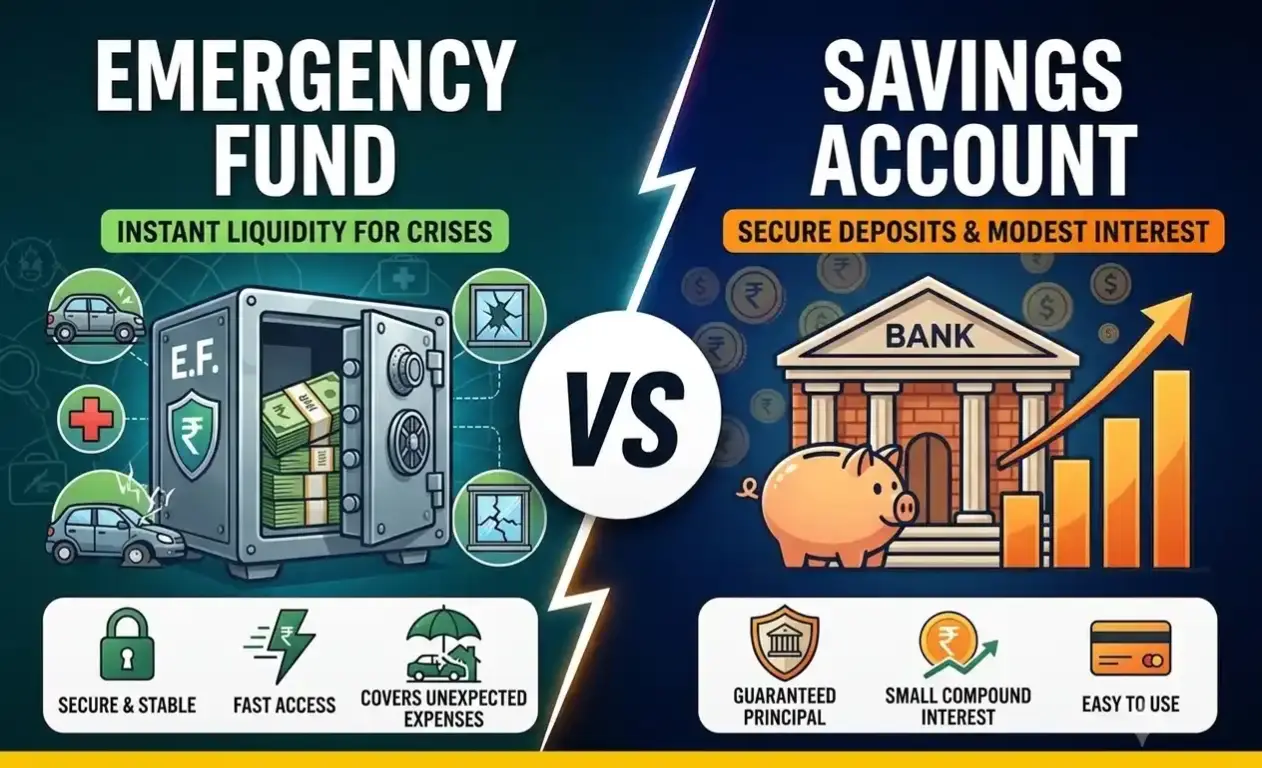
The important thing to understand is that an emergency fund and a savings account are not competing products. An emergency fund is money reserved for unexpected expenses, while a savings account is one of the places where you can keep that money.
In this guide, we’ll break down emergency fund vs savings account, how much you should keep aside, and the practical places where you can keep your emergency money in India—without sacrificing safety and easy access.
What You’ll Learn in This Guide
By the end of this guide, you’ll know:
- Emergency fund vs savings account — dono mein kya difference hai aur emergency money ke liye kya purpose hai.
- How much emergency fund you need — 3–6 months ke expenses ka target kaise calculate karein.
- Risks of keeping all your money in one account — low returns aur everyday spending ka emergency savings par kya effect ho sakta hai.
- Where to keep your emergency fund in India — savings account, sweep-in FD aur liquid mutual funds jaise options ko samjhenge.
- How to build an emergency fund with a low or irregular income — fixed salary na hone par bhi backup fund kaise banayein.
- Common emergency fund mistakes — PPF, ELSS ya ghar par bahut zyada cash rakhne jaise mistakes se kaise bachein.
- Practical FAQs — credit card aur digital gold ko emergency backup ke liye use karna chahiye ya nahi.
What Is an Emergency Fund and Why Do You Need It?
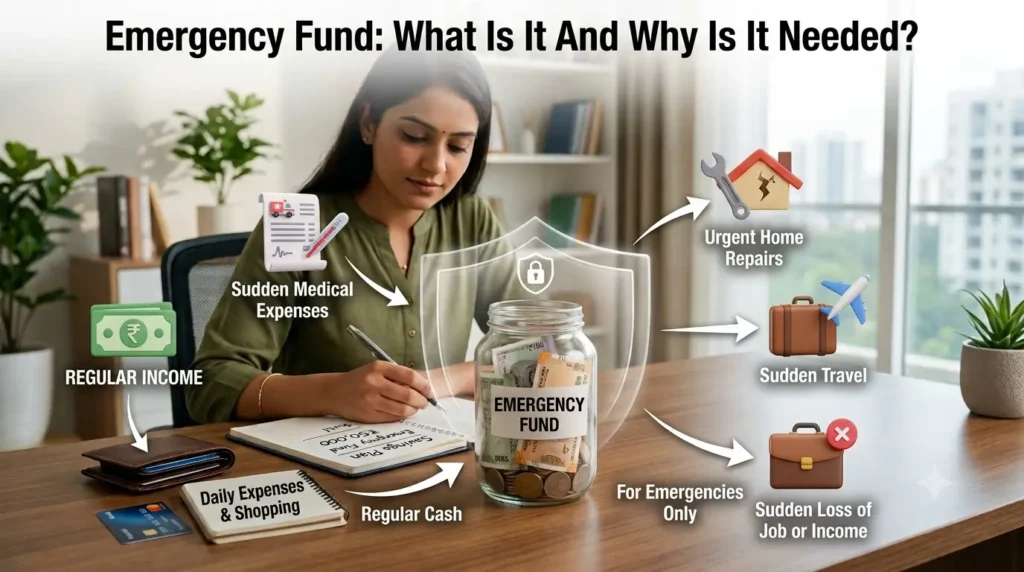
An emergency fund is money kept aside for unexpected expenses that can disturb your normal budget. It can help you handle things like a medical bill, urgent travel, essential repair, job loss, or a temporary income gap without immediately borrowing money.
Think of it as your financial safety net. Your regular income already has many jobs—food, rent, bills, transportation, savings and investments. An emergency fund is there for the expenses you didn’t see coming.
Emergency Fund vs Regular Savings: What’s the Difference?
The main difference between an emergency fund and regular savings is their purpose. Emergency savings are for unexpected problems, while regular savings are often used for planned expenses or goals.
For example, if you’re saving ₹40,000 for a laptop, that’s goal-based savings. But if you keep ₹60,000 aside in case your income stops temporarily or an unexpected expense appears, that’s your emergency fund.
| Money Type | Purpose | Example |
|---|---|---|
| Emergency fund | Unexpected expenses | Medical bill, job gap, repair |
| Regular savings | General saving | Money you’re building up |
| Goal savings | Planned expense | Laptop, education, travel |
| Investments | Long-term goals | Retirement, wealth building |
One important thing: an emergency fund doesn’t have to be a special financial product. You can keep it in a savings account. What makes it an emergency fund is the purpose you’ve given that money.
Can an Emergency Fund Be Kept in a Savings Account?
Yes, an emergency fund can be kept in a savings account, and a separate account can make it easier to avoid spending that money accidentally.
I learned this from my own saving habit too. Instead of keeping all my money in the account I used for everyday expenses, I started putting some money into a separate account. The amount wasn’t always big, but keeping it separate made me think twice before touching it.
Gradually, that separate balance became my backup money.
This is a simple idea that can work for beginners: when your income comes in, move a small amount into your emergency fund before you start spending on non-essential things.
For example, if you receive ₹25,000 and can comfortably save ₹2,000, you could move that ₹2,000 into your separate emergency savings account.
The U.S. Consumer Financial Protection Bureau also recommends keeping emergency savings specifically for unplanned expenses and notes that even a small amount can provide some financial security.
You can use our Budget Calculator to understand your monthly expenses and decide how much you can realistically save.
For eligible bank deposits in India, DICGC deposit insurance currently covers up to ₹5 lakh per depositor per bank, subject to its applicable rules.
How Many Months of Expenses Should You Save?
A common starting target is 3–6 months of essential expenses, but the right amount depends on your income, responsibilities and financial situation.
Use this simple formula:
Monthly essential expenses × Number of months = Emergency fund target
For example, if your essential expenses are ₹20,000 per month:
- 3 months = ₹60,000
- 6 months = ₹1,20,000
You don’t have to save ₹1.2 lakh immediately. Start with a smaller milestone:
₹10,000 → ₹25,000 → ₹50,000 → 3 months → 6 months
If your income is irregular, you may need a larger cushion because your monthly income can change. For example, if you earn ₹18,000 one month and ₹30,000 the next, you can save more during stronger months and a smaller amount during difficult months.
MoneyHelper in the UK also uses three to six months of essential outgoings as a common rule of thumb for emergency savings.
Why Is an Emergency Fund Important?
An emergency fund gives you money to fall back on when something unexpected happens, reducing the need to immediately borrow or disturb other financial goals.
Imagine you suddenly need ₹15,000.
Without an emergency fund, you might need to borrow, use a credit card, delay another payment, or sell an investment.
With an emergency fund, you can use part of your reserve and then rebuild it later.
That’s why the first priority of emergency money should be safety and accessibility, rather than chasing the highest possible return.
If you’re currently managing a tight budget, you can also read our guide on How to Budget When Living Paycheck to Paycheck on a Low Income.
Quick Emergency Fund Checklist
- ☐ I know my monthly essential expenses.
- ☐ I have started saving a separate emergency fund.
- ☐ I have calculated my initial target.
- ☐ I can access the money when a genuine emergency happens.
- ☐ I’m not treating the fund as normal spending money.
- ☐ I’m gradually working toward 3–6 months of essential expenses, if appropriate for my situation.
- ☐ I review the target when my income or expenses change.
You don’t need a huge amount to start. The important thing is to create the habit of keeping some money aside for the unexpected.
The Hidden Risks of Keeping All Your Emergency Cash in a Regular Savings Account
Keeping your emergency fund in a savings account is not automatically a bad idea. In fact, easy access and safety are more important than chasing high returns when it comes to emergency money.
The problem is usually not the savings account itself. The bigger issues are keeping your emergency money mixed with everyday spending money and ignoring how inflation affects its purchasing power.
If you’re still trying to understand where your money goes every month, you can first use our Budget Calculator to calculate your regular expenses.
Why Low Interest Rates Are Losing You Money to Inflation
When your savings earn less than the rate at which prices are rising, your money can lose purchasing power over time. Your account balance may stay the same or increase slightly, but the same amount may buy fewer things later.
For example, imagine you keep ₹1,00,000 in a savings account for several years.
If the interest you earn is lower than inflation, the ₹1,00,000 may not have the same purchasing power in the future. This is why simply looking at your account balance doesn’t tell the whole story.
The U.S. Bureau of Labor Statistics tracks changes in consumer prices through the Consumer Price Index (CPI), which is one way economists measure inflation.
But this does not mean you should put your emergency fund into risky investments just to beat inflation.
Your emergency fund has a different job.
Think about its priorities like this:
- Safety
- Easy access
- Reasonable return
- Higher return only when the first two aren’t compromised
The Consumer Financial Protection Bureau recommends keeping emergency savings somewhere safe and accessible because the money may be needed when an unexpected expense occurs.
So instead of asking only:
“Where can I get the highest return?”
Ask:
“Where can I keep this money safe and access it quickly when I actually need it?”
That question is much more useful when you’re dealing with an emergency fund.
The Temptation of Impulse Spending with Debit Cards
Keeping your emergency fund in the same account you use for everyday spending can make it easier to spend the money without realising it.
Suppose your bank balance shows ₹80,000.
You know that ₹50,000 of it is actually your emergency fund, but the entire amount is sitting in the same account you use for UPI payments, shopping, food and entertainment.
Then you see something you want to buy.
Your brain sees:
“I have ₹80,000.”
But your actual spending money is only ₹30,000.
This is one reason a separate emergency savings account can be useful. You can still access the money when there’s a genuine emergency, but it isn’t constantly sitting in front of you while you’re making everyday purchases.
The CFPB also discusses keeping emergency savings in a dedicated place that is safe and accessible while reducing the temptation to spend it on non-emergency purchases.
A simple setup could look like this:
- Main account: salary, UPI, bills and daily expenses
- Emergency fund: unexpected expenses only
- Goal savings: laptop, education, travel or other planned purchases
- Investments: long-term financial goals
This separation doesn’t have to be complicated.
For example, if you receive ₹25,000, you might decide that ₹2,000 goes toward your emergency fund, while the remaining money is used for your regular budget and other goals.
The exact amount will depend on your income and expenses. The important part is giving your emergency money a clear purpose.
If you’re managing several financial goals at the same time, our guide on How to Organize Multiple Savings Goals Before 2027 can help you separate different savings targets instead of mixing everything together.
How to Keep Your Emergency Fund Accessible Without Making It Easy to Spend
The simplest approach is to keep your emergency money separate from your everyday spending account while making sure you can still access it when a genuine emergency happens.
For example, suppose your essential expenses are ₹30,000 per month.
A 3-month starter target would be:
₹30,000 × 3 = ₹90,000
Instead of keeping that ₹90,000 mixed with your normal spending balance, you could keep it in a separate suitable account or another low-risk, accessible option.
This gives your money a specific job:
Everyday account → Spend
Emergency account → Protect
Investment account → Grow for long-term goals
And if you ever have to use the emergency fund, that’s exactly what it is there for. You can then rebuild it gradually.
If your current income is tight and saving feels difficult, our guide on How to Budget When Living Paycheck to Paycheck on a Low Income can help you find room in your budget before setting a larger emergency-fund target.
A Simple Rule to Remember
Don’t choose an emergency-fund option only because it offers a higher return. Choose a place where your money is reasonably safe, accessible and less likely to be spent accidentally.
Your emergency fund isn’t designed to make you rich.
Its job is to make an unexpected financial problem easier to handle.
3 Best and Safest Places to Keep Your Emergency Fund in India
The best place for an emergency fund should give you two things: easy access and reasonable safety. You don’t necessarily need to keep the entire fund in one account. You can divide it between a regular savings account and another low-risk option depending on how much money you have.
1. Sweep-in Fixed Deposits: A Balance Between Liquidity and Returns
A sweep-in fixed deposit can be useful for keeping part of your emergency fund while still having relatively easy access to the money.
For example, suppose you have a ₹1 lakh emergency fund. You could keep ₹30,000 in a savings account for immediate expenses and place the remaining ₹70,000 in a sweep-in FD, depending on the bank’s rules and terms.
The advantage is that the FD portion may earn more interest than money sitting entirely in a normal savings account. When you need money, the linked sweep facility may automatically break the required portion of the FD, depending on the bank’s conditions.
However, don’t assume every sweep-in FD works the same way. Check the bank’s rules for minimum balance, premature withdrawal, sweep limits, interest calculation and how quickly the money becomes available.
Also, eligible bank deposits such as savings and fixed deposits are covered by DICGC deposit insurance up to ₹5 lakh per depositor per bank, subject to the applicable rules.
Best suited for: People who already have some emergency savings and want part of it to earn more while keeping access reasonably convenient.
2. A Separate Savings Account from a Scheduled Bank
A separate savings account is one of the simplest ways to keep an emergency fund away from your everyday spending money.
For example:
- Main account → salary, UPI and regular expenses
- Emergency account → medical bills, job gap and urgent repairs
- Goal account → travel, education or a future purchase
This separation can make your emergency fund easier to protect because you are less likely to accidentally spend it on everyday purchases.
Before opening a separate account, compare things such as interest rate, minimum balance requirements, account charges, ATM/UPI access and withdrawal convenience.
If you’re keeping a larger amount in bank deposits, also understand the DICGC limit. Deposits in different accounts at the same bank and same ownership capacity are generally aggregated when calculating the ₹5 lakh insurance limit. Deposits held with different banks have separate coverage limits.
You can also use your Budget Calculator to estimate your monthly essential expenses and work out how much emergency money you need.
Best suited for: Beginners who want a simple, accessible and easy-to-manage emergency fund.
3. Liquid Mutual Funds: An Option to Understand Carefully
Liquid mutual funds can be considered for some short-term money, but they should not be treated as the same thing as a bank savings account or FD.
A liquid mutual fund invests in short-term money-market and debt instruments. Its value can change, and mutual funds are not covered by DICGC deposit insurance. DICGC specifically lists mutual funds among the products that are not covered by its deposit insurance scheme.
SEBI’s investor disclosures also make clear that mutual fund investments involve investment risks and that returns are not guaranteed.
So, if you’re building your first emergency fund, you don’t need to move everything into a liquid mutual fund just to chase a potentially higher return. The first priority should be having money available when you genuinely need it.
If you already have a well-built emergency fund and understand how liquid mutual funds work, you can decide whether they fit a portion of your short-term money.
Best suited for: Someone who understands mutual funds and wants to consider a separate short-term investment option—not someone looking for a guaranteed emergency-fund product.
Which Option Should You Choose?
| Option | Access | Main Benefit | Important Limitation |
|---|---|---|---|
| Separate savings account | Very easy | Simple and accessible | Interest may be modest |
| Sweep-in FD | Relatively easy | Combines FD with linked access | Bank-specific conditions |
| Liquid mutual fund | Through redemption | Potential short-term return | Market-linked and not DICGC-insured |
For most beginners, the important thing isn’t finding the option with the highest possible return. Your emergency money exists for one reason: to be available when something unexpected happens.
If you’re still building your first emergency fund, start small and make the habit automatic. You can later increase the amount as your income grows.
You can also read How to Organize Multiple Savings Goals Before 2027 if you are saving for an emergency fund along with other financial goals.
And if your income is currently tight, How to Budget When Living Paycheck to Paycheck on a Low Income can help you find room in your monthly budget for emergency savings.
How to Connect Your Emergency Fund with Your Budgeting Strategy?
Your emergency fund works best when it is built into your regular budget instead of being treated as something you will save only when extra money is left over. Even a small amount saved consistently can gradually create a useful financial cushion.
The RBI’s financial education material recommends keeping an emergency fund in a separate, easily accessible savings account and building it gradually if you cannot fund the entire amount at once.
For example, if you earn ₹20,000 per month, you don’t have to wait until you can save ₹60,000 or ₹1 lakh. You could start with ₹500, ₹1,000, or whatever amount your budget can comfortably handle.
Applying the Cash Stuffing Method for Emergency Cash
The cash stuffing method can help you control everyday spending, but your main emergency fund does not need to be kept as physical cash at home.
Cash stuffing usually means dividing your spending money into separate categories so you know how much you can spend on things such as groceries, transport, entertainment and other expenses.
You can use the same idea digitally for your emergency fund.
For example:
| Money Category | Example Amount |
|---|---|
| Monthly expenses | ₹15,000 |
| Emergency fund | ₹2,000 |
| Short-term goals | ₹1,500 |
| Flexible spending | ₹1,500 |
Instead of putting ₹2,000 into an envelope and keeping it at home, you could transfer it to a separate savings account labelled for emergencies.
This gives you the psychological benefit of separating your money without keeping a large amount of cash physically at home.
The CFPB also recommends keeping emergency savings somewhere that is safe, accessible and less tempting to spend on non-emergency purchases.
If you want to learn the complete budgeting technique, you can also read our Cash Stuffing Method guide.
How to Build a Backup Fund with an Irregular Income
If your income changes every month, use a flexible savings target instead of forcing yourself to save the exact same amount every month.
For example, imagine your income looks like this:
- January: ₹18,000
- February: ₹25,000
- March: ₹14,000
- April: ₹30,000
Saving ₹5,000 every month may not be realistic. Instead, you could save a smaller amount during low-income months and put more aside when your income is higher.
For example:
| Monthly Income | Possible Emergency Saving |
|---|---|
| ₹14,000 | ₹500 |
| ₹18,000 | ₹1,000 |
| ₹25,000 | ₹2,000 |
| ₹30,000 | ₹3,000 |
These are only examples—not fixed rules. Your actual amount should depend on your essential expenses and what your budget can comfortably handle.
The CFPB specifically notes that people with fluctuating income can use cash-flow management and save more during periods when they have extra money available.
You can also use our Budget Calculator to estimate your monthly expenses and see how much you can realistically put toward your emergency fund.
If your income changes frequently, our guide How to Budget with an Irregular Income can also help you build a more flexible monthly plan.
A Simple Emergency-Fund Budget Rule
A simple approach is to treat your emergency fund as a regular budget category.
For example:
Income → Essential expenses → Emergency savings → Other goals → Flexible spending
You don’t have to start with a large amount. The important part is creating a system that you can repeat.
Once your emergency fund reaches your first target—perhaps ₹10,000 or ₹25,000—you can continue building it toward several months of essential expenses.
And if you ever need to use the fund, that’s exactly what it is there for. After the emergency is handled, make rebuilding the fund one of your next savings priorities.
This approach turns your emergency fund from a one-time goal into a habit that becomes part of your overall budgeting system.
Common Emergency Fund Mistakes to Avoid
Building an emergency fund is a great step, but where and how you keep the money matters too. Some common mistakes can make your emergency fund difficult to access when you actually need it.
Here are two mistakes beginners should avoid when setting up an emergency backup.
Locking Your Money in Long-Term Investments Like PPF or ELSS
Your main emergency fund should generally not be locked into long-term investments such as PPF or ELSS, because an emergency can happen before the money becomes easily accessible.
PPF is designed as a long-term savings scheme. The account has a 15-year maturity period, although certain withdrawals and other facilities are available under specific conditions. (indiapost.gov.in)
ELSS mutual funds have a 3-year lock-in period for each investment. That means you cannot simply redeem your ELSS investment whenever you want during the applicable lock-in period. SEBI also describes mutual funds as market-linked investments where returns are not guaranteed. (sebi.gov.in)
Imagine you suddenly need ₹30,000 for an urgent expense. If that money is sitting inside a product with access restrictions, you may have to find another source of money.
That’s why it helps to separate your financial goals:
| Money | Suitable Purpose |
|---|---|
| Emergency fund | Unexpected expenses |
| PPF | Long-term savings |
| ELSS | Long-term investment/tax-saving goals |
| Goal savings | Planned expenses |
| Other investments | Long-term wealth building |
Your emergency fund doesn’t need to generate the highest possible return. Accessibility and safety are more important for money you may need unexpectedly.
If you’re working toward several goals at the same time, our guide on How to Organize Multiple Savings Goals Before 2027 can help you separate emergency savings from other goals.
Keeping Too Much Physical Cash at Home
Keeping a small amount of cash for immediate needs can be practical, but your entire emergency fund should generally not be stored as physical cash at home.
For example, keeping ₹2,000–₹5,000 at home for situations where digital payments aren’t available may be different from keeping ₹1 lakh in cash at home.
Large amounts of physical cash can be exposed to risks such as theft, loss, fire or simply being forgotten or spent. It also doesn’t earn interest while sitting unused.
A better approach can be to keep a small cash buffer for immediate situations and store the larger emergency fund in an appropriate separate bank account or other suitable accessible option.
For bank deposits, DICGC provides deposit insurance up to ₹5 lakh per depositor per bank, subject to the applicable rules. This is another reason to understand how your bank deposits are covered rather than assuming every type of financial product has the same protection. (dicgc.org.in)
A Simple Way to Avoid Both Mistakes
You can keep your money organised into three simple buckets:
1. Immediate cash: A small amount for situations where cash is necessary.
2. Emergency fund: Money kept in an easily accessible, suitable savings option for unexpected expenses.
3. Long-term investments: Money invested for goals that are years away.
This separation makes your financial system easier to understand and reduces the chance of using long-term investments for short-term emergencies.
And remember, an emergency fund is not supposed to make you rich. Its job is to protect your financial plan when life doesn’t go according to plan.
A common starting target is 3–6 months of essential living expenses. But you don’t have to reach that amount immediately.If your essential expenses are ₹20,000 per month, a 3-month emergency fund would be ₹60,000, while 6 months would be ₹1.2 lakh. If that feels too large, start with a smaller target such as ₹10,000 or ₹25,000 and build it gradually.
Keep your emergency fund somewhere safe and easily accessible, such as a separate savings account or another suitable low-risk option.The main goal is not to get the highest possible return. You want the money to be available when an unexpected expense happens without taking unnecessary investment risk.
You don’t necessarily have to keep the entire emergency fund in one account. You can keep some money immediately accessible in a savings account and use another suitable option for the remaining amount, depending on your needs.For larger bank deposits, remember that DICGC deposit insurance has an applicable limit of ₹5 lakh per depositor per bank, subject to its rules.
Conclusion: Take the First Step Towards Financial Peace of Mind
An emergency fund is one of the simplest ways to protect yourself from unexpected financial problems. Whether it’s a medical expense, urgent repair, sudden travel, or a temporary loss of income, having money set aside can help you handle these situations without immediately depending on credit or loans.
The key is to understand that an emergency fund is different from your regular savings goals. Your emergency money should be kept separate, easily accessible, and in a place where you can use it when you genuinely need it.
For many people, a separate savings account can be a simple starting point. A sweep-in FD can be considered for part of the fund, while liquid mutual funds are an option that should be understood carefully because they are market-linked and not the same as bank deposits.
You also don’t need to build your emergency fund overnight. Start with whatever amount your budget allows and gradually work toward 3–6 months of essential expenses. If your income is irregular, adjust your contribution according to your income instead of forcing yourself to save the same amount every month.
Most importantly, avoid common mistakes such as locking your emergency money into long-term investments or keeping a large amount of physical cash at home.
Start small, keep it separate, and keep building it. A well-planned emergency fund may not feel exciting, but when an unexpected expense arrives, it can give you something much more valuable: financial breathing room.
- Emergency Fund vs Savings Account: Where to Keep Your Backup Cash in 2026?
- How to Organize Multiple Savings Goals Before 2027: A Simple Money Plan
- Cash Stuffing Method for Beginners: A Simple Step-by-Step Guide
- How to Budget When Living Paycheck to Paycheck
- How to Divide Your Salary for Beginners: Complete Guide With Examples