
Learning the essential principles of flat vs reducing rate is critical for anyone looking to build healthy money habits, avoid debt traps, and make smart financial decisions in India.
Learning the mechanics of flat vs reducing rate loans is essential for anyone borrowing funds, financing electronics, or buying vehicles in India. Specifically, many NBFC sales executives advertise 10% flat rates, yet consumers ultimately pay an effective 18.5% borrowing cost.
Never compare flat rates with reducing rates directly. In fact, a 10% flat rate is equivalent to approximately 18.5% reducing APR. Consequently, always demand the official Key Fact Statement before signing any credit contract.
Additionally, table of Contents
1. What is a Flat Rate and How Does It Compare in a Flat vs Reducing Rate Loan?
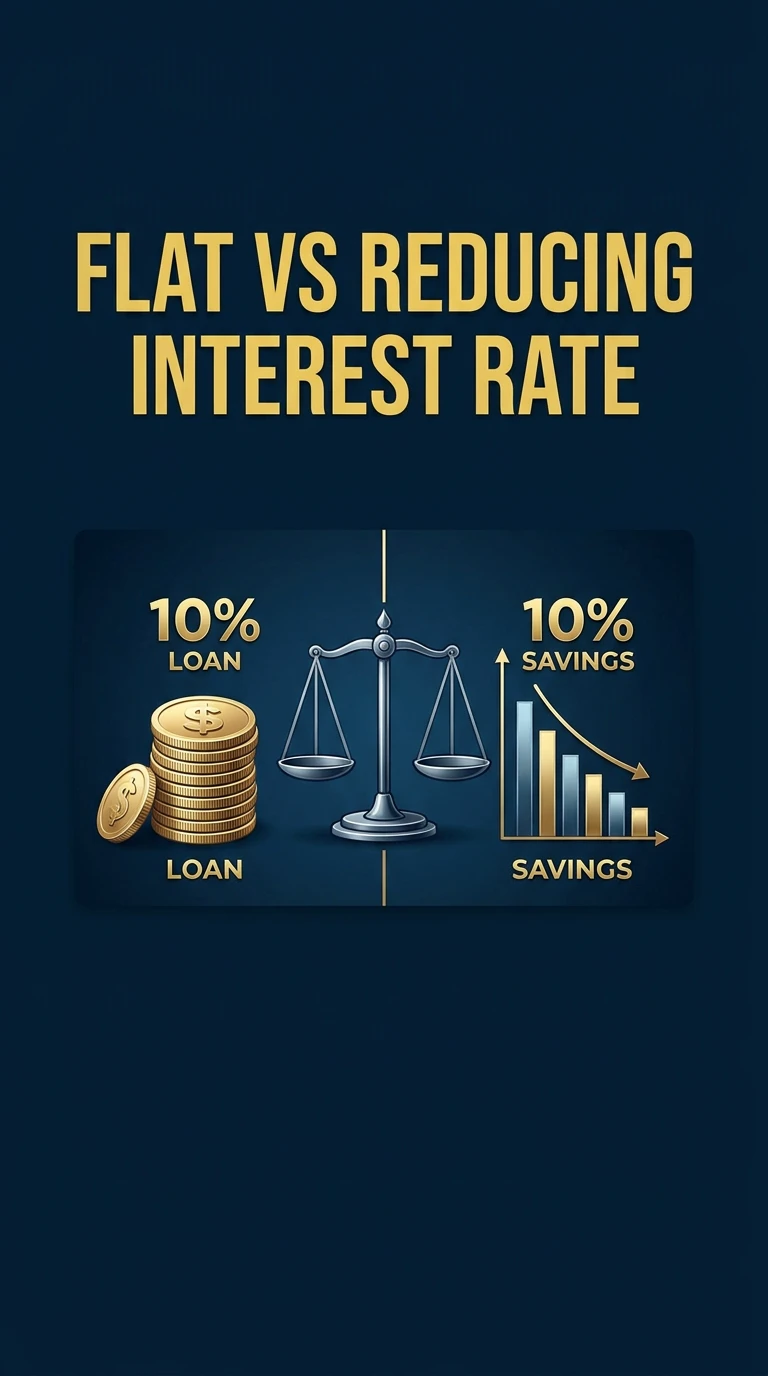
To begin with, a flat interest rate calculates loan interest on the entire original principal for the full duration of your tenure. Specifically, even when you have paid off 90% of your borrowed money, the lender continues charging interest on the original sanction amount.
Furthermore, because the principal balance never decreases in the calculation formula, you pay substantially higher total rupees. In contrast, borrowers mistakenly assume that a 10% flat interest offer from an NBFC is cheaper than a 14% reducing loan from a public sector bank.
Furthermore, for instance, imagine taking a ₹1,00,000 personal loan for 3 years at a 10% flat interest rate. Consequently, you pay ₹10,000 in interest every year, totaling ₹30,000 across the loan term, irrespective of your monthly payments.
2. What is a Reducing Rate in the Flat vs Reducing Rate Equation?
In contrast to flat structures, a reducing interest rate charges interest solely on the outstanding principal balance remaining at the end of each billing cycle. Therefore, each monthly EMI payment contains two clear components: an interest portion and a principal repayment portion.
Specifically, as you make your scheduled monthly installments, your principal balance drops systematically. Consequently, the interest component decreases every single month, while the principal component rises.
Additionally, modern banks and housing finance corporations follow this diminishing balance method mandated by the Reserve Bank of India (RBI). In fact, this system ensures fair treatment, because borrowers only pay interest on funds they are currently utilizing.
3. Real Rupee Comparison: The ₹2,00,000 Flat vs Reducing Rate Showdown
To understand the monetary difference clearly, let us analyze a realistic ₹2,00,000 loan taken for 24 months (2 years) at a quoted 10% rate. Specifically, this side-by-side comparison reveals the exact rupee impact on your household budget.
| Loan Parameter | 10% Flat Rate Scheme | 10% Reducing Balance Scheme | Financial Difference |
|---|---|---|---|
| Loan Principal Amount | ₹2,00,000 | ₹2,00,000 | Exact Same |
| Repayment Tenure | 24 Months (2 Years) | 24 Months (2 Years) | Exact Same |
| Monthly EMI Payout | ₹10,000 | ₹9,229 | Save ₹771 / Month |
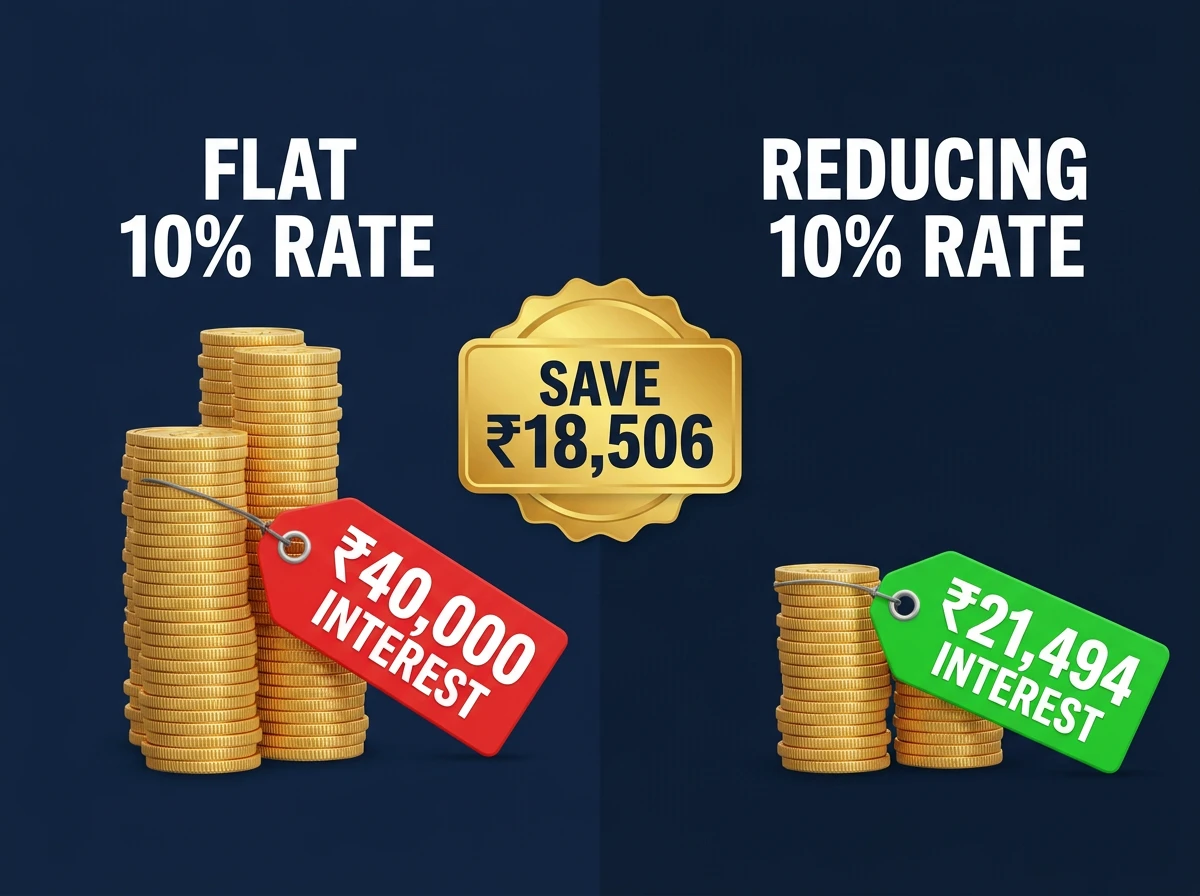
| Total Interest Paid | ₹40,000 | ₹21,494 | Save ₹18,506 Pure Cash! |
| Effective True APR | ~18.5% Reducing APR | 10.0% Reducing APR | 8.5% Real Rate Gap |
For example, as demonstrated in the comparison table, the flat rate scheme forces the borrower to hand over an additional ₹18,506 in pure interest. Consequently, clearly, paying ₹40,000 on a ₹2,00,000 loan over two years represents an effective APR of roughly 18.5%, completely shattering the illusion of cheap borrowing.
Furthermore, before committing to any loan, test your own monthly numbers with our free interactive PaisaKmao Loan EMI Calculator to verify exact principal and interest schedules.
4. The Quick Conversion Formula: Flat vs Reducing Rate
Furthermore, evaluating loans while standing in an electronics showroom or bike dealership requires a quick mental calculation. In addition, fortunately, financial analysts use an accurate rule of thumb to translate flat rates into true reducing numbers.
Consequently, true Reducing Rate ≈ Quoted Flat Rate × 1.85
In addition, for example, if a car dealer quotes a 7% flat rate, multiply 7 by 1.85. The real borrowing cost is approximately 12.95% reducing interest.
Moreover, the exact mathematical conversion formula relies on the internal rate of return (IRR). Specifically, because the average outstanding balance over the tenure is roughly half of the original principal, the true interest rate almost doubles.
In addition, choosing a flat vs reducing rate without running this multiplier leads to major financial leaks. Consequently, smart consumers never accept flat figures at face value.
5. Where Unregulated Lenders Hide Flat Interest Traps
Similarly, understanding the market landscape protects your pocketbook from aggressive sales pitches. Specifically, flat interest models rarely appear in home loans, but they remain rampant across specific high-margin retail segments in India:
- Two-Wheeler & Bike Financing: Dealerships frequently advertise “Only 6.5% interest” on popular scooters. In reality, that 6.5% flat rate translates into an exorbitant 12.2% reducing APR.
- Consumer Durable No-Cost EMI Tricks: When purchasing smartphones or laptops, zero-cost promotions often hide upfront processing fees or subvention costs that mirror flat charges.
- Used Car Dealerships: Second-hand automobile dealers predominantly quote flat rates to mask high risk premiums on aging vehicles.
- Quick Instant Cash Apps: Instant credit apps often quote monthly flat rates like “Just 2% per month”, which actually amounts to an astronomical 42% annualized reducing rate.
Therefore, if you are a student or young earner seeking safe credit without predatory traps, explore our guide on the Best RuPay Credit Card for Students Without Income Proof to build credit history safely.
6. RBI Mandatory Rules on KFS and APR Transparency
However, fortunately, the Reserve Bank of India has introduced strict consumer protection directives under its Fair Practices Code. Specifically, all commercial banks, cooperative institutions, and non-banking financial companies (NBFCs) must follow clear transparency standards:
- Mandatory Key Fact Statement (KFS): Lenders are legally required to provide a standardized, one-page KFS document prior to executing any loan contract.
- Prominent APR Disclosure: The KFS must state the Annual Percentage Rate (APR) in clear, bold typography, encompassing all processing charges, verification fees, documentation costs, and insurance premiums.
- Cooling-off Grace Period: Borrowers are entitled to an explicit look-up period during which they can exit the loan without penalty by simply returning the principal amount.
Therefore, whenever a lending agent pitches an attractive flat interest rate, simply request their standardized Key Fact Statement. Consequently, looking at the official APR row immediately exposes the real borrowing cost without guesswork.
Furthermore, consumers who spot deceptive calculations can file formal grievances through the RBI Banking Ombudsman portal. As a result, commercial lenders must resolve complaints within 30 days.
Plan Your Monthly Debt and Savings Budget
Therefore, learn how to allocate salary, prevent EMI debt traps, and save consistently with our 50/30/20 budget tool.
7. Frequently Asked Questions (FAQ)
In fact, lenders promote flat rates because the nominal percentage sounds significantly cheaper to uninformed retail consumers. Specifically, a 9% flat rate seems more enticing than an 11% reducing rate, even though the flat rate actually costs the borrower far more money.
In most flat rate contracts, early repayment provides minimal interest savings because lenders calculate the entire tenure’s interest upfront. In contrast, under RBI guidelines for reducing personal loans, floating-rate personal loans cannot carry prepayment penalties.
Particularly, simply ask the lender for their official RBI Key Fact Statement (KFS) or run the loan amount, tenure, and quoted EMI through the Excel RATE formula: =RATE(nper, -pmt, pv)*12. Consequently, this formula instantly outputs the true annualized reducing interest rate.
Written & Researched by Asif Khan

Moreover, over 4 years of active personal finance research in Indian markets. In fact, focused on transparent, math-backed guides to help students and young professionals build wealth and manage money smartly.
Disclaimer: This guide on flat vs reducing rate loans is published strictly for financial literacy and educational awareness. Specifically, PaisaKmao.de is not a licensed banking entity or registered loan distributor. Always review official loan sanction letters and consult certified financial planners before entering legally binding credit obligations.
1 thought on “Flat vs Reducing Rate: Why 10% Flat Rate Is Actually 18.5% APR (2026)”