
How to Budget with an Irregular Income: Step-by-Step Guide (2026)

Colorful illustration showing the best budgeting method for irregular income with a step-by-step financial planning system, savings, budgeting, investing, and money management concepts.

introduction

How to Budget with Managing money becomes difficult when your income is not the same every month. Unlike salaried employees who receive a fixed paycheck, people with irregular income often face uncertainty — one month can bring high earnings, while the next month may be much lower.

The biggest challenge is not only earning money; it is creating a system that works when your income changes.

Many people with irregular income make the mistake of spending more during good months and struggling during slow months. Without a proper budgeting system, even a good income can disappear quickly.

This is where irregular income budgeting becomes important.

Instead of creating a budget based on your highest earning month, you need a flexible system that helps you manage expenses, save money, and prepare for unpredictable income.

In this guide, you will learn a practical step-by-step method to create a budget for irregular income, including how to calculate your minimum monthly expenses, manage variable spending, build an income buffer, and create a stable financial plan.

Whether you are a freelancer, self-employed professional, business owner, content creator, or anyone with changing income, this guide will help you take control of your money.

Before starting your budgeting system, understanding your financial goals and current money habits is also important. You can also read:
Why Can’t I Save Money? 5 Hidden Reasons You’re Still Broke (Even With a Good Salary).

Now let’s start with the first and most important step: calculating your Minimum Monthly Expenses (Survival Budget).

What You Will Learn in This Guide

In this complete guide to budgeting with irregular income, you will learn:

  • How to calculate your minimum monthly expenses.
  • How to create a Survival Budget that works during low-income months.
  • How to separate essential expenses from unnecessary spending.
  • How to manage variable income without financial stress.
  • How to build an income buffer for unpredictable months.
  • How to create a long-term money management system.

This guide focuses on practical strategies that you can apply immediately, not just general budgeting advice.

Whether your income changes every week, every month, or seasonally, these methods will help you create a flexible financial system.

Now let’s start with the first step: calculating your Minimum Monthly Expenses (Survival Budget).

Step 1: Calculate Your Minimum Monthly Expenses (Survival Budget)
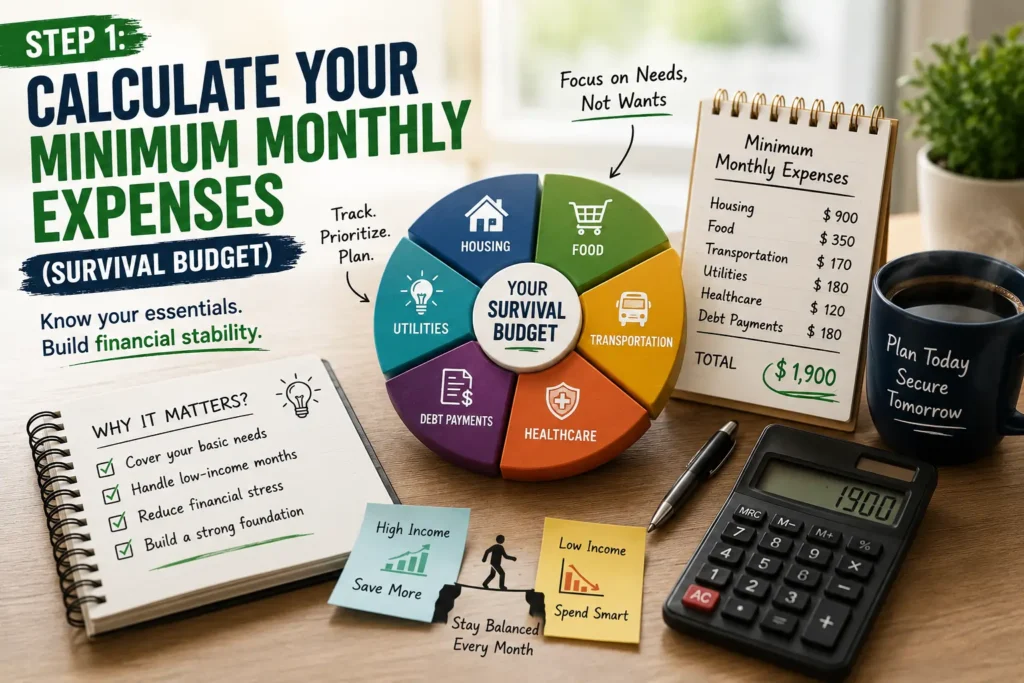
When your income changes every month, the first step is not deciding how much you should spend — it is understanding the minimum amount of money you actually need to run your life.

This amount is called your Survival Budget.

Your Survival Budget is the foundation of an effective irregular income budgeting system. It tells you the minimum money required to cover your essential expenses before you spend on lifestyle choices, entertainment, or other non-essential things.

For freelancers, self-employed professionals, business owners, and anyone with variable income, this system creates financial stability because you stop depending on your best earning months.


Why Your Survival Budget Is Important

Many people with irregular income follow an unstable money pattern:

High-income month → Spend more → Low-income month → Financial stress

The problem is not always income. The problem is not knowing your minimum financial requirement.

A Survival Budget helps you understand:

  • The minimum income you need every month.
  • Which expenses must be protected first.
  • How much extra money you can save or invest.
  • How to prepare for months when income is lower.

For example, if your minimum monthly expenses are $1,800, then your first financial target is not buying luxury items or increasing your lifestyle — it is securing that $1,800 amount first.

According to the
Consumer Financial Protection Bureau (CFPB),
creating a realistic budget helps people understand their spending and make better financial decisions.


The Survival Budget Formula

You can calculate your Survival Budget using this simple formula:

Survival Budget = Fixed Expenses + Essential Variable Expenses + Minimum Debt Payments

Fixed Expenses

These expenses usually remain the same every month:

  • Rent or mortgage
  • Insurance
  • Phone and internet bills
  • Loan payments

Essential Variable Expenses

These expenses change but are necessary:

  • Groceries
  • Transportation
  • Electricity
  • Healthcare
  • Household needs

Minimum Financial Payments

Include all payments you cannot skip:

  • Credit card minimum payments
  • Loan installments
  • Other required payments

How to Calculate Your Minimum Monthly Expenses

1. Review Your Last 3–6 Months Spending

The first step is understanding your real spending pattern.

Check:

  • Bank statements
  • Payment apps
  • Credit card history
  • Expense tracking records

Write down every expense, including small purchases.

Many people underestimate small expenses because they seem insignificant. However, repeated small spending can reduce your savings significantly over time.


2. Separate Needs From Wants

After collecting your expenses, divide them into two categories.

Essential Expenses (Needs)

These are expenses required for your basic lifestyle:

  • Housing
  • Food
  • Utilities
  • Transportation
  • Healthcare
  • Insurance

Non-Essential Expenses (Wants)

These expenses are optional:

  • Eating outside
  • Entertainment
  • Shopping
  • Premium subscriptions
  • Luxury purchases

Reducing unnecessary expenses does not mean removing all enjoyment. It means creating space for your important financial goals.

If you struggle with unnecessary spending, you can also read:How to Manage Your Salary: A Complete Day 1 to Day 30 Money Plan (2026)


Example: Calculating Your Survival Budget

Imagine your monthly essential expenses are:

CategoryAmount
Rent$800
Food$300
Utilities$150
Transportation$150
Insurance$100
Debt Payment$200
Total Survival Budget$1,700

Your Survival Budget is $1,700 per month.

This means you need at least $1,700 before spending money on optional things.

Any income above this amount can be used for:

  • Emergency savings
  • Investments
  • Debt reduction
  • Future low-income months

Common Mistakes To Avoid

Avoid these mistakes while creating your Survival Budget:

  • Planning your lifestyle around your highest income month.
  • Ignoring small recurring expenses.
  • Spending extra income immediately.
  • Not tracking your monthly cash flow.
  • Mixing business and personal expenses.

A proper Survival Budget protects you from financial uncertainty and gives you more control over your money.


Action Plan: Create Your Survival Budget Today

Follow these steps:

✅ Review your last 3–6 months of expenses.
✅ Write down every monthly cost.
✅ Separate needs and wants.
✅ Add only essential expenses.
✅ Calculate your Survival Budget number.
✅ Use this number as the base of your irregular income budget.

Once you know your Survival Budget, the next step is to calculate your Baseline Income — the income level you should target to create a stable financial system even when your earnings change every month.

Step 2: Calculate Your Baseline Income

Once you know your Survival Budget, the next step is to calculate your Baseline Income. This is one of the most important parts of budgeting with irregular income because it gives you a realistic income target instead of relying on your best earning month.

Many people make the mistake of planning their budget around the highest amount they have ever earned. For example, if you earned $5,000 last month, it’s easy to assume you’ll earn the same again. But irregular income rarely works that way. Some months are excellent, while others are much slower.

Your Baseline Income is the amount you can reasonably expect to earn on a consistent basis. It becomes the foundation for your monthly budget, savings plan, and financial decisions. Instead of chasing unpredictable numbers, you build your budget around a realistic average that keeps your finances stable throughout the year.

Why Your Baseline Income Matters

A Baseline Income helps you answer one simple question:

“How much money can I safely plan to spend every month?”

Without knowing this number, it becomes easy to overspend during good months and struggle during slow months.

A realistic Baseline Income helps you:

  • Create a stable monthly budget.
  • Avoid lifestyle inflation.
  • Plan savings with confidence.
  • Reduce financial stress during low-income months.
  • Make better long-term financial decisions.

According to the Consumer Financial Protection Bureau (CFPB), tracking your income over time helps you build a more accurate and sustainable budget.

How to Calculate Your Baseline Income

1. Collect Your Income Records

Start by gathering your income from the last 6–12 months.

This may include:

  • Client payments
  • Freelance income
  • Business revenue
  • Commission earnings
  • Side hustle income
  • Part-time work

The longer the time period you review, the more accurate your Baseline Income will be.

2. Calculate Your Average Monthly Income

Add all your income from the past 6–12 months and divide it by the number of months.

Formula:

Baseline Income = Total Income ÷ Number of Months

Example:

MonthIncome
January$3,500
February$2,400
March$4,100
April$2,800
May$3,200
June$3,000

Total Income = $19,000

Baseline Income = $19,000 ÷ 6 = $3,166

Instead of budgeting as if you’ll earn $4,100 every month, you should build your budget around $3,166, because it reflects your average earning pattern.

Don’t Budget Using Your Best Month

One of the biggest financial mistakes is treating your highest-income month as your normal income.

A better strategy is:

  • Budget using your Baseline Income.
  • Save extra income during high-earning months.
  • Use those savings to support low-income months.

This simple system creates consistency, even when your income is unpredictable.

If you often find that your income disappears quickly despite earning well, you may also find this guide helpful: Why Can’t I Save Money? 5 Hidden Reasons You’re Still Broke (Even With a Good Salary).

Action Plan

Before moving to the next step, complete these tasks:

  • ✅ Review your last 6–12 months of income.
  • ✅ Add every income source.
  • ✅ Calculate your average monthly income.
  • ✅ Use this number as your Baseline Income.
  • ✅ Ignore unusually high-income months when creating your budget.

Next Step: Now that you know your Baseline Income, the next step is to prioritize your expenses using a flexible budgeting system that works even when your income changes every month.

Step 3: Prioritize Essential Expenses First

Now that you know your Survival Budget and Baseline Income, it’s time to decide where your money should go first.

One of the biggest reasons people with irregular income struggle financially is not because they earn too little—but because they spend money in the wrong order.

Many people pay for shopping, entertainment, subscriptions, or lifestyle upgrades as soon as they receive income. Later, when rent, groceries, or utility bills are due, they find themselves short of cash.

A better approach is to prioritize your expenses based on importance, not urgency.

This simple habit ensures that even during a low-income month, your essential needs are always covered before you spend money on anything optional.

Why Prioritizing Expenses Is So Important

When your income changes every month, you cannot afford to treat every expense equally.

Some expenses keep your life running, while others simply make life more enjoyable.

If you pay for optional expenses before covering your basic needs, you’ll constantly feel financial pressure.

By prioritizing your expenses, you can:

  • Always pay your essential bills first.
  • Reduce financial stress during slow months.
  • Avoid relying on credit cards or loans.
  • Build better money habits.
  • Create a stable financial system even with unpredictable income.

According to the Consumer Financial Protection Bureau (CFPB), a successful budget should focus on covering essential expenses before discretionary spending.

The 4-Level Expense Priority System

Instead of treating every expense equally, organize your spending into four priority levels.

Level 1: Essential Living Expenses (Highest Priority)

These are the expenses you must pay first because they directly affect your daily life.

Examples include:

  • Rent or mortgage
  • Groceries
  • Electricity, water, and gas
  • Transportation
  • Healthcare
  • Insurance
  • Minimum debt payments

If your income is lower than expected this month, these expenses should still be fully funded.

Level 2: Financial Protection

After covering your essential expenses, the next priority is protecting your future.

This includes:

  • Emergency fund contributions
  • Insurance premiums
  • Small savings for unexpected expenses

Even saving a small amount every month creates financial security over time.

You can learn more about emergency preparedness from: Ready.gov – Financial Preparedness.

Level 3: Financial Growth

Once your basic needs and financial protection are covered, you can focus on growing your wealth.

Examples include:

  • Investing
  • Retirement contributions
  • Skill development
  • Business growth
  • Education

These expenses improve your long-term financial future instead of only solving today’s problems.

Level 4: Lifestyle Expenses

These are optional expenses that improve your lifestyle but are not essential for survival.

Examples:

  • Dining out
  • Entertainment
  • Online shopping
  • Premium subscriptions
  • Luxury purchases
  • Vacations

If your income is lower this month, these are the first expenses you should reduce or postpone.

A Simple Priority Rule

Whenever money enters your bank account, ask yourself one question:

“Does this expense help me survive, protect my future, grow my wealth, or simply improve my lifestyle?”

If it only improves your lifestyle, delay it until the first three priorities have been funded.

This simple decision-making framework prevents impulsive spending and helps you stay in control of your finances.

If you’re earning well but still struggling to build savings, you may also find this helpful: Why Can’t I Save Money? 5 Hidden Reasons You’re Still Broke (Even With a Good Salary).

Action Plan

Complete these steps before moving to the next budgeting strategy:

  • ✅ List all of your monthly expenses.
  • ✅ Divide them into the four priority levels.
  • ✅ Always fund Level 1 before spending elsewhere.
  • ✅ Build emergency savings after covering essential expenses.
  • ✅ Spend on lifestyle expenses only if money is left.

For additional budgeting guidance, you can also explore: Consumer.gov – Managing Your Money.

Next Step: Now that your expenses are organized by priority, the next step is to build an Income Buffer that protects you during slow-income months and gives you greater financial confidence.

Step 4: Build an Income Buffer for Low-Income Months

By now, you’ve calculated your Survival Budget, estimated your Baseline Income, and learned how to prioritize essential expenses. The next step is creating an Income Buffer—a financial cushion that helps you stay stable during months when your income is lower than expected.

For people with irregular income, earning less in some months is completely normal. The real problem begins when there is no money set aside to cover essential expenses. That’s where an Income Buffer becomes one of the most powerful tools in your budgeting system.

Instead of worrying about whether next month’s income will be enough, you can use the money you’ve saved during high-income months to cover the gap. This creates peace of mind and helps you avoid borrowing money or using credit cards for everyday expenses.

Why an Income Buffer Is Important

An Income Buffer protects your monthly budget from unexpected income fluctuations.

Whether you’re a freelancer, self-employed professional, content creator, consultant, or seasonal worker, your income can change for many reasons—fewer clients, seasonal demand, delayed payments, or economic changes.

Without an Income Buffer, even a small drop in income can affect your ability to pay rent, buy groceries, or cover utility bills.

With an Income Buffer, your financial life becomes much more predictable because you already have money reserved for slower months.

According to the Consumer Financial Protection Bureau (CFPB), setting aside money for unexpected situations helps reduce financial stress and improves long-term financial stability.

How to Build an Income Buffer

1. Set a Clear Savings Target

Start with a realistic goal.

If you’re just beginning, aim to save enough money to cover one month of your Survival Budget.

Once you reach that goal, gradually increase it to cover:

  • One month of essential expenses.
  • Three months of essential expenses.
  • Six months of essential expenses for greater financial security.

Don’t try to save everything at once. Building an Income Buffer is a gradual process.

2. Save Extra Income During High-Earning Months

One of the biggest advantages of irregular income is that some months can be much better than others.

Instead of increasing your lifestyle during those months, save a portion of the extra income.

For example:

  • Survival Budget: $2,000
  • Monthly Income: $3,500

Instead of spending the extra $1,500, move part of it into your Income Buffer.

Over time, these small contributions create a strong financial cushion.

3. Keep Your Income Buffer Separate

Avoid keeping your Income Buffer in the same account you use for daily spending.

A separate high-yield savings account or dedicated savings account makes it less tempting to spend the money on non-essential purchases.

The FDIC Money Smart Program also encourages building healthy saving habits and keeping emergency savings separate from everyday spending.

4. Rebuild Your Buffer After Using It

An Income Buffer is meant to be used when income falls—not for shopping, vacations, or impulse purchases.

If you use part of your buffer during a slow month, make rebuilding it your priority during the next high-income month.

This keeps your financial safety net ready for future income fluctuations.

Real-Life Example

Imagine David is a freelance photographer.

His average monthly income is around $3,200, but some months he earns only $1,800.

His Survival Budget is $2,000.

During a busy wedding season, David saves an extra $600 every month into his Income Buffer.

A few months later, when business slows down, he uses the buffer to cover the difference instead of borrowing money or missing bill payments.

Because he planned ahead, his lifestyle remains stable even when his income changes.

Common Mistakes to Avoid

Avoid these mistakes when building your Income Buffer:

  • Spending all extra income during good months.
  • Keeping your buffer in your daily spending account.
  • Using the buffer for luxury purchases.
  • Stopping contributions after reaching your first savings goal.
  • Waiting for a financial emergency before starting to save.

Action Plan

Before moving to the next step, complete these tasks:

  • ✅ Calculate your first Income Buffer target.
  • ✅ Open a separate savings account if possible.
  • ✅ Save a portion of every high-income month.
  • ✅ Use the buffer only when your income falls below your normal level.
  • ✅ Rebuild your buffer immediately after using it.

For more practical guidance on building emergency savings and financial resilience, you can also explore: MyMoney.gov – Emergency Funds.

Next Step: Once you have an Income Buffer in place, the next step is to create a Zero-Based Budget so every dollar you earn has a clear purpose and nothing is wasted.

Step 5: Use the Zero-Based Budgeting Method

Now that you have a Survival Budget, a realistic Baseline Income, prioritized your expenses, and built an Income Buffer, it’s time to give every dollar a specific purpose.

This is where the Zero-Based Budgeting Method becomes one of the most effective budgeting strategies for people with irregular income.

Despite its name, Zero-Based Budgeting does not mean your bank account should reach zero. It simply means every dollar you earn is assigned a job before you spend it.

Instead of wondering where your money went at the end of the month, you decide in advance where every dollar will go. This gives you complete control over your finances and reduces unnecessary spending.

Why Zero-Based Budgeting Works for Irregular Income

When your income changes every month, spending money without a plan can quickly create financial problems.

Zero-Based Budgeting helps you:

  • Give every dollar a clear purpose.
  • Avoid impulse spending.
  • Control lifestyle inflation.
  • Save consistently during high-income months.
  • Stay organized even when your income fluctuates.

Unlike traditional budgeting, this method is flexible. Each month, you create a new budget based on the income you actually expect to receive instead of using the same budget every month.

According to the Consumer Financial Protection Bureau (CFPB), creating a spending plan before using your money is one of the best ways to improve financial management.

How Zero-Based Budgeting Works

The basic formula is simple:

Income − Expenses − Savings − Investments = $0

This doesn’t mean you’ve spent all your money.

It means every dollar has already been assigned to a category before you begin spending.

For example:

Monthly Baseline Income: $3,200

  • Housing: $900
  • Groceries: $350
  • Utilities: $180
  • Transportation: $170
  • Insurance: $120
  • Debt Payments: $200
  • Emergency Savings: $300
  • Investments: $400
  • Personal Spending: $280
  • Miscellaneous: $300

Money Remaining = $0

Every dollar now has a purpose.

How to Apply Zero-Based Budgeting

1. Start With Your Baseline Income

Never create your budget using your highest earning month.

Instead, use the Baseline Income you calculated in Step 2.

This makes your budget realistic and easier to follow.

2. Fund Essential Expenses First

Your first responsibility is covering your Survival Budget.

Always fund:

  • Housing
  • Food
  • Utilities
  • Transportation
  • Insurance
  • Minimum debt payments

Only after these expenses are covered should you move to savings, investing, and lifestyle spending.

3. Give Every Remaining Dollar a Job

Extra income should never remain “unplanned.”

Assign every remaining dollar to one of these categories:

  • Income Buffer
  • Emergency Fund
  • Investments
  • Debt repayment
  • Business growth
  • Personal goals

A clear plan prevents unnecessary spending and keeps your financial priorities on track.

Real-Life Example

Sarah is a freelance graphic designer.

Her Baseline Income is $2,800 per month.

Instead of spending money as clients pay her, she creates a Zero-Based Budget before the month begins.

She first funds her essential expenses, then adds money to her Income Buffer, contributes to her investments, and finally sets aside a small amount for entertainment.

When unexpected expenses arise, she already knows where her money is allocated, so she avoids using credit cards unnecessarily.

Common Mistakes to Avoid

Avoid these common mistakes:

  • Creating a budget after spending your money.
  • Forgetting to budget for savings.
  • Leaving extra income without a purpose.
  • Budgeting based on your highest-income month.
  • Not reviewing your budget when your income changes.

Action Plan

Complete these steps today:

  • ✅ Calculate your Baseline Income.
  • ✅ List every monthly expense.
  • ✅ Assign every dollar a purpose.
  • ✅ Prioritize essential expenses first.
  • ✅ Allocate money for savings and investing.
  • ✅ Review your budget before the month begins.

For additional budgeting resources, you can also visit: Consumer.gov – Managing Your Money.

Next Step: Now that every dollar has a purpose, the next step is learning how to manage separate bank accounts for spending, savings, and taxes, making your irregular income even easier to control.

Step 6: Create Separate Accounts for Spending, Savings, and Taxes

One of the smartest habits of people who successfully manage irregular income is keeping their money organized. Instead of using one bank account for everything, they divide their money into separate accounts with a specific purpose.

When all of your income stays in one account, it’s easy to lose track of how much money is actually available to spend. You may accidentally use money meant for taxes, emergency savings, or future bills.

Creating separate accounts gives every part of your money a clear destination. This simple system reduces financial mistakes, improves cash flow, and makes budgeting much easier.

Why Separate Bank Accounts Matter

People with fixed salaries usually know exactly when and how much money they will receive. However, freelancers, self-employed professionals, creators, consultants, and small business owners often receive payments at different times and in different amounts.

Without a clear system, all your income mixes together, making it difficult to know:

  • How much you can safely spend.
  • How much should be saved.
  • How much belongs to future taxes.
  • How much is available for investing.

Separating your money creates financial discipline and reduces the temptation to spend savings on everyday purchases.

According to the Consumer Financial Protection Bureau (CFPB), organizing your finances and planning ahead can make budgeting easier and help you stay on track with your financial goals.

The 4-Account Money Management System

You don’t need dozens of accounts. For most people with irregular income, four accounts are enough.

1. Spending Account

This is your everyday account.

Use it only for:

  • Rent
  • Groceries
  • Utilities
  • Transportation
  • Healthcare
  • Daily living expenses

Transfer only your planned monthly spending amount into this account.

Once the money is used, avoid moving extra money from your savings unless it’s absolutely necessary.

2. Emergency Savings Account

This account is for unexpected situations, not everyday spending.

Examples include:

  • Medical emergencies
  • Emergency home repairs
  • Temporary income loss
  • Unexpected travel

Keep this money separate so you’re less likely to spend it impulsively.

3. Tax Account

If you’re self-employed, a freelancer, or a business owner, taxes should never be treated as spending money.

Every time you receive a payment, move a percentage into a dedicated tax account.

This simple habit prevents financial stress when tax payments become due.

For general tax planning information, you can explore: IRS – Payments and Tax Information.

4. Investment and Goal Account

Once your essential expenses and emergency savings are covered, direct extra money into a separate account for long-term goals.

Examples include:

  • Investing
  • Retirement savings
  • Business expansion
  • Skill development
  • Buying a home

Keeping investment money separate reduces the temptation to spend it on short-term wants.

How to Manage Money Between Your Accounts

Whenever you receive income, divide it immediately.

For example:

Monthly Income: $4,000

  • Spending Account → $2,000
  • Emergency Savings → $500
  • Tax Account → $700
  • Investment Account → $800

By assigning money immediately, every dollar already has a purpose before you start spending.

Real-Life Example

Emma is a freelance web designer.

Previously, she kept all her income in one account.

Whenever she saw a large balance, she assumed she could spend freely. Later, she struggled to pay taxes and had little money left for emergencies.

After switching to a four-account system, she automatically separates every client payment.

Now she always knows:

  • How much she can safely spend.
  • How much is reserved for taxes.
  • How much is growing as savings.
  • How much is available for investing.

Her finances became more organized without increasing her income.

Common Mistakes to Avoid

Avoid these common mistakes:

  • Keeping all your money in one account.
  • Spending tax money accidentally.
  • Using emergency savings for shopping.
  • Investing before covering essential expenses.
  • Moving money between accounts without a plan.

Action Plan

Complete these steps today:

  • ✅ Open separate accounts for spending, savings, taxes, and investments.
  • ✅ Decide the purpose of each account.
  • ✅ Transfer money immediately after receiving income.
  • ✅ Review account balances every month.
  • ✅ Avoid using savings or tax money for everyday expenses.

For more practical money management guidance, you can also visit: Consumer.gov – Managing Your Money.

Next Step: Once your money is organized into separate accounts, the next step is learning how to save more during high-income months so you can stay financially secure when income slows down.

Step 7: Save Extra Income During High-Earning Months

One of the biggest advantages of having an irregular income is that some months can bring significantly higher earnings than others. However, this advantage can quickly become a financial problem if you spend the extra money instead of preparing for future slow months.

Many freelancers, business owners, creators, and self-employed professionals celebrate a high-income month by upgrading their lifestyle. They buy expensive gadgets, eat out more often, or increase their monthly spending. When the next month brings lower income, they struggle to pay even their essential bills.

A smarter strategy is to treat every high-income month as an opportunity to strengthen your financial future—not your lifestyle.

Why Saving Extra Income Is So Important

Irregular income is unpredictable by nature. You cannot always control when clients pay you, how much business you’ll receive, or whether demand will slow down.

What you can control is what you do with the extra money you earn during good months.

Saving part of your extra income helps you:

  • Prepare for low-income months.
  • Reduce financial stress.
  • Avoid unnecessary debt.
  • Build long-term financial security.
  • Reach your financial goals faster.

According to the Consumer Financial Protection Bureau (CFPB), consistently setting aside money improves financial resilience and helps people handle unexpected financial challenges.

Follow the “Save First, Spend Later” Rule

Many people save whatever money is left at the end of the month.

Successful money management works the opposite way.

As soon as you receive a larger-than-normal payment:

  1. Cover your essential expenses.
  2. Add money to your Income Buffer.
  3. Increase your emergency savings.
  4. Invest toward your long-term goals.
  5. Spend only the remaining amount.

This approach ensures that your future is funded before your lifestyle.

How Much Should You Save?

There isn’t one percentage that works for everyone, but having a target makes saving easier.

For example:

  • Save 20–30% of extra income if you’re still building an Income Buffer.
  • Save 30–50% if your emergency savings are not yet complete.
  • Invest a portion after your essential savings goals are covered.

The exact percentage depends on your financial situation, but consistency matters more than perfection.

Real-Life Example

Imagine Alex owns a small online business.

His average monthly income is $3,000, but during a holiday season he earns $5,500.

Instead of increasing his spending, Alex follows a simple plan:

  • Pays all essential expenses.
  • Adds money to his Income Buffer.
  • Increases his emergency savings.
  • Invests part of the remaining income.
  • Keeps a small amount for personal enjoyment.

A few months later, when sales slow down, he continues paying his bills without financial stress because he planned ahead.

Common Mistakes to Avoid

Avoid these common mistakes during high-income months:

  • Assuming every month will be equally profitable.
  • Increasing your lifestyle too quickly.
  • Spending bonuses immediately.
  • Ignoring future slow seasons.
  • Saving only when it’s convenient.

Small, consistent decisions during good months often determine your financial stability during difficult months.

Action Plan

Complete these steps whenever you earn more than usual:

  • ✅ Cover your Survival Budget first.
  • ✅ Add money to your Income Buffer.
  • ✅ Increase your emergency savings.
  • ✅ Invest toward your long-term goals.
  • ✅ Spend only what remains after your priorities are funded.

For additional guidance on building healthy saving habits, you can also explore: MyMoney.gov – Save Money.

Next Step: Now that you’ve learned how to use high-income months wisely, the next step is to track your income and expenses regularly so you can identify spending patterns and improve your budget over time.

Step 8: Track Your Income and Expenses Every Week

Creating a budget is only the beginning. The real difference comes from tracking your income and expenses consistently.

For people with irregular income, waiting until the end of the month to review finances is often too late. By then, you may have already overspent or missed opportunities to save.

A simple weekly money review helps you stay in control of your cash flow, spot spending problems early, and make better financial decisions before small mistakes become expensive ones.

Instead of asking, “Where did all my money go?”, you’ll know exactly where every dollar was earned and spent.

Why Weekly Tracking Is Better Than Monthly Tracking

When your income changes every month, your financial situation can change quickly.

You might receive several client payments in one week and nothing in the next. If you only check your finances once a month, it’s easy to lose control of your spending.

A weekly review helps you:

  • Monitor your cash flow.
  • Stay within your budget.
  • Identify unnecessary expenses.
  • Track progress toward your savings goals.
  • Adjust your budget before problems grow.

According to the Consumer Financial Protection Bureau (CFPB), regularly reviewing your income and expenses helps you make informed financial decisions and stay on track with your budget.

What Should You Track Every Week?

You don’t need complicated software. A simple spreadsheet, budgeting app, or notebook is enough.

Focus on these four areas:

1. Income Received

Record every payment you receive, including:

  • Freelance payments
  • Business income
  • Salary
  • Side hustle earnings
  • Commissions
  • Passive income

Tracking income helps you compare your actual earnings with your expected Baseline Income.

2. Essential Expenses

Review all necessary spending, such as:

  • Rent
  • Groceries
  • Utilities
  • Transportation
  • Insurance
  • Healthcare

This ensures your Survival Budget stays under control.

3. Non-Essential Spending

Track optional expenses like:

  • Dining out
  • Shopping
  • Entertainment
  • Subscriptions
  • Online purchases

Small purchases may seem harmless individually, but together they can significantly reduce your savings.

4. Savings and Investments

Every week, ask yourself:

  • Did I add money to my Income Buffer?
  • Did I contribute to my emergency savings?
  • Did I invest toward my long-term goals?

Tracking progress keeps your financial goals visible and motivates you to stay consistent.

Create a Simple Weekly Money Review

Choose one day each week—such as Sunday evening—and spend 15 to 20 minutes reviewing your finances.

Ask yourself these questions:

  • How much money did I earn this week?
  • Where did I spend the most?
  • Were all my expenses necessary?
  • Did I follow my budget?
  • What should I improve next week?

A short review every week is much easier than trying to fix an entire month’s financial mistakes.

Real-Life Example

Sophia is a freelance writer whose income changes every month.

Before tracking her finances weekly, she often forgot about small subscriptions and online purchases.

After creating a 20-minute weekly review, she discovered she was spending over $150 every month on services she rarely used.

By canceling unnecessary subscriptions, she redirected that money into her Income Buffer and emergency savings.

Common Mistakes to Avoid

Avoid these common mistakes:

  • Reviewing finances only at the end of the month.
  • Ignoring small daily expenses.
  • Forgetting to record cash payments.
  • Tracking expenses but never reviewing them.
  • Giving up after missing one week.

Remember, consistency is more valuable than perfection.

Action Plan

Complete these steps every week:

  • ✅ Record every source of income.
  • ✅ Review essential and non-essential expenses.
  • ✅ Compare your spending with your budget.
  • ✅ Update your savings and investment progress.
  • ✅ Make one small improvement for the following week.

For more practical budgeting guidance, you can also visit: Consumer.gov – Managing Your Money.

Next Step: After tracking your finances consistently, the final step is to review and adjust your budget every month so it continues to work as your income and financial goals change.

Step 9: Review and Adjust Your Budget Every Month

A budget is not something you create once and forget. It should evolve as your income, expenses, and financial goals change. This is especially important if you have an irregular income, where no two months are exactly the same.

A monthly budget review helps you identify what worked, what didn’t, and what needs to change. Instead of repeating the same financial mistakes, you improve your budgeting system every month.

Think of your budget as a living financial plan—not a fixed document.

Why You Should Review Your Budget Every Month

Even if you followed your budget perfectly this month, your financial situation may be different next month.

For example:

  • You may earn more or less than expected.
  • Your rent or utility bills may increase.
  • You may have unexpected medical expenses.
  • You may reach a savings goal and set a new one.

Reviewing your budget regularly allows you to adapt instead of reacting.

According to the Consumer Financial Protection Bureau (CFPB), reviewing your spending plan regularly helps you make better financial decisions and stay aligned with your goals.

How to Review Your Budget

1. Compare Your Planned Budget With Actual Spending

Start by comparing what you planned to spend with what you actually spent.

Ask yourself:

  • Which categories stayed within budget?
  • Which categories exceeded the budget?
  • Why did those differences happen?

The goal is not perfection—it is learning from your spending habits.

2. Review Your Income

Compare your actual monthly income with your Baseline Income.

If you earned more than expected:

  • Increase your Income Buffer.
  • Save or invest the extra money.

If you earned less than expected:

  • Reduce non-essential spending.
  • Use your Income Buffer if necessary.
  • Avoid unnecessary debt.

3. Update Your Financial Goals

Your goals will change over time.

For example, after completing your emergency fund, you may decide to focus on:

  • Investing.
  • Paying off debt.
  • Saving for a home.
  • Growing your business.
  • Learning new skills.

Your budget should always support your current priorities.

Questions to Ask Every Month

At the end of each month, answer these questions honestly:

  • Did I follow my budget?
  • Which expenses were unnecessary?
  • Did I save enough?
  • Did I invest consistently?
  • What financial habit should I improve next month?

These simple questions help you improve your budgeting system month after month.

Real-Life Example

Michael is a self-employed photographer.

At the end of every month, he spends 30 minutes reviewing his finances.

One month, he notices that transportation costs are much higher than expected because of extra client visits.

Instead of ignoring the problem, he increases that category in next month’s budget while reducing entertainment expenses.

This small adjustment keeps his overall budget balanced without affecting his savings goals.

Common Mistakes to Avoid

Avoid these common mistakes:

  • Never reviewing your budget.
  • Ignoring overspending.
  • Making unrealistic budget changes.
  • Forgetting to adjust for income changes.
  • Giving up after one difficult month.

Remember, a budget should improve over time. Small monthly adjustments often produce better long-term results than making major changes once a year.

Action Plan

At the end of every month:

  • ✅ Compare planned spending with actual spending.
  • ✅ Review your monthly income.
  • ✅ Identify unnecessary expenses.
  • ✅ Update your savings and investment goals.
  • ✅ Adjust next month’s budget based on what you learned.

For additional budgeting and money management resources, you can also visit: Consumer.gov – Managing Your Money.

Next Step: After building a budgeting system that adapts to changing income, the final step is to focus on long-term financial stability through emergency savings, investing, and continuous financial planning.

Step 10: Build Long-Term Financial Stability

Creating a budget for irregular income is not just about paying this month’s bills—it’s about building a financial system that continues to support you for years to come. Once you’ve learned how to calculate your Survival Budget, estimate your Baseline Income, prioritize expenses, build an Income Buffer, and track your spending, the final step is turning these habits into long-term financial stability.

Financial stability doesn’t mean earning a huge income. It means having enough control over your money that unexpected events don’t completely disrupt your life. Whether you earn $2,000 or $10,000 a month, consistent financial habits will always matter more than occasional high-income months.

Why Long-Term Financial Planning Matters

People with irregular income often focus only on the next payment. While this is understandable, constantly thinking short-term makes it difficult to build wealth.

A long-term financial plan helps you:

  • Stay financially secure during income fluctuations.
  • Reduce money-related stress.
  • Build wealth gradually.
  • Achieve important life goals.
  • Become financially independent over time.

According to the Investor.gov, investing consistently over time is one of the most effective ways to build long-term wealth.

Build Your Long-Term Financial System

Instead of relying only on budgeting, combine budgeting with saving, investing, and goal planning.

1. Maintain Your Emergency Fund

Your emergency fund is your first line of financial protection.

Aim to keep enough money to cover at least three to six months of essential living expenses.

Use this money only for genuine emergencies, such as:

  • Medical expenses
  • Temporary income loss
  • Major home or vehicle repairs
  • Unexpected family emergencies

Continue rebuilding the fund whenever you need to use it.

2. Invest Consistently

Once your emergency savings are in place, start investing regularly.

You don’t need to invest a large amount.

The most important habit is consistency.

Depending on your financial goals, you may choose investments such as:

  • Index funds
  • Mutual funds
  • Retirement accounts
  • Other diversified long-term investments

If you’re new to investing, begin with research and invest according to your risk tolerance and financial objectives.

3. Continue Learning About Personal Finance

Financial success is a continuous learning process.

Make time to improve your knowledge about:

  • Budgeting
  • Saving
  • Investing
  • Taxes
  • Debt management
  • Retirement planning

The more you understand money, the better financial decisions you’ll make throughout your life.

4. Review Your Financial Goals Every Year

Your priorities will change over time.

Once a year, review your goals and ask yourself:

  • Have my financial priorities changed?
  • Am I saving enough?
  • Am I investing consistently?
  • Do I need to increase my Income Buffer?
  • What is my next financial milestone?

Regular reviews help ensure your money continues working toward your future goals.

Real-Life Example

Emma is a self-employed photographer whose income changes throughout the year.

A few years ago, she lived from one payment to the next.

Today, she follows a complete financial system.

She maintains an emergency fund, invests a portion of every profitable month, reviews her budget monthly, and adjusts her financial goals every year.

Although her income is still irregular, her financial life is far more stable because her habits—not her income—create consistency.

Common Mistakes to Avoid

Avoid these long-term financial mistakes:

  • Stopping your budget after reaching one savings goal.
  • Ignoring investing.
  • Depending entirely on one source of income.
  • Never reviewing your financial goals.
  • Assuming high income automatically leads to wealth.

Financial stability is built through consistent decisions, not occasional success.

Action Plan

Complete these long-term financial habits:

  • ✅ Maintain an emergency fund covering 3–6 months of essential expenses.
  • ✅ Invest consistently, even if you start with a small amount.
  • ✅ Continue improving your financial knowledge.
  • ✅ Review your financial goals every year.
  • ✅ Keep updating your budgeting system as your income and lifestyle change.

For trusted financial education and long-term investing guidance, you can explore: Investor.gov and MyMoney.gov.

Final Thoughts

Budgeting with irregular income may seem challenging at first, but it becomes much easier when you follow a proven system. By calculating your Survival Budget, estimating your Baseline Income, prioritizing essential expenses, building an Income Buffer, using Zero-Based Budgeting, organizing your accounts, saving during high-income months, tracking your finances, and reviewing your budget regularly, you can take control of your money with confidence.

Remember, financial success isn’t determined by earning the same income every month—it’s determined by how consistently you manage the income you have. Start with one step today, stay disciplined, and improve your system over time. Small actions repeated consistently can lead to lasting financial freedom.

What is the best budgeting method for irregular income


What is the best budgeting method for irregular income? The best budgeting method for irregular income is to combine a Survival Budget, Baseline Income, Income Buffer, and Zero-Based Budgeting. This system helps you cover essential expenses first, save during high-income months, and stay financially stable even when your income changes.
FAQ 2
How much emergency savings should I have if my income is irregular? A good goal is to save at least three to six months of essential living expenses. If you're just starting, aim to build one month of expenses first and gradually increase your emergency fund over time.
FAQ 3
Should I budget based on my highest-income month? No. Budgeting based on your highest-income month can lead to overspending during slower months. Instead, calculate your Baseline Income using your average earnings from the last 6–12 months and build your budget around that amount.
FAQ 4
How often should I review my budget if I have irregular income? Review your budget every week to track income and expenses, and complete a full budget review at the end of each month. Regular reviews help you adjust your spending, improve savings, and stay on track with your financial goals.
Key Takeaway 1
Know your Survival Budget before making any spending decisions.
Key Takeaway 2
Save extra income during high-earning months instead of increasing your lifestyle.
Key Takeaway 3
Track your income and expenses consistently because what gets measured gets managed.
Key Takeaway 4
Review and improve your budget every month to keep it aligned with your changing income and financial goals.

Conclusion

Budgeting with irregular income may seem difficult at first, but it becomes much easier when you follow a proven system instead of relying on guesswork. The goal isn’t to predict exactly how much you’ll earn every month—it’s to build a financial plan that works whether your income is high or low.

By calculating your Survival Budget, estimating your Baseline Income, prioritizing essential expenses, building an Income Buffer, using Zero-Based Budgeting, organizing separate accounts, saving more during high-income months, tracking your finances weekly, and reviewing your budget regularly, you can create a stable financial system that grows with you.

Remember, financial success doesn’t depend on having a fixed salary. It depends on making consistent, smart decisions with the money you earn. Even small improvements, repeated every month, can lead to greater financial security, less stress, and long-term wealth.

Start with the first step today. You don’t need a perfect budget—you just need a system that you can follow consistently. Over time, those small habits will help you take full control of your finances, no matter how unpredictable your income may be.

Article Summary
If your income changes every month, creating a traditional budget may not work. Instead, you need a flexible budgeting system designed specifically for irregular income.
In this guide, you learned how to calculate your Survival Budget, estimate your Baseline Income, prioritize essential expenses, build an Income Buffer, use the Zero-Based Budgeting Method, organize separate bank accounts, save more during high-income months, track your finances every week, review your budget every month, and build long-term financial stability.
By following these 10 practical steps, you can reduce financial stress, avoid overspending, prepare for low-income months, and make smarter financial decisions. The key is not earning the same amount every month—it’s creating a money management system that adapts to changing income while helping you save, invest, and achieve your long-term financial goals.
Whether you’re a freelancer, self-employed professional, small business owner, content creator, or anyone with variable income, this budgeting method can help you stay in control of your money and build lasting financial confidence.

How to Save Money Fast in 30 Days (2026): 15 Proven Strategies That Actually Work

How to Save Money Fast in 30 Days with 15 proven money-saving strategies, budgeting tips, emergency fund, and personal finance habits.

introduction

Introduction

Have you ever reached the end of the month and wondered, “Where did all my money go?” You’re not alone. Millions of people earn a decent income but still struggle to save because of impulse spending, poor budgeting, hidden expenses, and the lack of a clear financial plan.

The good news is that you don’t need a higher salary to start saving. With the right strategy, it’s possible to save money fast in 30 days by making small, practical changes to your daily habits. Whether you’re trying to build an emergency fund, pay off debt, or simply take control of your finances, the next 30 days can completely change the way you manage money.

In this step-by-step guide, you’ll learn 15 proven strategies that actually work—from creating a realistic budget and cutting unnecessary expenses to building smarter spending habits and staying motivated throughout the month. These are practical techniques that beginners can start using today, without making extreme sacrifices.

If you’re serious about improving your financial life, don’t wait for the “perfect time.” Start your 30-day money-saving journey today, because every day you delay is another day of missed savings and lost financial opportunities.

Is It Really Possible to Save Money Fast in 30 Days?

Yes—but only if you follow a realistic plan instead of chasing unrealistic money-saving hacks. Many people believe they need a higher salary before they can start saving, but that’s one of the biggest financial myths. In reality, the first 30 days are not about becoming rich overnight. They’re about changing your spending habits, creating a simple budget, and building a system that helps you save consistently.

If you’re wondering how to save money fast in 30 days, the answer isn’t cutting out everything you enjoy. It’s about identifying unnecessary expenses, making smarter financial decisions, and taking small actions that add up over time. Even saving a small amount every week can create momentum and make long-term saving much easier.

Instead of looking for shortcuts, focus on building habits that you can continue long after these 30 days are over. That’s exactly what this guide is designed to help you do.

Why Most People Fail to Save Money

Most people don’t fail because they earn too little—they fail because they don’t have a clear financial system. Without tracking expenses or planning ahead, it’s easy for money to disappear on small daily purchases, subscriptions, impulse shopping, or lifestyle upgrades that seem harmless at first.

Another common mistake is waiting for the “perfect time” to start saving. Unfortunately, that perfect time rarely comes. The sooner you begin, the sooner you’ll gain control over your finances.

What You Can Realistically Achieve in 30 Days

This guide doesn’t promise overnight wealth or unrealistic results. Instead, it focuses on practical improvements that almost anyone can achieve with consistency.

By following these 15 proven strategies, you can:

  • Build a simple and realistic monthly budget.
  • Reduce unnecessary spending without feeling deprived.
  • Save your first meaningful amount of money.
  • Develop healthier money habits that last beyond 30 days.
  • Take the first step toward long-term financial freedom.

Remember, the goal isn’t just to save money fast in 30 days—it’s to build a financial system that continues working for you month after month

1. Track Every Expense Before You Cut Costs

If you’re searching for how to save money fast in 30 days, you’re probably hoping to find one simple trick that will instantly increase your savings.

Maybe you’ve already tried cutting back on coffee, deleting shopping apps, canceling streaming subscriptions, or promising yourself that this month you’ll finally stick to a budget.

But despite all your efforts, your savings account still doesn’t grow.

If that sounds familiar, don’t worry—you’re not alone.

Millions of people struggle to save money every month, not because they earn too little, but because they don’t fully understand where their money actually goes.

That’s why the first strategy in this guide isn’t about investing.

It isn’t about earning more money.

It isn’t even about creating a budget.

The first step is much simpler—but far more powerful.

Track every expense before you cut costs.

Because you can’t improve what you don’t measure.

If you don’t know where your money is going today, you’ll never know where you should start saving tomorrow.

Many people think they know their spending habits.

The reality is very different.

Small daily purchases—like a cup of coffee before work, ordering food after a busy day, buying something during an online sale, paying for subscriptions you rarely use, or grabbing snacks while traveling—don’t feel expensive in the moment.

However, when these purchases happen repeatedly, they quietly consume hundreds of dollars every month.

By the time payday arrives again, many people ask themselves the same question:

“I earned my salary… so where did all my money disappear?”

If you’ve ever asked yourself that question, this strategy will completely change the way you manage money.

Why Can’t I Save Money? Hidden Reasons You’re Still Broke Even with a Good Salary


Why Tracking Every Expense Is the Foundation of Saving Money

Imagine trying to fill a bucket with water.

You keep pouring more and more water into it.

But no matter how much water you add, the bucket never becomes full.

After looking closely, you notice several tiny holes at the bottom.

The problem wasn’t that you weren’t pouring enough water.

The problem was that the water was leaking before it had a chance to collect.

Your money works exactly the same way.

Many people believe they need a higher salary before they can start saving money.

While earning more certainly helps, income isn’t always the biggest problem.

The real problem is often unnoticed spending.

Without tracking your expenses, you’re making financial decisions based on assumptions instead of facts.

Expense tracking gives you something that every financially successful person has:

Financial awareness.

Once you’re aware of where your money goes, you’ll start noticing patterns that were completely invisible before.

You may discover you’re paying for subscriptions you forgot about.

You may realize that ordering food three or four times a week costs far more than cooking at home.

Or perhaps you’ll notice that small impulse purchases are slowly destroying your monthly savings.

This awareness becomes the foundation for every financial decision you’ll make in the future.

The Consumer Financial Protection Bureau’s budgeting resources also emphasize understanding your spending before building a realistic budget.


A Real-Life Story: How One Simple Habit Changed Everything

Meet Alex.

Alex is 27 years old and works a full-time office job.

He earns approximately $2,800 every month.

He’s not irresponsible with money.

He pays his rent on time.

He doesn’t buy expensive luxury items.

He rarely travels.

Yet somehow…

Every month ends exactly the same way.

Very little money remains in his bank account.

Alex becomes frustrated.

He blames inflation.

He blames his salary.

He even starts searching for a second job.

One weekend, instead of looking for ways to earn more money, Alex decides to perform a simple experiment.

For the next seven days, he’ll record every single expense—no matter how small.

Every coffee.

Every snack.

Every ride-share.

Every online purchase.

Every subscription payment.

Nothing is ignored.

At the end of the week, the results shock him.

ExpenseWeekly Spending
Coffee$28
Food Delivery$46
Snacks$22
Online Shopping$41
Ride Sharing$23

Total Weekly Spending: $160

That’s nearly $640 every month.

The surprising part wasn’t the amount.

It was the fact that Alex couldn’t even remember making most of those purchases.

After identifying these hidden money leaks, he reduced only a few unnecessary expenses.

Three months later, he had already saved more than $900—without getting a raise, working overtime, or sacrificing everything he enjoyed.

His income didn’t change.

His awareness did.

That’s the real power of tracking every expense.

If you’re new to budgeting, learning the fundamentals from Investopedia’s budgeting guide can also help you understand why awareness always comes before budgeting.

Key Lesson: Before you cut expenses, you need to identify them. Every dollar you track today gives you more control over your money tomorrow.


What Expenses Should You Track?

One of the biggest mistakes people make is believing that only large purchases matter.

That’s simply not true.

A $500 purchase is easy to notice.

But ten $5 purchases often go completely unnoticed.

Ironically, those small daily expenses usually have a much bigger impact on your monthly savings than one occasional large expense.

If your goal is to save money fast in 30 days, you need to develop the habit of tracking every single expense—not just the expensive ones.

Think of yourself as a financial detective.

Your job isn’t to judge your spending.

Your job is to discover where your money is quietly disappearing.


Categorize Every Expense

To make your spending easier to understand, divide every expense into simple categories.

1. Essential Expenses (Needs)

These are the costs required for your daily life.

  • Rent or Home Loan
  • Electricity Bill
  • Water Bill
  • Internet
  • Mobile Recharge
  • Groceries
  • Transportation
  • Fuel
  • Healthcare
  • Insurance
  • Education

These expenses usually can’t be avoided.

Instead of eliminating them, focus on reducing unnecessary costs within these categories whenever possible.


2. Lifestyle Expenses (Wants)

These aren’t always necessary, but they improve your lifestyle.

Examples include:

  • Coffee
  • Restaurants
  • Food Delivery
  • Entertainment
  • Shopping
  • Streaming Services
  • Gaming
  • Weekend Trips

There’s nothing wrong with spending money on things you enjoy.

The problem starts when these purchases become automatic habits instead of intentional choices.


3. Hidden Money Leaks

This is where most people lose money without realizing it.

Hidden expenses often include:

  • ATM Charges
  • Bank Fees
  • Delivery Charges
  • Late Payment Fees
  • Forgotten Subscriptions
  • Premium Mobile Apps
  • In-App Purchases
  • Convenience Fees

These expenses rarely look expensive individually.

However, together they can quietly cost hundreds of dollars every year.

If you’ve ever wondered why your savings aren’t growing despite earning a decent salary, hidden money leaks are often the answer.

Learn how hidden money leaks silently destroy your savings.


Step-by-Step: How to Track Every Expense

The good news is that tracking expenses doesn’t require complicated software.

You don’t need to be a financial expert.

You simply need consistency.

Step 1 — Record Every Purchase Immediately

The biggest mistake is trusting your memory.

Instead, record every purchase the moment you spend money.

Whether it’s a cup of coffee, a grocery bill, or an online order, write it down immediately.

The more accurate your records are, the easier it becomes to identify unnecessary spending.


Step 2 — Choose a Tracking Method You’ll Actually Use

The best expense tracker isn’t the most advanced one.

It’s the one you’ll continue using every day.

You can choose:

  • Google Sheets
  • Microsoft Excel
  • A budgeting app
  • A notebook
  • Your phone’s Notes app

Don’t waste time searching for the “perfect” tool.

Consistency is far more important than features.


Step 3 — Review Your Spending Every Evening

Spend just five minutes reviewing everything you purchased during the day.

Ask yourself three simple questions:

  • Did I really need this?
  • Could I have spent less?
  • Would I buy this again tomorrow?

These questions gradually train your brain to become more mindful before spending money.

Over time, you’ll naturally start making smarter financial decisions without feeling restricted.


A Small Habit That Creates Big Results

Imagine reducing just $10 of unnecessary spending every day.

That doesn’t sound life-changing.

But over one month, you’ve already saved around $300.

Over one year, that’s approximately $3,650—without earning an extra dollar.

That’s the power of small financial habits.

According to the Consumer Financial Protection Bureau, understanding where your money goes is one of the most important first steps toward building better financial habits.

Many successful investors don’t become wealthy because they never spend money.

They become wealthy because they understand where every dollar goes before deciding where it should go next.

Key Takeaway: Before you try to earn more money, learn to manage the money you already have. Financial awareness is the first habit that separates successful savers from everyone else.

4. Automate Your Savings Before You Spend

Many people believe they’ll save whatever money is left at the end of the month.

Unfortunately, that day rarely comes.

Unexpected expenses appear.

Online shopping becomes tempting.

Friends invite you out.

A sale pops up on your phone.

By the end of the month, there’s little or nothing left to save.

That’s why one of the smartest ways to save money fast in 30 days is to reverse the process.

Instead of saving what’s left after spending…

Save first, then spend what’s left.

This simple strategy is called Pay Yourself First, and it’s one of the most effective habits used by financially successful people.


Why Saving First Works

Your brain naturally adapts to the money that’s available.

For example, if your salary is $2,000 and you immediately transfer $200 into your savings account, your mind quickly adjusts to living on the remaining $1,800.

After a few weeks, it starts feeling normal.

However, if you wait until the end of the month to save, chances are you’ll find reasons to spend that extra $200.

The problem isn’t your income.

The problem is that spending always expands to match the money available.

Automating your savings removes emotion and temptation from the process.

According to the Consumer Financial Protection Bureau, automatic savings can help people build consistent financial habits by reducing the need for daily decisions.


How to Automate Your Savings

Step 1 – Decide Your Savings Percentage

Start with an amount that’s realistic.

For example:

  • 10% of your monthly salary
  • 15% if your budget allows
  • Even 5% is better than saving nothing

The goal is consistency—not perfection.

Step 2 – Create a Separate Savings Account

Avoid keeping your savings in the same account you use for daily spending.

A separate account creates a mental barrier, making impulse spending less likely.

Step 3 – Schedule Automatic Transfers

Set up an automatic transfer for the same day your salary arrives.

This way, your savings happen before you have a chance to spend the money.

Once it’s automated, you don’t have to rely on motivation or memory every month.


Real-Life Example

Sarah earns $3,000 every month.

For years, she tried to save money manually but never stayed consistent.

She decided to automate 15% of her salary.

Every payday, $450 was transferred directly into her savings account.

At first, she worried she wouldn’t have enough money.

After two months, she barely noticed the difference.

Within one year, Sarah had saved more than $5,000 without changing her lifestyle dramatically.

The system—not willpower—made the difference.


💡 Pro Tip

Increase your automatic savings by just 1% every six months.

Because the increase is small, you’ll barely notice it, but over time it can significantly grow your savings.


⚠️ Common Mistake

Don’t automate so much that you struggle to pay essential bills.

If your savings target feels stressful, lower the percentage and focus on consistency.

Saving a smaller amount every month is far better than saving a large amount for only one month.


📌 Expert Insight

Behavioral finance research shows that removing the need to make repeated financial decisions reduces the chances of impulsive spending.

Automation turns saving into a habit instead of a monthly challenge.

If you’re still struggling to control spending, read Why Can’t I Save Money? Hidden Reasons You’re Still Broke Even with a Good Salary to identify the habits that silently drain your income.


✅ Quick Action Plan

  • Decide your monthly savings percentage.
  • Open a dedicated savings account if you don’t already have one.
  • Schedule an automatic transfer on your payday.
  • Review your progress after 30 days.
  • Increase your savings rate gradually as your income grows.

Key Takeaway

You don’t build wealth by saving what’s left after spending.

You build wealth by saving first and spending the rest.

When your savings become automatic, financial discipline becomes much easier because your system does the work for you—not your willpower.

Next Strategy: Learn how to eliminate unnecessary subscriptions and recurring expenses that quietly drain your monthly budget.

5. Stop Impulse Buying with the 24-Hour Rule

Have you ever opened an online shopping app just to “look around” and ended up buying something you never planned to purchase?

You’re not alone.

Impulse buying is one of the biggest reasons people fail to save money fast in 30 days.

The problem isn’t always expensive purchases.

It’s the small, emotional purchases that happen without planning.

A flash sale.

A “Limited Time Offer.”

A “Buy One Get One Free” deal.

A social media advertisement.

Or a friend recommending a product.

These situations trigger emotions instead of logic, causing us to spend money on things we don’t actually need.

That’s why one of the simplest—and most effective—money-saving habits is following the 24-Hour Rule.

Instead of buying immediately…

Wait 24 hours.

This small pause gives your brain enough time to separate want from need.


Why the 24-Hour Rule Works

Most impulse purchases are emotional, not logical.

When you see a product, your brain imagines how happy owning it will make you feel.

This feeling is temporary.

After waiting one day, the excitement usually fades.

Once your emotions settle down, you begin asking better questions.

  • Do I really need this?
  • Will I still use it next month?
  • Is there a cheaper alternative?
  • Can I borrow it instead?
  • What happens if I don’t buy it today?

In many cases, you’ll realize you never needed the product in the first place.

According to Consumer Financial Protection Bureau (CFPB), creating intentional spending habits is one of the most effective ways to improve long-term financial health.


How to Use the 24-Hour Rule

Step 1 – Never Buy Immediately

Whenever you find something you want to purchase, don’t click “Buy Now.”

Instead, save the product to your wishlist or shopping cart.

Walking away for just one day helps remove emotional pressure.


Step 2 – Ask Yourself Five Questions

Before purchasing, answer these honestly.

  • Do I really need this?
  • Can I afford it without touching my savings?
  • Will I still use it six months from now?
  • Is this solving a real problem?
  • Would I rather invest or save this money?

If most answers are No, don’t buy it.


Step 3 – Compare Prices

Many people purchase the first product they see.

Instead, compare prices on different websites.

You may find the same item at a significantly lower price or discover that you don’t need it at all.

Learning smart shopping habits can save hundreds of dollars every year.


Real-Life Example

David wanted to buy a new smartwatch after seeing an advertisement online.

The discount looked amazing.

Normally, he would have purchased it immediately.

Instead, he followed the 24-Hour Rule.

The next day, he realized his current watch was working perfectly.

The excitement had disappeared.

Rather than spending $280 on something unnecessary, he transferred that money into his emergency fund.

A few months later, that same money helped him pay an unexpected medical bill.

One small decision protected his finances.


💡 Pro Tip

Whenever you feel tempted to buy something, add it to a 30-Day Wishlist instead of your shopping cart.

If you still genuinely want the item after several weeks—and it fits your budget—you can buy it without guilt.

Most items never make it off the wishlist.


⚠️ Common Mistake

Don’t confuse needs with wants.

Replacing broken shoes for work is a need.

Buying another pair simply because they’re on sale is a want.

Sales don’t save money.

Buying only what you truly need does.


📌 Expert Insight

Behavioral economists have found that delaying purchasing decisions reduces emotional spending and improves financial discipline.

Giving yourself time creates space for logical thinking instead of emotional reactions.

If you’re still wondering where your salary disappears every month, read Why Can’t I Save Money? Hidden Reasons You’re Still Broke Even with a Good Salary to identify the hidden habits that quietly drain your income.


✅ Quick Action Plan

  • Enable a 24-hour waiting period before every non-essential purchase.
  • Create a wishlist instead of buying immediately.
  • Compare prices before making any purchase.
  • Ask yourself the five questions above.
  • Move the money you didn’t spend into your savings account.

Key Takeaway

Impulse buying steals money one emotional decision at a time.

The 24-Hour Rule helps you slow down, think clearly, and spend intentionally.

The goal isn’t to stop enjoying life.

The goal is to make sure every purchase supports your financial goals instead of delaying them.

Next Strategy: Learn how to reduce your monthly bills and recurring expenses without lowering your quality of life.

6. Reduce Your Monthly Bills Without Sacrificing Your Lifestyle

When people decide to save money, they often believe they have to stop enjoying life.

No more restaurants.

No more entertainment.

No more shopping.

While extreme budgeting might work for a few weeks, it’s rarely sustainable.

The good news is that you don’t always have to cut the things you love.

Sometimes, you simply need to pay less for the things you’re already using.

Reducing your monthly bills is one of the easiest ways to save money fast in 30 days because these savings repeat every single month.

Imagine saving just $100 every month.

That’s $1,200 a year without working extra hours or changing jobs.

Small monthly savings create long-term financial freedom.


Why Lowering Monthly Bills Matters

Most recurring bills increase slowly over time.

Internet plans become more expensive.

Streaming services raise their prices.

Insurance premiums go up.

Mobile plans include features you never use.

Because these increases happen gradually, many people never notice them.

Instead of asking,

“How can I earn more money?”

Start by asking,

“Am I paying more than I need to?”

According to the Consumer Financial Protection Bureau (CFPB), regularly reviewing recurring expenses is one of the simplest ways to improve your monthly cash flow.


How to Reduce Your Monthly Bills

Step 1 – Review Every Recurring Payment

Open your bank statement or credit card history.

Write down every recurring payment, including:

  • Internet
  • Mobile Recharge
  • Streaming Services
  • Gym Membership
  • Insurance
  • Cloud Storage
  • Software Subscriptions
  • Music Apps

Many people are surprised to discover subscriptions they completely forgot about.


Step 2 – Cancel What You Don’t Use

Ask yourself one simple question:

“Have I used this service in the last 30 days?”

If the answer is no, cancel it.

You’re not losing money by canceling.

You’re stopping unnecessary money from leaving your account every month.


Step 3 – Negotiate Better Prices

Many companies offer discounts to existing customers—but only if you ask.

Call your internet provider.

Contact your insurance company.

Compare mobile plans.

Even a small monthly discount adds up over time.

A five-minute phone call could save hundreds of dollars each year.


Real-Life Example

Maria was trying to save money but felt she couldn’t cut any more expenses.

Instead of giving up, she reviewed her monthly bills.

She discovered she was paying for:

  • Two streaming services she rarely watched.
  • A premium mobile plan she didn’t need.
  • A gym membership she hadn’t used for four months.

After canceling unnecessary subscriptions and switching to a cheaper internet plan, she reduced her monthly bills by $145.

That’s nearly $1,740 every year—without reducing her quality of life.

The money she saved was redirected into her emergency fund and long-term investments.


💡 Pro Tip

Schedule a “Monthly Bill Review Day” on your calendar.

Spend just 15 minutes reviewing every recurring payment.

This simple habit helps you catch unnecessary expenses before they become expensive long-term habits.


⚠️ Common Mistake

Don’t cancel services you genuinely use every day just to save a few dollars.

Focus on removing waste—not value.

Saving money should improve your financial life, not make your daily life miserable.


📌 Expert Insight

Financial experts often recommend optimizing recurring expenses before trying extreme budgeting.

Reducing fixed monthly costs creates permanent savings that continue month after month.

If you’re still wondering why your savings aren’t growing, read Why Can’t I Save Money? Hidden Reasons You’re Still Broke Even with a Good Salary to uncover hidden spending habits that quietly drain your finances.

For additional budgeting advice, you can also explore NerdWallet’s budgeting guide.


✅ Quick Action Plan

  • List every recurring monthly bill.
  • Cancel subscriptions you don’t use.
  • Compare prices with competitors.
  • Negotiate lower rates with service providers.
  • Transfer the money you save directly into your savings account.

Key Takeaway

You don’t always need to earn more to improve your finances.

Sometimes, the fastest way to save money is simply paying less for the services you already use.

Small monthly reductions may seem insignificant today, but over the course of a year, they can become one of the biggest contributors to your savings.

Next Strategy: Learn how meal planning and smart grocery shopping can dramatically reduce your food expenses without sacrificing healthy eating.

7. Plan Your Meals and Grocery Shopping Before You Spend

If you’re trying to save money fast in 30 days, there’s one area that can dramatically affect your monthly budget without you even noticing—food spending.

Most people think groceries are expensive.

The truth is that poor planning is expensive.

Buying food without a plan.

Ordering takeout because you’re too tired to cook.

Throwing away expired vegetables.

Buying snacks you didn’t intend to purchase.

These small habits slowly drain your wallet month after month.

The good news?

You don’t need to stop eating your favorite meals.

You simply need a smarter plan.

Meal planning helps you spend less, waste less, and save more—all without sacrificing your lifestyle.


Why Meal Planning Is One of the Smartest Money-Saving Habits

Imagine walking into a supermarket without a shopping list.

Everything looks useful.

Everything feels like a good deal.

You pick up chips because they’re on sale.

You buy extra drinks “just in case.”

You grab chocolates near the checkout counter.

By the time you reach home, you’ve spent far more than you planned.

A few days later, half the vegetables spoil, leftovers go untouched, and some groceries expire before you even use them.

That’s not just food waste.

That’s money waste.

According to the MyPlate nutrition guide, planning meals before shopping helps families make healthier food choices while reducing unnecessary purchases and food waste.


How to Spend Less on Food Without Feeling Restricted

Step 1 – Plan Your Meals for the Next 7 Days

Before buying anything, decide exactly what you’ll eat throughout the week.

Plan breakfast.

Plan lunch.

Plan dinner.

Plan snacks.

When every meal has a purpose, every grocery purchase also has a purpose.

This simple habit reduces impulse buying and makes food delivery much less tempting.


Step 2 – Check Your Kitchen Before Shopping

Open your refrigerator.

Look inside your freezer.

Check your pantry.

You might already have rice, pasta, spices, vegetables, or canned food waiting to be used.

Buying duplicates wastes money and increases food waste.

Use what you already own before purchasing more.


Step 3 – Make a Shopping List and Follow It

Never rely on memory.

Write down only the ingredients you actually need.

When you enter the supermarket with a clear shopping list, you’re far less likely to buy unnecessary products.

Think of your shopping list as your financial roadmap.

Every item should have a reason to be there.


Real-Life Example

Sophia loved ordering food after work because cooking felt exhausting.

Between groceries, takeout, and coffee stops, she was spending nearly $650 every month on food.

One Sunday, she decided to plan all her meals for the upcoming week.

She created a shopping list, cooked a few meals in advance, and carried lunch to work three times that week.

By the end of the month, her food expenses dropped to $430.

She didn’t stop eating well.

She simply stopped making last-minute decisions.

The money she saved went directly into her emergency fund.

Small changes produced big results.


💡 Pro Tip

Follow the “Shop Your Kitchen First” rule.

Before buying anything new, challenge yourself to prepare at least two meals using ingredients you already have at home.

You’ll reduce food waste and save money at the same time.


⚠️ Common Mistake

Don’t buy large quantities just because they’re on sale.

If you don’t use the food before it expires, the discount becomes a loss.

A product isn’t a bargain unless you actually use it.


📌 Expert Insight

Research from the USDA Food and Nutrition Service shows that meal planning and reducing food waste are practical ways to improve household budgeting while supporting healthier eating habits.

If you’ve already started tracking your daily expenses, you’ll find it much easier to identify how much of your monthly budget goes toward groceries and food delivery.

You can also read Why Can’t I Save Money? Hidden Reasons You’re Still Broke Even with a Good Salary to discover the hidden spending habits that silently reduce your savings.


✅ Quick Action Plan

  • Plan your meals for the next seven days.
  • Check your kitchen before shopping.
  • Create a grocery list and stick to it.
  • Avoid shopping when you’re hungry.
  • Compare this week’s grocery spending with last week’s.
  • Transfer the money you saved into your savings account.

Key Takeaway

Saving money on food isn’t about eating less.

It’s about planning better, shopping smarter, and wasting less.

When every grocery purchase has a purpose, your food budget becomes easier to manage, your kitchen becomes more organized, and your savings grow without making you feel deprived.

Next Strategy: Learn how to use cashback offers, reward programs, and credit card benefits wisely to save money without falling into the trap of unnecessary spending.

8. Try a 30-Day No-Spend Challenge to Reset Your Spending Habits

If you’ve been wondering how to save money fast in 30 days, there’s one powerful strategy that doesn’t require a higher salary, a second job, or extreme budgeting.

Instead, it requires one simple decision:

Stop buying things you don’t truly need—for just 30 days.

This is called a 30-Day No-Spend Challenge, and it’s one of the fastest ways to break bad spending habits while giving your finances a fresh start.

The goal isn’t to stop spending money completely.

That’s impossible.

You’ll still pay rent, buy groceries, pay your electricity bill, and cover transportation costs.

The real goal is to eliminate non-essential spending so you can clearly see how much money usually disappears because of habits rather than necessity.

By the end of the challenge, most people don’t just save more money—they completely change the way they think about spending.


Why the No-Spend Challenge Works

Every purchase starts with a decision.

Unfortunately, many of those decisions happen automatically.

You’re bored.

You open Amazon.

You’re stressed.

You order food.

You see a flash sale.

You convince yourself you’re saving money by spending money.

This cycle repeats over and over until payday arrives and your savings account is still empty.

The 30-Day No-Spend Challenge interrupts this pattern.

Instead of asking,

“Can I afford this?”

you begin asking,

“Do I actually need this?”

That single question changes everything.

According to the Consumer Financial Protection Bureau (CFPB), becoming more intentional about spending is one of the most effective ways to build healthier financial habits.


What You Can Spend Money On

During the challenge, spending is allowed only on essential needs.

✅ Rent or Mortgage

✅ Groceries

✅ Electricity and Water Bills

✅ Transportation

✅ Healthcare

✅ Education

✅ Emergency Expenses

Everything else should wait.

That includes:

❌ Online Shopping

❌ Fashion Purchases

❌ Entertainment Purchases

❌ Expensive Coffee

❌ Food Delivery

❌ Impulse Buying

❌ Unnecessary Gadgets

Remember…

You’re not saying “Never.”

You’re simply saying “Not today.”

Real-Life Example

Michael loved online shopping.

Almost every evening he bought something small.

Sometimes it was a phone accessory.

Sometimes new shoes.

Sometimes gadgets he never actually used.

Individually, none of these purchases felt expensive.

But after accepting a 30-Day No-Spend Challenge, he noticed something surprising.

Most of the items he wanted on Day 1 didn’t matter anymore by Day 10.

By the end of the month, he had saved nearly $520 without feeling deprived.

More importantly, he realized that many of his purchases were emotional—not necessary.

That lesson changed his financial habits permanently.


💡 Pro Tip

Whenever you feel tempted to buy something, write it down on a 30-Day Wish List instead of purchasing it immediately.

If you still genuinely want it after the challenge ends—and it fits your budget—you can buy it without regret.

Most people discover they no longer want nearly half the items on their list.


⚠️ Common Mistake

Don’t make the challenge so strict that you quit after a few days.

The goal isn’t perfection.

The goal is awareness.

If you accidentally buy something unnecessary, don’t give up.

Learn from the mistake and continue the challenge.

Progress always beats perfection.


📌 Expert Insight

Behavioral finance research shows that delaying gratification helps reduce impulsive spending and strengthens long-term financial discipline.

If you’re already tracking your expenses, this challenge becomes much easier because you’ll immediately notice where your biggest money leaks occur.

You can also read Why Can’t I Save Money? Hidden Reasons You’re Still Broke Even with a Good Salary to identify spending habits that silently reduce your savings.

For more practical consumer advice, visit the Consumer.gov Money Management resources.


✅ 30-Day Action Plan

  • Define your spending rules before Day 1.
  • List essential expenses.
  • Avoid all unnecessary purchases for 30 days.
  • Record every dollar you didn’t spend.
  • Transfer those savings into your emergency fund or savings account.
  • Review your progress at the end of each week.

Key Takeaway

A 30-Day No-Spend Challenge isn’t about making life boring.

It’s about proving to yourself that you control your money—not your impulses.

After just one month, you’ll spend more intentionally, save more consistently, and develop financial habits that continue long after the challenge ends.

Next Strategy: Learn how to build an emergency fund even if you’re living paycheck to paycheck.

9. Build an Emergency Fund—Even If You Can Only Save a Little

Imagine this.

Your phone suddenly stops working.

Your bike needs repairs.

You face an unexpected medical bill.

Or your car breaks down on the way to work.

None of these situations are part of your monthly budget.

Yet they happen to almost everyone.

When people don’t have an emergency fund, they often rely on credit cards, personal loans, or borrow money from friends and family.

Instead of solving one financial problem, they create another.

That’s why building an emergency fund is one of the smartest strategies if you want to save money fast in 30 days and protect your financial future.

An emergency fund isn’t just money sitting in a bank account.

It’s peace of mind.

It’s knowing that one unexpected expense won’t destroy your entire budget.

The best part?

You don’t need thousands of dollars to get started.

Even saving a small amount consistently can make a huge difference over time.


Why an Emergency Fund Is More Important Than You Think

Many people believe they should start investing before building emergency savings.

While investing is important, emergencies don’t wait for the stock market to perform well.

Without emergency savings, people often withdraw investments at the wrong time or take high-interest loans.

That’s why financial experts recommend building a cash safety cushion first.

According to the Consumer Financial Protection Bureau (CFPB), having emergency savings helps households recover from unexpected financial setbacks without relying on expensive debt.

Think of your emergency fund as a financial airbag.

You hope you’ll never need it.

But when an emergency happens, you’ll be grateful it’s there.


How to Build an Emergency Fund

Step 1 – Set a Small Starting Goal

Don’t aim for $10,000 immediately.

That number feels overwhelming.

Instead, focus on your first milestone.

For example:

  • First $100
  • Then $500
  • Then one month’s living expenses

Small victories create motivation.


Step 2 – Save Automatically

Treat your emergency fund like a monthly bill.

Transfer money into it as soon as your salary arrives.

Even $20 or $50 every month builds momentum.

Consistency matters far more than the amount.


Step 3 – Keep It Separate

Don’t keep your emergency savings in the same account you use for daily spending.

A separate savings account reduces temptation and protects your money from impulse purchases.

The harder it is to spend, the more likely you’ll keep saving.

Real-Life Example

Ryan worked as a delivery driver.

His income wasn’t very high, so he believed saving money was impossible.

Instead of giving up, he started saving just $25 every week.

After ten months, he had built an emergency fund of over $1,000.

One day, his motorcycle needed urgent repairs.

Instead of borrowing money or using a credit card, Ryan paid the repair bill from his emergency fund.

He continued working without falling into debt.

That small habit protected both his finances and his peace of mind.


💡 Pro Tip

Keep your emergency fund in a high-yield savings account or another secure savings account that earns interest while keeping your money easily accessible for genuine emergencies.

Avoid investing emergency savings in assets that can lose value in the short term.


⚠️ Common Mistake

Don’t use your emergency fund for vacations, shopping, or festival sales.

An emergency fund is only for unexpected and essential expenses such as medical emergencies, urgent home repairs, or temporary income loss.

If you spend it on non-emergencies, you’ll have nothing when a real emergency happens.


📌 Expert Insight

Financial planners generally recommend building an emergency fund before aggressively investing or paying for lifestyle upgrades because unexpected expenses are inevitable.

If you’re already following the earlier strategies in this guide—tracking expenses, reducing monthly bills, and avoiding impulse purchases—you’ll find it much easier to save money consistently.

You can also read Why Can’t I Save Money? Hidden Reasons You’re Still Broke Even with a Good Salary to identify hidden spending habits that may be preventing you from building emergency savings.

For additional guidance on emergency savings, visit the FDIC Money Smart financial education resources.


✅ Quick Action Plan

  • Set your first emergency savings goal today.
  • Open a separate savings account.
  • Automate a weekly or monthly transfer.
  • Use the fund only for genuine emergencies.
  • Rebuild the fund immediately after using it.

Key Takeaway

An emergency fund isn’t about expecting the worst.

It’s about being prepared for life’s unexpected moments.

Even if you can only save a small amount each week, consistency will eventually create a financial safety net that protects you from debt, reduces stress, and keeps your long-term savings goals on track.

Next Strategy: Learn how increasing your income with simple side hustles can accelerate your savings without relying only on cutting expenses.

10. Increase Your Income with a Simple Side Hustle Instead of Only Cutting Expenses

Cutting expenses is one of the fastest ways to save money.

But there’s a limit.

You can only reduce your spending so much before it starts affecting your lifestyle.

Your income, however, has much more room to grow.

That’s why one of the smartest ways to save money fast in 30 days is to focus on earning a little extra money alongside your regular income.

You don’t need to quit your job.

You don’t need a business degree.

And you certainly don’t need thousands of dollars to get started.

Even earning an extra $100–$300 per month can dramatically improve your savings, help you build an emergency fund faster, or pay off debt without feeling financially stressed.

The goal isn’t to work every waking hour.

The goal is to create an additional income stream that supports your financial goals.


Why Increasing Your Income Is Better Than Extreme Budgeting

Imagine two people.

The first person cuts every possible expense.

No coffee.

No entertainment.

No dining out.

No hobbies.

They manage to save $150 every month.

The second person keeps a balanced lifestyle but earns an extra $300 each month through freelancing, tutoring, selling digital products, or weekend work.

Who reaches their savings goal faster?

The second person.

That’s because increasing your income creates new financial opportunities instead of constantly restricting your lifestyle.

According to the Consumer Financial Protection Bureau (CFPB), combining smart budgeting with higher income is often more sustainable than relying only on cutting expenses.


How to Start a Side Hustle Without Feeling Overwhelmed

Step 1 – Identify a Skill You Already Have

You don’t need to learn something completely new.

Start with skills you already possess.

Examples include:

  • Writing
  • Graphic Design
  • Video Editing
  • Teaching
  • Photography
  • Coding
  • Social Media Management
  • Translation
  • Data Entry

Almost every skill can become a source of income.


Step 2 – Start Small

Don’t wait until everything is perfect.

Offer one service.

Get your first client.

Learn from feedback.

Improve gradually.

The biggest mistake beginners make is spending months planning instead of taking action.

Small progress every week creates long-term success.


Step 3 – Save Every Dollar You Earn

Here’s where most people go wrong.

They earn extra money…

Then immediately spend it.

Instead, make a rule:

Every dollar earned from your side hustle goes directly into savings or investments.

This separates your extra income from your everyday spending.


Real-Life Example

James worked a full-time office job and believed saving money was impossible because his salary barely covered his monthly expenses.

Instead of looking for another full-time job, he started freelancing on weekends as a graphic designer.

During his first month, he earned only $180.

Rather than spending that money, he transferred every dollar into his savings account.

Within eight months, he had saved more than $1,500 from side income alone.

His salary stayed exactly the same.

Only his income sources changed.


💡 Pro Tip

Choose a side hustle that matches your existing skills.

You’ll start earning much faster than trying to learn an entirely new profession from scratch.


⚠️ Common Mistake

Don’t chase every new “Get Rich Quick” opportunity you see online.

If something promises huge profits with little effort, treat it with caution.

Building extra income usually takes time, consistency, and patience.


📌 Expert Insight

Many financially successful people don’t rely on just one source of income.

They gradually build multiple income streams, allowing them to save more, invest more, and recover more easily from unexpected financial setbacks.

If you’re already saving money by tracking expenses and reducing unnecessary bills, adding even a small side income can accelerate your progress significantly.

You may also like reading Why Can’t I Save Money? Hidden Reasons You’re Still Broke Even with a Good Salary to understand how spending habits and earning habits work together to build long-term wealth.

For practical career and earning advice, explore the CareerOneStop Career Resources, sponsored by the U.S. Department of Labor.


✅ Quick Action Plan

  • List three skills you already have.
  • Choose one side hustle that matches those skills.
  • Set a goal to earn your first extra $100.
  • Save every dollar you earn from that side hustle.
  • Review your progress after 30 days and increase your income goal gradually.

Key Takeaway

Saving money isn’t only about spending less.

Sometimes, the fastest way to reach your financial goals is to earn a little more while continuing your smart saving habits.

When you combine disciplined spending with an additional source of income, you’ll build savings faster, reduce financial stress, and create more opportunities for your future.

Next Strategy: Learn how setting clear savings goals can keep you motivated and make it easier to stay consistent throughout your 30-day money-saving journey.

11. Set a Clear Savings Goal to Stay Motivated Every Day

Have you ever promised yourself,

“From next month, I’ll start saving money.”

But after a few weeks, that motivation disappeared?

If your answer is yes, you’re not alone.

One of the biggest reasons people fail to save money fast in 30 days isn’t because they don’t earn enough money.

It’s because they don’t have a clear reason to save.

Saving money without a goal is like driving without a destination.

You’ll keep moving, but you won’t know whether you’re making progress.

A specific savings goal gives every dollar a purpose.

Instead of thinking,

“I’m saving money because I should.”

You start thinking,

“I’m saving money because I want to buy my first home, build an emergency fund, travel, become debt-free, or achieve financial freedom.”

That small shift completely changes your mindset.


Why Clear Financial Goals Make Saving Easier

Our brains naturally stay motivated when we can see progress.

Imagine trying to climb a mountain without knowing where the top is.

You’d probably give up halfway.

Now imagine seeing clear milestones every few hundred meters.

Suddenly, the journey feels achievable.

Saving money works exactly the same way.

Instead of saying,

“I want to save more money.”

Say,

“I want to save $1,000 in the next six months.”

Now your goal becomes measurable.

According to the Consumer Financial Protection Bureau (CFPB), setting realistic financial goals helps people stay focused and make better everyday spending decisions.


How to Set a Savings Goal That You’ll Actually Achieve

Step 1 – Choose One Primary Goal

Don’t try to save for ten different things at once.

Focus on one goal first.

For example:

  • Build an Emergency Fund
  • Buy a New Laptop
  • Save for Higher Education
  • Buy Your First Car
  • Start Investing
  • Pay Off Debt
  • Build a House Down Payment

One clear goal creates better focus than several competing goals.


Step 2 – Give Your Goal a Deadline

Goals without deadlines usually remain wishes.

Instead of saying,

“I’ll save someday.”

Say,

“I’ll save $2,000 within the next eight months.”

A deadline creates urgency and helps you measure progress.


Step 3 – Break the Goal into Small Milestones

Large numbers often feel overwhelming.

Break them into smaller targets.

Example:

Goal = $1,200

Monthly Target = $100

Weekly Target = $25

Daily Target = Around $3.30

Small milestones make big goals feel achievable and keep you motivated throughout the journey.


Real-Life Example

Ava wanted to buy her first laptop for freelance work.

The laptop cost $1,200, but her salary barely covered her monthly expenses.

Instead of giving up, she created a clear savings goal.

She decided to save $100 every month by reducing unnecessary spending, cooking more meals at home, and setting aside part of her side-hustle income.

She tracked her progress every weekend.

Each month, watching her savings grow motivated her to continue.

Within one year, Ava bought her laptop without taking a loan or using a credit card.

The goal gave her direction.

The habit made it possible.


💡 Pro Tip

Keep your savings goal somewhere you’ll see it every day.

Write it on a sticky note, make it your phone wallpaper, or use a savings tracker.

A constant visual reminder helps you stay focused when you’re tempted to spend money impulsively.


⚠️ Common Mistake

Don’t set unrealistic goals.

Trying to save half of your salary overnight often leads to frustration.

Choose a goal that’s challenging but realistic.

It’s better to reach a smaller goal consistently than to abandon a larger one after a few weeks.


📌 Expert Insight

Behavioral finance research shows that people are far more likely to stick with financial habits when they have a specific, measurable goal instead of a vague intention.

If you’ve already started tracking your expenses and completed the earlier strategies in this guide, setting a clear savings goal becomes much easier because you already know how much money you can realistically save each month.

You may also find it helpful to read Why Can’t I Save Money? Hidden Reasons You’re Still Broke Even with a Good Salary to identify habits that may be slowing your progress.

For additional guidance on setting financial goals, visit the U.S. Securities and Exchange Commission (Investor.gov).


✅ Quick Action Plan

  • Choose one savings goal.
  • Decide exactly how much money you need.
  • Set a realistic deadline.
  • Break the goal into monthly and weekly targets.
  • Track your progress every week.
  • Celebrate each milestone without overspending.

Key Takeaway

People don’t stay motivated because they’re disciplined.

They stay motivated because they have a clear purpose.

When every dollar moves you one step closer to a meaningful goal, saving money becomes easier, more rewarding, and far more sustainable.

Next Strategy: Discover how reviewing your progress every week helps you stay consistent and reach your savings goals faster.

12. Review Your Finances Every Week to Stay on Track

Saving money isn’t something you do once and forget about.

It’s a habit that needs regular attention.

Many people start the month feeling motivated.

They create a budget.

Track their expenses.

Promise themselves they’ll spend less.

But after a week or two, life gets busy.

Small purchases go unnoticed.

Impulse spending slowly returns.

By the end of the month, they wonder why they failed to reach their savings goal.

The problem isn’t a lack of motivation.

The problem is a lack of regular financial reviews.

Just as businesses review their finances every week, you should also schedule a weekly money check-in.

It takes only 15–20 minutes, but it can save you hundreds of dollars every month.


Why Weekly Reviews Are So Powerful

Imagine driving from one city to another without ever looking at the road signs or your GPS.

You might still reach your destination—but you’ll probably take wrong turns, waste fuel, and lose time.

Managing money works the same way.

If you never review your finances, you won’t notice problems until it’s too late.

A weekly review helps you catch mistakes early.

Maybe you spent more on dining out than expected.

Maybe you forgot to cancel a subscription.

Maybe you achieved your weekly savings target ahead of schedule.

Reviewing your finances every week allows you to make small adjustments before those mistakes become expensive habits.

According to the Consumer.gov Money Management Guide, regularly reviewing your income, expenses, and savings is one of the best ways to build long-term financial stability.


How to Do a Weekly Money Review

Step 1 – Check Your Income and Expenses

Open your banking app, expense tracker, or spreadsheet.

Compare how much money came in versus how much went out.

Look for anything unusual.

Did you spend more than expected?

Did you receive extra income?

The goal isn’t to judge yourself.

It’s to understand your financial habits.


Step 2 – Compare Your Spending with Your Budget

Now compare your actual spending with the budget you planned.

Ask yourself:

  • Did I stay within my grocery budget?
  • Did I avoid unnecessary online shopping?
  • Did I save what I planned this week?
  • Which category needs improvement next week?

This simple comparison helps you stay accountable.


Step 3 – Celebrate Small Wins and Fix Small Mistakes

Don’t focus only on what went wrong.

Celebrate every small success.

Maybe you avoided impulse buying.

Maybe you cooked meals at home all week.

Maybe you reached your weekly savings target.

Recognizing progress keeps you motivated to continue.

If you made mistakes, don’t feel guilty.

Instead, create a simple plan to avoid repeating them next week.


Real-Life Example

Chris wanted to save $3,000 within a year.

Instead of checking his finances only at the end of each month, he reviewed them every Sunday evening.

During one review, he noticed he had spent much more than expected on food delivery.

The following week, he planned his meals in advance and cut those expenses nearly in half.

That one adjustment helped him stay on track without making drastic lifestyle changes.

By the end of the year, Chris successfully reached his savings goal because he corrected small problems before they became big ones.


💡 Pro Tip

Choose the same day and time every week for your money review.

For example, every Sunday at 7:00 PM.

When it becomes part of your weekly routine, you’ll be much more likely to stay consistent.


⚠️ Common Mistake

Don’t wait until the end of the month to review your finances.

By then, the money is already spent.

Weekly reviews give you enough time to correct mistakes while they’re still small and manageable.


📌 Expert Insight

Successful investors, business owners, and financially disciplined individuals don’t leave their money to chance.

They regularly measure their financial progress and make small improvements over time.

If you’ve already completed the earlier strategies in this guide, a weekly financial review ties everything together by helping you stay accountable and consistent.

You may also find it helpful to revisit Why Can’t I Save Money? Hidden Reasons You’re Still Broke Even with a Good Salary to identify recurring habits that could still be slowing your financial progress.

For additional financial planning resources, visit the U.S. Securities and Exchange Commission’s Investor.gov website.


✅ Quick Action Plan

  • Schedule a 20-minute money review every week.
  • Compare your income, expenses, and savings.
  • Identify one spending habit to improve.
  • Celebrate one financial win from the week.
  • Adjust your budget if necessary.
  • Repeat the process every week.

Key Takeaway

Saving money isn’t about being perfect.

It’s about making small improvements consistently.

A weekly financial review helps you stay aware of your spending, correct mistakes before they grow, and remain focused on your long-term financial goals.

Next Strategy: Learn how to avoid common money mistakes that silently destroy your savings and keep you from achieving financial freedom.

13. Avoid Lifestyle Inflation as Your Income Grows

Getting a salary raise should improve your financial future.

Unfortunately, for many people, it only increases their monthly expenses.

They earn more…

Then immediately upgrade their phone.

Move into a more expensive apartment.

Buy a newer car.

Eat out more often.

Purchase premium subscriptions.

Within a few months, their higher income disappears just as quickly as before.

This financial trap is called lifestyle inflation, and it’s one of the biggest reasons people struggle to build wealth—even with a good salary.

If your goal is to save money fast in 30 days and continue growing your savings for years to come, learning how to control lifestyle inflation is essential.

Remember:

Making more money doesn’t automatically make you wealthier.

Keeping more of what you earn does.


What Is Lifestyle Inflation?

Lifestyle inflation happens when your spending increases every time your income increases.

Instead of saving or investing your extra income, you slowly upgrade your lifestyle.

At first, these upgrades feel harmless.

A better smartphone.

A nicer watch.

More expensive restaurants.

Premium memberships.

Luxury vacations.

None of these purchases seem like a major problem individually.

But together, they quietly consume every salary increase you receive.

As a result, you continue living paycheck to paycheck—even though you’re earning more than ever before.

According to the Consumer Financial Protection Bureau (CFPB), increasing savings alongside income is one of the most effective ways to build long-term financial security.


How to Avoid Lifestyle Inflation

Step 1 – Save Before You Upgrade

Whenever your income increases, decide in advance where the extra money will go.

For example:

  • Save 50%
  • Invest 30%
  • Enjoy 20%

This approach allows you to improve your lifestyle without sacrificing your future.


Step 2 – Increase Your Savings Rate

Instead of increasing only your spending, increase your savings too.

If you previously saved 10% of your salary, try saving 15% after your next raise.

Your future self will thank you.


Step 3 – Ask Yourself One Important Question

Before buying something more expensive, ask yourself:

“Am I buying this because I truly need it, or simply because I earn more now?”

That simple question prevents countless unnecessary purchases.


Real-Life Example

Kevin received a salary increase of $500 per month.

Most of his friends encouraged him to buy a newer car.

Instead, Kevin decided to keep driving his current car for another two years.

He automatically transferred $350 of his salary increase into his savings and investment accounts.

The remaining $150 was used to improve his lifestyle.

After two years, Kevin had built thousands of dollars in savings while still enjoying his higher income.

His friends, however, had larger car payments and very little savings.

The difference wasn’t income.

It was financial discipline.


💡 Pro Tip

Whenever you receive a salary raise, bonus, or tax refund, wait 30 days before making any major purchase.

Giving yourself time helps you make logical decisions instead of emotional ones.


⚠️ Common Mistake

Don’t compare your lifestyle to other people’s social media posts.

Many expensive-looking lifestyles are financed with debt—not wealth.

Build your financial future based on your own goals, not someone else’s appearance.


📌 Expert Insight

Many millionaires continue living below their means even after their income grows substantially.

They understand that wealth isn’t measured by what you spend—it’s measured by what you keep and invest.

If you’re already following the earlier strategies in this guide, avoiding lifestyle inflation becomes much easier because you’ll already have better control over your spending habits.

You may also benefit from reading Why Can’t I Save Money? Hidden Reasons You’re Still Broke Even with a Good Salary, where we explain the hidden habits that quietly reduce long-term wealth.

For more investor education, visit the Investor.gov website maintained by the U.S. Securities and Exchange Commission.


✅ Quick Action Plan

  • Decide how you’ll use your next salary increase before you receive it.
  • Increase your savings rate whenever your income grows.
  • Wait 30 days before making expensive purchases.
  • Avoid comparing your lifestyle with others.
  • Review your financial goals every month.

Key Takeaway

A higher income creates an opportunity to build wealth—but only if you resist the temptation to increase your spending at the same pace.

The people who achieve financial freedom aren’t always the ones who earn the most.

They’re the ones who consistently save, invest, and live below their means.

Next Strategy: Discover how small daily habits can compound into life-changing savings over time.

14. Build Small Daily Money Habits That Compound Over Time

When people think about saving money, they often look for one big solution.

A higher salary.

A better investment.

A huge discount.

A second job.

While these can certainly help, they usually aren’t what separates people who build wealth from those who constantly struggle with money.

The real difference is found in small daily habits.

Tiny financial decisions may seem insignificant today, but when repeated consistently, they create remarkable results over months and years.

Think about brushing your teeth.

Doing it once won’t make much difference.

But doing it every day protects your teeth for years.

Saving money works exactly the same way.

A small habit repeated consistently is far more powerful than one big financial decision made once.

If you truly want to save money fast in 30 days, start by improving your daily habits—not by searching for shortcuts.


Why Small Habits Create Big Financial Results

Most people underestimate the power of consistency.

Saving $5 today doesn’t feel life-changing.

Neither does avoiding one unnecessary online purchase.

But imagine repeating that decision every day for an entire year.

Those small choices gradually become thousands of dollars.

The reason is simple.

Financial success isn’t built in a single weekend.

It’s built through hundreds of smart decisions made over time.

According to the Consumer Financial Protection Bureau (CFPB), creating consistent financial habits is one of the most effective ways to improve long-term financial well-being.


Small Daily Habits That Save Money

1. Check Your Bank Balance Every Morning

This simple habit keeps your spending under control.

When you know exactly how much money you have, you’re less likely to make impulsive purchases.

Financial awareness leads to better financial decisions.


2. Ask One Question Before Every Purchase

Before spending money, pause for five seconds and ask yourself:

“Will this purchase improve my life next month, or am I buying it only because I want it today?”

That one question prevents countless unnecessary purchases.


3. Save Every Small Amount

Found $10 in your wallet?

Received cashback?

Earned a small bonus?

Instead of spending it immediately, transfer it directly into your savings account.

Small amounts eventually become meaningful savings.


4. Spend Five Minutes Learning About Money

Read one article.

Watch an educational video.

Listen to a personal finance podcast.

Improving your financial knowledge helps you make smarter decisions throughout your life.

Knowledge compounds just like money.


Real-Life Example

Olivia didn’t receive a promotion.

She didn’t start a side business.

She simply changed five small daily habits.

She stopped buying coffee every morning.

Checked her bank account daily.

Prepared lunch at home.

Transferred every cashback reward into savings.

Reviewed her expenses every Sunday.

None of these habits seemed extraordinary.

Yet after one year, she had saved over $3,000 without feeling like she had sacrificed her lifestyle.

Her success wasn’t created by one big decision.

It was built through hundreds of small ones.


💡 Pro Tip

Don’t try to build ten new financial habits at once.

Choose one habit every week.

Once it becomes automatic, add another.

Small improvements are easier to maintain than dramatic lifestyle changes.


⚠️ Common Mistake

Many people believe small savings don’t matter.

They think,

“It’s only $5.”

But that mindset repeated hundreds of times each year quietly destroys long-term wealth.

Never underestimate the value of small financial decisions.


📌 Expert Insight

Behavioral finance experts often explain that lasting financial success depends more on consistent habits than short bursts of motivation.

If you’ve followed the previous strategies in this guide—tracking expenses, avoiding impulse buying, building an emergency fund, and reviewing your finances weekly—you’ve already started creating habits that can benefit you for years to come.

For a deeper understanding of why many people struggle to keep their savings, revisit Why Can’t I Save Money? Hidden Reasons You’re Still Broke Even with a Good Salary.

You can also explore practical financial education from the MoneyHelper service for more guidance on budgeting, saving, and managing everyday finances.


✅ Quick Action Plan

  • Check your bank balance every morning.
  • Pause before every non-essential purchase.
  • Save unexpected income instead of spending it.
  • Learn one new money lesson every day.
  • Focus on building one financial habit each week.
  • Review your progress every Sunday.

Key Takeaway

Wealth isn’t created by one perfect decision.

It’s created by small, consistent habits repeated over time.

When smart money habits become part of your daily routine, saving money stops feeling difficult and starts becoming automatic.

Next Strategy: Learn the final habit that ties everything together and helps you continue saving money long after your 30-day challenge is over.

15. Turn Saving Money into a Lifelong Habit—Not Just a 30-Day Challenge

Congratulations.

If you’ve followed the strategies in this guide, you’ve already taken a huge step toward improving your financial life.

You’ve learned how to:

  • Track every expense.
  • Create a realistic budget.
  • Cut unnecessary spending.
  • Avoid impulse purchases.
  • Reduce monthly bills.
  • Plan your grocery shopping.
  • Complete a No-Spend Challenge.
  • Build an emergency fund.
  • Increase your income.
  • Set meaningful savings goals.
  • Review your finances weekly.
  • Avoid lifestyle inflation.
  • Build strong daily money habits.

But here’s the truth that many people overlook.

Saving money for 30 days is relatively easy.

Saving money consistently for years is what creates real financial freedom.

The biggest difference between people who constantly struggle with money and those who build lasting wealth isn’t intelligence.

It isn’t luck.

It isn’t even income.

It’s consistency.

Financial success isn’t built by making one perfect decision.

It’s built by making hundreds of smart decisions over months and years.

That’s why this final strategy isn’t about learning another budgeting trick.

It’s about creating a lifestyle where saving money becomes automatic.


Why Long-Term Consistency Matters More Than Short-Term Motivation

Motivation comes and goes.

Some days you’ll feel excited to save money.

Other days you’ll want to spend everything you’ve earned.

If your financial success depends only on motivation, you’ll eventually lose momentum.

Successful savers rely on systems, not emotions.

Think about exercising.

Going to the gym once doesn’t make you healthy.

Eating one healthy meal doesn’t transform your body.

The same principle applies to money.

Saving a large amount once is helpful.

Saving consistently every month changes your life.

According to the Consumer Financial Protection Bureau (CFPB), people who create consistent financial habits are more likely to achieve long-term financial stability than those who rely on occasional motivation.


How to Make Saving Money Automatic

Step 1 – Create a Monthly Money Routine

Choose one day every month to manage your finances.

During that session:

  • Review your income.
  • Check your expenses.
  • Update your savings.
  • Review your financial goals.
  • Plan next month’s budget.

Treat this appointment as seriously as any important meeting.


Step 2 – Increase Your Savings Every Year

Whenever your salary increases, increase your savings too.

Even raising your savings rate by just 2–5% each year can make a remarkable difference over time.

Don’t let every salary increase disappear into lifestyle inflation.


Step 3 – Keep Learning About Personal Finance

Financial education never stops.

The more you learn, the better decisions you’ll make.

Read trusted finance books.

Follow reliable financial websites.

Stay updated on budgeting, saving, investing, and debt management.

Knowledge is one of the few investments that continues paying dividends throughout your life.


Real-Life Example

David started with a simple goal:

Save $100 every month.

It didn’t seem like much.

His friends invested in expensive gadgets and luxury items.

David continued following his savings routine.

Each year, as his income grew, he increased his monthly savings.

Five years later, he had built an emergency fund, started investing, and saved enough for a down payment on his first home.

His success wasn’t the result of one brilliant financial decision.

It came from consistently following simple habits year after year.


💡 Pro Tip

Create a simple personal rule:

“Every time I earn more, I save more.”

This one habit helps your savings grow automatically as your income increases.


⚠️ Common Mistake

Don’t stop tracking your finances after reaching your first savings goal.

Many people save their first $1,000, celebrate, and slowly return to old spending habits.

Financial success isn’t reaching one milestone.

It’s continuing the journey.


📌 Expert Insight

Financial experts consistently emphasize that wealth is built through disciplined habits rather than occasional big wins.

The strategies you’ve learned in this guide work best when they’re combined into a long-term system rather than used individually.

If you ever notice your savings slowing down, revisit Why Can’t I Save Money? Hidden Reasons You’re Still Broke Even with a Good Salary to identify hidden habits that may be affecting your progress.

For more evidence-based personal finance guidance, visit the Consumer.gov financial education resources.


✅ Final Action Plan

  • Continue tracking every expense.
  • Review your finances every week.
  • Increase your savings whenever your income grows.
  • Keep building healthy money habits.
  • Continue learning about personal finance.
  • Stay patient and trust the process.

Key Takeaway

The fastest way to save money fast in 30 days is to take action today.

The smartest way to build wealth is to continue those habits long after the 30 days are over.

Money management isn’t about being perfect.

It’s about making better financial decisions, one day at a time.

Over the years, those small decisions compound into something far more valuable than money alone:

Financial confidence, financial security, and the freedom to live life on your own terms.

1. Is it really possible to save money fast in 30 days

### 1. Is it really possible to save money fast in 30 days?Yes. While you may not become financially independent in just one month, you can make significant progress by tracking your expenses, creating a realistic budget, reducing unnecessary spending, avoiding impulse purchases, and following a consistent savings plan. Even small daily improvements can lead to noticeable savings within 30 days.

How much money should I try to save in 30 days

### 2. How much money should I try to save in 30 days?The amount depends on your income and monthly expenses. A practical goal is to save **10–20% of your monthly income**. If that’s not possible, start with a smaller target and increase it gradually. The most important thing is building a consistent saving habit rather than chasing an unrealistic number.

What is the fastest way to save money if I have a low income?

3. What is the fastest way to save money if I have a low income?
If you have a low income, focus on the strategies that have the biggest impact. Track every expense, eliminate unnecessary subscriptions, plan your meals, avoid impulse purchases, and try to earn extra income through a side hustle. Even saving a small amount consistently can make a big difference over time.

4 What should I do after completing the 30-day

4 What should I do after completing the 30-day money-saving challenge?
Don’t stop after the first month. Continue tracking your spending, reviewing your budget every week, increasing your savings as your income grows, and setting new financial goals. The real objective isn’t just to save money for 30 days—it’s to develop lifelong financial habits that help you build lasting wealth.

What should I do after completing the 30-day money-saving challenge

### 5. What should I do after completing the 30-day money-saving challenge?Don’t stop after the first month. Continue tracking your spending, reviewing your budget every week, increasing your savings as your income grows, and setting new financial goals. The real objective isn’t just to save money for 30 days—it’s to develop lifelong financial habits that help you build lasting wealth.

Conclusion: Start Saving Money Today—Your Future Self Will Thank You

Learning how to save money fast in 30 days isn’t about finding one secret trick or following an extremely strict budget.

It’s about making small, smart financial decisions consistently.

Throughout this guide, you’ve learned 15 proven strategies that can help you take control of your money—from tracking every expense and creating a realistic budget to avoiding impulse purchases, building an emergency fund, increasing your income, and developing lifelong money habits.

You don’t need to implement all 15 strategies perfectly on your first day.

Instead, start with one or two strategies today.

Build momentum.

Then add another habit next week.

Remember, financial success isn’t determined by how much you earn—it’s determined by how well you manage what you earn.

Every dollar you save today is a step toward a stronger financial future.

Whether your goal is to build an emergency fund, become debt-free, invest for the future, buy your dream home, or simply stop living paycheck to paycheck, the journey begins with one decision:

Start today.

Don’t wait for next month.

Don’t wait for a higher salary.

Don’t wait for the “perfect time.”

The best time to take control of your finances is right now.

If you found this guide helpful, consider bookmarking it and revisiting these strategies whenever you need a financial reset. Consistently applying these habits can help you build long-term wealth and achieve lasting financial freedom.

Your 30-day challenge starts today. The sooner you begin, the sooner you’ll see results.

## Article Summary

Saving money doesn’t require a high income—it requires smart financial habits and consistent action. In this guide, you learned **15 proven strategies** to help you **save money fast in 30 days**, including tracking every expense, creating a realistic budget, avoiding impulse purchases, reducing monthly bills, planning grocery shopping, building an emergency fund, increasing your income, setting clear savings goals, and developing long-term money habits.

The key takeaway is simple: **small financial decisions made consistently create big results over time.** You don’t have to apply every strategy at once. Start with one or two habits today, stay consistent, and gradually build a financial system that supports your goals.

Whether you’re saving for an emergency fund, paying off debt, buying your first home, or simply trying to stop living paycheck to paycheck, these practical strategies can help you take control of your money and build a more secure financial future.

**Remember:** Financial freedom isn’t achieved overnight. It’s built one smart decision at a time.

10 Best AI Tools to Manage Your Personal Finances in 2026: The Ultimate Guide

Alt Text: 10 Best AI Tools to Manage Your Personal Finances in 2026 infographic showing AI budgeting, expense tracking, financial planning, and money management apps.

introduction

10 Best AI Tools for Personal Finance Managing your finances has never been more important—or more challenging. With the rapid advancement of artificial intelligence, managing your money is no longer limited to spreadsheets or traditional budgeting apps. The 10 Best AI Tools to Manage Your Personal Finances in 2026 can help you automate budgeting, track expenses, monitor subscriptions, build better saving habits, and make smarter financial decisions with personalized insights. Whether you’re a student, a working professional, a freelancer, or simply looking to take control of your finances, choosing the right AI tool can save you time, reduce financial stress, and improve the way you manage your money. In this comprehensive guide, we’ll compare the top AI-powered personal finance tools based on their features, pricing, ease of use, security, and overall value, helping you confidently choose the best solution for your financial goals.

1.What Are AI Tools for Personal Finance?

Managing money is no longer just about tracking your income and expenses—it’s about making smarter financial decisions every day. AI tools for personal finance use artificial intelligence to analyze your financial habits, automate repetitive tasks, identify spending patterns, and provide personalized recommendations that help you budget better, save more, and achieve your financial goals faster. Unlike traditional budgeting apps that simply record transactions, AI-powered tools learn from your financial behavior over time and generate actionable insights based on your unique spending habits.

Why Are AI Tools Changing Personal Finance?

The biggest advantage of AI is that it transforms financial data into meaningful insights. Instead of manually reviewing hundreds of transactions each month, AI automatically categorizes expenses, tracks recurring subscriptions, predicts upcoming bills, monitors cash flow, and identifies areas where you may be overspending. This allows users to focus less on manual calculations and more on making informed financial decisions.

Example: How AI Improves Money Management

Imagine your monthly income is $3,500.

CategoryAmount
Housing$1,200
Groceries$450
Transportation$300
Entertainment$350
Subscriptions$90
Savings$700
Other Expenses$410

Instead of simply displaying these numbers, an AI finance tool can analyze your spending habits and provide useful insights, such as identifying recurring subscriptions, highlighting categories that account for a large share of your monthly spending, or helping you understand how changes to your budget could affect your savings goals. The exact recommendations depend on the tool you use and your financial data.

Key Benefits of AI Personal Finance Tools
  • Automated Budgeting: Create smarter monthly budgets based on your spending history.
  • Expense Tracking: Automatically organize transactions into categories without manual work.
  • Cash Flow Forecasting: Estimate future income and expenses to help you prepare ahead.
  • Goal-Based Saving: Monitor progress toward financial goals with personalized suggestions.
  • Spending Analysis: Understand where your money goes and identify opportunities to improve your budget.

As AI continues to evolve, these tools are becoming valuable assistants for anyone who wants to spend less time managing money manually and more time making informed financial decisions. However, AI should support your financial planning—not replace your own judgment or professional advice when making major financial decisions.letest postGlobal Index Funds vs S&P 500: The Smarter Choice for Beginner Investors in 2026

2.How Do AI Tools for Personal Finance Work?

Understanding how AI Tools for Personal Finance work is the first step toward making smarter financial decisions. Unlike traditional budgeting apps that only record your transactions, AI-powered finance tools analyze your financial behavior, identify spending patterns, and generate personalized insights that help you budget better, save more, and improve your overall financial health. Whether you’re exploring AI Money Management or searching for the Best AI Finance Apps, understanding the technology behind these tools will help you choose the right solution for your needs.

From Financial Data to Smart Decisions

Every time you earn income, pay a bill, buy groceries, or use a credit card, you create financial data. AI collects the information you choose to provide, organizes it into meaningful categories, and transforms thousands of transactions into easy-to-understand insights. This is why AI Expense Tracking is far more efficient than manually reviewing bank statements or spreadsheets.

A Practical Budget Analysis Example

Imagine your monthly income is $4,500.

CategoryAmount
Income$4,500
Essential Expenses$2,700
Lifestyle Spending$1,000
Savings$800

Instead of simply displaying these numbers, an AI finance tool analyzes your spending habits and highlights where your money is being used. In this example, your lifestyle spending represents 22.2% of your income ($1,000 ÷ $4,500 × 100). If your financial goal is to save more, the AI may encourage you to review discretionary expenses while helping you build a more balanced budget through AI Budgeting Tools.

Why This Process Matters

AI doesn’t make financial decisions for you—it helps you make better ones. Whether your goal is AI Financial Planning, learning How to Create a Monthly Budget, or discovering the Best Free AI Tools for Personal Finance, AI transforms complex financial information into practical recommendations. By combining automation with personalized insights, these tools can help you spend less time managing money and more time achieving your financial goals.

3.How We Selected the Best AI Tools for Personal Finance

Not every AI finance app deserves a place on this list. Some tools focus on automation, while others specialize in budgeting, expense tracking, or financial planning. To ensure this guide is useful, every recommendation was evaluated using practical criteria that matter to real users—not just marketing claims. Whether you’re searching for the Best AI Finance Apps, AI Budgeting Tools, or a reliable AI Financial Assistant, understanding these selection standards will help you make a smarter choice.

Our Evaluation Criteria

Instead of ranking tools based on popularity alone, we focused on the features that directly affect your personal finance experience.

AI Capabilities

A quality AI finance tool should do more than display transactions. It should analyze spending patterns, identify recurring expenses, provide personalized insights, and support better AI Money Management through intelligent recommendations.

Budgeting & Expense Tracking

We evaluated how effectively each platform handles AI Expense Tracking, automatic transaction categorization, monthly budgeting, subscription monitoring, and spending analysis. A useful tool should reduce manual work while giving you a clear view of your financial habits.

Security, Privacy & Data Protection

Financial information is sensitive, so security was one of our highest priorities. We considered encryption, account protection, authentication features, privacy policies, and how responsibly each platform handles user data. A powerful AI tool should never compromise your financial privacy.

Ease of Use & Overall Value

Even the most advanced technology has little value if it’s difficult to use. We looked at interface design, setup process, learning curve, pricing, and the overall value each tool provides. Whether you’re new to AI Financial Planning or already using Best Free AI Tools for Personal Finance, the right platform should be easy to understand and practical for everyday use.

Why These Criteria Matter

Choosing the wrong AI finance tool can waste both time and money. By evaluating every platform using consistent criteria, you can compare features more confidently and select a solution that matches your financial goals instead of relying on advertising or popularity alone.

4.Quick Comparison of the Best AI Tools for Personal Finance

Choosing the right AI Tools for Personal Finance isn’t about finding the tool with the most features—it’s about finding the one that fits your financial goals. Some platforms are designed for budgeting, while others focus on expense tracking, financial planning, or AI-powered insights. Before exploring each tool in detail, this quick comparison will help you understand which type of solution may be the best fit for your needs.

Compare the Most Important Features

When comparing Best AI Finance Apps, don’t focus only on price. Evaluate each platform based on the features that will have the biggest impact on your daily money management.

FeatureWhy It Matters
AI BudgetingHelps create and adjust realistic monthly budgets.
Expense TrackingAutomatically organizes transactions into categories.
Financial InsightsIdentifies spending trends and opportunities to save.
Goal TrackingMonitors progress toward savings and financial goals.
SecurityProtects sensitive financial information.
PricingHelps determine whether the features justify the cost.

Which Tool Is Right for You?

For Beginners

If you’re new to AI-powered finance, prioritize tools with a simple interface, automatic setup, and clear budgeting recommendations. Exploring AI Budgeting Tools or How to Create a Monthly Budget is a good starting point before choosing advanced features.

For Better Money Management

If your goal is reducing unnecessary expenses and building healthier financial habits, look for platforms that offer AI Expense Tracking, AI Money Management, and personalized spending insights instead of basic transaction lists.

For Long-Term Financial Planning

If you’re focused on saving, investing, or achieving long-term goals, choose tools that support AI Financial Planning, Financial Goal Planning, and detailed cash flow analysis. These features can help you make more informed decisions as your financial needs grow.

Key Takeaway

The best AI finance tool isn’t necessarily the most expensive or the most popular. It’s the one that solves your biggest financial challenge, fits your budget, protects your data, and supports your long-term financial goals. Use this comparison as a starting point before reading the detailed reviews of each tool in the next section.letest post read 10 Best Financial Habits Every College Student Should Develop (2026)

5.How to Choose the Right AI Tools for Personal Finance

Choosing the best AI Tools for Personal Finance isn’t about selecting the app with the most features—it’s about finding the one that fits your financial goals, budget, and daily needs. A tool that works well for a student may not be the best choice for an investor or a freelancer. Before exploring the Best AI Finance Apps, it’s important to understand which features truly matter.

Identify Your Financial Goals

Start by asking yourself what problem you want AI to solve. Do you need better AI Budgeting Tools, accurate AI Expense Tracking, smarter AI Financial Planning, or an intelligent AI Financial Assistant that helps you manage money more efficiently? Choosing a tool based on your primary goal will save both time and money.

Questions to Ask Before Choosing

  • Does the tool fit my monthly budget?
  • Does it support my financial goals?
  • Is my financial data protected?
  • Is the interface easy to use?
  • Does it provide practical insights instead of just charts?

Compare Features Before You Decide

Don’t choose an AI tool based only on popularity. Compare budgeting, expense tracking, cash-flow forecasting, goal tracking, security, integrations, pricing, and ease of use. If your priority is AI Money Management, How to Create a Monthly Budget, Financial Goal Planning, or How to Save Money with AI, the right combination of features matters far more than the number of downloads.

Why Choosing the Right Tool Matters

The best AI finance tool is the one you’ll actually use consistently. A platform that matches your needs can help simplify budgeting, improve financial discipline, and support better long-term decisions. Once you know what to look for, comparing the top 10 AI tools becomes much easier and more meaningful.

6.Top 10 AI Tools for Personal Finance at a Glance

Before reading the detailed reviews, here’s a quick overview of the Best AI Finance Apps featured in this guide. Every tool has different strengths—some are designed for AI Budgeting Tools, while others excel in AI Expense Tracking, AI Financial Planning, or investment research. This summary helps you quickly identify which platform best matches your financial needs before diving into the full reviews.

Quick Comparison

AI ToolBest ForFree PlanIdeal User
ChatGPTAI Money Management✅Beginners & Professionals
ClaudeFinancial Research✅Students & Writers
Perplexity AIInvestment Research✅Investors
CleoBudgeting✅Beginners
Monarch MoneyFamily Budgeting❌Families
Copilot MoneyExpense Tracking❌iPhone Users
Rocket MoneySubscription Management✅Everyday Users
YNABBudget Planning❌Budget-Focused Users
OriginWealth Management❌Professionals
Quicken SimplifiComplete Personal Finance❌Advanced Users

How to Use This Comparison

Don’t choose a tool simply because it’s ranked first. Instead, compare each platform based on your financial goals. If you want better AI Budgeting Tools, focus on budgeting features. If your priority is AI Expense Tracking, compare automation and reporting capabilities. For long-term AI Financial Planning, consider goal tracking, forecasting, and financial insights rather than popularity alone.

Continue Reading

The following sections provide a detailed review of every tool, including its features, pricing, advantages, limitations, security, and overall value. If you’re looking for Best Free AI Tools for Personal Finance, How to Create a Monthly Budget, Financial Goal Planning, or How to Save Money with AI, each review will help you choose the right solution with confidence.

7.ChatGPT – Best AI Assistant for Personal Finance

Among all the AI Tools for Personal Finance, ChatGPT stands out because it helps users understand their finances instead of simply displaying numbers. From creating a monthly budget to explaining financial concepts and building personalized saving plans, ChatGPT acts as an intelligent financial assistant that supports better money decisions. Whether you’re exploring AI Budgeting Tools, AI Expense Tracking, or AI Financial Planning, ChatGPT can simplify complex financial tasks through natural conversations.

Why Choose ChatGPT?

Unlike many traditional finance apps, ChatGPT can answer questions, explain financial strategies, create personalized budgets, compare financial products, and help organize financial information based on your goals. If you’re learning How to Create a Monthly Budget, improving AI Money Management, or looking for the Best AI Finance Apps, ChatGPT offers flexibility that goes beyond standard budgeting software.

Key Features

  • Personalized budget creation
  • Financial education in simple language
  • Savings and debt repayment planning
  • Spending analysis using your provided data
  • Goal-based financial guidance
  • Easy-to-understand financial explanations

Real-World Example

Suppose your monthly income is $5,000, your total expenses are $3,900, and your savings target is $1,200.

Current Savings Capacity:

$5,000 − $3,900 = $1,100

You’re $100 short of your monthly savings goal. ChatGPT can help you review your budget, identify discretionary spending, and suggest practical adjustments to support Financial Goal Planning and How to Save Money with AI.

Who Should Use ChatGPT?

ChatGPT is ideal for students, professionals, freelancers, and anyone who wants practical guidance for AI Money Management, Best Free AI Tools for Personal Finance, and smarter everyday financial decisions without needing advanced financial knowledge.

8.Claude – Best AI Tool for Financial Research and Decision Support

If your goal is to understand financial topics in greater depth rather than simply track expenses, Claude is a strong choice. Among today’s Best AI Finance Apps, Claude excels at breaking down complex financial concepts, comparing investment ideas, summarizing reports, and helping users make informed decisions. It workClaudehttps://s particularly well alongside AI Financial Planning and AI Money Management by turning complicated information into clear, structured explanations.

Why Choose Claude?

Claude is designed for thoughtful analysis instead of quick answers alone. Whether you’re researching investment strategies, comparing financial products, or creating a long-term budget, it can organize large amounts of information into practical insights. If you’re interested in How to Create a Monthly Budget, Financial Goal Planning, or improving your financial knowledge, Claude can help simplify the learning process.

Key Features

  • Deep financial research assistance
  • Long-document analysis
  • Budget planning support
  • Investment comparison
  • Financial report summaries
  • Personalized financial explanations
  • Goal-based planning assistance

Practical Example

Suppose you’re comparing two investment options.

InvestmentExpected Annual ReturnRisk Level
Fund A8%Medium
Fund B11%High

Instead of recommending one option outright, Claude can help you compare the trade-offs, explain how risk and return relate, and organize the information into an easy-to-understand comparison. It supports better AI Financial Planning by helping you evaluate choices rather than making decisions for you.

Pros

  • Excellent for financial learning and research
  • Easy-to-understand explanations
  • Strong document analysis
  • Helpful for comparing financial options

Cons

  • Not a banking or budgeting application
  • Does not automatically connect to financial accounts

Best For

Students, investors, bloggers, researchers, and professionals looking to improve AI Money Management, explore Best Free AI Tools for Personal Finance, strengthen AI Budgeting Tools, and make better-informed financial decisions through deeper analysis.

9.Perplexity AI – Best AI Tool for Real-Time Financial Research

When you need up-to-date financial information, perplexity.ai/can be a useful research assistant. Unlike traditional budgeting apps, it helps you find and summarize current information from multiple sources, making it valuable for learning about markets, financial products, and personal finance topics. If you’re exploring Best AI Finance Apps, improving AI Financial Planning, or researching smarter money strategies, Perplexity AI can help you gather information more efficiently.

Why Choose Perplexity AI?

Perplexity AI is designed for research rather than budgeting. It can help you compare financial products, understand investment concepts, summarize articles, and answer finance-related questions with source-backed information. If you’re learning How to Create a Monthly Budget, researching AI Money Management, or comparing different financial options, it can save significant research time.

Key Features

  • Real-time financial research
  • Source-backed answers
  • Investment and market summaries
  • Product comparisons
  • Financial learning support
  • Fast information discovery
  • Easy-to-read explanations

Practical Example

Imagine you’re comparing two savings accounts.

OptionInterest RateAnnual Interest on $10,000*
Account A3.5%$350
Account B4.2%$420

*Illustrative calculation before taxes, fees, or compounding differences.

Instead of manually searching dozens of websites, Perplexity AI can help you collect relevant information, compare key features, and understand the differences more quickly. You should always verify important financial details with the official provider before making a decision.

Pros

  • Fast research with cited sources
  • Excellent for financial learning
  • Easy product comparisons
  • Simple and beginner-friendly interface

Cons

  • Not a budgeting application
  • Does not manage bank accounts or investments directly

Best For

Students, investors, bloggers, researchers, and anyone looking to strengthen AI Financial Planning, //investor.gov/ explore AI Expense Tracking solutions, discover Best Free AI Tools for Personal Finance, and make more informed financial decisions through efficient research.

Final Verdict: Which AI Tool for Personal Finance Should You Choose?

After comparing the 10 Best AI Tools to Manage Your Personal Finances in 2026, the right choice ultimately depends on your financial goals, experience level, and the features you value most. There isn’t a single tool that’s perfect for everyone. Some excel at budgeting, others at financial research, while a few are designed for long-term money management and planning.

Our Top Recommendations

If you’re looking for an all-around AI assistant for budgeting, financial education, and planning, ChatGPT is an excellent choice. For deeper document analysis and financial research, Claude offers strong reasoning capabilities. If your priority is real-time financial research with source-backed answers, Perplexity AI is one of the best options available.

Which Tool Matches Your Goal?

Final Thoughts

The best AI finance tool isn’t necessarily the one with the most features—it’s the one you’ll actually use consistently. Start with a tool that matches your current needs, learn its features, and build better financial habits over time. As your goals evolve, you can always switch to a platform that offers more advanced capabilities. Making informed financial decisions consistently is far more important than choosing the most popular app.

What is the best AI tool for personal finance in 2026?


The best AI Tool for Personal Finance depends on your financial goals. ChatGPT is ideal for budgeting and financial guidance, Claude is excellent for in-depth financial research, and Perplexity AI is a strong choice for real-time financial information. Budgeting-focused users may also prefer YNAB or Rocket Money.

Are AI tools for personal finance safe to use

Are AI tools for personal finance safe to use?Yes, most reputable AI Finance Apps use encryption and industry-standard security practices to protect user data. Before using any platform, review its privacy policy, enable two-factor authentication when available, and avoid sharing highly sensitive financial information unless necessary.

Can AI help me save more money?Yes. Modern AI Budgeting Tools

Can AI help me save more money?Yes. Modern AI Budgeting Tools analyze your spending habits, categorize expenses, identify recurring subscriptions, and provide personalized suggestions that may help you improve your budget and increase savings. AI should be used as a decision-support tool rather than a replacement for your own financial judgment.

Article Summtools for personal finance ary
AI tools for personal finance are transforming the way people manage money by simplifying budgeting, expense tracking, savings, and financial planning. In this guide, we explored how AI finance tools work, the key factors to consider before choosing one, and the 10 best AI tools for personal finance in 2026. We also compared their features, strengths, limitations, pricing, and ideal use cases to help you make an informed decision. Whether you’re a beginner looking for smarter budgeting or a professional seeking advanced financial insights, the right AI tool can save time, improve financial habits, and support better long-term money management. The best choice is the one that aligns with your financial goals, budget, and everyday needs.