

Planning for multiple financial goals can feel overwhelming. This simple guide shows you how to prioritize your goals, set realistic targets, calculate monthly savings, and stay on track for 2027.
Saving for one goal is simple. But when you have several goals at the same time—such as an emergency fund, annual expenses, a new laptop, a trip, or future needs—it can become difficult to know where your money should go first.
The key is not to save for everything equally. You need to organize multiple savings goals, set priorities, and decide how much to save for each goal based on its deadline and importance.
In this guide, you’ll learn how to organize your savings goals, set realistic targets, calculate your monthly savings, and create a simple plan you can follow before 2027.
Step 1: List All Your Savings Goals
Before deciding how much to save for each goal, write down everything you want or need to save for.
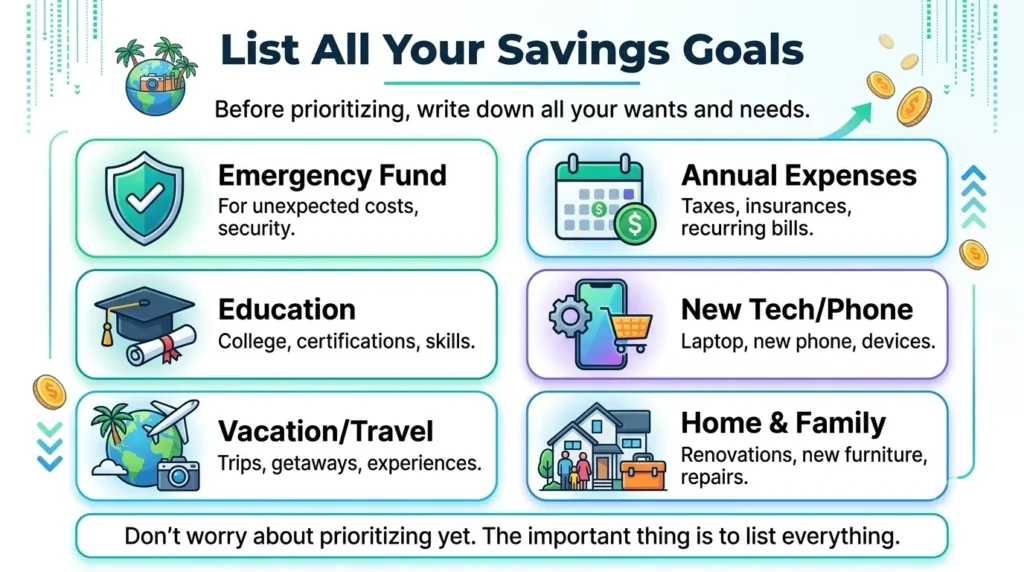
Include both important financial goals and upcoming expenses, such as:
- Emergency fund
- Annual bills or expenses
- Education
- New phone or laptop
- Vacation or travel
- Home or family expenses
- Other planned purchases
Don’t worry about prioritizing them yet. The first goal is simply to get a clear picture of where your money may need to go.
Once you have listed everything, you can group the goals by time frame, importance, and deadline. This makes it much easier to decide which goals should receive more attention first.
Step 2: Separate Short-Term, Medium-Term, and Long-Term Savings Goals
Not every savings goal has the same deadline. A bill due next month needs a different approach from a car you want to buy in three years or a future financial goal that may take much longer.
That is why one of the easiest ways to organize multiple savings goals is to separate them by time frame.
Short-Term Savings Goals
Short-term goals are goals you expect to reach relatively soon, such as annual bills, emergency expenses, a phone, or a planned purchase.
These goals usually need more immediate attention because their deadlines are closer.
Medium-Term Savings Goals
Medium-term savings goals sit between immediate expenses and long-term financial goals. They may take several months or a few years to complete, depending on the size and deadline of the goal.
Common examples include:
- Buying a car
- Saving for education or training
- A major home expense
- Starting a small business
- Saving for a wedding or major event
- Preparing for a large planned purchase
The advantage of a medium-term goal is that you have more time to build the money. Instead of trying to save a large amount at once, you can break the target into smaller monthly savings contributions.
How to Calculate a Medium-Term Savings Target
Use this simple formula:
Target Amount ÷ Months Remaining = Monthly Savings Needed
For example, suppose your goal is to save $3,000 in 30 months.
$3,000 ÷ 30 = $100 per month
So your basic monthly savings target would be $100.
| Goal | Target | Time Remaining | Monthly Target | Priority |
|---|---|---|---|---|
| Education | $3,000 | 30 months | $100 | High |
| Car fund | $6,000 | 36 months | $167 | Medium |
| Major purchase | $1,500 | 24 months | $63 | Low |
This gives you a clearer picture of how much each goal requires instead of simply saving money without knowing whether you are on track.
What If the Monthly Amount Is Too High?
This is where a realistic savings plan matters.
If your calculated monthly contribution does not fit your budget, you have several options:
- Extend the deadline if possible.
- Reduce the target amount.
- Give the goal a lower priority.
- Temporarily focus on a more important goal.
- Look for ways to reduce expenses or increase available savings.
You do not have to abandon a goal just because the first calculation does not fit your current cash flow.
The Consumer Financial Protection Bureau recommends breaking savings goals into manageable targets and considering the amount needed and the time available when creating a savings plan.
For a broader reference, you can also review the CFPB’s savings and goal-setting tools, which include tools for setting goals, planning savings, tracking money, and preparing for large purchases.
For your own numbers, you can use our budget calculator to see how your income and expenses affect the amount available for different savings goals.
The important point is simple: medium-term goals should have a target, deadline, and monthly contribution. Once those three numbers are clear, a large future expense becomes much easier to manage.
Step 3: Prioritize Your Savings Goals
Once you have separated your goals by time frame, the next step is to decide which savings goals should come first.
When you have multiple savings goals, you do not always need to divide your money equally. Some goals are more important because they protect your financial stability, have a fixed deadline, or could create a bigger problem if you do not prepare for them.
A simple priority system can help you decide where your monthly savings should go first.
Start With Financial Safety
Before putting a large amount toward optional goals, consider whether you have enough money set aside for unexpected expenses.
An emergency fund can help cover unexpected costs such as an urgent repair, medical expense, or temporary loss of income without forcing you to depend on debt.
Your financial priorities will depend on your situation, but building a basic financial safety net is often an important starting point.
For a broader overview, read our guide to the 7 rules of personal finance, which explains the role of budgeting, emergency savings, debt management, and long-term financial goals.
Consider the Deadline and Consequences
Not every savings goal has the same level of urgency. A goal with a fixed deadline may need more attention than a goal that can be delayed.
Before deciding how to divide your savings, ask yourself:
- Does this expense have a fixed deadline?
- What happens if I do not save enough by that date?
- Is the goal essential or optional?
- Can I delay the goal without creating a financial problem?
- Could failing to prepare lead to debt or another financial cost?
- Does this goal protect my basic financial needs?
For example, an annual insurance payment due in three months may deserve more attention than a vacation planned for next year.
The vacation can still be an important savings goal, but its deadline and consequences are different.
Use a High, Medium, and Low Priority System
A simple three-level priority system makes it easier to manage multiple savings goals without feeling overwhelmed.
| Priority | Type of Goal | Example |
|---|---|---|
| High | Financial safety or essential deadline | Emergency fund, essential annual expense |
| Medium | Important planned expense | Education, major repair, vehicle |
| Low | Optional or flexible goal | Vacation, new gadget, entertainment |
This does not mean low-priority goals should never receive money. It simply means they should not take money away from a more important financial need when your available savings are limited.
How to Divide Money Between Savings Goals
If your monthly savings amount is limited, a useful starting order is:
- Financial safety
- Essential upcoming expenses
- Important planned goals
- Optional goals
For example, suppose you can save $300 per month and you have three goals:
- Emergency fund — High priority
- Education — Medium priority
- Vacation — Low priority
Instead of automatically giving each goal $100, you could direct more of your available savings toward the emergency fund and education while making a smaller contribution toward the vacation.
The exact amounts depend on your income, essential expenses, current savings, and the deadlines of your goals.
If you want to connect your savings goals with your income and expenses, see our guide to financial planning for beginners.
Do Not Try to Fund Every Goal Equally
One common mistake when managing multiple savings goals is assuming that every goal should receive the same amount of money.
For example, imagine you have $500 available for savings and the following goals:
| Goal | Amount Needed | Deadline | Priority |
|---|---|---|---|
| Emergency fund | $1,500 | Flexible | High |
| Annual bill | $600 | 4 months | High |
| Laptop | $1,000 | 10 months | Medium |
| Vacation | $1,200 | 12 months | Low |
An equal split would give each goal $125. But the annual bill has a much closer deadline, while the vacation may be more flexible.
Your savings plan should reflect importance and urgency, not simply equality.
What If Two Savings Goals Have the Same Priority?
When two goals are equally important, use their deadlines to decide which one should receive more attention.
As a simple rule, consider the goal that:
- Has the earlier deadline.
- Requires a larger monthly contribution.
- Has greater consequences if you miss the target.
You can also change the priority later. Your income, expenses, deadlines, and financial goals may change, so your savings plan should be flexible enough to change with them.
Keep Your Savings Priorities Simple
You do not need a complicated financial planning system to organize multiple savings goals.
For each goal, know these four things:
- What you are saving for
- How much you need
- When you need it
- How important it is compared with your other goals
Once these details are clear, it becomes much easier to decide where your money should go each month.
The goal is not to create a perfect plan that never changes. The goal is to build a practical savings plan that gives every dollar a purpose while keeping your most important financial goals on track.
Step 4: Set a Target Amount and Deadline for Every Savings Goal
Once you know which savings goals are most important, give each goal a specific target amount and deadline.
“I want to save more money” is a good intention, but it is difficult to follow because there is no clear finish line. A better savings plan tells you exactly how much you need, when you need it, and how much you should save each month.
This approach can make multiple savings goals much easier to organize and track.
Give Every Financial Goal a Specific Target
Start by deciding the approximate amount you need for each goal.
For example, instead of writing:
- Save for a laptop
- Save for a trip
- Save for education
Turn them into measurable goals:
- Laptop — $1,000
- Trip — $1,500
- Education — $3,000
A specific target gives you something you can calculate against. It also makes it easier to see whether your current monthly savings are enough.
Set a Realistic Savings Deadline
After deciding the target amount, choose when you want or need to reach it.
Your deadline can be based on:
- A fixed bill or payment date
- A planned purchase
- A school or education deadline
- A planned trip or event
- A personal financial milestone
- A timeframe that is realistic for your income
Try not to choose a deadline simply because it sounds good. A deadline should be realistic enough that you can continue making the required monthly contribution without putting your essential expenses under pressure.
Calculate the Time You Have Left
Once you know the target and deadline, calculate how many months you have remaining.
For example:
| Goal | Target | Time Available | Approx. Monthly Saving |
|---|---|---|---|
| Laptop | $1,000 | 10 months | $100 |
| Trip | $1,500 | 12 months | $125 |
| Education | $3,000 | 24 months | $125 |
These numbers give you a starting point for building your monthly savings plan. In the next step, we will use the same information to calculate the required monthly contribution more precisely.
Use the SMART Approach for Savings Goals
A useful way to make a savings goal clearer is to make it specific and measurable, with a realistic timeframe.
For example:
Vague goal: “I want to save for a laptop.”
Clear goal: “I want to save $1,000 for a laptop within 10 months.”
The second goal gives you three important pieces of information:
- What: Laptop
- Target: $1,000
- Deadline: 10 months
The Consumer Financial Protection Bureau’s SMART savings goal worksheet also uses a structured approach to help people turn a general savings intention into a clearer goal.
Use the Same Method in USD, GBP, or INR
The currency does not change the basic method. Whether you are saving in US dollars, British pounds, or Indian rupees, the process is the same:
Target amount → Deadline → Months remaining → Monthly savings requirement
For example:
| Currency | Goal | Target | Time |
|---|---|---|---|
| USD | Laptop | $1,000 | 10 months |
| GBP | Holiday | £1,200 | 12 months |
| INR | Education | ₹120,000 | 24 months |
You do not need to convert these amounts into one currency. Keep each goal in the currency you will actually spend.
What If the Target Is Too High for Your Income?
This is where your savings plan becomes practical.
Suppose you calculate that you need to save $400 per month for several goals, but after essential expenses you can realistically save only $250.
Do not simply assume you have failed. Rework the plan.
You could:
- Extend the deadline
- Reduce the target amount
- Give higher priority to the most important goal
- Temporarily pause a lower-priority goal
- Reduce unnecessary expenses
- Increase your savings contribution when your income rises
A realistic savings target that you can consistently follow is usually more useful than an aggressive target that makes your monthly budget impossible to maintain.
Keep Your Savings Goals in One Simple Table
Once you have several goals, put the important numbers in one place. This makes it easier to see the complete picture instead of keeping separate notes in your head.
| Goal | Target | Saved | Remaining | Deadline | Priority |
|---|---|---|---|---|---|
| Emergency fund | $1,500 | $600 | $900 | Flexible | High |
| Laptop | $1,000 | $250 | $750 | 10 months | Medium |
| Vacation | $1,200 | $300 | $900 | 12 months | Low |
This simple savings tracker gives you a quick view of what you are saving for, how much you have already saved, what remains, and which goals deserve the most attention.
Once every goal has a target and deadline, the next step is to calculate exactly how much you need to save each month.
Step 5: Calculate Your Monthly Savings for Each Goal
Now that every savings goal has a target amount and deadline, you can calculate how much you need to save each month.
This is the point where a list of financial goals becomes an actual savings plan. Instead of guessing how much to put aside, you can work backward from the amount you need and the time available.
Use the Monthly Savings Formula
The basic calculation is simple:
Monthly Savings Needed = Amount Remaining ÷ Months Remaining
For example, suppose you want to save $1,200 for a planned purchase and you have 12 months remaining.
$1,200 ÷ 12 = $100 per month
So, you would need to set aside approximately $100 each month to reach the target, assuming the money you save does not earn additional returns and there are no extra costs.
Calculate Each Savings Goal Separately
When you have multiple savings goals, calculate the monthly contribution for each one instead of combining all the targets into one number.
| Goal | Amount Remaining | Months Remaining | Monthly Savings |
|---|---|---|---|
| Emergency fund | $1,000 | 10 | $100 |
| Laptop | $900 | 9 | $100 |
| Vacation | $1,200 | 12 | $100 |
In this example, the total monthly requirement would be:
$100 + $100 + $100 = $300 per month
Now you can compare that $300 requirement with the amount your monthly budget can realistically provide.
Check Your Monthly Savings Capacity
Before committing to a savings target, look at your actual cash flow.
A simple starting calculation is:
Monthly Income − Essential Expenses − Required Payments = Potential Savings
For example:
| Monthly Budget | Amount |
|---|---|
| Income | $2,500 |
| Essential expenses | $1,700 |
| Required payments and regular spending | $400 |
| Potential savings | $400 |
If your savings goals require $300 per month and you can realistically save $400, the plan has some room for unexpected expenses or faster progress.
If your goals require $550 but your realistic savings capacity is only $400, you need to adjust the goals rather than forcing an unrealistic budget.
Use a Budget Calculator to Find Your Available Savings
Working out your income and expenses manually can become difficult when you have several financial goals.
You can use our Budget Calculator to organize your income and spending and get a clearer idea of how much money may be available for savings each month.
Once you know your available savings amount, you can compare it with the monthly contribution required for each goal.
What If Your Monthly Savings Requirement Is Too High?
This is one of the most important parts of creating a realistic savings plan.
If the numbers do not fit your budget, do not simply cut essential expenses or put yourself under unnecessary financial pressure. Rework the plan.
You can:
- Extend the deadline: Give yourself more months to reach the target.
- Reduce the target: Look for a lower-cost version of the planned purchase.
- Prioritize: Put more money toward essential or time-sensitive goals.
- Pause a lower-priority goal: Temporarily stop funding a flexible goal.
- Increase your savings capacity: Reduce unnecessary spending or direct future extra income toward the goal.
- Review the target: Make sure the original amount is still realistic.
A savings plan should fit your real financial situation. A target that looks impressive on paper but cannot be maintained every month is not a useful target.
Use the Deadline to Adjust Your Monthly Contribution
Your monthly savings requirement can change when the deadline changes.
| Target | Deadline | Monthly Savings |
|---|---|---|
| $1,200 | 6 months | $200 |
| $1,200 | 12 months | $100 |
| $1,200 | 18 months | About $67 |
This shows why the deadline matters. The same savings goal can require very different monthly contributions depending on how much time you have.
Do Not Forget the Amount You Have Already Saved
If you have already saved part of the money, calculate the monthly requirement using the remaining amount, not the original target.
For example:
Target: $2,000
Already saved: $500
Remaining: $1,500
Time remaining: 10 months
$1,500 ÷ 10 = $150 per month
This makes your savings target more accurate and prevents you from saving more than necessary for the same goal.
Keep a Small Buffer for Real Life
Monthly budgets do not always go exactly as planned. An unexpected expense can temporarily reduce the amount you are able to save.
For that reason, avoid building a savings plan that uses every available dollar with no flexibility.
If your calculations show that you can save $400 per month, but your goals require exactly $400, consider whether you need some breathing room for irregular expenses before committing to the full amount.
This is especially important when your income changes from month to month.
The Consumer Financial Protection Bureau’s Your Money, Your Goals toolkit also provides tools and guidance for setting goals, planning spending, and managing savings.
A Simple Rule for Multiple Savings Goals
Once you calculate the monthly requirement for every goal, add them together and compare the total with your realistic monthly savings capacity.
If required savings ≤ available savings: Your plan may be realistic.
If required savings > available savings: Prioritize the goals and adjust the deadlines, targets, or contributions.
This simple comparison can prevent a common problem: creating too many savings goals without checking whether your income can actually support them.
In the next step, we will look at how to divide your available money between multiple savings goals when you cannot fully fund every goal at the same time.
Step 6: How to Divide Money Between Multiple Savings Goals
Knowing how much you need to save each month is only half the job. When you have several financial goals, you also need to decide how to divide your available savings between them.
You do not have to give every goal the same amount. The right approach depends on each goal’s priority, deadline, target amount, and how much you can realistically save after your regular expenses.
The aim is to create a savings plan that is realistic enough to follow every month while still moving your most important financial goals forward.
First, Know How Much You Can Save Each Month
Before deciding how much goes into each goal, calculate your available monthly savings.
A simple starting point is:
Monthly Income − Essential Expenses − Required Payments = Potential Savings
For example, if your monthly income is $2,500, essential expenses are $1,700, and other required payments and regular spending total $400, you may have around $400 available for savings.
You can use our Budget Calculator to organize your income and expenses and get a clearer picture of how much you may be able to save each month.
If you want a broader approach to dividing your income between spending, savings, and financial priorities, you can also read our guide on how to divide your salary for beginners.
Method 1: Equal Contribution for Multiple Savings Goals
The simplest approach is to divide your available savings equally between your goals.
For example, if you can save $300 per month and have three goals, you could contribute:
- Goal 1 — $100 per month
- Goal 2 — $100 per month
- Goal 3 — $100 per month
This method is easy to understand and can work well when the goals have similar importance and similar deadlines.
However, equal contributions are not always the best option. If one goal has a much earlier deadline or greater financial importance, it may need a larger share of your monthly savings.
Method 2: Priority-Based Savings
With a priority-based savings plan, you give more of your available money to goals that are more important and reduce contributions to goals that can wait.
A simple order could be:
- Financial safety
- Essential upcoming expenses
- Important planned goals
- Optional goals
For example, if you are building an emergency fund while also saving for a vacation, you may decide that the emergency fund deserves a larger contribution because it provides greater financial protection.
This method can be especially useful when your monthly savings are limited and you cannot fully fund every goal at the same time.
Method 3: Deadline-Based Savings
Another practical method is to divide your savings according to how soon each goal needs to be funded.
Suppose you have the following goals:
| Goal | Amount Remaining | Time Remaining | Priority |
|---|---|---|---|
| Annual bill | $600 | 4 months | High |
| Laptop | $1,000 | 10 months | Medium |
| Vacation | $1,200 | 12 months | Low |
The annual bill has the closest deadline, so it may need more immediate attention. The laptop and vacation goals have more time, which gives you greater flexibility with their contributions.
This method is particularly useful for short-term and medium-term savings goals where missing a deadline could create a financial problem.
Which Savings Method Should You Choose?
There is no single method that works for every person or every savings goal. You can choose one method or combine several.
| Method | Best For | Main Advantage |
|---|---|---|
| Equal contribution | Goals with similar importance | Simple and easy to maintain |
| Priority-based | Limited monthly savings | Focuses money on important goals |
| Deadline-based | Goals with different due dates | Helps prevent missed deadlines |
For example, you could use a priority-based approach for your emergency fund and essential expenses, then divide whatever remains between flexible goals.
Example: Dividing $500 Between Multiple Savings Goals
Suppose you have $500 available for savings each month and four goals:
| Goal | Priority | Monthly Contribution |
|---|---|---|
| Emergency fund | High | $200 |
| Annual expenses | High | $150 |
| Laptop | Medium | $100 |
| Vacation | Low | $50 |
| Total | $500 |
This is only an illustrative example, not a universal rule. Your own allocation should be based on your income, expenses, current savings, deadlines, and priorities.
The important idea is that you do not need to divide your money equally just because you have multiple goals.
Match Your Savings Allocation With Your Financial Plan
Your savings goals should not exist separately from the rest of your budget. They should fit into your overall financial plan.
Consider:
- Your monthly income
- Essential living expenses
- Existing debt or required payments
- Emergency savings
- Upcoming annual expenses
- Short-term financial goals
- Longer-term goals
Our guide to financial planning for beginners explains how different money priorities can be organized into a broader financial plan.
For additional guidance on setting savings goals and creating a savings plan, you can also refer to the Consumer Financial Protection Bureau’s savings plan tool.
What If You Cannot Fund Every Goal?
This is completely normal. Having several savings goals does not mean you have to make progress on all of them at the same speed.
If your required monthly contributions are higher than your available savings, you can:
- Focus on the highest-priority goal first.
- Give more time to a flexible goal.
- Reduce the target amount if appropriate.
- Temporarily pause a lower-priority goal.
- Redirect money to another goal after completing one target.
- Increase contributions later when your financial situation improves.
A realistic savings plan is better than a complicated plan that consistently leaves you short of money.
Review and Rebalance Your Savings Goals
Your savings allocation does not need to remain unchanged throughout the year.
Review your plan at least once a month and consider whether:
- Your income has changed.
- Your regular expenses have increased or decreased.
- A deadline is getting closer.
- You have already reached one of your targets.
- A new essential expense has appeared.
- One goal has become more or less important.
For example, once you finish saving for an annual expense, you can redirect that monthly contribution toward your next priority instead of leaving the money unassigned.
A Simple Rule for Dividing Your Savings
If you are unsure where your money should go, ask yourself three questions every month:
- What is most important right now?
- Which goal has the nearest deadline?
- How much can I realistically save this month?
Your answers can help you decide how to divide money between multiple savings goals without making your budget unnecessarily complicated.
The goal is not to save the same amount for everything. The goal is to give your available money a clear purpose while keeping your most important financial goals on track.
There is no fixed number of savings goals you should have. Start with the goals that are most important and realistic for your current income. Too many goals can make it harder to stay consistent, so focus on your priorities first.
Yes. If your budget allows, you can save for several goals at the same time. Give more money to urgent or essential goals and smaller amounts to flexible goals.
Prioritize your most important goals instead of trying to fund everything equally. You can reduce optional targets, extend deadlines, or increase your monthly savings later when your income improves.
Review your savings plan at least once a month. Check your progress, remaining amount, deadlines, and monthly contributions. Adjust the plan whenever your income, expenses, or priorities change
Final Thoughts: How to Organize Multiple Savings Goals
Managing multiple savings goals becomes much easier when every goal has a clear target, deadline, and priority. Instead of trying to save for everything equally, focus your money on what matters most and adjust your plan as your situation changes.
Start small, stay consistent, and review your progress each month. A simple plan you can follow is more valuable than a complicated plan you cannot maintain.
- Emergency Fund vs Savings Account: Where to Keep Your Backup Cash in 2026?
- How to Organize Multiple Savings Goals Before 2027: A Simple Money Plan
- Cash Stuffing Method for Beginners: A Simple Step-by-Step Guide
- How to Budget When Living Paycheck to Paycheck
- How to Divide Your Salary for Beginners: Complete Guide With Examples