
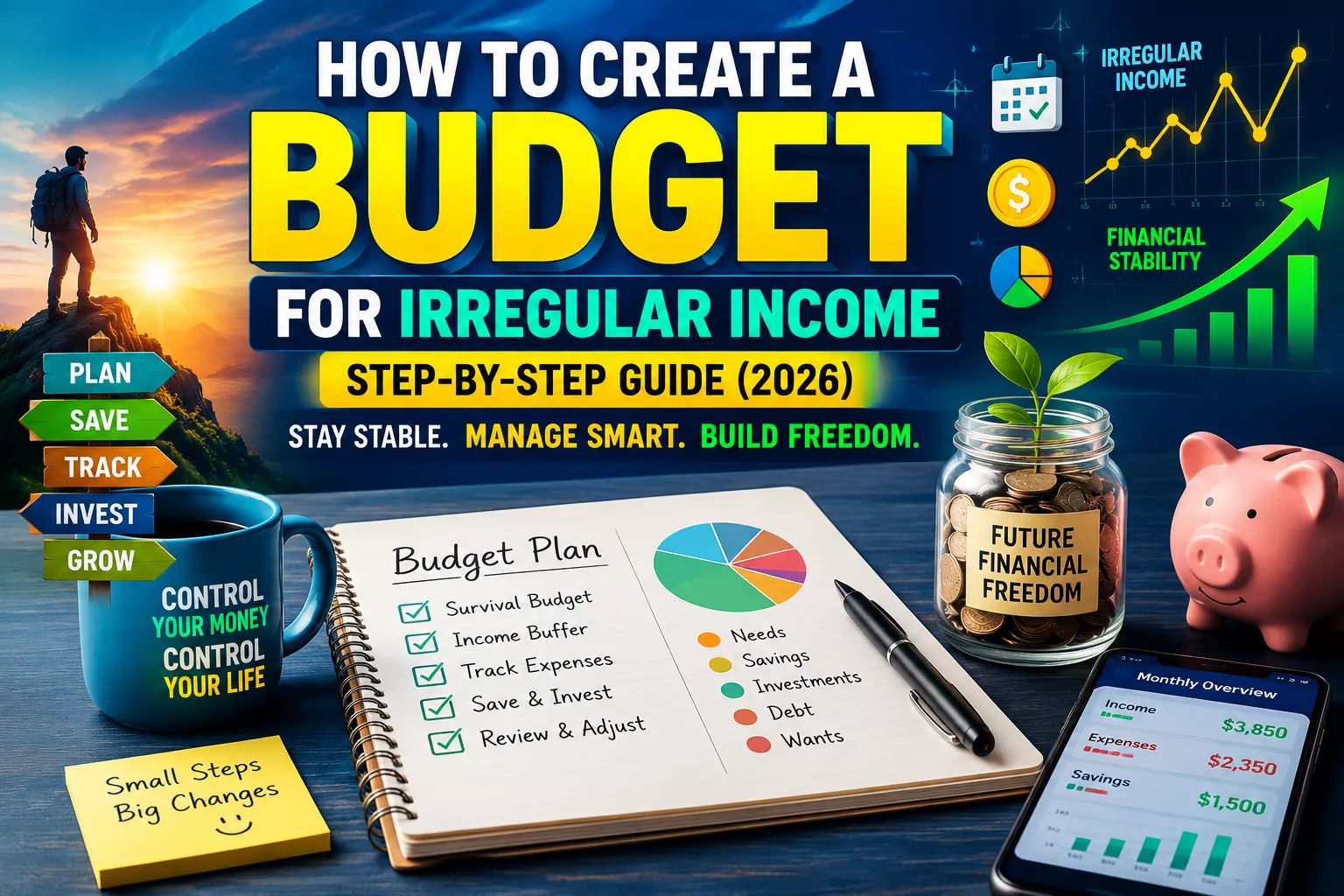
introduction
How to Budget with Managing money becomes difficult when your income is not the same every month. Unlike salaried employees who receive a fixed paycheck, people with irregular income often face uncertainty — one month can bring high earnings, while the next month may be much lower.
The biggest challenge is not only earning money; it is creating a system that works when your income changes.
Many people with irregular income make the mistake of spending more during good months and struggling during slow months. Without a proper budgeting system, even a good income can disappear quickly.
This is where irregular income budgeting becomes important.
Instead of creating a budget based on your highest earning month, you need a flexible system that helps you manage expenses, save money, and prepare for unpredictable income.
In this guide, you will learn a practical step-by-step method to create a budget for irregular income, including how to calculate your minimum monthly expenses, manage variable spending, build an income buffer, and create a stable financial plan.
Whether you are a freelancer, self-employed professional, business owner, content creator, or anyone with changing income, this guide will help you take control of your money.
Before starting your budgeting system, understanding your financial goals and current money habits is also important. You can also read:
Why Can’t I Save Money? 5 Hidden Reasons You’re Still Broke (Even With a Good Salary).
Now let’s start with the first and most important step: calculating your Minimum Monthly Expenses (Survival Budget).
What You Will Learn in This Guide
In this complete guide to budgeting with irregular income, you will learn:
- How to calculate your minimum monthly expenses.
- How to create a Survival Budget that works during low-income months.
- How to separate essential expenses from unnecessary spending.
- How to manage variable income without financial stress.
- How to build an income buffer for unpredictable months.
- How to create a long-term money management system.
This guide focuses on practical strategies that you can apply immediately, not just general budgeting advice.
Whether your income changes every week, every month, or seasonally, these methods will help you create a flexible financial system.
Now let’s start with the first step: calculating your Minimum Monthly Expenses (Survival Budget).
Step 1: Calculate Your Minimum Monthly Expenses (Survival Budget)
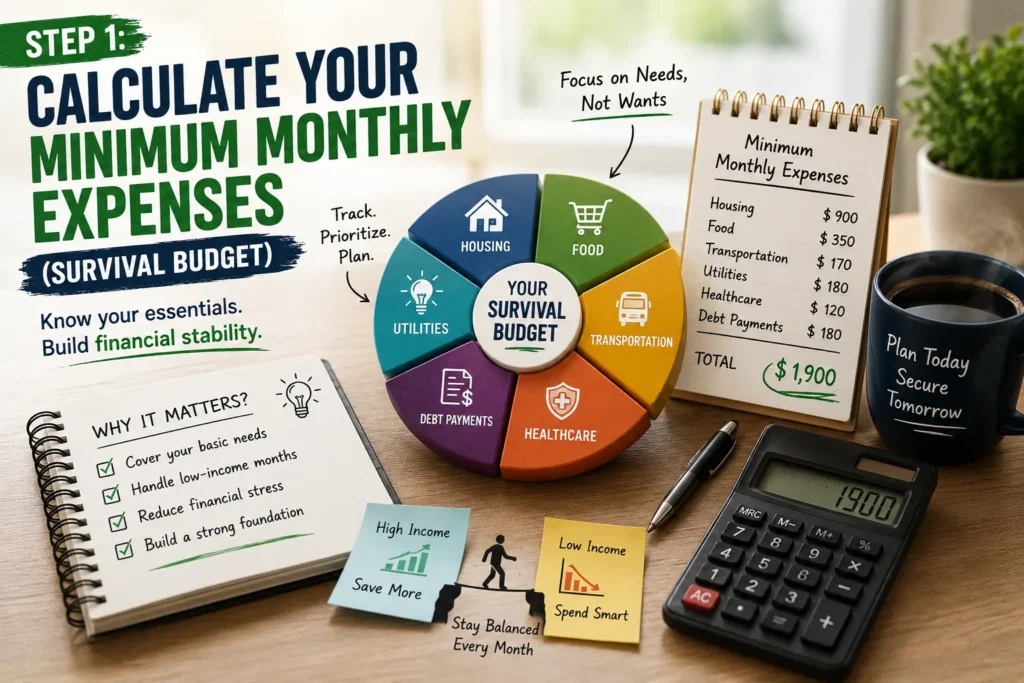
When your income changes every month, the first step is not deciding how much you should spend — it is understanding the minimum amount of money you actually need to run your life.
This amount is called your Survival Budget.
Your Survival Budget is the foundation of an effective irregular income budgeting system. It tells you the minimum money required to cover your essential expenses before you spend on lifestyle choices, entertainment, or other non-essential things.
For freelancers, self-employed professionals, business owners, and anyone with variable income, this system creates financial stability because you stop depending on your best earning months.
Why Your Survival Budget Is Important
Many people with irregular income follow an unstable money pattern:
High-income month → Spend more → Low-income month → Financial stress
The problem is not always income. The problem is not knowing your minimum financial requirement.
A Survival Budget helps you understand:
- The minimum income you need every month.
- Which expenses must be protected first.
- How much extra money you can save or invest.
- How to prepare for months when income is lower.
For example, if your minimum monthly expenses are $1,800, then your first financial target is not buying luxury items or increasing your lifestyle — it is securing that $1,800 amount first.
According to the
Consumer Financial Protection Bureau (CFPB),
creating a realistic budget helps people understand their spending and make better financial decisions.
The Survival Budget Formula
You can calculate your Survival Budget using this simple formula:
Survival Budget = Fixed Expenses + Essential Variable Expenses + Minimum Debt Payments
Fixed Expenses
These expenses usually remain the same every month:
- Rent or mortgage
- Insurance
- Phone and internet bills
- Loan payments
Essential Variable Expenses
These expenses change but are necessary:
- Groceries
- Transportation
- Electricity
- Healthcare
- Household needs
Minimum Financial Payments
Include all payments you cannot skip:
- Credit card minimum payments
- Loan installments
- Other required payments
How to Calculate Your Minimum Monthly Expenses
1. Review Your Last 3–6 Months Spending
The first step is understanding your real spending pattern.
Check:
- Bank statements
- Payment apps
- Credit card history
- Expense tracking records
Write down every expense, including small purchases.
Many people underestimate small expenses because they seem insignificant. However, repeated small spending can reduce your savings significantly over time.
2. Separate Needs From Wants
After collecting your expenses, divide them into two categories.
Essential Expenses (Needs)
These are expenses required for your basic lifestyle:
- Housing
- Food
- Utilities
- Transportation
- Healthcare
- Insurance
Non-Essential Expenses (Wants)
These expenses are optional:
- Eating outside
- Entertainment
- Shopping
- Premium subscriptions
- Luxury purchases
Reducing unnecessary expenses does not mean removing all enjoyment. It means creating space for your important financial goals.
If you struggle with unnecessary spending, you can also read:How to Manage Your Salary: A Complete Day 1 to Day 30 Money Plan (2026)
Example: Calculating Your Survival Budget
Imagine your monthly essential expenses are:
| Category | Amount |
|---|---|
| Rent | $800 |
| Food | $300 |
| Utilities | $150 |
| Transportation | $150 |
| Insurance | $100 |
| Debt Payment | $200 |
| Total Survival Budget | $1,700 |
Your Survival Budget is $1,700 per month.
This means you need at least $1,700 before spending money on optional things.
Any income above this amount can be used for:
- Emergency savings
- Investments
- Debt reduction
- Future low-income months
Common Mistakes To Avoid
Avoid these mistakes while creating your Survival Budget:
- Planning your lifestyle around your highest income month.
- Ignoring small recurring expenses.
- Spending extra income immediately.
- Not tracking your monthly cash flow.
- Mixing business and personal expenses.
A proper Survival Budget protects you from financial uncertainty and gives you more control over your money.
Action Plan: Create Your Survival Budget Today
Follow these steps:
✅ Review your last 3–6 months of expenses.
✅ Write down every monthly cost.
✅ Separate needs and wants.
✅ Add only essential expenses.
✅ Calculate your Survival Budget number.
✅ Use this number as the base of your irregular income budget.
Once you know your Survival Budget, the next step is to calculate your Baseline Income — the income level you should target to create a stable financial system even when your earnings change every month.
Step 2: Calculate Your Baseline Income
Once you know your Survival Budget, the next step is to calculate your Baseline Income. This is one of the most important parts of budgeting with irregular income because it gives you a realistic income target instead of relying on your best earning month.
Many people make the mistake of planning their budget around the highest amount they have ever earned. For example, if you earned $5,000 last month, it’s easy to assume you’ll earn the same again. But irregular income rarely works that way. Some months are excellent, while others are much slower.
Your Baseline Income is the amount you can reasonably expect to earn on a consistent basis. It becomes the foundation for your monthly budget, savings plan, and financial decisions. Instead of chasing unpredictable numbers, you build your budget around a realistic average that keeps your finances stable throughout the year.
Why Your Baseline Income Matters
A Baseline Income helps you answer one simple question:
“How much money can I safely plan to spend every month?”
Without knowing this number, it becomes easy to overspend during good months and struggle during slow months.
A realistic Baseline Income helps you:
- Create a stable monthly budget.
- Avoid lifestyle inflation.
- Plan savings with confidence.
- Reduce financial stress during low-income months.
- Make better long-term financial decisions.
According to the Consumer Financial Protection Bureau (CFPB), tracking your income over time helps you build a more accurate and sustainable budget.
How to Calculate Your Baseline Income
1. Collect Your Income Records
Start by gathering your income from the last 6–12 months.
This may include:
- Client payments
- Freelance income
- Business revenue
- Commission earnings
- Side hustle income
- Part-time work
The longer the time period you review, the more accurate your Baseline Income will be.
2. Calculate Your Average Monthly Income
Add all your income from the past 6–12 months and divide it by the number of months.
Formula:
Baseline Income = Total Income ÷ Number of Months
Example:
| Month | Income |
|---|---|
| January | $3,500 |
| February | $2,400 |
| March | $4,100 |
| April | $2,800 |
| May | $3,200 |
| June | $3,000 |
Total Income = $19,000
Baseline Income = $19,000 ÷ 6 = $3,166
Instead of budgeting as if you’ll earn $4,100 every month, you should build your budget around $3,166, because it reflects your average earning pattern.
Don’t Budget Using Your Best Month
One of the biggest financial mistakes is treating your highest-income month as your normal income.
A better strategy is:
- Budget using your Baseline Income.
- Save extra income during high-earning months.
- Use those savings to support low-income months.
This simple system creates consistency, even when your income is unpredictable.
If you often find that your income disappears quickly despite earning well, you may also find this guide helpful: Why Can’t I Save Money? 5 Hidden Reasons You’re Still Broke (Even With a Good Salary).
Action Plan
Before moving to the next step, complete these tasks:
- ✅ Review your last 6–12 months of income.
- ✅ Add every income source.
- ✅ Calculate your average monthly income.
- ✅ Use this number as your Baseline Income.
- ✅ Ignore unusually high-income months when creating your budget.
Next Step: Now that you know your Baseline Income, the next step is to prioritize your expenses using a flexible budgeting system that works even when your income changes every month.
Step 3: Prioritize Essential Expenses First
Now that you know your Survival Budget and Baseline Income, it’s time to decide where your money should go first.
One of the biggest reasons people with irregular income struggle financially is not because they earn too little—but because they spend money in the wrong order.
Many people pay for shopping, entertainment, subscriptions, or lifestyle upgrades as soon as they receive income. Later, when rent, groceries, or utility bills are due, they find themselves short of cash.
A better approach is to prioritize your expenses based on importance, not urgency.
This simple habit ensures that even during a low-income month, your essential needs are always covered before you spend money on anything optional.
Why Prioritizing Expenses Is So Important
When your income changes every month, you cannot afford to treat every expense equally.
Some expenses keep your life running, while others simply make life more enjoyable.
If you pay for optional expenses before covering your basic needs, you’ll constantly feel financial pressure.
By prioritizing your expenses, you can:
- Always pay your essential bills first.
- Reduce financial stress during slow months.
- Avoid relying on credit cards or loans.
- Build better money habits.
- Create a stable financial system even with unpredictable income.
According to the Consumer Financial Protection Bureau (CFPB), a successful budget should focus on covering essential expenses before discretionary spending.
The 4-Level Expense Priority System
Instead of treating every expense equally, organize your spending into four priority levels.
Level 1: Essential Living Expenses (Highest Priority)
These are the expenses you must pay first because they directly affect your daily life.
Examples include:
- Rent or mortgage
- Groceries
- Electricity, water, and gas
- Transportation
- Healthcare
- Insurance
- Minimum debt payments
If your income is lower than expected this month, these expenses should still be fully funded.
Level 2: Financial Protection
After covering your essential expenses, the next priority is protecting your future.
This includes:
- Emergency fund contributions
- Insurance premiums
- Small savings for unexpected expenses
Even saving a small amount every month creates financial security over time.
You can learn more about emergency preparedness from: Ready.gov – Financial Preparedness.
Level 3: Financial Growth
Once your basic needs and financial protection are covered, you can focus on growing your wealth.
Examples include:
- Investing
- Retirement contributions
- Skill development
- Business growth
- Education
These expenses improve your long-term financial future instead of only solving today’s problems.
Level 4: Lifestyle Expenses
These are optional expenses that improve your lifestyle but are not essential for survival.
Examples:
- Dining out
- Entertainment
- Online shopping
- Premium subscriptions
- Luxury purchases
- Vacations
If your income is lower this month, these are the first expenses you should reduce or postpone.
A Simple Priority Rule
Whenever money enters your bank account, ask yourself one question:
“Does this expense help me survive, protect my future, grow my wealth, or simply improve my lifestyle?”
If it only improves your lifestyle, delay it until the first three priorities have been funded.
This simple decision-making framework prevents impulsive spending and helps you stay in control of your finances.
If you’re earning well but still struggling to build savings, you may also find this helpful: Why Can’t I Save Money? 5 Hidden Reasons You’re Still Broke (Even With a Good Salary).
Action Plan
Complete these steps before moving to the next budgeting strategy:
- ✅ List all of your monthly expenses.
- ✅ Divide them into the four priority levels.
- ✅ Always fund Level 1 before spending elsewhere.
- ✅ Build emergency savings after covering essential expenses.
- ✅ Spend on lifestyle expenses only if money is left.
For additional budgeting guidance, you can also explore: Consumer.gov – Managing Your Money.
Next Step: Now that your expenses are organized by priority, the next step is to build an Income Buffer that protects you during slow-income months and gives you greater financial confidence.
Step 4: Build an Income Buffer for Low-Income Months
By now, you’ve calculated your Survival Budget, estimated your Baseline Income, and learned how to prioritize essential expenses. The next step is creating an Income Buffer—a financial cushion that helps you stay stable during months when your income is lower than expected.
For people with irregular income, earning less in some months is completely normal. The real problem begins when there is no money set aside to cover essential expenses. That’s where an Income Buffer becomes one of the most powerful tools in your budgeting system.
Instead of worrying about whether next month’s income will be enough, you can use the money you’ve saved during high-income months to cover the gap. This creates peace of mind and helps you avoid borrowing money or using credit cards for everyday expenses.
Why an Income Buffer Is Important
An Income Buffer protects your monthly budget from unexpected income fluctuations.
Whether you’re a freelancer, self-employed professional, content creator, consultant, or seasonal worker, your income can change for many reasons—fewer clients, seasonal demand, delayed payments, or economic changes.
Without an Income Buffer, even a small drop in income can affect your ability to pay rent, buy groceries, or cover utility bills.
With an Income Buffer, your financial life becomes much more predictable because you already have money reserved for slower months.
According to the Consumer Financial Protection Bureau (CFPB), setting aside money for unexpected situations helps reduce financial stress and improves long-term financial stability.
How to Build an Income Buffer
1. Set a Clear Savings Target
Start with a realistic goal.
If you’re just beginning, aim to save enough money to cover one month of your Survival Budget.
Once you reach that goal, gradually increase it to cover:
- One month of essential expenses.
- Three months of essential expenses.
- Six months of essential expenses for greater financial security.
Don’t try to save everything at once. Building an Income Buffer is a gradual process.
2. Save Extra Income During High-Earning Months
One of the biggest advantages of irregular income is that some months can be much better than others.
Instead of increasing your lifestyle during those months, save a portion of the extra income.
For example:
- Survival Budget: $2,000
- Monthly Income: $3,500
Instead of spending the extra $1,500, move part of it into your Income Buffer.
Over time, these small contributions create a strong financial cushion.
3. Keep Your Income Buffer Separate
Avoid keeping your Income Buffer in the same account you use for daily spending.
A separate high-yield savings account or dedicated savings account makes it less tempting to spend the money on non-essential purchases.
The FDIC Money Smart Program also encourages building healthy saving habits and keeping emergency savings separate from everyday spending.
4. Rebuild Your Buffer After Using It
An Income Buffer is meant to be used when income falls—not for shopping, vacations, or impulse purchases.
If you use part of your buffer during a slow month, make rebuilding it your priority during the next high-income month.
This keeps your financial safety net ready for future income fluctuations.
Real-Life Example
Imagine David is a freelance photographer.
His average monthly income is around $3,200, but some months he earns only $1,800.
His Survival Budget is $2,000.
During a busy wedding season, David saves an extra $600 every month into his Income Buffer.
A few months later, when business slows down, he uses the buffer to cover the difference instead of borrowing money or missing bill payments.
Because he planned ahead, his lifestyle remains stable even when his income changes.
Common Mistakes to Avoid
Avoid these mistakes when building your Income Buffer:
- Spending all extra income during good months.
- Keeping your buffer in your daily spending account.
- Using the buffer for luxury purchases.
- Stopping contributions after reaching your first savings goal.
- Waiting for a financial emergency before starting to save.
Action Plan
Before moving to the next step, complete these tasks:
- ✅ Calculate your first Income Buffer target.
- ✅ Open a separate savings account if possible.
- ✅ Save a portion of every high-income month.
- ✅ Use the buffer only when your income falls below your normal level.
- ✅ Rebuild your buffer immediately after using it.
For more practical guidance on building emergency savings and financial resilience, you can also explore: MyMoney.gov – Emergency Funds.
Next Step: Once you have an Income Buffer in place, the next step is to create a Zero-Based Budget so every dollar you earn has a clear purpose and nothing is wasted.
Step 5: Use the Zero-Based Budgeting Method
Now that you have a Survival Budget, a realistic Baseline Income, prioritized your expenses, and built an Income Buffer, it’s time to give every dollar a specific purpose.
This is where the Zero-Based Budgeting Method becomes one of the most effective budgeting strategies for people with irregular income.
Despite its name, Zero-Based Budgeting does not mean your bank account should reach zero. It simply means every dollar you earn is assigned a job before you spend it.
Instead of wondering where your money went at the end of the month, you decide in advance where every dollar will go. This gives you complete control over your finances and reduces unnecessary spending.
Why Zero-Based Budgeting Works for Irregular Income
When your income changes every month, spending money without a plan can quickly create financial problems.
Zero-Based Budgeting helps you:
- Give every dollar a clear purpose.
- Avoid impulse spending.
- Control lifestyle inflation.
- Save consistently during high-income months.
- Stay organized even when your income fluctuates.
Unlike traditional budgeting, this method is flexible. Each month, you create a new budget based on the income you actually expect to receive instead of using the same budget every month.
According to the Consumer Financial Protection Bureau (CFPB), creating a spending plan before using your money is one of the best ways to improve financial management.
How Zero-Based Budgeting Works
The basic formula is simple:
Income − Expenses − Savings − Investments = $0
This doesn’t mean you’ve spent all your money.
It means every dollar has already been assigned to a category before you begin spending.
For example:
Monthly Baseline Income: $3,200
- Housing: $900
- Groceries: $350
- Utilities: $180
- Transportation: $170
- Insurance: $120
- Debt Payments: $200
- Emergency Savings: $300
- Investments: $400
- Personal Spending: $280
- Miscellaneous: $300
Money Remaining = $0
Every dollar now has a purpose.
How to Apply Zero-Based Budgeting
1. Start With Your Baseline Income
Never create your budget using your highest earning month.
Instead, use the Baseline Income you calculated in Step 2.
This makes your budget realistic and easier to follow.
2. Fund Essential Expenses First
Your first responsibility is covering your Survival Budget.
Always fund:
- Housing
- Food
- Utilities
- Transportation
- Insurance
- Minimum debt payments
Only after these expenses are covered should you move to savings, investing, and lifestyle spending.
3. Give Every Remaining Dollar a Job
Extra income should never remain “unplanned.”
Assign every remaining dollar to one of these categories:
- Income Buffer
- Emergency Fund
- Investments
- Debt repayment
- Business growth
- Personal goals
A clear plan prevents unnecessary spending and keeps your financial priorities on track.
Real-Life Example
Sarah is a freelance graphic designer.
Her Baseline Income is $2,800 per month.
Instead of spending money as clients pay her, she creates a Zero-Based Budget before the month begins.
She first funds her essential expenses, then adds money to her Income Buffer, contributes to her investments, and finally sets aside a small amount for entertainment.
When unexpected expenses arise, she already knows where her money is allocated, so she avoids using credit cards unnecessarily.
Common Mistakes to Avoid
Avoid these common mistakes:
- Creating a budget after spending your money.
- Forgetting to budget for savings.
- Leaving extra income without a purpose.
- Budgeting based on your highest-income month.
- Not reviewing your budget when your income changes.
Action Plan
Complete these steps today:
- ✅ Calculate your Baseline Income.
- ✅ List every monthly expense.
- ✅ Assign every dollar a purpose.
- ✅ Prioritize essential expenses first.
- ✅ Allocate money for savings and investing.
- ✅ Review your budget before the month begins.
For additional budgeting resources, you can also visit: Consumer.gov – Managing Your Money.
Next Step: Now that every dollar has a purpose, the next step is learning how to manage separate bank accounts for spending, savings, and taxes, making your irregular income even easier to control.
Step 6: Create Separate Accounts for Spending, Savings, and Taxes
One of the smartest habits of people who successfully manage irregular income is keeping their money organized. Instead of using one bank account for everything, they divide their money into separate accounts with a specific purpose.
When all of your income stays in one account, it’s easy to lose track of how much money is actually available to spend. You may accidentally use money meant for taxes, emergency savings, or future bills.
Creating separate accounts gives every part of your money a clear destination. This simple system reduces financial mistakes, improves cash flow, and makes budgeting much easier.
Why Separate Bank Accounts Matter
People with fixed salaries usually know exactly when and how much money they will receive. However, freelancers, self-employed professionals, creators, consultants, and small business owners often receive payments at different times and in different amounts.
Without a clear system, all your income mixes together, making it difficult to know:
- How much you can safely spend.
- How much should be saved.
- How much belongs to future taxes.
- How much is available for investing.
Separating your money creates financial discipline and reduces the temptation to spend savings on everyday purchases.
According to the Consumer Financial Protection Bureau (CFPB), organizing your finances and planning ahead can make budgeting easier and help you stay on track with your financial goals.
The 4-Account Money Management System
You don’t need dozens of accounts. For most people with irregular income, four accounts are enough.
1. Spending Account
This is your everyday account.
Use it only for:
- Rent
- Groceries
- Utilities
- Transportation
- Healthcare
- Daily living expenses
Transfer only your planned monthly spending amount into this account.
Once the money is used, avoid moving extra money from your savings unless it’s absolutely necessary.
2. Emergency Savings Account
This account is for unexpected situations, not everyday spending.
Examples include:
- Medical emergencies
- Emergency home repairs
- Temporary income loss
- Unexpected travel
Keep this money separate so you’re less likely to spend it impulsively.
3. Tax Account
If you’re self-employed, a freelancer, or a business owner, taxes should never be treated as spending money.
Every time you receive a payment, move a percentage into a dedicated tax account.
This simple habit prevents financial stress when tax payments become due.
For general tax planning information, you can explore: IRS – Payments and Tax Information.
4. Investment and Goal Account
Once your essential expenses and emergency savings are covered, direct extra money into a separate account for long-term goals.
Examples include:
- Investing
- Retirement savings
- Business expansion
- Skill development
- Buying a home
Keeping investment money separate reduces the temptation to spend it on short-term wants.
How to Manage Money Between Your Accounts
Whenever you receive income, divide it immediately.
For example:
Monthly Income: $4,000
- Spending Account → $2,000
- Emergency Savings → $500
- Tax Account → $700
- Investment Account → $800
By assigning money immediately, every dollar already has a purpose before you start spending.
Real-Life Example
Emma is a freelance web designer.
Previously, she kept all her income in one account.
Whenever she saw a large balance, she assumed she could spend freely. Later, she struggled to pay taxes and had little money left for emergencies.
After switching to a four-account system, she automatically separates every client payment.
Now she always knows:
- How much she can safely spend.
- How much is reserved for taxes.
- How much is growing as savings.
- How much is available for investing.
Her finances became more organized without increasing her income.
Common Mistakes to Avoid
Avoid these common mistakes:
- Keeping all your money in one account.
- Spending tax money accidentally.
- Using emergency savings for shopping.
- Investing before covering essential expenses.
- Moving money between accounts without a plan.
Action Plan
Complete these steps today:
- ✅ Open separate accounts for spending, savings, taxes, and investments.
- ✅ Decide the purpose of each account.
- ✅ Transfer money immediately after receiving income.
- ✅ Review account balances every month.
- ✅ Avoid using savings or tax money for everyday expenses.
For more practical money management guidance, you can also visit: Consumer.gov – Managing Your Money.
Next Step: Once your money is organized into separate accounts, the next step is learning how to save more during high-income months so you can stay financially secure when income slows down.
Step 7: Save Extra Income During High-Earning Months
One of the biggest advantages of having an irregular income is that some months can bring significantly higher earnings than others. However, this advantage can quickly become a financial problem if you spend the extra money instead of preparing for future slow months.
Many freelancers, business owners, creators, and self-employed professionals celebrate a high-income month by upgrading their lifestyle. They buy expensive gadgets, eat out more often, or increase their monthly spending. When the next month brings lower income, they struggle to pay even their essential bills.
A smarter strategy is to treat every high-income month as an opportunity to strengthen your financial future—not your lifestyle.
Why Saving Extra Income Is So Important
Irregular income is unpredictable by nature. You cannot always control when clients pay you, how much business you’ll receive, or whether demand will slow down.
What you can control is what you do with the extra money you earn during good months.
Saving part of your extra income helps you:
- Prepare for low-income months.
- Reduce financial stress.
- Avoid unnecessary debt.
- Build long-term financial security.
- Reach your financial goals faster.
According to the Consumer Financial Protection Bureau (CFPB), consistently setting aside money improves financial resilience and helps people handle unexpected financial challenges.
Follow the “Save First, Spend Later” Rule
Many people save whatever money is left at the end of the month.
Successful money management works the opposite way.
As soon as you receive a larger-than-normal payment:
- Cover your essential expenses.
- Add money to your Income Buffer.
- Increase your emergency savings.
- Invest toward your long-term goals.
- Spend only the remaining amount.
This approach ensures that your future is funded before your lifestyle.
How Much Should You Save?
There isn’t one percentage that works for everyone, but having a target makes saving easier.
For example:
- Save 20–30% of extra income if you’re still building an Income Buffer.
- Save 30–50% if your emergency savings are not yet complete.
- Invest a portion after your essential savings goals are covered.
The exact percentage depends on your financial situation, but consistency matters more than perfection.
Real-Life Example
Imagine Alex owns a small online business.
His average monthly income is $3,000, but during a holiday season he earns $5,500.
Instead of increasing his spending, Alex follows a simple plan:
- Pays all essential expenses.
- Adds money to his Income Buffer.
- Increases his emergency savings.
- Invests part of the remaining income.
- Keeps a small amount for personal enjoyment.
A few months later, when sales slow down, he continues paying his bills without financial stress because he planned ahead.
Common Mistakes to Avoid
Avoid these common mistakes during high-income months:
- Assuming every month will be equally profitable.
- Increasing your lifestyle too quickly.
- Spending bonuses immediately.
- Ignoring future slow seasons.
- Saving only when it’s convenient.
Small, consistent decisions during good months often determine your financial stability during difficult months.
Action Plan
Complete these steps whenever you earn more than usual:
- ✅ Cover your Survival Budget first.
- ✅ Add money to your Income Buffer.
- ✅ Increase your emergency savings.
- ✅ Invest toward your long-term goals.
- ✅ Spend only what remains after your priorities are funded.
For additional guidance on building healthy saving habits, you can also explore: MyMoney.gov – Save Money.
Next Step: Now that you’ve learned how to use high-income months wisely, the next step is to track your income and expenses regularly so you can identify spending patterns and improve your budget over time.
Step 8: Track Your Income and Expenses Every Week
Creating a budget is only the beginning. The real difference comes from tracking your income and expenses consistently.
For people with irregular income, waiting until the end of the month to review finances is often too late. By then, you may have already overspent or missed opportunities to save.
A simple weekly money review helps you stay in control of your cash flow, spot spending problems early, and make better financial decisions before small mistakes become expensive ones.
Instead of asking, “Where did all my money go?”, you’ll know exactly where every dollar was earned and spent.
Why Weekly Tracking Is Better Than Monthly Tracking
When your income changes every month, your financial situation can change quickly.
You might receive several client payments in one week and nothing in the next. If you only check your finances once a month, it’s easy to lose control of your spending.
A weekly review helps you:
- Monitor your cash flow.
- Stay within your budget.
- Identify unnecessary expenses.
- Track progress toward your savings goals.
- Adjust your budget before problems grow.
According to the Consumer Financial Protection Bureau (CFPB), regularly reviewing your income and expenses helps you make informed financial decisions and stay on track with your budget.
What Should You Track Every Week?
You don’t need complicated software. A simple spreadsheet, budgeting app, or notebook is enough.
Focus on these four areas:
1. Income Received
Record every payment you receive, including:
- Freelance payments
- Business income
- Salary
- Side hustle earnings
- Commissions
- Passive income
Tracking income helps you compare your actual earnings with your expected Baseline Income.
2. Essential Expenses
Review all necessary spending, such as:
- Rent
- Groceries
- Utilities
- Transportation
- Insurance
- Healthcare
This ensures your Survival Budget stays under control.
3. Non-Essential Spending
Track optional expenses like:
- Dining out
- Shopping
- Entertainment
- Subscriptions
- Online purchases
Small purchases may seem harmless individually, but together they can significantly reduce your savings.
4. Savings and Investments
Every week, ask yourself:
- Did I add money to my Income Buffer?
- Did I contribute to my emergency savings?
- Did I invest toward my long-term goals?
Tracking progress keeps your financial goals visible and motivates you to stay consistent.
Create a Simple Weekly Money Review
Choose one day each week—such as Sunday evening—and spend 15 to 20 minutes reviewing your finances.
Ask yourself these questions:
- How much money did I earn this week?
- Where did I spend the most?
- Were all my expenses necessary?
- Did I follow my budget?
- What should I improve next week?
A short review every week is much easier than trying to fix an entire month’s financial mistakes.
Real-Life Example
Sophia is a freelance writer whose income changes every month.
Before tracking her finances weekly, she often forgot about small subscriptions and online purchases.
After creating a 20-minute weekly review, she discovered she was spending over $150 every month on services she rarely used.
By canceling unnecessary subscriptions, she redirected that money into her Income Buffer and emergency savings.
Common Mistakes to Avoid
Avoid these common mistakes:
- Reviewing finances only at the end of the month.
- Ignoring small daily expenses.
- Forgetting to record cash payments.
- Tracking expenses but never reviewing them.
- Giving up after missing one week.
Remember, consistency is more valuable than perfection.
Action Plan
Complete these steps every week:
- ✅ Record every source of income.
- ✅ Review essential and non-essential expenses.
- ✅ Compare your spending with your budget.
- ✅ Update your savings and investment progress.
- ✅ Make one small improvement for the following week.
For more practical budgeting guidance, you can also visit: Consumer.gov – Managing Your Money.
Next Step: After tracking your finances consistently, the final step is to review and adjust your budget every month so it continues to work as your income and financial goals change.
Step 9: Review and Adjust Your Budget Every Month
A budget is not something you create once and forget. It should evolve as your income, expenses, and financial goals change. This is especially important if you have an irregular income, where no two months are exactly the same.
A monthly budget review helps you identify what worked, what didn’t, and what needs to change. Instead of repeating the same financial mistakes, you improve your budgeting system every month.
Think of your budget as a living financial plan—not a fixed document.
Why You Should Review Your Budget Every Month
Even if you followed your budget perfectly this month, your financial situation may be different next month.
For example:
- You may earn more or less than expected.
- Your rent or utility bills may increase.
- You may have unexpected medical expenses.
- You may reach a savings goal and set a new one.
Reviewing your budget regularly allows you to adapt instead of reacting.
According to the Consumer Financial Protection Bureau (CFPB), reviewing your spending plan regularly helps you make better financial decisions and stay aligned with your goals.
How to Review Your Budget
1. Compare Your Planned Budget With Actual Spending
Start by comparing what you planned to spend with what you actually spent.
Ask yourself:
- Which categories stayed within budget?
- Which categories exceeded the budget?
- Why did those differences happen?
The goal is not perfection—it is learning from your spending habits.
2. Review Your Income
Compare your actual monthly income with your Baseline Income.
If you earned more than expected:
- Increase your Income Buffer.
- Save or invest the extra money.
If you earned less than expected:
- Reduce non-essential spending.
- Use your Income Buffer if necessary.
- Avoid unnecessary debt.
3. Update Your Financial Goals
Your goals will change over time.
For example, after completing your emergency fund, you may decide to focus on:
- Investing.
- Paying off debt.
- Saving for a home.
- Growing your business.
- Learning new skills.
Your budget should always support your current priorities.
Questions to Ask Every Month
At the end of each month, answer these questions honestly:
- Did I follow my budget?
- Which expenses were unnecessary?
- Did I save enough?
- Did I invest consistently?
- What financial habit should I improve next month?
These simple questions help you improve your budgeting system month after month.
Real-Life Example
Michael is a self-employed photographer.
At the end of every month, he spends 30 minutes reviewing his finances.
One month, he notices that transportation costs are much higher than expected because of extra client visits.
Instead of ignoring the problem, he increases that category in next month’s budget while reducing entertainment expenses.
This small adjustment keeps his overall budget balanced without affecting his savings goals.
Common Mistakes to Avoid
Avoid these common mistakes:
- Never reviewing your budget.
- Ignoring overspending.
- Making unrealistic budget changes.
- Forgetting to adjust for income changes.
- Giving up after one difficult month.
Remember, a budget should improve over time. Small monthly adjustments often produce better long-term results than making major changes once a year.
Action Plan
At the end of every month:
- ✅ Compare planned spending with actual spending.
- ✅ Review your monthly income.
- ✅ Identify unnecessary expenses.
- ✅ Update your savings and investment goals.
- ✅ Adjust next month’s budget based on what you learned.
For additional budgeting and money management resources, you can also visit: Consumer.gov – Managing Your Money.
Next Step: After building a budgeting system that adapts to changing income, the final step is to focus on long-term financial stability through emergency savings, investing, and continuous financial planning.
Step 10: Build Long-Term Financial Stability
Creating a budget for irregular income is not just about paying this month’s bills—it’s about building a financial system that continues to support you for years to come. Once you’ve learned how to calculate your Survival Budget, estimate your Baseline Income, prioritize expenses, build an Income Buffer, and track your spending, the final step is turning these habits into long-term financial stability.
Financial stability doesn’t mean earning a huge income. It means having enough control over your money that unexpected events don’t completely disrupt your life. Whether you earn $2,000 or $10,000 a month, consistent financial habits will always matter more than occasional high-income months.
Why Long-Term Financial Planning Matters
People with irregular income often focus only on the next payment. While this is understandable, constantly thinking short-term makes it difficult to build wealth.
A long-term financial plan helps you:
- Stay financially secure during income fluctuations.
- Reduce money-related stress.
- Build wealth gradually.
- Achieve important life goals.
- Become financially independent over time.
According to the Investor.gov, investing consistently over time is one of the most effective ways to build long-term wealth.
Build Your Long-Term Financial System
Instead of relying only on budgeting, combine budgeting with saving, investing, and goal planning.
1. Maintain Your Emergency Fund
Your emergency fund is your first line of financial protection.
Aim to keep enough money to cover at least three to six months of essential living expenses.
Use this money only for genuine emergencies, such as:
- Medical expenses
- Temporary income loss
- Major home or vehicle repairs
- Unexpected family emergencies
Continue rebuilding the fund whenever you need to use it.
2. Invest Consistently
Once your emergency savings are in place, start investing regularly.
You don’t need to invest a large amount.
The most important habit is consistency.
Depending on your financial goals, you may choose investments such as:
- Index funds
- Mutual funds
- Retirement accounts
- Other diversified long-term investments
If you’re new to investing, begin with research and invest according to your risk tolerance and financial objectives.
3. Continue Learning About Personal Finance
Financial success is a continuous learning process.
Make time to improve your knowledge about:
- Budgeting
- Saving
- Investing
- Taxes
- Debt management
- Retirement planning
The more you understand money, the better financial decisions you’ll make throughout your life.
4. Review Your Financial Goals Every Year
Your priorities will change over time.
Once a year, review your goals and ask yourself:
- Have my financial priorities changed?
- Am I saving enough?
- Am I investing consistently?
- Do I need to increase my Income Buffer?
- What is my next financial milestone?
Regular reviews help ensure your money continues working toward your future goals.
Real-Life Example
Emma is a self-employed photographer whose income changes throughout the year.
A few years ago, she lived from one payment to the next.
Today, she follows a complete financial system.
She maintains an emergency fund, invests a portion of every profitable month, reviews her budget monthly, and adjusts her financial goals every year.
Although her income is still irregular, her financial life is far more stable because her habits—not her income—create consistency.
Common Mistakes to Avoid
Avoid these long-term financial mistakes:
- Stopping your budget after reaching one savings goal.
- Ignoring investing.
- Depending entirely on one source of income.
- Never reviewing your financial goals.
- Assuming high income automatically leads to wealth.
Financial stability is built through consistent decisions, not occasional success.
Action Plan
Complete these long-term financial habits:
- ✅ Maintain an emergency fund covering 3–6 months of essential expenses.
- ✅ Invest consistently, even if you start with a small amount.
- ✅ Continue improving your financial knowledge.
- ✅ Review your financial goals every year.
- ✅ Keep updating your budgeting system as your income and lifestyle change.
For trusted financial education and long-term investing guidance, you can explore: Investor.gov and MyMoney.gov.
Final Thoughts
Budgeting with irregular income may seem challenging at first, but it becomes much easier when you follow a proven system. By calculating your Survival Budget, estimating your Baseline Income, prioritizing essential expenses, building an Income Buffer, using Zero-Based Budgeting, organizing your accounts, saving during high-income months, tracking your finances, and reviewing your budget regularly, you can take control of your money with confidence.
Remember, financial success isn’t determined by earning the same income every month—it’s determined by how consistently you manage the income you have. Start with one step today, stay disciplined, and improve your system over time. Small actions repeated consistently can lead to lasting financial freedom.
What is the best budgeting method for irregular income? The best budgeting method for irregular income is to combine a Survival Budget, Baseline Income, Income Buffer, and Zero-Based Budgeting. This system helps you cover essential expenses first, save during high-income months, and stay financially stable even when your income changes.
FAQ 2How much emergency savings should I have if my income is irregular? A good goal is to save at least three to six months of essential living expenses. If you're just starting, aim to build one month of expenses first and gradually increase your emergency fund over time.
FAQ 3Should I budget based on my highest-income month? No. Budgeting based on your highest-income month can lead to overspending during slower months. Instead, calculate your Baseline Income using your average earnings from the last 6–12 months and build your budget around that amount.
FAQ 4How often should I review my budget if I have irregular income? Review your budget every week to track income and expenses, and complete a full budget review at the end of each month. Regular reviews help you adjust your spending, improve savings, and stay on track with your financial goals.
Key Takeaway 1Know your Survival Budget before making any spending decisions.
Key Takeaway 2Save extra income during high-earning months instead of increasing your lifestyle.
Key Takeaway 3Track your income and expenses consistently because what gets measured gets managed.
Key Takeaway 4Review and improve your budget every month to keep it aligned with your changing income and financial goals.
Conclusion
Budgeting with irregular income may seem difficult at first, but it becomes much easier when you follow a proven system instead of relying on guesswork. The goal isn’t to predict exactly how much you’ll earn every month—it’s to build a financial plan that works whether your income is high or low.
By calculating your Survival Budget, estimating your Baseline Income, prioritizing essential expenses, building an Income Buffer, using Zero-Based Budgeting, organizing separate accounts, saving more during high-income months, tracking your finances weekly, and reviewing your budget regularly, you can create a stable financial system that grows with you.
Remember, financial success doesn’t depend on having a fixed salary. It depends on making consistent, smart decisions with the money you earn. Even small improvements, repeated every month, can lead to greater financial security, less stress, and long-term wealth.
Start with the first step today. You don’t need a perfect budget—you just need a system that you can follow consistently. Over time, those small habits will help you take full control of your finances, no matter how unpredictable your income may be.
Article Summary
If your income changes every month, creating a traditional budget may not work. Instead, you need a flexible budgeting system designed specifically for irregular income.
In this guide, you learned how to calculate your Survival Budget, estimate your Baseline Income, prioritize essential expenses, build an Income Buffer, use the Zero-Based Budgeting Method, organize separate bank accounts, save more during high-income months, track your finances every week, review your budget every month, and build long-term financial stability.
By following these 10 practical steps, you can reduce financial stress, avoid overspending, prepare for low-income months, and make smarter financial decisions. The key is not earning the same amount every month—it’s creating a money management system that adapts to changing income while helping you save, invest, and achieve your long-term financial goals.
Whether you’re a freelancer, self-employed professional, small business owner, content creator, or anyone with variable income, this budgeting method can help you stay in control of your money and build lasting financial confidence.
- Emergency Fund vs Savings Account: Where to Keep Your Backup Cash in 2026?
- How to Organize Multiple Savings Goals Before 2027: A Simple Money Plan
- Cash Stuffing Method for Beginners: A Simple Step-by-Step Guide
- How to Budget When Living Paycheck to Paycheck
- How to Divide Your Salary for Beginners: Complete Guide With Examples