
introduction
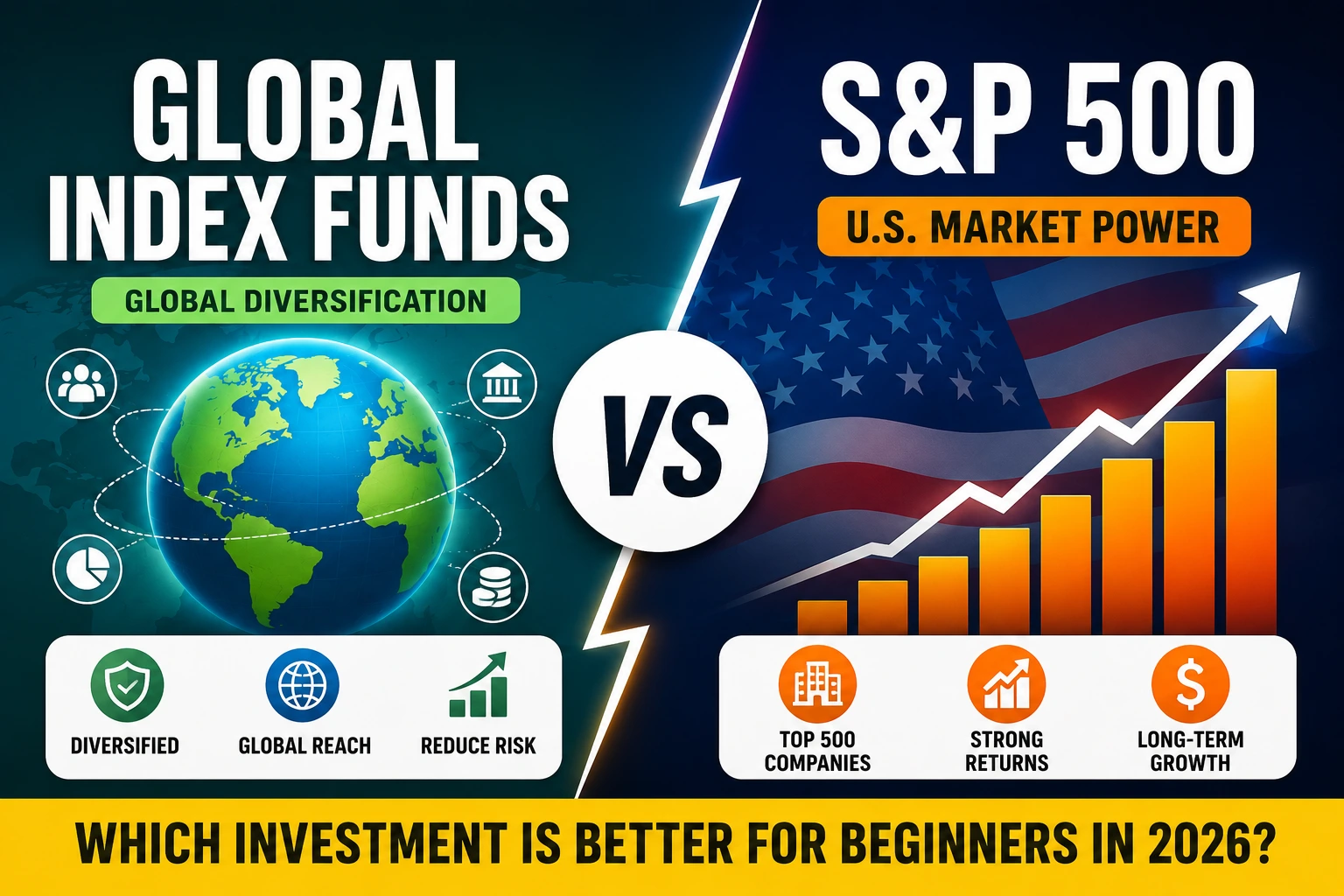
Global Index Funds vs S&P 500 is one of the most common questions beginners ask when starting their investing journey. While both investment options offer diversification and long-term growth potential, they differ in terms of global exposure, risk, and returns. In this guide, we’ll compare Global Index Funds and the S&P 500 in simple terms to help you decide which option may be the better choice for your financial goals.
What Is a Global Index Fund?
1. How Does a Global Index Fund Work?
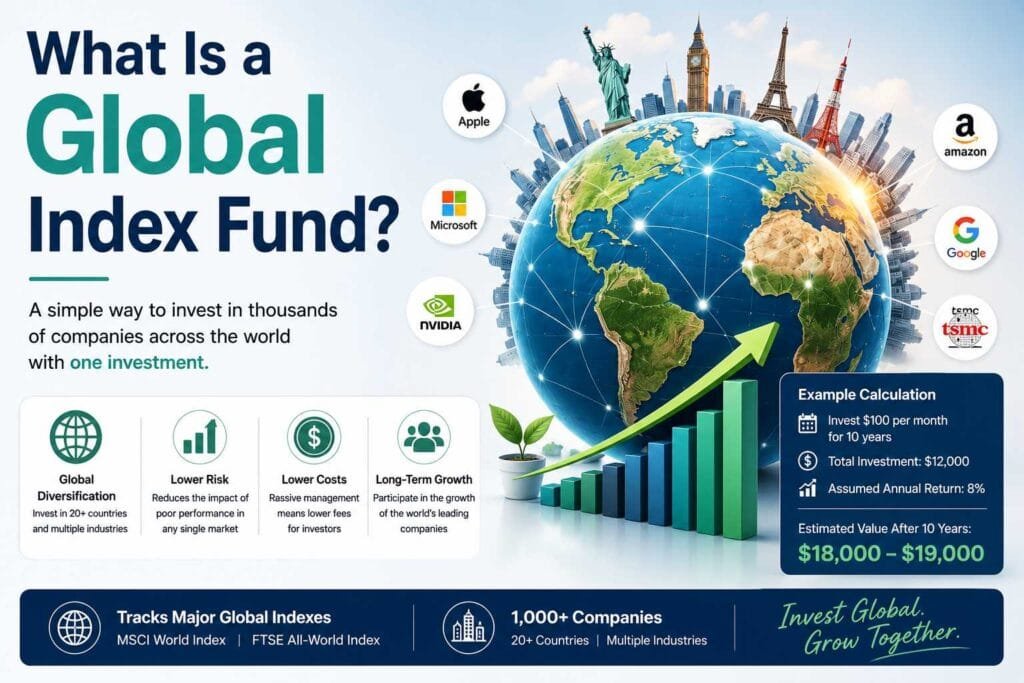
A Global Index Fund is an investment fund that allows investors to own a small share of hundreds or even thousands of companies around the world through a single investment. Instead of spending time researching individual stocks, investors can simply buy a Global Index Fund and instantly gain exposure to global markets.
For example, imagine you invest $100 per month in a Global Index Fund. Over 10 years, you would contribute $12,000 of your own money. If the fund earns an average annual return of 8%, your investment could grow to approximately $18,000–$19,000. This example shows how long-term investing and compounding can help grow wealth over time.
Most Global Index Funds track major indexes such as the MSCI World Index or the FTSE All-World Index. These indexes contain 1,000+ companies from 20+ countries, providing investors with broad diversification across different economies and industries.
A typical Global Index Fund may include global giants such as Apple, Microsoft, Nvidia, Amazon, and many other multinational corporations. Instead of relying on the success of just 1 company, investors gain exposure to hundreds or thousands of businesses through a single fund.
One of the biggest advantages of a Global Index Fund is portfolio diversification. If one country or sector performs poorly, strong performance from other regions may help balance overall returns. This is why many long-term investors prefer diversified funds over individual stock picking.
Another important benefit is passive investing. Because the fund simply follows an index, management costs are often lower than actively managed funds. A difference of just 1% per year in fees can potentially save investors thousands of dollars over a 20–30 year investment period.
For beginners looking to build long-term wealth, a Global Index Fund offers a simple way to invest globally, reduce risk through diversification, and participate in the growth of the world’s largest companies without constantly monitoring the stock market.Safe Investment Guide for Students During War Economic Crisis
What Is the S&P 500?
1. Definition of the S&P 500
The S&P 500 is one of the most popular stock market indexes in the world. It tracks the performance of approximately 500 of the largest publicly traded U.S. companies. Instead of investing in a single company, investors can gain exposure to hundreds of leading businesses through an S&P 500 index fund or ETF.
The index includes companies from multiple sectors, including technology, healthcare, finance, consumer goods, and energy. Some of the largest holdings often include Apple, Microsoft, Nvidia, Amazon, and other industry leaders.
To learn more about the index, visit the official S&P 500 Index page.
2. How Does the S&P 500 Work?
The S&P 500 is weighted by market capitalization, which means larger companies have a greater impact on the index’s performance. When major companies perform well, the overall index tends to rise.
For example, if an investor contributes $200 per month into an S&P 500 index fund, they would invest $2,400 per year. Over 20 years, that equals $48,000 in contributions. Assuming an average annual return of 10%, the investment could potentially grow to more than $150,000 through the power of long-term compounding.
Many investors choose the S&P 500 because it provides exposure to some of the most profitable companies in the world while requiring very little ongoing management.
Learn more about Market Capitalization and how index weighting works.
3. 3 Key Benefits of Investing in the S&P 500
Benefit #1: Strong Historical Performance
The S&P 500 has historically delivered attractive long-term returns, making it a popular choice for retirement and wealth-building portfolios.
Benefit #2: Low-Cost Investing
Most S&P 500 index funds have very low expense ratios. Saving even 0.50%–1% annually in fees can make a significant difference over a 20–30 year investment period.
Benefit #3: Exposure to World-Class Companies
Investors gain access to some of the world’s most successful businesses through a single investment rather than purchasing dozens of individual stocks.
To better understand index investing, explore this guide on Index Funds.
Global Index Funds vs S&P 500: Key Differences
1. Diversification: Which Investment Offers More Exposure?
One of the biggest differences between Global Index Funds vs S&P 500 is diversification. A Global Index Fund provides exposure to companies from multiple countries, while the S&P 500 focuses only on large U.S. companies.
For example, if you invest $10,000 in a Global Index Fund, your money may be spread across 20–50 countries and 1,000+ companies. In contrast, a $10,000 investment in the S&P 500 is invested entirely in the U.S. market through approximately 500 companies.
Investors looking for broader international exposure often prefer Global Index Funds, while those who believe in the long-term strength of the U.S. economy may prefer the S&P 500.
Learn more about Portfolio Diversification.
2. Returns and Growth Potential
When comparing Global Index Funds vs S&P 500, returns are one of the most important factors. Historically, the S&P 500 has often delivered higher returns because many of the world’s largest technology and growth companies are based in the United States.
Imagine two investors each invest $500 per month for 20 years.
- Investor A chooses a Global Index Fund with an average annual return of 8%.
- Investor B chooses the S&P 500 with an average annual return of 10%.
After 20 years:
- Global Index Fund ≈ $294,000
- S&P 500 ≈ $382,000
This example shows how even a small difference in annual returns can create a large gap over time through compounding.
You can learn more about Compound Interest and its impact on long-term investing.
3. Risk: Which Option Is Safer for Beginners?
Risk is another major consideration in Global Index Funds vs S&P 500. A Global Index Fund reduces dependence on a single country because investments are spread across multiple economies. If one region experiences a slowdown, other markets may help balance performance.
On the other hand, the S&P 500 depends entirely on the U.S. market. While the United States has historically been one of the strongest economies, investors face concentration risk by relying on a single country.
Risk Factor #1: Geographic Risk
A Global Index Fund spreads risk globally, while the S&P 500 is concentrated in the United States.
Risk Factor #2: Currency Risk
Global investors may face currency fluctuations when investing internationally. Understanding Foreign Exchange Risk is important before investing globally.
Risk Factor #3: Market Concentration
The S&P 500 can become heavily influenced by a small number of large technology companies, which may increase concentration risk during certain market conditions.
For beginners, both options can be excellent long-term investments, but the right choice depends on whether you prioritize global diversification or greater exposure to the U.S. market.
Global Index Funds vs S&P 500: Key Differences
1. Diversification Comparison
One of the biggest differences between Global Index Funds vs S&P 500 is diversification. A Global Index Fund invests across multiple countries and industries, while the S&P 500 focuses only on large U.S. companies.
For example, if you invest $10,000 in a Global Index Fund, your money may be spread across 1,000+ companies in 20–50 countries. In comparison, a $10,000 investment in the S&P 500 provides exposure to around 500 U.S. companies.
Investors who want maximum diversification often prefer Global Index Funds, while those seeking concentrated exposure to America’s largest companies may choose the S&P 500.
2. Returns and Growth Potential
Historically, the S&P 500 has delivered stronger returns than many international markets because it includes some of the world’s most profitable companies.
Suppose two investors contribute $500 per month for 20 years.
- Investor A chooses a Global Index Fund with an average return of 8%.
- Investor B chooses the S&P 500 with an average return of 10%.
After 20 years:
- Global Index Fund ≈ $294,000
- S&P 500 ≈ $382,000
This creates a difference of approximately $88,000, despite both investors contributing the same amount of money.
3. Global Index Fund vs S&P 500 Comparison Chart
| Feature | Global Index Fund | S&P 500 |
|---|---|---|
| Number of Companies | 1,000+ | Around 500 |
| Countries Covered | 20–50+ Countries | United States Only |
| Diversification | Very High | High |
| Global Exposure | Excellent | Limited |
| Historical Return Potential | 8–10% | 10–12% |
| Risk Level | Moderate | Moderate to High |
| Currency Risk | Yes | Low |
| Expense Ratio | Low | Very Low |
| Best For | Global Diversification | U.S. Growth |
| Beginner Friendly | Yes | Yes |
Quick Verdict
✔ Choose a Global Index Fund if you want worldwide diversification and lower dependence on a single country.
✔ Choose the S&P 500 if you want stronger exposure to America’s largest companies and higher historical growth potential.
✔ Many experienced investors combine both investments to benefit from global diversification and long-term U.S. market growth.
Final Verdict: Global Index Funds or S&P 500?
Which Investment Is the Smarter Choice for Beginners?
After comparing Global Index Funds vs S&P 500, the truth is that both can be excellent long-term investments. The better option depends on your investment goals, risk tolerance, and how much diversification you want in your portfolio.
A Global Index Fund is ideal for investors who want exposure to companies from around the world through a single investment. Instead of depending on one country, your money is spread across multiple economies and industries. This broader diversification can help reduce country-specific risk over the long term.
On the other hand, the S&P 500 focuses entirely on America’s largest companies. Historically, many of these businesses have delivered strong growth, making the S&P 500 one of the most popular investment choices for wealth building.
Example Portfolio Allocation
Suppose you have $10,000 to invest:
Option 1: Conservative Diversification
- $7,000 in a Global Index Fund
- $3,000 in the S&P 500
Best for investors who prioritize diversification.
Option 2: Balanced Strategy
- $5,000 in a Global Index Fund
- $5,000 in the S&P 500
Best for investors seeking a balance between global exposure and U.S. growth.
Option 3: Growth-Focused Strategy
- $3,000 in a Global Index Fund
- $7,000 in the S&P 500
Best for investors who strongly believe in long-term U.S. market growth.
Final Takeaway
If you want maximum diversification, choose a Global Index Fund.
If you want higher historical growth potential, choose the S&P 500.
If you cannot decide between the two, consider owning both. Many experienced investors combine Global Index Funds and the S&P 500 to create a diversified portfolio that benefits from worldwide market exposure and long-term U.S. economic growth.
For most beginners, consistency matters more than choosing the perfect fund. Investing regularly, staying invested for decades, and allowing compound growth to work over time are often more important than selecting one investment over another.Top Mutual Funds With 35%+ One-Year Returns — Deep Dive Analysis & Guide (2026 Data)
Summary
Both Global Index Funds and the S&P 500 are excellent investments for beginners. A Global Index Fund offers broader diversification by investing in companies across many countries, while the S&P 500 focuses on America’s largest and most successful businesses.
If your goal is global exposure and lower country-specific risk, a Global Index Fund may be the better choice. If you want stronger historical returns and believe in the long-term growth of the U.S. economy, the S&P 500 may be a better fit.
Ultimately, the best investment is the one you can consistently hold for the long term. Many successful investors even combine both to enjoy the benefits of global diversification and U.S. market growth.
- Emergency Fund vs Savings Account: Where to Keep Your Backup Cash in 2026?
- How to Organize Multiple Savings Goals Before 2027: A Simple Money Plan
- Cash Stuffing Method for Beginners: A Simple Step-by-Step Guide
- How to Budget When Living Paycheck to Paycheck
- How to Divide Your Salary for Beginners: Complete Guide With Examples
A Global Index Fund invests in companies from multiple countries around the world, providing broad international diversification. In contrast, the S&P 500 tracks approximately 500 of the largest publicly traded companies in the United States. The main difference is that a Global Index Fund offers global exposure, while the S&P 500 focuses entirely on the U.S. market.
Both can be excellent choices for beginners. A Global Index Fund is often preferred by investors who want maximum diversification and lower dependence on a single country. The S&P 500 may be a better option for those who believe in the long-term growth of the U.S. economy and want a simple, low-cost investment strategy.
Yes. Many experienced investors combine both investments in the same portfolio. This approach allows investors to benefit from global diversification while still maintaining strong exposure to leading U.S. companies. A balanced portfolio may help reduce risk while capturing growth opportunities from different regions of the world.
2 thoughts on “Global Index Funds vs S&P 500: The Smarter Choice for Beginner Investors in 2026”