

Introduction
7 Rules of Personal Finance? Managing money can be difficult, especially when you are just starting to take control of your finances. You may earn a regular income but still struggle to save, deal with unexpected expenses, manage debt, or know where to invest your money.
The problem is often not simply how much you earn, but how you manage the money you have. Without a clear system, it is easy to spend too much, delay saving, depend on debt, or make financial decisions without knowing what should come first.
So, what are the 7 rules of personal finance? These rules provide a simple framework for managing your money, from controlling spending and building an emergency fund to managing debt, investing, protecting your finances, and setting financial goals.
In this complete beginner’s guide, we’ll explain each rule with practical examples, common mistakes, and actionable steps so you can build a stronger financial foundation step by step.
Quick Answer: What Are the 7 Rules of Personal Finance?
The 7 rules of personal finance are:
- Spend Less Than You Earn — Keep your expenses below your income so you can create room for saving and investing.
- Create and Follow a Budget — Plan where your money should go and track your spending.
- Build an Emergency Fund — Keep savings available for unexpected expenses or a temporary loss of income.
- Manage High-Interest Debt — Pay attention to expensive debt because high interest can slow down your financial progress.
- Save and Invest Consistently — Save for short-term needs and invest appropriately for long-term financial goals.
- Protect Your Finances — Reduce major financial risks with appropriate insurance and other safeguards.
- Set Financial Goals and Review Your Progress — Give your money clear goals and regularly check whether you are moving toward them.
These seven rules work together. The goal is not to follow them perfectly from day one, but to build each habit step by step and create a financial system that fits your income, expenses, priorities, and long-term goals.
Rule 1: Spend Less Than You Earn
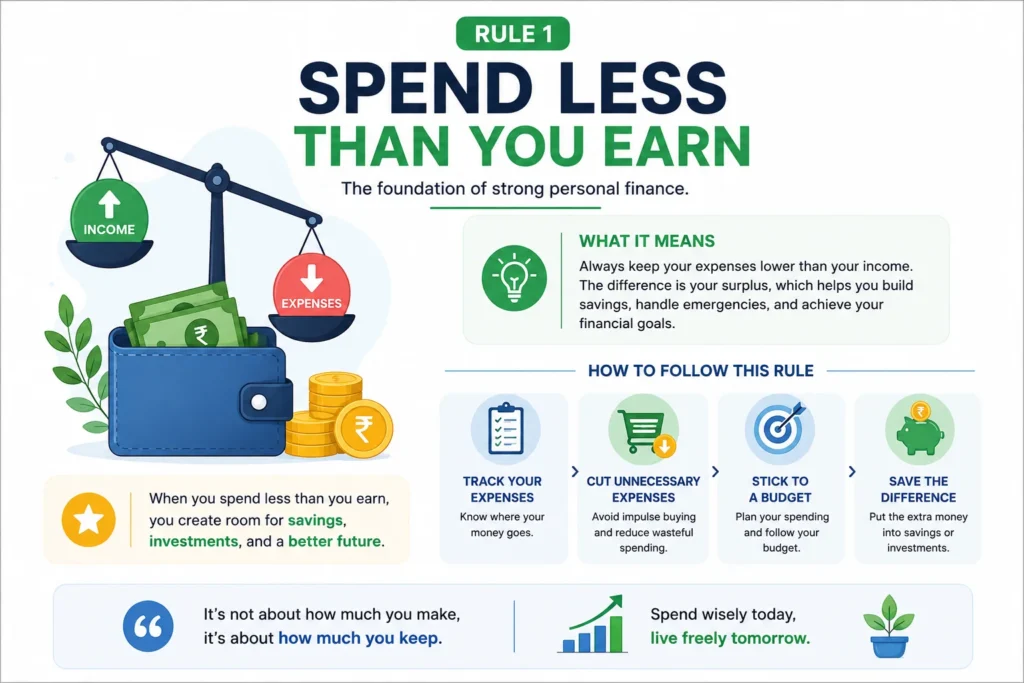
The first rule of personal finance is simple: spend less than you earn. It may sound obvious, but this basic habit creates the financial space you need to save money, handle unexpected expenses, repay debt, and work toward long-term goals.
If you earn ₹30,000 a month and spend ₹30,000, you have no financial surplus. But if you earn ₹30,000 and spend ₹25,000, you have ₹5,000 left that can be given a specific purpose.
The goal is not to stop enjoying your money. It is to make sure your spending does not consume everything you earn.
What Does “Spend Less Than You Earn” Mean?
At its simplest:
Income − Expenses = Financial Surplus
For example:
| Monthly Money | Amount |
|---|---|
| Take-home income | ₹30,000 |
| Essential expenses | ₹18,000 |
| Lifestyle spending | ₹5,000 |
| Other expenses | ₹2,000 |
| Money remaining | ₹5,000 |
That ₹5,000 is your financial surplus. Instead of allowing it to disappear through unplanned spending, you can direct it toward savings, an emergency fund, debt repayment, or an appropriate long-term financial goal.
Investor.gov’s official financial guidance recommends tracking income and expenses and including savings and investing when looking at your overall finances.
Why Is Spending Less Than You Earn So Important?
Most important financial goals require money to remain after your regular expenses have been paid.
- Saving requires a portion of your income to remain available.
- An emergency fund requires regular contributions.
- Debt repayment becomes easier when you have extra cash flow.
- Investing requires money that you do not need for immediate expenses.
- Financial goals become easier when your spending stays below your income.
Consider two people who both earn ₹30,000 per month.
Person A: earns ₹30,000 and spends ₹29,500, leaving ₹500.
Person B: earns ₹30,000 and spends ₹24,000, leaving ₹6,000.
They earn the same amount, but Person B has created much more financial breathing room.
This does not mean Person A is necessarily irresponsible. Their higher expenses could be caused by rent, healthcare, family responsibilities, transportation, or other essential costs. The important lesson is that income alone does not determine financial progress.
Spending Less Does Not Mean Living Miserably
A common misunderstanding about personal finance is that spending less means eliminating everything you enjoy.
That is not the goal.
You can still spend money on entertainment, hobbies, eating out, travel, or things that genuinely improve your quality of life. The important question is whether those expenses fit within your financial situation.
Before making a non-essential purchase, ask yourself:
- Do I actually need this?
- Does it provide enough value for its cost?
- Is this purchase delaying an important financial goal?
- Could I get similar value for less money?
- Can I comfortably afford it without using debt?
Good personal finance is not about saying “no” to everything. It is about deciding what deserves your money.
Understand Needs, Wants, and Desires
One practical way to control spending is to separate your expenses into needs, wants, and desires.
Needs
Needs are essential expenses required for basic living and important responsibilities. Examples include food, housing, basic clothing, healthcare, and necessary transportation.
Wants
Wants are things that improve comfort or lifestyle but are not essential. Examples include dining out, entertainment, vacations, and some subscriptions.
Desires
Desires are stronger aspirations or luxury purchases that can usually be delayed, such as an expensive phone, luxury car, or high-end electronics.
SEBI Investor’s guide to needs, wants and desires explains that prioritising needs before wants and desires can help people manage spending and make room for saving.
The point is not to eliminate wants and desires. It is to make sure they do not consume money that should first go toward essential expenses and important financial priorities.
Track Your Spending Before Trying to Fix It
Many people know exactly how much they earn but cannot explain where most of their money goes.
That makes it difficult to improve your finances.
For the next 30 days, record every expense. You can divide your spending into categories such as:
- Housing
- Food and groceries
- Transportation
- Utilities and bills
- Debt payments
- Shopping
- Entertainment
- Subscriptions
- Savings
- Investments
Do not worry about changing everything while you are tracking. First understand your actual spending pattern. Once you can see where your money goes, you can decide what needs to change.
Create a Monthly Spending Gap
After tracking your expenses, calculate your monthly surplus.
For example:
Income = ₹35,000
Total expenses = ₹29,000
Surplus = ₹6,000
Now the ₹6,000 needs a purpose.
Depending on your situation, it might be used for an emergency fund, high-interest debt repayment, a short-term financial goal, or long-term investing.
There is no single percentage that works for everyone. Your income, responsibilities, debt, location, goals, and financial stability all matter.
What If You Spend More Than You Earn?
Suppose your income is ₹30,000 but your monthly expenses are ₹32,000.
₹30,000 − ₹32,000 = −₹2,000
You have a monthly deficit of ₹2,000.
Do not immediately try to remove every small expense. First identify the biggest causes of the deficit.
- Calculate your actual take-home income.
- List all your monthly expenses.
- Identify your three largest discretionary expenses.
- Review recurring payments and subscriptions.
- Look for expenses that can realistically be reduced.
- Consider whether your income needs to increase.
- Use the money you free up to eliminate the deficit first.
If you already earn a reasonable income but still struggle to save, you can explore the deeper reasons in your related article, Why Can’t I Save Money? 5 Hidden Reasons You’re Still Broke Even With a Good Salary.
Watch Out for Lifestyle Inflation
One of the biggest challenges to spending less than you earn is lifestyle inflation.
Imagine your salary increases from ₹30,000 to ₹40,000. Instead of allowing some of that additional ₹10,000 to improve your savings or financial position, you increase your lifestyle by ₹10,000 as well.
Your income increased, but your financial surplus did not.
A better approach is to enjoy part of an income increase while directing another part toward savings, debt repayment, or other financial goals.
Build a System Instead of Depending on Willpower
Trying to remember every financial decision throughout the month can become exhausting. A simple system is easier to maintain.
You can think of your money flow like this:
Income → Essential expenses → Financial priorities → Flexible spending
When your financial priorities are decided in advance, you are less likely to spend the entire income before thinking about your future.
If your income changes from month to month, your system needs to be more flexible. In that situation, your existing guide on How to Budget with an Irregular Income can help you build a more suitable monthly approach.
Don’t Ignore Small Repeated Expenses
A single ₹100 expense may not look important. But repeated spending can become significant.
For example:
₹100 × 20 purchases = ₹2,000
This does not mean every ₹100 purchase is bad. The point is to identify spending patterns that happen automatically or provide very little value.
Investor.gov also highlights that small everyday expenses can add up over time, which is why tracking spending can reveal opportunities to save.
What Should You Do With the Money You Don’t Spend?
Creating a surplus is only the first step. The next step is giving that surplus a purpose.
Depending on your circumstances, your priorities might include:
- Building an emergency fund
- Paying down high-interest debt
- Saving for short-term goals
- Preparing for major future expenses
- Investing for appropriate long-term goals
An emergency fund can be especially useful because unexpected expenses can otherwise force you to rely on credit or loans. The Consumer Financial Protection Bureau’s emergency-fund guide explains how dedicated emergency savings can help people handle unplanned expenses and financial shocks.
Common Mistakes Beginners Make
1. Saving Only What Is Left
If you spend first and save whatever happens to remain, saving may become inconsistent.
2. Increasing Spending Every Time Income Increases
A higher income can improve your financial position, but only if some of the increase remains available for financial goals.
3. Ignoring Recurring Expenses
Subscriptions, memberships, EMIs, and automatic payments can quietly reduce your monthly surplus.
4. Using Debt for Unnecessary Lifestyle Spending
Borrowing can make something affordable today while creating a financial obligation for the future.
5. Following Someone Else’s Budget Exactly
A budget that works for another person may not work for you. Your income, responsibilities, expenses, and goals are different.
A Simple 30-Day Action Plan
Week 1: Track
Record every expense without trying to judge or change your behaviour immediately.
Week 2: Analyze
Separate needs from wants and identify your largest spending categories.
Week 3: Reduce
Choose one or two realistic expenses that you can reduce without creating an unsustainable lifestyle.
Week 4: Redirect
Give the money you saved a specific purpose, such as emergency savings, debt repayment, or another financial goal.
The goal is not to become perfect in 30 days. The goal is to build a system you can continue every month.
Quick Checklist
- ☐ I know my actual monthly take-home income.
- ☐ I track my monthly expenses.
- ☐ My total spending is lower than my income.
- ☐ I understand the difference between needs and wants.
- ☐ I am aware of lifestyle inflation.
- ☐ I have a plan for my monthly surplus.
- ☐ I am building financial security instead of spending everything I earn.
Key Takeaway
Spending less than you earn is not about living a miserable or extremely restrictive life. It is about creating financial breathing room.
When you consistently maintain a gap between your income and expenses, that surplus can become savings, emergency protection, debt reduction, and long-term wealth.
Earn → Spend intentionally → Keep a surplus → Give the surplus a purpose.
Once you understand how to create that surplus, the next question is how to control and organize your monthly spending. That brings us to Rule 2: Create and Follow a Budget.
Rule 2: Build an Emergency Fund Before You Need It
An emergency fund is one of the most important foundations of personal finance for beginners. It is money kept aside specifically for unexpected expenses or financial emergencies, so you do not have to depend immediately on credit cards, loans, or money meant for other goals.
The purpose is not to make you afraid of unexpected expenses. The purpose is to make sure that an unexpected expense does not completely destroy your monthly budget.
What Is an Emergency Fund?
An emergency fund is a separate pool of money reserved for expenses that are unexpected, necessary, and difficult to postpone. Examples can include an urgent medical bill, essential home or vehicle repair, sudden job loss, or an unexpected period of reduced income.
The Consumer Financial Protection Bureau (CFPB) describes an emergency fund as a cash reserve specifically set aside for unplanned expenses and financial emergencies. It also notes that even a small amount of emergency savings can provide some financial security.
CFPB: An Essential Guide to Building an Emergency Fund
Why Is an Emergency Fund So Important?
Without emergency savings, one unexpected expense can turn into a much larger financial problem. You may have to borrow money, use a credit card, sell investments at the wrong time, or delay important bills.
For example, imagine that you earn $2,000 a month and normally manage your expenses successfully. Then your car suddenly needs a $600 repair. If you have no emergency savings, that $600 may have to come from debt or money intended for rent, investing, or another financial goal.
With an emergency fund, the same problem can be handled using money that was already reserved for unexpected situations.
This is why an emergency fund is not simply another savings goal. It is a financial protection system.
How Much Should You Keep in an Emergency Fund?
There is no single emergency-fund amount that is perfect for everyone. Your target should depend on your essential monthly expenses, income stability, debt obligations, dependents, and how difficult it would be to replace your income.
A useful way to think about your target is in stages:
- Starter fund: Build a small first layer that can handle common minor emergencies.
- Basic emergency fund: Work toward several months of essential living expenses.
- Higher safety buffer: Consider a larger reserve if your income is unstable, you have dependents, or replacing your income would take longer.
FDIC consumer guidance notes that a common recommendation is to keep around three to six months of expenses in emergency savings, while also emphasizing that the appropriate amount depends on factors such as income and expenses.
FDIC: Emergency Savings Guidance
Calculate Your Emergency Fund From Essential Expenses
Do not automatically calculate your emergency fund from your total monthly spending. Start by identifying the expenses you would still need to pay if your income suddenly became limited.
Your essential monthly expenses might include:
- Rent or housing costs
- Basic groceries
- Utilities
- Essential transportation
- Insurance premiums
- Minimum debt payments
- Essential medical expenses
- Other necessary household costs
For example, if your essential expenses are $1,500 per month and you decide that your initial target is three months of essential expenses:
$1,500 × 3 = $4,500
Your target would therefore be $4,500 for a three-month emergency reserve.
This is only an example. Your actual target should reflect your own circumstances rather than blindly copying someone else’s number.
Start Small If You Cannot Save Thousands
One of the biggest mistakes beginners make is believing that an emergency fund is useless unless they can immediately save several months of expenses.
That mindset can prevent people from starting at all.
If your income is limited, begin with an amount that is realistic for you. Even a small reserve can be useful when an unexpected expense appears.
For example, you could create milestones such as:
- First goal: build your first small emergency buffer.
- Second goal: cover one common unexpected expense.
- Third goal: build one month of essential expenses.
- Long-term goal: gradually increase the fund toward several months of essential expenses.
The important principle is progress. Your emergency fund does not have to be perfect on day one.
Where Should You Keep Your Emergency Fund?
An emergency fund should be safe, accessible, and separated enough from everyday spending that you are not tempted to use it for unnecessary purchases.
A dedicated savings or bank account can make the purpose of the money clearer. The best place will depend on your country, available accounts, access requirements, fees, and applicable protections.
The CFPB recommends considering safety and accessibility when deciding where to keep emergency savings.
CFPB: Where to Keep Emergency Savings
Keep Your Emergency Fund Separate From Everyday Spending
If your emergency money sits in the same account you use for shopping, entertainment, subscriptions, and daily spending, it can become very easy to spend it without realizing it.
A simple system is:
- Everyday money: regular bills and daily expenses.
- Emergency money: unexpected and necessary expenses only.
- Goal-based savings: planned purchases and short-term goals.
- Investment money: long-term wealth-building.
This separation makes the purpose of each dollar easier to understand and reduces accidental spending.
What Counts as a Financial Emergency?
Not every unexpected purchase is an emergency. A useful test is to ask three questions:
- Was the expense genuinely unexpected?
- Is it necessary or financially important?
- Can the expense reasonably wait until it can be paid from normal income?
Examples that may qualify include:
- Unexpected essential medical costs
- Urgent home repairs
- Necessary vehicle repairs
- Unexpected loss or reduction of income
- Essential emergency travel
- Other major unplanned expenses that cannot reasonably be postponed
What Should You NOT Use an Emergency Fund For?
An emergency fund should not become a general-purpose spending account.
It is usually better not to use emergency savings for:
- A new phone when your current phone works
- Shopping during a sale
- Planned vacations
- Entertainment
- Luxury purchases
- Regular monthly bills that you already knew about
- Investments that you simply want to make
Planned expenses should normally have their own savings category instead of being taken from your emergency reserve.
Emergency Fund vs. Regular Savings: What Is the Difference?
Regular savings and emergency savings both involve putting money aside, but they serve different purposes.
| Emergency Fund | Regular Savings |
|---|---|
| Unexpected financial problems | Planned future expenses |
| Medical emergency or urgent repair | Vacation or new phone |
| Unexpected income loss | Planned purchase |
| Used only when necessary | Used according to your savings goal |
Keeping these purposes separate helps you avoid spending your emergency reserve on expenses that could have been planned for in advance.
How Can You Build an Emergency Fund on a Low Income?
Building emergency savings on a low income can be difficult, but the strategy does not have to be complicated.
Start by choosing a small amount that you can consistently save. It could be a fixed amount from every paycheck or a percentage of your income.
For example, if you can comfortably save $25 from each paycheck, do not dismiss it because it seems small. Consistency turns small contributions into a growing financial buffer.
You can also direct occasional extra money toward the fund, such as bonuses, gifts, refunds, or income from temporary work, while still keeping enough money available for your essential needs.
The CFPB also recommends starting with what you can afford and building the emergency fund over time rather than waiting until you can save a large amount at once.
What If Your Income Is Irregular?
If your income changes from month to month, an emergency fund becomes even more useful because your financial risk is different from someone with a highly predictable paycheck.
Instead of depending on a fixed monthly savings amount, you can use a flexible system:
- Save a minimum amount during low-income months.
- Save more during stronger-income months.
- Send part of unexpected extra income to your emergency fund.
- Protect the fund from unnecessary withdrawals.
If your income is irregular, you can also learn more about creating a survival budget and managing variable income in your related guide:
How to Budget with an Irregular Income: Step-by-Step Guide (2026)
Should You Build an Emergency Fund Before Investing?
For many beginners, building at least an initial emergency buffer before taking significant investment risk can make the overall financial system more stable.
The reason is simple: investments are designed for longer-term goals and can fluctuate in value. An emergency fund is designed for money you may need unexpectedly and should therefore prioritize accessibility and stability.
This does not mean every person must stop investing completely until they reach a large emergency-fund target. Your decision should consider your income, debt, financial responsibilities, and risk tolerance.
The key principle is to avoid putting money into investments that you may suddenly need for an emergency.
What Should You Do If You Have to Use Your Emergency Fund?
Using your emergency fund does not mean you failed.
That is exactly what the fund is designed for.
If a genuine emergency happens and you need to use the money, focus first on solving the emergency. After the situation is under control, make rebuilding your emergency fund your next financial priority.
For example:
Emergency → Use the fund → Stabilize your finances → Rebuild the fund → Return to normal saving and investing.
The CFPB specifically recommends rebuilding emergency savings after you have used it for an unexpected expense.
Common Emergency Fund Mistakes Beginners Make
1. Waiting Until You Can Save a Large Amount
Waiting for the perfect income level can delay your emergency savings for years. Start with what is realistic today.
2. Keeping the Money Too Easy to Spend
If emergency savings are mixed with everyday spending money, you may accidentally treat them as available spending money.
3. Using the Fund for Wants
A discount, vacation, gadget, or entertainment purchase is not automatically an emergency just because it was unexpected.
4. Never Rebuilding the Fund
After using emergency savings, some people simply continue with their normal budget. That leaves them exposed to the next unexpected expense.
5. Copying Someone Else’s Target
Your emergency-fund requirement depends on your own expenses, income stability, responsibilities, and financial situation. A target that works for one household may be too small or unnecessarily large for another.
A Simple Emergency Fund Building System
You can turn the rule into a simple system instead of relying on motivation.
- Calculate essential monthly expenses.
- Choose your first realistic savings milestone.
- Create a separate place for emergency savings.
- Automate or schedule contributions when possible.
- Add extra money when your income allows.
- Use the fund only for genuine emergencies.
- Rebuild it after every major withdrawal.
- Review the target whenever your income or responsibilities change.
Automatic transfers can make saving easier because the money is moved before you have an opportunity to spend it. FDIC consumer guidance also highlights automatic transfers as a practical way to build savings over time.
FDIC: Saving for the Unexpected and Your Future
A Practical Example: Building an Emergency Fund Step by Step
Imagine a beginner has essential monthly expenses of $1,200.
Instead of thinking, “I need thousands of dollars immediately,” the person can create milestones.
- Stage 1: Build a small starter buffer.
- Stage 2: Increase the fund until it can handle a common unexpected expense.
- Stage 3: Reach one month of essential expenses.
- Stage 4: Continue building toward several months of essential expenses.
This approach makes a large financial goal feel more achievable because you are focusing on the next milestone rather than the entire journey at once.
Emergency Fund Quick Checklist
- ☐ I know my essential monthly expenses.
- ☐ I have a separate emergency savings location.
- ☐ I have chosen a realistic first savings target.
- ☐ I contribute regularly, even if the amount is small.
- ☐ I know what qualifies as an emergency.
- ☐ I avoid using emergency savings for wants.
- ☐ I increase my target when my financial responsibilities increase.
- ☐ I rebuild the fund after using it.
Key Takeaway
An emergency fund is not about predicting exactly when something will go wrong. It is about preparing before something goes wrong.
The strongest approach is to start with an amount you can realistically save, keep the money accessible and separate from everyday spending, use it only for genuine emergencies, and gradually increase the reserve as your financial situation improves.
Once you have a basic financial safety net, the next rule becomes important: protecting that progress by managing debt carefully and avoiding financial decisions that can push you backward.
Rule 3: Pay Off High-Interest Debt
One of the most important rules of personal finance is to control and pay off high-interest debt. Debt itself is not always bad, but expensive debt can quietly consume your income and make it much harder to save, invest, or build financial security.
If a large part of your monthly income goes toward interest and debt payments, you have less money available for your future. That is why understanding which debt deserves the most attention is an essential part of personal finance for beginners.
Why High-Interest Debt Can Hold You Back
Imagine you have ₹50,000 of debt carrying a very high interest rate. Even if you make regular payments, a significant portion of your money may go toward interest instead of reducing the amount you originally borrowed.
This creates a cycle:
Debt → Interest → Higher payments → Less money available for saving → More dependence on credit.
The problem becomes even worse when you continue borrowing while trying to repay the old debt.
Paying expensive debt down can therefore improve your monthly cash flow and give you more control over your money.
Not All Debt Is the Same
A common beginner mistake is treating every type of debt as equally dangerous.
Instead, look at three things:
- Interest rate: How expensive is the debt?
- Balance: How much do you still owe?
- Purpose: What did the borrowed money pay for?
High-interest consumer debt generally deserves more urgent attention because the cost of carrying it can grow quickly.
Lower-cost debt used for an important long-term purpose may require a different strategy. The right decision depends on the interest rate, repayment terms, your cash flow, and your overall financial situation.
Find Your Most Expensive Debt First
Make a simple list of everything you owe.
| Debt | Balance | Interest Rate | Priority |
|---|---|---|---|
| Credit card | ₹40,000 | High | High |
| Personal loan | ₹80,000 | Medium | Medium |
| Lower-rate loan | ₹2,00,000 | Lower | Lower |
This simple comparison can reveal where your money is being lost most quickly.
Do not choose a repayment strategy based only on the size of the balance. A smaller debt with a much higher interest rate can sometimes be costing you more than a larger, lower-rate debt.
Two Popular Ways to Pay Off Debt
Once you know which debts you have, two common approaches are the debt avalanche and the debt snowball.
Debt Avalanche
With the avalanche method, you continue making required payments on all debts while directing extra money toward the debt with the highest interest rate.
After that debt is cleared, you move the extra payment toward the next-highest-rate debt.
Best suited for: people who want to focus primarily on reducing interest costs.
Debt Snowball
With the snowball method, you continue required payments on all debts but direct extra money toward the smallest balance first.
Once that debt disappears, you move the payment toward the next-smallest balance.
Best suited for: people who benefit from quick psychological wins and visible progress.
Neither method is automatically perfect for everyone. The most useful strategy is the one you can consistently follow while meeting all required payments.
Never Ignore Minimum Payments
While aggressively paying one debt, do not simply stop paying your other debts.
Your repayment system should first protect you from missed payments, penalties, and additional financial damage. Then any extra amount can be directed toward your priority debt.
A simple system is:
Pay required amounts on all debts → Choose one priority debt → Put extra money toward it → Clear it → Move to the next.
Should You Stop Saving While Paying Debt?
This is where many beginners make an extreme decision.
They either ignore debt completely while investing, or they put every available rupee into debt and keep absolutely no emergency savings.
A more balanced approach is often better.
Try to maintain at least a basic emergency buffer while aggressively dealing with expensive debt. Otherwise, one unexpected expense could force you to borrow again and undo your progress.
Your exact balance between debt repayment and saving depends on the interest rate, income stability, emergency needs, and financial responsibilities.
Stop the Debt From Coming Back
Paying off debt is only half the solution.
If the behaviour that created the debt continues, the balance can return.
Before using credit for a purchase, ask:
- Can I afford this from my current income?
- Is this purchase necessary?
- Am I borrowing because I genuinely need it or because I want it immediately?
- Will the repayment make next month’s budget harder?
If you repeatedly use debt to cover normal living expenses, the underlying problem may be that your spending is too high compared with your income. In that situation, return to the reasons you may be struggling to save money and identify the root cause instead of treating every new loan as a separate problem.
A Simple Debt-Payoff Plan
- List every debt with its balance, interest rate, and required payment.
- Protect your required payments so you do not create additional problems.
- Choose one priority debt using the avalanche or snowball approach.
- Put extra money toward that debt whenever your budget allows.
- Avoid taking new unnecessary debt while paying the old debt.
- Move the freed-up payment toward your next financial priority after the debt is cleared.
Quick Debt Checklist
- ☐ I know exactly how much I owe.
- ☐ I know the interest rate on each debt.
- ☐ I make all required payments on time.
- ☐ I have chosen a debt-payoff strategy.
- ☐ I am prioritising expensive debt.
- ☐ I am avoiding unnecessary new borrowing.
- ☐ I have a plan for the money freed after a debt is cleared.
Key Takeaway
Debt becomes dangerous when its cost prevents you from moving forward financially. The goal is not simply to become debt-free as quickly as possible at any cost. The goal is to reduce expensive debt while protecting your basic financial stability.
Know what you owe, understand the interest you are paying, choose a repayment strategy, and prevent unnecessary new debt from replacing the old debt.
Know your debt → Prioritise expensive debt → Pay consistently → Avoid new unnecessary borrowing → Redirect the freed-up money.
Rule 4: Save and Invest for Your Future
Saving money gives you financial stability today, but saving and investing for the future helps you prepare for tomorrow.
This is where personal finance starts moving beyond simply “spending less.” Once your basic expenses are under control and expensive debt is being managed, you need a plan for the money you want to keep for future goals.
You do not need to become an investing expert overnight. As a beginner, the first goal is to understand why you are saving, when you will need the money, and how much risk you can realistically handle.
Saving and Investing Are Not the Same Thing
Saving and investing are connected, but they serve different purposes.
| Saving | Investing |
|---|---|
| Usually for short-term or near-term needs | Usually for longer-term goals |
| Focuses more on safety and accessibility | Focuses on potential long-term growth |
| Useful for emergencies and planned expenses | Useful for long-term wealth-building |
| Generally lower risk | Can involve market risk |
For example, money you may need next month should not normally be treated the same way as money you do not expect to need for many years.
That simple difference can prevent a common beginner mistake: putting short-term money into something that can fluctuate significantly when you actually need it.
Give Every Saving Goal a Purpose
Instead of simply saying, “I want to save more money,” give your savings a specific job.
You might have separate goals for:
- Emergency expenses
- Upcoming purchases
- Education or skill development
- Travel
- Major household expenses
- Long-term financial independence
A goal becomes easier to act on when you know how much you need and when you need it.
For example, if you want ₹24,000 for a purchase in 12 months:
₹24,000 ÷ 12 = ₹2,000 per month
Now “save ₹24,000” becomes a simple monthly target of ₹2,000.
Start Investing Only After Understanding the Basics
Investing can help your money grow over long periods, but it is not a guaranteed way to make money quickly.
Different investments have different levels of risk. The value of market-linked investments can rise and fall, sometimes significantly.
That is why beginners should avoid choosing an investment simply because someone online says it will give high returns.
Before investing, understand at least these four things:
- What are you investing in?
- What risks are involved?
- How long can you keep the money invested?
- What fees or costs are involved?
SEBI’s investor education resources also emphasize understanding investments and their risks before making investment decisions.
SEBI Investor: Official Investor Education Resources
Think About Time Before Choosing an Investment
Your time horizon matters.
Imagine you need ₹50,000 in six months for an important expense. Taking substantial market risk with that money may not make sense because you have very little time to recover if the investment falls.
Now imagine you are investing money for a goal that is decades away. You have much more time to handle short-term market fluctuations.
So instead of asking:
“Which investment gives the highest return?”
Start with:
“When will I need this money, and how much risk can I afford?”
That is a much healthier starting point for a beginner.
Use Compounding to Your Advantage
One reason people invest for the long term is the potential effect of compounding.
Compounding means that returns can themselves generate returns over time. The longer money remains invested and the more consistently you contribute, the more important this effect can become.
For example, suppose you invest ₹2,000 every month for many years. You are not only contributing your own money; over time, investment growth can also contribute to the value of the portfolio.
The exact result will depend on the investment, returns, fees, taxes, and market conditions. There is no guaranteed return.
The important lesson is simple:
Time can be one of an investor’s biggest advantages.
Do Not Wait for the “Perfect” Time to Start
Many beginners keep waiting.
“I will start when my salary increases.”
“I will invest after I understand everything.”
“I will start next year.”
Learning before investing is good. But waiting forever for perfect conditions can become another form of procrastination.
You do not need to know everything before beginning your financial education. Start by understanding basic concepts, building good money habits, and making decisions that match your situation.
What If You Can Only Invest a Small Amount?
Do not compare your beginning with someone else’s portfolio.
If you can invest only ₹500 or ₹1,000 per month right now, that does not make your effort meaningless.
Your first goal is to build the habit of consistently setting money aside while improving your income and financial knowledge.
As your income grows, your contribution can grow too.
The bigger mistake is not starting small. It is believing that small amounts do not matter and therefore never developing the habit at all.
Don’t Invest Money You May Need Soon
This is one of the simplest rules beginners can remember.
If money has an important short-term job, keep its risk appropriate to that job.
For example:
- Emergency money → prioritise safety and accessibility.
- Money needed soon → avoid taking unnecessary investment risk.
- Long-term goal money → consider suitable long-term investments after understanding the risks.
This separation makes your financial system much easier to manage because every pool of money has a clear purpose.
A Simple Saving and Investing System
You do not need a complicated portfolio or dozens of financial products.
Start with a simple sequence:
- Control your monthly spending.
- Build an emergency buffer.
- Deal with expensive debt.
- Define your financial goals.
- Decide when you will need each goal’s money.
- Choose saving or investing according to the goal and risk.
- Contribute consistently and review your plan periodically.
The point is not to create the most complicated financial system. The point is to create one you can actually maintain.
Common Mistakes Beginners Make
1. Chasing High Returns
A higher potential return usually comes with higher risk. “High return with no risk” should immediately make you cautious.
2. Investing Without an Emergency Buffer
If every unexpected expense forces you to sell investments, your long-term plan can become difficult to maintain.
3. Copying Someone Else’s Portfolio
Another person’s income, goals, age, responsibilities, and risk tolerance may be completely different from yours.
4. Constantly Switching Investments
Changing investments every time you hear a new prediction can turn long-term investing into emotional decision-making.
5. Ignoring Fees and Taxes
Returns are not the only thing that matters. Costs and taxes can affect the amount of money you actually keep.
Quick Checklist
- ☐ I have clear financial goals.
- ☐ I know when I will need the money for each goal.
- ☐ I understand the difference between saving and investing.
- ☐ I understand the basic risks of what I am investing in.
- ☐ I am not investing emergency money unnecessarily.
- ☐ I am investing according to my time horizon.
- ☐ I am focusing on consistency rather than quick profits.
- ☐ I review my financial plan when my circumstances change.
Key Takeaway
Saving protects your financial stability, while appropriate long-term investing can help your money work toward future goals.
You do not need a huge salary or a complicated investment strategy to begin. Start with clear goals, understand your risk, keep short-term money appropriately safe, and build the habit of putting money aside consistently.
Save for near-term needs → Protect your emergency fund → Understand risk → Invest for appropriate long-term goals → Stay consistent.
Rule 5: Set Clear Financial Goals
Saving money without knowing why you are saving can make personal finance feel frustrating. You may put money aside every month, but after a while you may still wonder, “What am I actually working toward?”
That is why the fifth rule of personal finance is to set clear financial goals.
A financial goal gives your money a direction. Instead of simply trying to “save more,” you know what the money is for, how much you need, and when you want to reach it.
Turn “I Want to Save Money” Into a Real Goal
Compare these two statements:
Goal A: “I want to save more money.”
Goal B: “I want to save ₹60,000 for an emergency fund within the next 12 months.”
Goal B is much easier to act on because it gives you three important pieces of information:
- What: ₹60,000
- Why: Emergency fund
- When: 12 months
Once a goal becomes specific, you can turn it into a monthly plan.
₹60,000 ÷ 12 months = ₹5,000 per month.
Now you are no longer simply “trying to save.” You have a measurable target.
Use Three Time Horizons
You do not need dozens of financial goals. A simple way to organise them is to divide them into three time horizons.
| Time Horizon | Possible Goals |
|---|---|
| Short term | Emergency buffer, upcoming purchase, annual expense |
| Medium term | Education, business capital, major purchase |
| Long term | Retirement, financial independence, long-term wealth |
This separation matters because money needed soon should generally be managed differently from money you do not expect to need for many years.
It also prevents a common mistake: treating every financial goal as if it has the same deadline and the same risk requirements.
Give Your Goals a Number and a Deadline
A goal becomes much more useful when you can measure it.
For every important goal, write down:
- Target amount
- Target date
- Current amount
- Monthly contribution
- Priority
For example:
| Goal | Target | Deadline | Monthly Amount |
|---|---|---|---|
| Emergency fund | ₹60,000 | 12 months | ₹5,000 |
| Education | ₹36,000 | 12 months | ₹3,000 |
| Vacation | ₹24,000 | 12 months | ₹2,000 |
Now your money has a job instead of simply sitting inside a vague “savings” category.
Not Every Goal Should Be a Priority
This is where real-life personal finance becomes important.
You may want to build an emergency fund, buy a new phone, invest for retirement, repay debt, travel, and save for education—all at the same time.
But your income may not be large enough to fully fund everything simultaneously.
That is okay.
Instead of trying to do everything at once, rank your goals.
A simple priority order could be:
- Essential financial stability
- Emergency protection
- Expensive debt reduction
- Important short- and medium-term goals
- Long-term wealth-building
- Optional lifestyle goals
Your exact order can change depending on your circumstances. Someone with expensive debt may need a different priority from someone who has stable income and no significant debt.
Use the “Why” Behind the Goal
A number alone may not keep you motivated.
Knowing why the goal matters to you can make it easier to stay consistent.
For example:
“I want ₹50,000” is just a number.
“I want ₹50,000 so that an unexpected expense does not force me to borrow money” has a clear purpose.
The second version connects the financial target with a real problem you want to solve.
When you feel tempted to spend the money unnecessarily, that purpose can remind you what you are working toward.
Break Big Goals Into Small Wins
A ₹5 lakh goal can feel overwhelming when you look at the entire number.
Instead, break it into smaller milestones.
For example:
₹5,00,000 goal
↓
₹50,000 → ₹1,00,000 → ₹2,00,000 → ₹3,00,000 → ₹4,00,000 → ₹5,00,000
Each milestone gives you something measurable to celebrate.
This is particularly useful when the final goal may take several years. You do not need to mentally carry the entire target every day. Focus on the next milestone.
What If Your Income Is Too Small for Your Goals?
This is a situation many beginners face.
You calculate your goals and realise that the required monthly amount is higher than what you can realistically save.
For example:
Required monthly saving = ₹10,000
Affordable monthly saving = ₹4,000
That does not mean the goal is impossible.
You have several options:
- Extend the deadline.
- Reduce the target amount.
- Temporarily lower the priority of another goal.
- Reduce unnecessary expenses.
- Look for ways to increase income.
- Combine several of these approaches.
A realistic goal that takes longer is usually better than an unrealistic goal that makes you give up after two months.
Keep Planned Goals Separate From Emergency Money
Suppose you are saving for a vacation and also building an emergency fund.
If you keep both amounts in one mental bucket, it becomes easy to spend emergency money on the vacation—or postpone your emergency savings because the vacation feels more exciting.
Give different goals different names and, where practical, separate them into different savings categories or accounts.
This simple separation makes it easier to see what money is actually available for each purpose.
Review Your Goals When Your Life Changes
A financial goal is not a contract that can never change.
Your income may increase. Your expenses may change. You may get married, move to another city, change jobs, start a business, or take on new responsibilities.
When your situation changes, your goals should be reviewed too.
A good habit is to review your major financial goals periodically and ask:
- Is this goal still important?
- Has the target amount changed?
- Is the deadline still realistic?
- Am I contributing enough?
- Has another goal become more important?
Changing a goal does not mean you failed. It means your financial plan is adapting to your actual life.
A Simple Goal-Setting System
You can turn this entire rule into a simple five-step process:
- Choose the goal. Decide exactly what you want your money to accomplish.
- Put a number on it. Estimate the amount you will need.
- Choose a deadline. Decide when you want to reach it.
- Calculate the monthly contribution. Divide the required amount by the available time, while adjusting for your current savings.
- Review and adjust. Increase, decrease, or extend the plan when your circumstances change.
For example:
Goal: ₹1,20,000
Current savings: ₹20,000
Remaining: ₹1,00,000
Time: 20 months
Required average contribution: ₹5,000 per month
Now the goal is no longer abstract. You know exactly what needs to happen.
Quick Goal-Setting Checklist
- ☐ I know what I am saving or investing for.
- ☐ Each important goal has a target amount.
- ☐ Each goal has a realistic deadline.
- ☐ I know how much I need to contribute regularly.
- ☐ I have prioritised my goals.
- ☐ I have separated emergency money from planned spending.
- ☐ I review my goals when my circumstances change.
Key Takeaway
Money becomes easier to manage when it has a clear destination.
You do not need twenty different financial goals. Start with the goals that matter most, give each one a number and a deadline, and turn the large target into smaller monthly actions.
Choose the goal → Give it a number → Set a deadline → Prioritise it → Take small consistent steps → Review and adjust.
The next step is to make sure your financial plan does not depend only on your current income. That brings us to Rule 6: Increase Your Income and Protect Your Financial Progress.
Rule 6: Increase Your Income and Protect Your Financial Progress
There is a limit to how much you can improve your finances by cutting expenses alone. You can cancel subscriptions, reduce unnecessary spending, and create a strict budget—but if your income stays too low while your responsibilities keep increasing, eventually you may feel stuck.
That is why an important part of personal finance for beginners is learning how to increase your earning power while protecting the financial progress you have already made.
The goal is not simply to earn more money and then spend more money. The real goal is to create a gap between what you earn and what you need, then use that gap to build savings, reduce debt, and invest for the future.
Why Increasing Income Matters
Imagine two people.
Person A earns ₹20,000 per month and spends ₹19,500.
Person B earns ₹40,000 per month and spends ₹25,000.
Person B has much more room to save, invest, handle emergencies, and work toward financial goals.
This does not mean earning more automatically makes someone financially successful. Someone can earn ₹1 lakh and still spend ₹1.1 lakh. The important number is the gap between income and spending.
Income − Essential and controlled spending = Money available for financial progress
Increasing that gap gives your financial plan more room to breathe.
Do Not Depend on Only One Income Strategy
When people hear “increase your income,” they often immediately think about starting a side hustle.
But there are several ways to improve your earning power:
- Increase your main income: improve your skills, take on better responsibilities, negotiate when appropriate, or move toward better-paying work.
- Add a second income stream: freelance work, services, digital products, or another legitimate source of income.
- Monetise a useful skill: writing, design, programming, editing, research, teaching, or another skill people are willing to pay for.
- Reduce income leaks: make sure money is not disappearing through unnecessary fees, poor financial decisions, or repeated avoidable expenses.
You do not need to pursue all of these at once. Choose the option that fits your current skills, available time, and situation.
Build Skills That Increase Your Earning Power
A useful long-term approach is to treat some of your time and money as an investment in your ability to earn more.
For example, learning a skill that helps you qualify for better work can have a much larger long-term effect than saving a few hundred rupees by cutting every small expense.
Ask yourself:
- What skill could make me more valuable in my current work?
- What skill could help me move into a better-paying role?
- What service could I realistically offer to other people?
- What skill can I practise consistently with the time I have available?
The best skill is not necessarily the trendiest one. It is the one you can actually learn, practise, demonstrate, and eventually use to create value.
Turn Extra Income Into Financial Progress
Suppose your income increases by ₹10,000 per month.
You now have a choice.
You could increase your lifestyle by the full ₹10,000, or you could use part of the increase to improve your financial position.
For example:
- ₹3,000 → emergency savings
- ₹3,000 → debt repayment
- ₹2,000 → long-term investing
- ₹2,000 → lifestyle improvement
The exact numbers do not matter. The principle does.
When income increases, do not automatically allow spending to increase by the same amount.
Give your extra income a job before it disappears into lifestyle spending.
Watch Out for Lifestyle Inflation
Lifestyle inflation happens when your spending rises as your income rises.
You get a raise, so you upgrade your phone. Then you move to a more expensive apartment. Then you start eating out more often. Soon your salary is higher, but your financial situation has barely improved.
This can create a frustrating situation where someone earns significantly more than before but still says:
“I don’t know where my money goes.”
You do not have to live exactly the same way forever. Enjoying some of your increased income is perfectly reasonable. The problem is allowing every income increase to become a permanent increase in expenses.
A useful rule is:
Let your lifestyle improve slower than your income.
That creates room for your savings, investments, and financial security to grow.
What If You Have Very Little Time?
You do not need to create a complicated second business after working all day.
If your available time is limited, focus on one realistic improvement instead of trying five different income ideas simultaneously.
For example:
Current situation: 1 hour available each evening.
Bad approach: Start freelancing, YouTube, blogging, trading, dropshipping, and five courses at the same time.
Better approach: Choose one skill, practise it consistently, create a few examples of your work, and gradually look for opportunities to earn from it.
Financial progress does not require doing everything. It requires doing the right things consistently.
Protect Your Higher Income
Earning more is useful only if the additional money actually improves your financial position.
Once your income rises, protect the progress by keeping a simple system:
- Increase your savings rate.
- Pay down expensive debt.
- Continue building your emergency reserve.
- Invest appropriately for long-term goals.
- Allow some money for enjoyment.
This balance matters. A financial plan that gives you no room to enjoy your money can become so restrictive that you eventually abandon it.
A Simple Income-Growth Experiment
Instead of thinking about increasing your income as a huge life-changing project, try a 90-day experiment.
Days 1–30: Identify one skill that could increase your earning potential and start learning or improving it.
Days 31–60: Practise the skill and create something that demonstrates what you can do.
Days 61–90: Look for realistic opportunities to use that skill—additional work, freelance projects, clients, better job opportunities, or another legitimate route.
You may not double your income in 90 days. That is not the point.
The point is to create a repeatable process for increasing your earning ability instead of waiting for your income to magically improve.
When Your Income Increases, Ask These Questions
Before changing your lifestyle after a raise or new income source, stop for a moment and ask:
- How much of this additional income will improve my financial security?
- Do I have expensive debt that should receive more money?
- Is my emergency fund strong enough?
- What long-term goal could this money accelerate?
- How much can I enjoy without damaging my financial plan?
These questions help you enjoy progress without accidentally spending all of it.
Quick Checklist
- ☐ I know how much money I earn each month.
- ☐ I know how much of my income is actually available after essential expenses.
- ☐ I am working on at least one skill that can improve my earning power.
- ☐ I am not depending entirely on lifestyle cuts to improve my finances.
- ☐ I avoid automatically increasing my lifestyle whenever my income increases.
- ☐ I give extra income a specific purpose.
- ☐ I balance saving, debt repayment, investing, and reasonable enjoyment.
- ☐ I am focusing on one realistic income-growth opportunity at a time.
Key Takeaway
Cutting unnecessary expenses can help you create financial breathing room, but increasing your earning power can expand that room much further.
The goal is not to chase money endlessly. It is to become more valuable, increase your income over time, and make sure that higher income actually improves your financial life.
Increase your skills → Increase your earning potential → Control lifestyle inflation → Give extra income a purpose → Build long-term financial strength.
Once your income, spending, saving, and investing systems are working together, the final rule is about bringing everything into one simple financial system you can maintain for years.
Rule 7: Create a Simple Financial System and Review It Regularly
Knowing the rules of personal finance is useful, but knowing them is not enough. The real difference comes from turning those rules into a system that works in your everyday life.
You can know how to budget, save, invest, manage debt, and increase your income—but if all of these things are happening randomly, your money can still feel difficult to control.
The seventh and final rule is therefore simple: create a financial system you can actually follow and review it regularly.
Put Your Money on a Simple Path
Think of your personal finances as a series of steps rather than seven completely separate rules.
Earn → Plan → Spend → Save → Protect → Invest → Review → Improve
Each part has a job.
- Earn: Bring money into your financial system.
- Plan: Decide where your money needs to go.
- Spend: Cover your needs without consistently spending more than you earn.
- Save: Build money for emergencies and planned goals.
- Protect: Reduce the damage unexpected events can cause.
- Invest: Put appropriate long-term money to work according to your goals and risk.
- Review: Check what is working and what is not.
- Improve: Make small changes as your income, expenses, and goals change.
This is much easier to maintain than trying to remember dozens of financial rules every day.
Give Every Part of Your Income a Job
When money comes into your account, you should have a basic idea of where it needs to go before you start spending it.
For example, your monthly income might be divided between:
- Essential living expenses
- Debt payments
- Emergency savings
- Financial goals
- Long-term investing
- Personal and entertainment spending
The exact percentages will depend on your income and circumstances. There is no universal formula that works perfectly for everyone.
The important idea is to give your money a purpose before your spending decides its purpose for you.
Automate What You Can
One of the easiest ways to make a financial system easier is to remove unnecessary decisions.
If you know that you want to save ₹3,000 every month, you can arrange an automatic transfer when your bank or financial service allows it.
Instead of thinking every month, “Should I save this month?” the system helps make saving part of your normal routine.
The same principle can apply to recurring bill payments and other predictable financial commitments.
Automation does not replace financial awareness. You still need to check your accounts and make sure the amounts are appropriate.
Use a Weekly Money Check
You do not need to spend hours analysing your finances every day.
A short weekly check can be enough to catch problems before they become bigger.
Once a week, look at:
- How much money you spent
- Whether any unusual expense appeared
- Your upcoming bills
- Your current account balance
- Whether you stayed within your spending plan
This is not about judging yourself for every small purchase. It is about staying aware.
If you notice that you spent too much in one category, you can adjust early instead of discovering the problem at the end of the month.
Do a Deeper Monthly Review
Your weekly check keeps you aware. Your monthly review helps you make decisions.
At the end of each month, ask yourself:
- Did I spend more or less than I earned?
- Did my savings increase?
- Did my debt decrease?
- Did I invest according to my plan?
- Did an unexpected expense change my budget?
- Which spending category needs attention?
- What worked well this month?
- What should I change next month?
Keep the review simple. You are looking for patterns, not trying to create a complicated financial report.
Use a One-Page Personal Finance Dashboard
If you want to make your system even easier, keep your most important numbers in one place.
| Metric | What to Track |
|---|---|
| Monthly income | Money coming in |
| Essential expenses | Money required for basic living |
| Debt | Total outstanding balance |
| Emergency fund | Current emergency savings |
| Financial goals | Progress toward important targets |
| Investments | Long-term portfolio value and contributions |
| Net worth | Assets minus liabilities |
You do not need to check investment values every day. The purpose of a dashboard is to understand your overall direction.
Measure Progress With Net Worth, Not Just Income
A higher salary is useful, but income alone does not tell you whether your financial situation is improving.
Consider two people who both earn ₹50,000 per month.
One has ₹5 lakh in savings and investments with manageable debt. The other has large debt and almost no savings.
Their incomes are identical, but their financial positions are very different.
This is why tracking net worth can be useful.
Net worth = Total assets − Total liabilities
Assets can include savings, investments, and other things of financial value. Liabilities are amounts you owe.
Your net worth does not need to increase every single month. Markets fluctuate and life creates unexpected expenses. What matters is the long-term direction and whether your financial decisions are improving your position over time.
Make Your Financial System Flexible
A good financial system should not collapse because one month goes badly.
Maybe your income is lower than expected. Maybe your phone breaks. Maybe you have an urgent family expense. Maybe your work situation changes.
Your plan should have enough flexibility to handle real life.
For example, during a difficult month you may temporarily reduce optional spending or investing contributions while protecting essential expenses and required debt payments.
When your situation improves, you can return to your normal plan.
Flexibility is not failure. It is part of a realistic financial system.
Protect the Progress You Have Built
As your finances improve, protecting that progress becomes increasingly important.
That can mean maintaining an emergency fund, avoiding unnecessary high-cost debt, using appropriate insurance where relevant, keeping important financial documents organised, and being careful about scams or unrealistic investment promises.
Investor.gov, the U.S. Securities and Exchange Commission’s investor education website, also provides resources on avoiding investment fraud and making informed investment decisions.
Investor.gov: Investor Alerts and Bulletins
The specific protections you need will depend on your country and personal circumstances, so treat this as a general principle rather than a one-size-fits-all checklist.
Build a Financial Routine You Can Maintain
You do not need to think about money constantly.
A simple routine might look like this:
Every payday: Check income, move planned savings, and cover important obligations.
Every week: Review spending and upcoming expenses.
Every month: Review savings, debt, goals, and cash flow.
Every few months: Review your financial goals and make adjustments.
Once a year: Take a broader look at your income, expenses, investments, insurance, debt, and long-term goals.
This routine turns personal finance from something you constantly worry about into something you manage systematically.
What to Do When You Make a Financial Mistake
You will probably make some.
You may overspend one month. You may buy something you later regret. You may choose an investment that does not work out as expected. You may miss a savings target.
The important thing is not to turn one mistake into a permanent habit.
Instead, ask:
- What happened?
- Why did it happen?
- Was there a weakness in my system?
- What can I change so it is less likely to happen again?
For example, if you repeatedly overspend because you use your main account for both bills and entertainment, the solution may not be “I need more discipline.” A better solution might be to separate spending money from money reserved for important obligations.
Good financial systems reduce the amount of willpower you need.
Put All Seven Rules Together
Now the seven rules can work as one system:
- Spend less than you earn so you create financial breathing room.
- Build an emergency fund so unexpected expenses do not immediately destroy your budget.
- Pay off high-interest debt so expensive interest does not keep consuming your income.
- Save and invest for the future so your money can support long-term goals.
- Set clear financial goals so you know what your money is working toward.
- Increase your income and protect your progress so your financial capacity can grow.
- Create a simple financial system and review it regularly so all the other rules continue working together.
Notice that these rules are connected.
Spending less creates room. That room helps you build an emergency fund. A stronger emergency fund reduces the need for expensive debt. Lower debt gives you more money for goals and investing. Increasing your income can accelerate the entire process. Regular reviews keep the system from falling apart when life changes.
Your Complete Personal Finance Routine
If you are a beginner and all of this feels like a lot, do not try to change everything tomorrow.
Start with the basics:
- Know your monthly income.
- Know where your money is going.
- Spend less than you earn whenever possible.
- Build an emergency buffer.
- Control expensive debt.
- Set specific financial goals.
- Learn before investing.
- Work on increasing your earning power.
- Review your money regularly.
Then improve one part at a time.
Your financial life does not need to become perfect. It needs to become more organised, more intentional, and more resilient over time.
Final Checklist: Are You Following the 7 Rules?
- ☐ I spend less than I earn or have a clear plan to fix the gap.
- ☐ I am building an emergency fund.
- ☐ I know what debts I owe and which ones are expensive.
- ☐ I save and invest according to my goals and risk.
- ☐ My important financial goals have amounts and deadlines.
- ☐ I am working on increasing my earning potential.
- ☐ I review my finances regularly.
- ☐ I adjust my plan when my circumstances change.
- ☐ I focus on progress instead of trying to become financially perfect.
Final Takeaway
The seven rules of personal finance are not seven separate tricks for becoming rich. They are a framework for making better decisions with the money you have today while building a stronger financial future.
You do not need a high salary to start. You do not need to understand every investment product. And you do not need to change your entire life overnight.
Start with one improvement. Then build the next one on top of it.
Earn → Spend intentionally → Save → Protect → Reduce expensive debt → Invest appropriately → Increase your income → Review → Repeat.
That is how personal finance becomes a system rather than a collection of random money tips.
The 7 rules of personal finance are to spend less than you earn, build an emergency fund, manage expensive debt, save and invest for the future, set clear financial goals, increase your income, and create a simple financial system that you review regularly. Together, these rules help you manage your money and build long-term financial stability.
For beginners, one of the most important rules is to spend less than you earn. This creates financial breathing room that can be used to build an emergency fund, reduce expensive debt, save for important goals, and invest appropriately for the future.
If you have a low income, start by understanding exactly how much you earn and where your money goes. Focus on essential expenses, avoid unnecessary debt, build a small emergency buffer, and set realistic savings goals. At the same time, work on developing skills or finding opportunities that can gradually increase your income.
Build good financial habits by creating a simple system instead of relying only on willpower. Track your spending, save regularly, set specific financial goals, manage debt, invest according to your goals and risk, and review your finances regularly. Consistent small improvements can gradually strengthen your financial position.
conclusion
Personal finance does not have to be complicated. The 7 rules of personal finance give you a simple framework to take control of your money: spend less than you earn, build an emergency fund, manage expensive debt, save and invest for the future, set clear financial goals, increase your income, and review your financial system regularly.You do not need a high income or a perfect financial plan to start. Begin with the problem that matters most right now and improve one part of your finances at a time.The goal is not to become financially perfect overnight. It is to build better money habits, protect yourself from financial setbacks, and gradually create more freedom and stability.Start small, stay consistent, and let your financial system improve as your income, goals, and life change.
- Best 5 Mutual Funds for College Students in India (2026)
- Best 5 Lifetime Free Credit Cards for College Students in India (No Income Proof) in 2026
- How to Organize Multiple Savings Goals Before 2027: A Simple Money Plan
- Cash Stuffing Method for Beginners: A Simple Step-by-Step Guide
- How to Budget When Living Paycheck to Paycheck
2 thoughts on “What Are the 7 Rules of Personal Finance? Complete Beginner’s Guide (2026)”