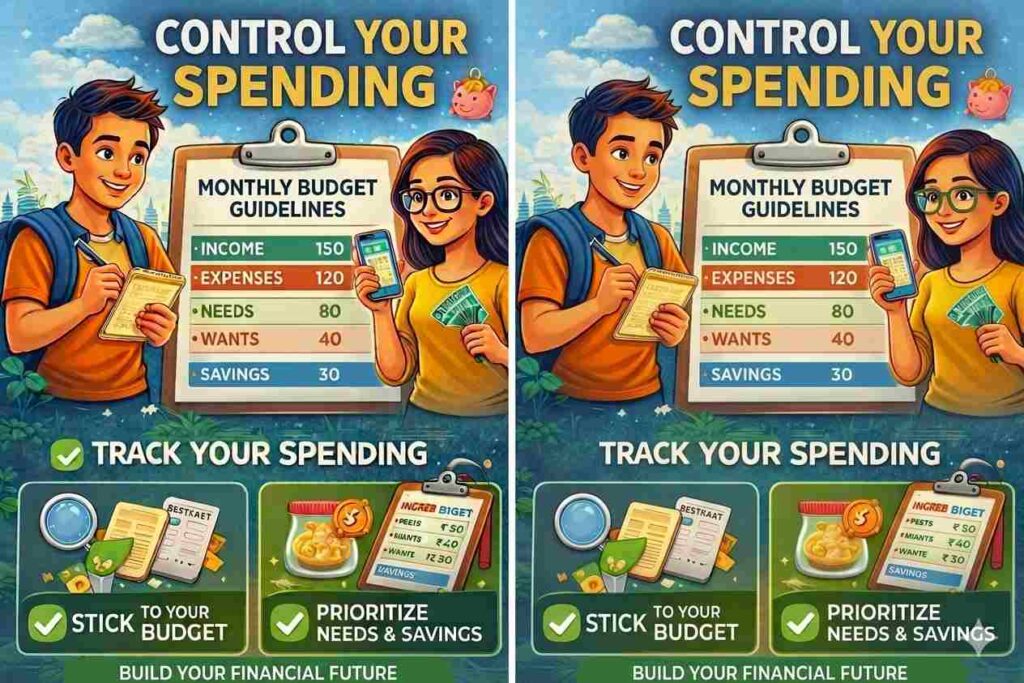

I need to make $100 as a student maybe for fees, daily expenses, or just to stop asking others for money. Even ₹500–₹1000 feels important when you have nothing in your pocket.The pressure is real. Time is limited. And the worst part? Not knowing where to start.But here’s the truth: you don’t need a job or big skills to earn your first $100 (₹8,000+). You just need a simple plan — and once you make your first $10, reaching $100 becomes much easier.
INTRODUCTION
I need to make $100 as a student is not just a random thought — it’s a real situation many students face when money is tight. Maybe you have no skills, no experience, and no idea how to earn even $10–$20 (₹800–₹1600) to get started.But here’s the reality: making your first $100 (₹8,000) is possible if you follow the right steps. You don’t need investment or a full-time job — just a few simple methods that actually work for beginners.In this guide, you’ll discover 7 easy and practical ways to earn money as a students
Freelancing Micro-Tasks: Make Your First $100 as a Student Fast
Start with Simple Freelancing Tasks
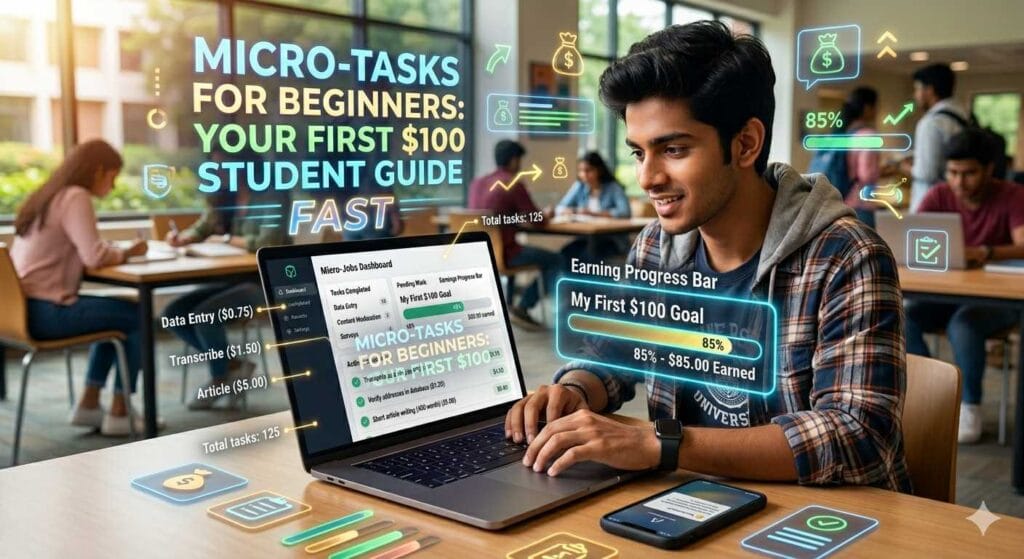
If you’re thinking I need to make $100 as a student, the fastest way to begin is micro freelancing. You don’t need experience, a degree, or investment — just simple tasks that people are already paying for daily.
Instead of waiting to “learn everything,” start with small actions. Platforms like Create an account on Fiverr, Upwork, or Freelancer… https://www.freelancer.com/Fiverr and Upwork https://www.upwork.com/already have buyers looking for quick work. If you stay active and respond fast, your first order can come sooner than you expect. This is one of the most practical ways to how to make $100 as a student without wasting time “7 Proven Ways for Small-Town Students to Earn Money Online in 2025 (₹5k–₹50k/Month)”
Beginner-Friendly Work You Can Offer
You can start with simple services like:
- Converting PDF files into Word documents
- Copy-paste and data entry work
- Basic Canva designs (thumbnails, posts)
- Rewriting short content in simple English
👉 These are proven ways to make money online as a student even if you have no skills.
Simple System to Reach Your First $100
Follow this focused plan:
- Create a clean profile on Fiverr
- Offer ONE simple service (keep it clear)
- Set a beginner price: $5–$10 per task (₹400–₹800 approx.)
- Stay active daily for 1–2 hours
- Deliver work quickly and collect reviews
👉 If you follow this consistently, you’ll naturally move towards how to earn $100 as a student step by step.
💰 Earning Breakdown (Clear Table + Example)
| Tasks Completed | Price per Task | Total Earnings |
|---|---|---|
| 20 Tasks | $5 | $100 |
| 10 Tasks | $10 | $100 |
| 5 Tasks | $20 | $100 |
👉 Even earning $10/day (₹800 approx.) means you can reach $100 in just 10 days.
Example:
A student started with basic typing work at $5 per task.
- Day 1–2: No orders
- Day 3: First order received
- Day 7: Completed 15–20 small tasks
👉 Total earning = $75–$100 (₹6,000–₹8,000 approx.)
This shows that you can realistically make $100 as a student with simple, consistent work.
👉 Micro freelancing is simple, practical, and one of the fastest ways to earn your first $100 as a student.
Sell Digital Notes: Turn Your Study Material into $100 Income
Start Selling What You Already Have
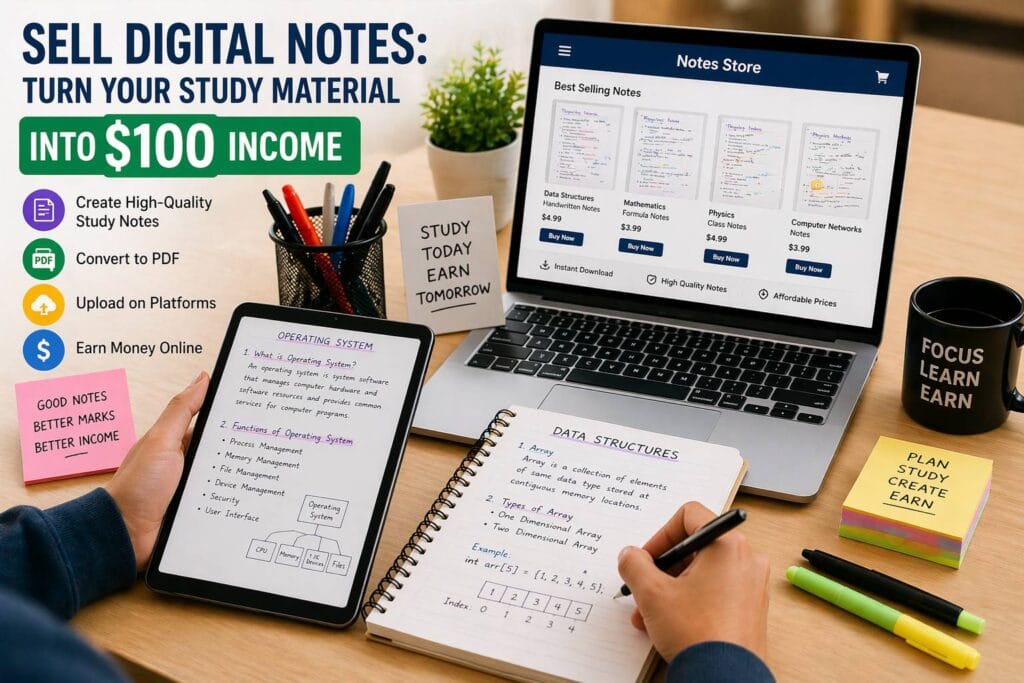
Make $100 as a Student by Selling Digital Notes Online
If you’re still thinking I need to make $100 as a student, then selling digital notes is one of the smartest and easiest ways to start. You don’t need any new skill — you already study, take notes, and understand topics.
Instead of keeping your notes unused, you can convert them into PDFs and sell them like https://gumroad.com/ and https://www.payhip.com/ to other students. This is a simple way to how to make $100 as a student using what you already have.
What Can You Sell as a Student?
You can create and sell:
- Class notes (short & easy summaries)
- Exam revision PDFs
- Important questions & answers
- Handwritten notes converted into PDF
👉 These are powerful ways to make money online as a student without any investment.
Simple System to Reach Your First $100
Follow this easy plan:
- Choose 1 subject you are good at
- Create clean and simple notes (PDF format)Create clean and attractive notes using https://www.canva.com/create-newbefore uploading and selling them
- Price your notes: $2–$5 (₹150–₹400 approx.)
- Share in Telegram groups, WhatsApp, or student communities
- Offer sample pages to build trust
👉 If you stay consistent, this method can help you achieve how to earn $100 as a student 7 Legal Online Income Ideas for Students in 2026 (Without Investment)
💰 Earning Breakdown (Clear Table + Example)
| Notes Sold | Price per Note | Total Earnings |
|---|---|---|
| 50 Sales | $2 | $100 |
| 25 Sales | $4 | $100 |
| 20 Sales | $5 | $100 |
👉 Even selling just 5 notes per day ($10–$15) can help you reach $100 within a week.
Example:
A student created simple revision notes for exams and shared them in Telegram groups.
- Day 1–2: Few downloads
- Day 3–5: More students joined
- Day 7: 25+ notes sold
👉 Total earning = $80–$100 (₹6,500–₹8,000 approx.)
👉 Selling digital notes is one of the easiest and smartest ways to earn your first $100 as a student using your existing knowledge.
Online Surveys & Micro Tasks: Earn Your First $100 as a Student Easily
Start with Simple Online Tasks
If you’re thinking I need to make $100 as a student, online surveys and micro-task websites can help you get started quickly. These platforms pay you for completing small tasks like answering questions, testing apps, or giving feedback.
You don’t need any skills or experience. Just a mobile or laptop and some free time. This is a beginner-friendly way to how to make $100 as a student without doing complex work.
Easy Tasks You Can Do
You can earn by doing:
- Online surveys
- Watching short videos
- App testing and reviews
- Simple data tasks
👉 These are simple ways to make money online as a student in your free time.
Simple System to Reach Your First $100
Follow this plan:
- Sign up on trusted platforms like
👉 Start earning on Swagbucks https://www.swagbucks.com/
👉 Join and complete tasks on ySense https://www.ysense.com/ - Complete surveys daily (20–30 minutes)
- Try multiple platforms for more opportunities
- Stay consistent every day
👉 This method helps you move towards how to earn $100 as a student step by step.
💰 Earning Breakdown (Clear Table + Example)
| Tasks Completed | Earning per Task | Total Earnings |
|---|---|---|
| 50 Tasks | $2 | $100 |
| 100 Tasks | $1 | $100 |
| 200 Tasks | $0.5 | $100 |
👉 Even earning $5–$10 daily (₹400–₹800 approx.) can help you reach $100 in 10–15 days.
Example:
A student started doing surveys daily for 30 minutes.
- Day 1–3: Earned small amounts
- Day 5–10: Regular surveys available
- Day 15: Reached $80–$100
👉 Total earning = $80–$100 (₹6,500–₹8,000 approx.)
👉 Online surveys and micro tasks are one of the easiest ways to make $100 as a student with consistency and daily effort.
Content Writing: Make $100 as a Student by Writing Simple Articles
Start Writing Simple Content for Beginners
If you’re thinking I need to make $100 as a student, content writing is one of the most powerful and long-term ways to start. You don’t need to be an expert writer — you just need basic English and the ability to explain things simply.
Many websites and clients are looking for beginners who can write short articles, blog posts, or product descriptions. This is a practical way to how to make $100 as a student by using your writing skills.
Beginner-Friendly Writing Work You Can Do
You can start with:
- Writing simple blog articles
- Rewriting content in easy words
- Product descriptions for websites
- Short social media captions
👉 These are great ways to make money online as a student using basic writing skills.
Simple System to Reach Your First $100
Follow this plan:
- Create samples using Canva Docs (https://www.canva.com/docs/)
- Start freelancing on Fiverr https://www.fiverr.com/
- Offer simple writing services ($5–$10 per article)
- Write 300–500 word articles for beginners
- Stay consistent and improve daily
👉 This method helps you move towards how to earn $100 as a student step by step.
💰 Earning Breakdown (Clear Table + Example)
| Articles Written | Price per Article | Total Earnings |
|---|---|---|
| 20 Articles | $5 | $100 |
| 10 Articles | $10 | $100 |
| 5 Articles | $20 | $100 |
👉 Even writing 1 article per day ($5–$10) can help you reach $100 in 10–15 days.
Example:
A student started writing simple blog posts for beginners.
- Day 1–3: Practiced writing
- Day 4–7: Got first client
- Day 10: Completed 10+ articles
👉 Total earning = $80–$100 (₹6,500–₹8,000 approx.)
👉 Content writing is one of the best ways to make $100 as a student while building a long-term skill.
Affiliate Marketing: Make $100 as a Student by Promoting Products
Start Promoting Simple Products
If you’re thinking I need to make $100 as a student, affiliate marketing is one of the smartest ways to earn online. You don’t need to create any product — you just promote other people’s products and earn a commission.
You can share links through WhatsApp, Telegram, or social media. When someone buys using your link, you earn money. This is a powerful way to how to make $100 as a student without investment.
Beginner-Friendly Products You Can Promote
You can start with:
- Online courses (low-cost beginner courses)
- Books and study materials
- Digital tools and software
- Student-related useful products
👉 These are easy ways to make money online as a student without creating anything.
Simple System to Reach Your First $100
Follow this plan:
- Join affiliate programs like
👉 Start affiliate marketing on Amazon Associates https://affiliate-program.amazon.com/
👉 Promote digital products on Digistore24 https://www.digistore24.com/ - Choose 1 product (don’t promote everything)
- Share your link in groups or social media
- Explain benefits in simple language
- Stay consistent and build trust
👉 This method helps you move towards how to earn $100 as a student step by step.
💰 Earning Breakdown (Clear Table + Example)
| Sales Made | Commission per Sale | Total Earnings |
|---|---|---|
| 10 Sales | $10 | $100 |
| 20 Sales | $5 | $100 |
| 5 Sales | $20 | $100 |
👉 Even making 1–2 sales per day can help you reach $100 in a few days.
Example:
A student promoted a low-cost online course using Telegram groups.
- Day 1–3: No sales
- Day 4–7: First few conversions
- Day 10: 10+ sales completed
👉 Total earning = $80–$100 (₹6,500–₹8,000 approx.)
👉 Affiliate marketing is one of the easiest ways to make $100 as a student by sharing useful products with others.
Reselling Products: Make $100 as a Student Without Investment
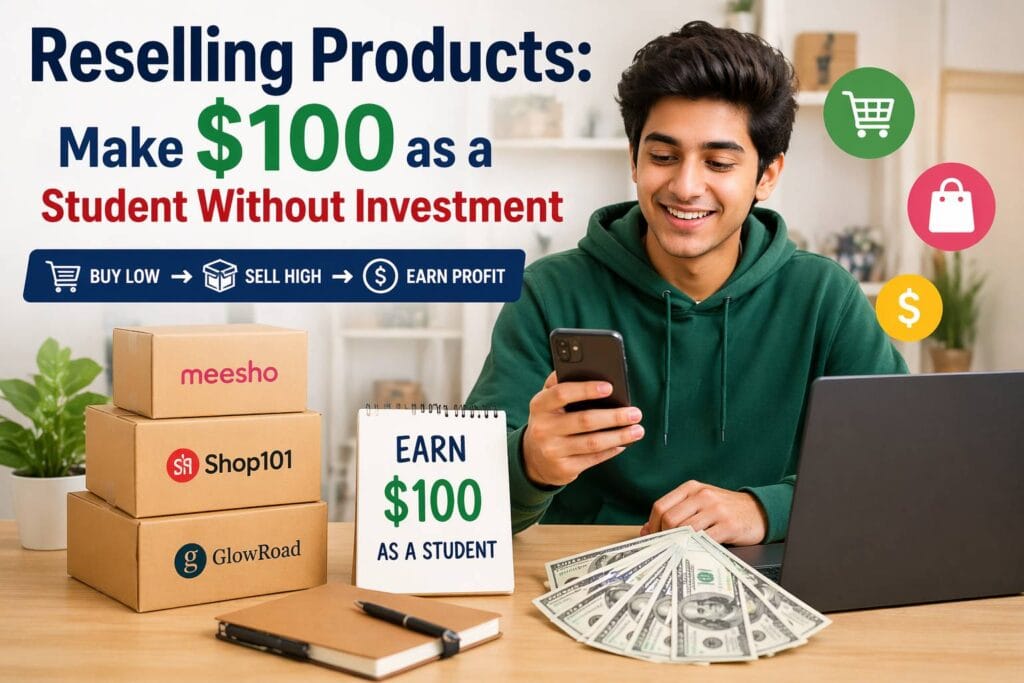
Start Reselling Products from Home
If you’re thinking I need to make $100 as a student, reselling is one of the easiest and fastest ways to start. You don’t need to create your own product — you simply sell products from suppliers and earn profit.
You can use platforms like WhatsApp, Instagram, or local groups to sell products. This is a practical way to how to make $100 as a student without any investment.
Beginner-Friendly Products You Can Resell
You can start with:
- Clothes (T-shirts, hoodies)
- Mobile accessories
- Trending gadgets
- Daily-use products
👉 These are simple ways to make money online as a student by reselling.
Simple System to Reach Your First $100
Follow this plan:
- Find products on
👉 Start reselling products on Meesho (https://www.meesho.com/
👉 Explore trending items on GlowRoad (https://www.shop101.com/) - Add your margin ($2–$5 per product)
- Share product images in WhatsApp/Instagram
- Take orders and confirm delivery
- Repeat daily for consistent sales
👉 This method helps you move towards how to earn $100 as a student step by step.
💰 Earning Breakdown (Clear Table + Example)
| Products Sold | Profit per Product | Total Earnings |
|---|---|---|
| 50 Orders | $2 | $100 |
| 25 Orders | $4 | $100 |
| 20 Orders | $5 | $100 |
👉 Even selling 3–5 products daily can help you reach $100 in a few days.
Example:
A student started reselling T-shirts using WhatsApp groups.
- Day 1–3: Few orders
- Day 4–7: Regular customers
- Day 10: 20+ sales
👉 Total earning = $80–$100 (₹6,500–₹8,000 approx.)
👉 Reselling is one of the fastest ways to make $100 as a student without skills or investment.
YouTube Shorts: Make $100 as a Student by Creating Viral Videos
Start Creating Short Videos (No Experience Needed)
If you’re thinking I need to make $100 as a student, YouTube Shorts is one of the fastest-growing ways to earn online. You don’t need a camera or high skills — just your mobile and simple ideas.
You can create short videos (15–60 seconds) using trending topics like money tips, facts, or student hacks. This is a powerful way to how to make $100 as a student by building an audience.
Beginner-Friendly Video Ideas
You can start with:
- Money tips for students
- “Earn online” tricks
- Study hacks & productivity tips
- Facts / motivation content
👉 These are easy ways to make money online as a student using short videos.
Simple System to Reach Your First $100
Follow this plan:
- Create videos using
👉 Edit videos easily using CapCuthttp://CapCut (https://www.capcut.com)
👉 Post and grow on YouTube Shortshttp://YouTube Shorts (https://www.youtube.com/shorts) - Upload 1–2 shorts daily
- Use trending hashtags
- Add simple captions
- Stay consistent for 15–20 days
👉 This method helps you move towards how to earn $100 as a student step by step.
💰 Earning Breakdown (Clear Table + Example)
| Views Achieved | Earning Method | Total Earnings |
|---|---|---|
| 10K–50K Views | Affiliate links | $20–$50 |
| 50K–100K Views | Promotions | $50–$100 |
| 100K+ Views | Multiple sources | $100+ |
👉 Even one viral video can help you reach $100 quickly.
Example:
A student created simple “money tips” shorts:
- Day 1–5: Low views
- Day 6–10: One video went viral
- Day 15: Got affiliate sales + followers
👉 Total earning = $80–$120 (₹6,500–₹10,000 approx.)
👉 YouTube Shorts is one of the smartest ways to make $100 as a student by using creativity and consistency.
🚀 Final Thoughts
You’ve explored 7 practical ways to make $100 as a student, but the real difference comes from taking action. Don’t overthink or wait for the perfect time — start now.
👉 Pick one method, focus on it, and give your best for the next few days.
👉 Your first $100 is not just money — it’s proof that you can earn on your own.
💡 Summary
You can start without investment
Skills grow with practice
Consistency beats perfection
Small daily earnings = big results
👉 Even earning $5–$10 daily can help you reach $100 quickly.
⚡ Action PlanChoose 1 method todayStart within 24 hoursWork 1–2 hours dailyTrack progress and improve👉 Follow this and you can realistically earn $100 (₹6,000–₹8,000 approx.)
👉 Yes, many methods like freelancing, surveys, and reselling require zero investment.
👉 Surveys, reselling, and digital notes are easiest to start.
👉 With consistency, you can achieve it in 7–15 days by.
👉 No, basic skills and learning mindset are enough.