
52 Week Money Challenge India 2025: Save ₹68,900 Easily

1000051862

Introduction

Saving money is not about cutting every expense — it’s about small, consistent habits that grow over time.The most viral and effective saving method in 2025 is the 52 Week Money Challenge.

This simple but powerful challenge helps you build a strong saving habit without stress, without strict budgeting, and without big income.

Let’s break it down step-by-stephttp://Money Savings Plan for a Better Future https://share.google/NWoXr2g01yM8NiG4g7 Money-Saving Secrets Students Can Use to Think Like the Wealthy

🌟 What is the 52 Week Money Challenge? (Simple Explanation)

1000051862

The 52 Week Money Challenge is a weekly saving plan where:

You start with a small amount in Week 1You increase the saving amount every weekBy Week 52, you save a big amountBy the end of the year → ₹50,000–₹70,000 is saved

The best part?You don’t feel pressure.The increase is small.And you build lifelong money discipline.

🌱 Why This Challenge Works (The Hidden Psychology)

Most people fail to save because they try to save too much too fast.This challenge fixes that Start small = No pressureSaving ₹50 is effortless.✔ Slow and steady growthHabit builds naturally.✔ Weekly system = disciplineYou save on autopilot.✔ GamificationEvery week you see progress → motivates you.✔ Perfect for students & beginnersNo big income needed.Your Attractive Heading

⭐ 52 Week Money Challenge Table (India 2025 Version)

This is the most popular version starting at ₹50 per week.Week Save This Week (₹) Total Saved (₹)

1 50 502 100 1503 150 3004 200 5005 250 7506 300 1,0507 350 1,4008 400 1,8009 450 2,25010 500 2,75011 550 3,30012 600 3,90013 650 4,55014 700 5,25015 750 6,00016 800 6,80017 850 7,65018 900 8,55019 950 9,50020 1,000 10,500

21–30 Increase ₹50 weekly ~₹25,500 total31–40 Increase ₹50 weekly ~₹39,000 total41–52 Increase ₹50 weekly ~₹68,900 total

👉 Final Savings: Almost ₹68,900

1️⃣ Easy Version – “Student Edition” (₹20/week

Week 1 → ₹20Week 2 → ₹40Week 3 → ₹60… continue increasing by ₹20

Total savings after 1 year: ₹13,780 approx.

3️⃣ Hard Version – “Aggressive Edition” (₹100/week)

If you want big savings:Week 1 → ₹100Week 2 → ₹200Week 3 → ₹300… increase by ₹100

Total savings after 1 year: ₹1,37,800 approx.This version builds a strong money mindset.Source: YouTube https://share.google/JnffBlszRKL7wYRP3

⭐ How to Start the 52 Week Challenge (Perfect Step-by-Step Guide)

Step 1: Decide the amount (₹20, ₹50, or ₹100)Choose based on your income.

Step 2: Pick a fixed “Saving Day”Most popular:SundayMondaySet a weekly reminder on your phone.

Step 3: Choose where you will store the money

Best options:A piggy bankA dedicated savings accountPhonePe/Google Pay savings tabNotion/Excel sheet

Step 4: Track every week

Write the weekly amount.When you track → your discipline increases.

Step 5: If you miss a week, DON’T QUIT

Just save double in the next week.Your challenge stays on track.

Step 6: Reward yourself after every 4 weeksSmall rewards boost motivation.

🌟 Why the 52 Week Challenge is Going Viral in India (2025)

Rising cost of livingYoung people want financial independenceReels/shorts making saving challenges trendyStudents want easy saving habitsNo need for financial knowledgeWorks for parents, students, job holders — everyone

Saving is becoming a culture, not a burden.

⭐ Where Should You Use This Saved Money? (Smart Options)

After 52 weeks, you should NOT waste the money.Here are the best uses:✔ Create an emergency fundThis makes you stress-free.✔ Start a SIP in mutual fundsEven ₹500/month can grow.✔ Buy a skill courseHigh ROI.✔ Invest in goldLow risk, good long-term return.✔ Invest in your blog or businessBest investment ever

⭐ Common Mistakes to Avoid

❌ Trying to save too much

Start small.

❌ Skipping tracking

Tracking = Discipline.

❌ Spending the challenge money early

Keep it safe till the end.

❌ Not increasing amount weekly

The increase is the real magic.

The 52 Week Money Challenge is more than a saving plan — it’s a mindset builder.
It teaches consistency, patience, and the power of small steps.

Start today with just ₹20 or ₹50, and by the end of the year, you will have a big amount + lifelong financial discipline.

10 Easy Ways to Make Money at Home (Beginner Friendly Guide)

1765003997425

introduction

10 Easy Ways to Make Money at Home” is not just a topic today, it has become a real need. Many people want to earn money from home — students, housewives, working professionals, and beginners. The good news is, with just a smartphone and an internet connection, there are several simple and practical ways to start earning from home without any big investment.https://www.quora.com/How-do-I-make-money-online-by-sitting-at-home

TABLE GRAF

file 000000000a287206aab2cf6edd47970a (1)
1765001899470

🟢 1) Why earn money from home?

Earning from home gives you:

✔ Freedom of time✔ No travel cost✔ Work from mobile/laptop✔ Build your own income

Even if you are a student, housewife or beginner, there are many easy ways to make money at home.

🟢 2) 10 Easy Ways To Make Money at Home

✅ 1. Blogging

If you love writing, start a blog.

Write about money, skills, fitness, recipes, motivation✔ Earn from ads + affiliate marketing

How much can you earn?$100 – $500 per month (starting)$1000+/month when traffic grows

Tip:Use WordPress and write 2 articles per week.

✅ 2. YouTube

No camera needed.Mobile is enough.

✔ Tutorials✔ Reviews✔ Cooking✔ Study tips

Income sources:

AdsSponsorshipAffiliate links

✅ 3. Affiliate Marketing

Share product links → Get commission.

Amazon✔ Flipkart✔ Awin✔ Impact

No investment needed.Best for:Blog, Instagram, YouTube“7 Proven Ways for Small-Town Students to Earn Money Online in 2025 (₹5k–₹50k/Month)”

✅ 4. Freelancing

Sell your skills online.

✔ writing✔ graphic design✔ video editing✔ translation

Platforms

fiver

upwork

freelancer

Start with small gigs → grow slowly

✅ 5. Selling Digital Products

Make once → Earn again and again.

Examples: ✔ eBook✔ templates✔ planners✔ presets✔ online course

Platforms:GumroadEtsy

✅ 6. Online Tutoring

If you know any subject:✔ maths✔ English✔ coding✔ physics

Teach students online on Zoom/Google Meet.

Charge ₹200 – ₹500/hour.

✅ 7. Content Writing

Companies need content every day.

Write: ✔ blog posts✔ product descriptions✔ social media captions

Earn ₹300 – ₹800 per article (beginner).

✅ 8. Stock Market Investing

Start with: ✔ Index fund ✔ Mutual fund ✔ SIPNot quick money, but long-term wealth.

Start with ₹500 per month.

✅ 9. Dropshipping

You sell products → supplier delivers.

You sell products → supplier delivers.✔ No inventory✔ No warehouse✔ No investment

You only need: ✔ website + ads

✅ 10. Mobile Apps That Pay

Apps: ✔ Google Opinion Rewards✔ Meesho✔ Roz Dhan✔ CashKaro

Small income but easy and fast.

Small income but easy and fast.

🟢 3) How to Start with No Experience

Follow this plan:

Choose 1 method✔ Learn basics from YouTube/Google✔ Work 1–2 hours daily✔ Stay consistent for 90 daysSmall progress → big results.

🟢 4) Tools You Will Need

🟢 4) Tools You Will Need✔ Smartphone✔ Internet✔ Canva (free graphics)✔ Gmail✔ Google Docs✔ WordPress (for blogging)

🟢 5) Mistakes to Avoid

❌ Trying 10 things at once❌ No consistency❌ Expecting fast results❌ Copy-paste content❌ Giving up early

🟢 Conclusion There are many easy ways to make money at home even if you are a complete beginner.Choose 1 method, take action, and stay consistent.Small efforts every day → big income after few months.👉 Success formula: Learn + Apply + Consistency = Results

Call To Action

Click here to🟢 Call to Action💬 Comment below:Which method will you try first? Blogging, YouTube, or Freelancing?📌 Want more guides?Ask me:Next article kis topic pe chahiye?I can write:✔ Passive income✔ Affiliate marketing✔ Student earning✔ BloggingJust tell me 😄

Top High-Return Mutual Funds for 2026 (AI-Predicted Expert

1764484055967

Introduction

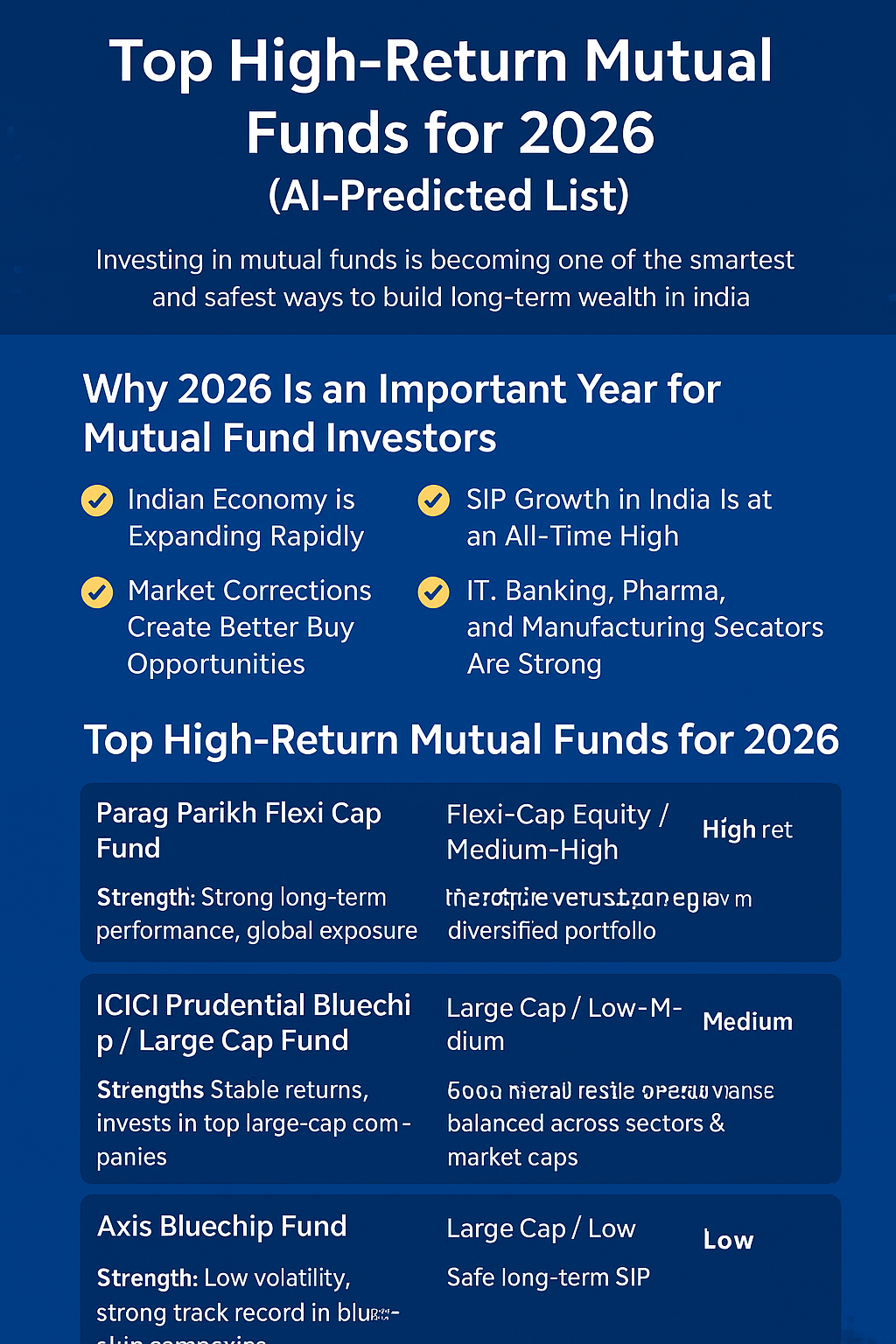
Investing in mutual funds is becoming Top High-Return Mutual Funds for 2026 (AI-Predicted Expertone of the smartest and safest ways to build long-term wealth in India. As we move towards 2026, millions of new investors are entering the market with the goal of achieving higher returns, lower risk, and stable long-term growth. But with so many mutual funds in the market, choosing the right ones can be confusing

To solve this, we have created a detailed, data-backed, AI-assisted list of the Top High-Return Mutual Funds for 2026. This list combines:https://m.economictimes.com/mf/analysis/top-10-mutual-funds-to-invest-in-november-2025/articleshow/125046363.cms

STRUCTURE Past performanceRisk managementFund manager reputationPortfolio structureHistorical returnsLong-term consistencyAI-based future trend analysis

Why 2026 Is an Important Year for Mutual Fund Investors

1764477280874

Before diving into the list, understand why 2026 is a strategic year for wealth building:

1. Indian Economy Is Expanding Rapidly

India is projected to become the third-largest economy in the world by 2027–28. This economic growth directly benefits equity mutual funds.

2. SIP Growth in India Is at an All-Time High

More than 7 crore SIP accounts exist.This shows investors are shifting toward long-term, stable, compounding-based wealth creation.

3. Market Corrections Create Better Buy Opportunities

Post-2024 and 2025 volatility, mutual funds in 2026 may offer excellent entry points for long-term investors.

4. IT, Banking, Pharma, and Manufacturing Sectors Are Strong

These sectors dominate many mutual fund portfolios — which creates long-term compounding potential.

🔥 Top High-Return Mutual Funds for 2026 (AI Predicted List)

1000050976

Below are the top funds chosen based on 5+ strong parameters.

1️⃣ Parag Parikh Flexi Cap Fund

Category: Flexi-Cap Equity

Ideal For: Wealth creation, long-term SIP, low-income investors with long horizon

Why this Fund is Powerful for 2026

This is one of India’s most trusted wealth-building funds.

The fund invests in large-cap, mid-cap, small-cap, and global stocks.

Exposure to global giants like Alphabet (Google), Meta, Amazon, etc.Strong fund manager decisions even during market crashes.

Consistent long-term returns

Very strong downside protection

High-quality companies

Risk-managed investing

Why AI Predicts Strong Growth

Its global + Indian portfolio offers the best balance of stability and growth for 2026.technology thematic fund india best technology mutual fund top technology thematic fund

2️⃣ ICICI Prudential Bluechip / Large Cap Fund

Category: Large Cap. Risk Level: Low to Medium

Ideal For: Beginners, safe long-term returns

Why this Fund Works in 2026

Large-cap funds invest in top 100 Indian companies — safe, stable, and reliable.This fund has historically shown:

Low volatilitySteady returnsStrong downside protectionExcellent risk management

Who Should Invest

StudentsSmall investorsNew mutual fund investorsAnyone wanting slow but steady growth

Why AI Predicts Strong Returns

Indian large-cap companies will benefit massively from economic expansion by 2026–2027.

3️⃣ HDFC Flexi Cap Fund

Category: Flexi-Cap

Risk Level: Medium

Ideal For: Balanced growth + moderate risk investors

Why This Fund is Strong

HDFC is known for long-term compounding and strong fund management.Portfolio includes:

Leading private banksStrong manufacturing companiesIT leadersPharma giants

Strengths

Good historical returnsSmart diversificationStrong fund manager reputation

AI Growth Reason

The fund’s balanced portfolio is strong for long cycles like 2026–2030.

Source: Groww https://share.google/bJjHPchz2NfFg3dpRHow to Start Investing: Step-by-Step Beginner’s Guide to Grow Your Money🤑

4️⃣ Axis Bluechip Fund

Category: Large CapRisk Level: Low to MediumIdeal For: Safe long-term SIPWhy Investors Love This Fund

Axis Bluechip focuses on quality blue-chip companies with:

Low volatilityHigh stabilityPredictable growth

Suitable For

BeginnersLow-risk investorsAnyone wanting safe compounding for 5–10 years

Fund Name Category Risk Ideal For Strength
Parag Parikh Flexi Cap Flexi Cap Med-High Long-term Global + Indian mixICICI Pru Large Cap Large Cap Low-Med Beginners StabilityHDFC Flexi Cap Flexi Cap Medium Balanced investors DiversifiedAxis Bluechip Large Cap Low Safe SIP Low volatility
High risk investment symetick fund in india

How to Choose the Best Fund for Yourself

✔ If you want highest long-term returns →

Parag Parikh Flexi Cap✔ If you want safe, stable return

ICICI Prudential Large CapAxis Bluechip Fund

If you want balanced risk + growth →HDFC Flexi Cap

SIP Strategy for 2026 (Best Method)

1. Start Small: ₹500 – ₹1000 SIP

Even small SIPs grow big through compounding.

2. Invest for Minimum 5–7 Years

Short-term mutual fund investing doesn’t work.

3. Select 2 Funds Only

Too many funds = no focusBest combo:1 Flexi Cap + 1 Large Cap

4. Increase SIP Every Year

Even +10% yearly increase boosts wealth massively.

5. Don’t Stop SIP During Market Crash

Crash = discounted stocksThese periods give the highest future returns.

What Returns Can You Expect by 2026–2030

Fund Type Expected Return Range

Large Cap 10% – 14% per yearFlexi Cap 12% – 18% per yearMid Cap / Small Cap 15% – 25% per year (High Risk)

Beginner-Friendly Example (Perfect for Low Income)

Monthly SIP: ₹1000Duration: 10 YearsPossible Value: ₹2.5 – ₹4.8 LakhsThat’s the power of compounding.

Conclusion

The year 2026 is a golden opportunity for Indian investors.The mutual funds listed above — especially Parag Parikh Flexi Cap, HDFC Flexi Cap, Axis Bluechip, and ICICI Large Cap — are powerful wealth-building options for anyone who wants:

Long-term growthHigh returns with balanced riskReliable performanceStrong compoundingStress-free investing

If you start a SIP today, even a small amount, the next 5–10 years can transform your financial life.

Call To Action

✅ Top CTA Lines for Your Finance Blog1. Simple & Trust-Building CTA👉 Want to grow your money faster? Join our free weekly finance tips — start building wealth today!

💼 Ready to Start Investing?

Start small with SIPs and let compounding work for you. Choose reliable mutual funds and build steady wealth over time.

Start Investing Today

Simple Investing Habits Rich People Use to(2025 Guide)

simple investing habbit

Simple Investing Habits Rich People Use to(2025 Guide) more — it’s about managing, multiplying, and protecting money wisely.Rich people follow some simple, repeatable investing habits that help them stay wealthy for decades.In this guide, you’ll learn those exact habits, simplified for beginners in India.

Introduction

Most people think rich people follow complicated strategies, but in reality, wealthy people stick to simple, disciplined investment habits.These habits look small — but over time, they create huge financial advantage.Here are the 10 investing habits rich people consistently follow to stay wealthy.

oplus 131072

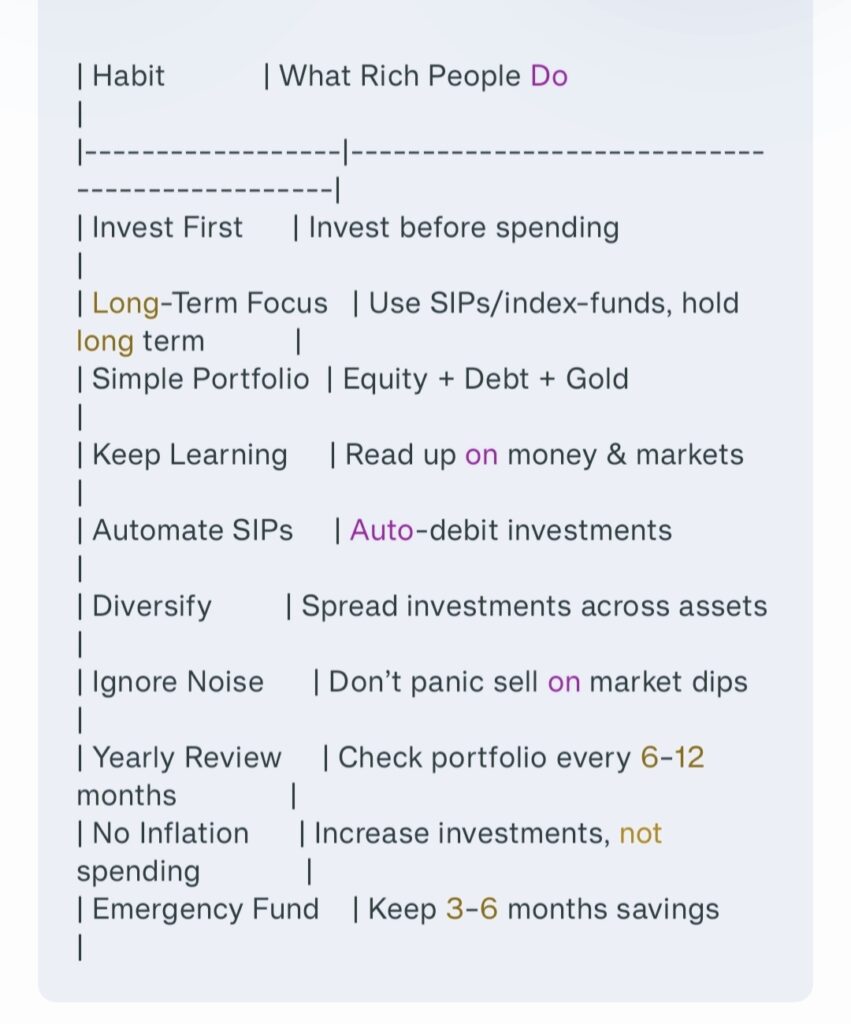
1. They Invest Before Spending (Pay Yourself First)

1000047057

Rich people never wait for “remaining money” to invest.They invest first, spend later.

Formula they follow:

Income → Investment → ExpensesNot: Income → Expenses → Investment (if anything left)

This single habit forces wealth creation automatically.Source: Groww https://share.google/1zt5qaLxqSsxXeAHX

2. They Choose Long-Term Investing Over Quick Profits

Rich people know the real game is long-term compounding.They avoid get-rich-quick schemes and focus on:

money 2696228 1280

Equity mutual funds

Index funds

Blue-chip stocks

Long-term SIPs

Wealth = Consistency × Time

3. They Keep Their Investments Extremely Simple

1000047056

Wealthy people don’t chase 100 different assets.They prefer simple portfolios:High risk investment symetick fund in india

50–60% Equity

20–30% Debt

10–15% Gold

5–10% Cash/REIT/Other assets

4. They Never Stop Learning About Money

Rich people actively learn about:

Finance

Market trends

New investment methods

Tax-saving strategies

They treat “financial literacy” like a skill. Simple Investing Habits Rich People Use

5. They Automate Investments (SIPs & Auto-Debit)

To stay consistent, rich people automate investing.

Why?Because “willpower” fails, but “automation” never forge

Even beginners can automate:

SIP

RD

gold sip

nps contribution

Automation builds wealth quietly.

6. They Diversify Properly

Rich people never put all money in one place.

They spread money across:

Stocks

Mutual funds

Gold

Real estate

Businesses

Cash reserves

Diversification = Risk control + Stable returns.

7. They Ignore Market Noise

Rich people don’t panic when:

Market drops

Finance news screams fear

Social media predicts crash

People say “Sell everything!”

They stay calm because they think long-term.

“If the business is strong, I stay invested.”

8. They Review Investments Every 6–12 Months

Wealthy people regularly review:

Portfolio performance

Asset allocation

SIP amounts

Financial goals

They don’t check the market daily — but they do check strategically.http://EARN MONEY AS A STUDENT JUST A PHONE, NO INVESTMENT

9. They Avoid Lifestyle Inflation

As income increases, the middle class increases expenses.Rich people do the opposite — they increase investments.

Simple Investing Habits Rich People Use to(2025 Guide

Their rule:

Income ↑ → Investment ↑Not: Income ↑ → Expenses ↑

This is why they keep getting richer.

10. They Always Keep Cash Reserves (Emergency Fund)

Rich people never invest 100% of their money.They keep at least 3–6 months of expenses as cash.

This protects them in situations like:

Job loss

Medical emergency

Business slowdown

Unexpected bills

A strong emergency fund = safer investing.http://7 Proven Ways for Students to Make Money ‣ paisakmao.de https://share.google/FxtRG31R1YD7EYeTq

ConclusionBecoming wealthy is not about luck or complicated formulas.It’s about simple habits repeated for years.If you follow even 3–4 of these habits, your financial life will start changing drastically.The real secret is:> Rich people don’t do extraordinary things.They do simple things extraordinarily consistently.

Early Retirement Planning in India: A Complete Guide (2025)

untitled design (2)
Early Retirement Planning in India: A Complete Guide (2025)

introduction

1000050508

Early retirement is no longer just a dream for the rich — it has become a clear and achievable financial goal for millions of Indians. With rising stress in corporate jobs, increasing awareness about financial independence, and the 💹 of smart investment options, more people now want to retire at 40 or 45, instead of waiting till 60https://www.iciciprulife.com/retirement-pension-plans/early-retirement-planning-tips..

But achieving early retirement in India requires one thing: a clear plan.You must know how much money you need, where to invest, how to grow your income, and how to protect your savings from inflation. The good news is that with the right strategy, even a middle-class person can retire early and live a peaceful, financially secure life.

1. What Is Early Retirement in India?

Early retirement means stopping regular job/work before the age of 60 and living fully from your savings, investments, and passive income.Today, many Indians aim to retire at 40–45 instead of 60.

. Why Early Retirement Is Becoming Popular

More freedom

Time for family

Time to build a business

Break from corporate stress

Financial independence

3. Calculate Your “Retirement Number”

Before planning, you must know: How much money do I need to retire early?

Formula:(Monthly expenses × 12) × 25

Example:

Your monthly expense = ₹25,000

Yearly = ₹3,00,000

Retirement Number = ₹3,00,000 × 25 = ₹75,00,000

https://groww.in/calculators/retirement-calculator

Means:If you invest and reach ₹75 lakhs, you can retire with 25k monthly expenses.

4. Understand Your FIRE Type

4.1. Lean FIRE

Minimum lifestyle with low expenses। Target investment: ₹40–60 lakhs.

4.2. Fat FIRE

Comfortable lifestyle, travel, shopping, luxury। Target: ₹1.5–3 crore.

4.3. Barista FIRE

Retire early but work part-time for fun.

4.4. Coast FIRE

5. How Much You Must Invest Every Month

Example (Goal: ₹1 Crore in 15 Years)

If expected return = If expected return = 12% (mutual funds), then:, then:

Start with ₹10,000/month → ₹45 lakhs

₹20,000/month → ₹90 lakhs

₹25,000/month → ₹1.1 crore

Conclusion:Start as early as possible.Time =

6. Best Investment Options for Early Retirement in India

6.1. Equity Mutual Funds (SIP)

Best for long-term wealth

12–15% return potential

Automatic compoundingPerfect for 10–20 year goals.How to Start Investing: Step-by-Step Beginner’s Guide to Grow Your Money🤑

6.2. Index Funds

Low risk

Low cost

Long-term stable Growth best for simple investing.

6.3. Stocks

High return potential

Requires knowledgeUse only 10–20% of your portfolio.

6.4. PPF (Public Provident Fund)

Very safe

Tax-free

Good for long-term stability

6.5. NPS (National Pension System)

Good for retirement

Low fees

Extra tax savingUse it as a secondary retirement tool.

Final Summary (Short & Powerful)

Early retirement means stopping

Before planning, you must know: How much money do I need to retire early?

Minimum lifestyle with low expenses। Target investment:

2025 Investors Mutual Fund: Your Essential Blueprint for Building wealth

1762924741291

2025 Investors Mutual Fund: Your Essential Blueprint for Building wealth In today’s dynamic financial landscape, simply saving 🤑 is not enough to stay ahead of inflation. Mutual funds have emerged as the premier vehicle for wealth creation, offering diversification and professional management to retail investors. This comprehensive guide cuts through the complexity, providing you with a clear, step-by-step blueprint to understand, select, and manage mutual funds effectively. By the end of this article, you will be equipped with the knowledge to make informed decisions that align with your unique financial goals.https://www.mnclgroup.com/long-term-investing-beginners-blueprint-for-wealth-building

1000050070

Understanding the Core Mechanics of a Mutual Fund

A mutual fund is essentially a financial intermediary—a trust that collects money from a large number of investors with similar investment objectives. This pooled capital is then invested in various assets by a professional fund manager. The Key Players in Your Investment

The Investor (You): The individual buying the fund units, aiming for growth or income.

Fund Manager: The expert who actively researches and decides what to buy and when to sell, based on the fund’s mandate.

Custodian: A separate entity that holds the fund’s securities safely, ensuring investor protection.

: How Returns are Generated

Your investment grows primarily through two mechanisms:

Capital Appreciation: When the value of the underlying stocks or bonds in the fund’s portfolio increases.

Income Distribution: Interest (from bonds) or dividends (from stocks) earned by the fund are distributed to the unit holders.

Top investor to investor industries to investNAV (Net Asset Value): The price of one unit, which reflects the daily market value of the fund’s assets minus its liabilities. Monitoring NAV is key to tracking your return.https://www.rbcgam.com/en/ca/learn-plan/investment-basics/five-principles-of-successful-investing/detail http://Investor

📈 : The Investor’s Blueprint: A 5-Step Strategy

1000050071

Successful investing is a journey, not a sprint. Follow this structured approach to ensure your mutual fund choices are robust and resilient.

3: Step 1: Goal Setting and Risk Profiling

This is the most crucial preliminary step. You must link every investment to a specific, quantified goal (e.g., ₹20 Lakh in 10 years for a child’s education).

Short-Term (1-3 years): Park funds in safer Debt Funds or Liquid Funds

Long-Term (7+ years): Allocate a higher percentage to Equity Funds to benefit from compounding.

Risk Tolerance: Determine your ability and willingness to see a temporary drop in value. Your risk profile (Conservative, Moderate, or Aggressive) dictates your final asset allocation (Equity vs. Debt ratio).http://7 Proven Ways for Students to Make Money ‣ paisakmao.de https://share.google/PPhbO3ZCdEqjUk76X

3: Step 2: Choosing the Right Asset Allocation

Do not put all your capital into one type of fund. Diversification across asset classes is the primary risk mitigation tool.

Equity Funds: Best for long-term growth and capital appreciation. Example: Index Funds, Large-Cap Funds.technology thematic fund india best technology mutual fund top technology thematic fund

Debt Funds: Ideal for capital preservation and stable income. Example: Liquid Funds, Corporate Bond Funds.

Hybrid Funds: Provide a mix of equity and debt for balanced growth. Example: Aggressive Hybrid Funds.

H3: Step 3: Direct Plan vs. Regular PlanAs a smart investor, always consider the impact of fees over time:

3: Step 4: Investment Methodology (SIP vs. Lumpsum)

Systematic Investment Plan (SIP): Recommended for salaried individuals. By investing a fixed amount regularly, you automatically practice Rupee Cost Averaging, buying more units when prices are low and fewer when prices are high, thereby reducing market timing risk.

Lumpsum: Best suited if you have a large sum of money and are confident the market is undervalued, or for debt https://corporatefinanceinstitute.com/resources/career-map/sell-side/capital-markets/investment-methods/instruments where market timing is less critical.

3: Step 5: Monitoring and Review

Your job doesn’t end after investing. Review your portfolio every 6-12 months.

Portfolio Rebalancing: Adjust your asset allocation back to its original target (e.g., if Equity has grown too large, sell some and move to Debt).

Performance Check: Compare your fund’s return against its Benchmark Index and its peer group. If it consistently underperforms the benchmark over 3-5 years, consider switching.

2: Due Diligence: What Makes a Fund a Good Investment?

3: Critical Evaluation Metrics

1•Expense Ratio: The lower the fee, the better. Always verify the expense ratio of the Direct Plan.

2:Fund Manager‘s Experience: Look for a manager with a long tenure and a proven track record of navigating both bull and bear markets. Stability is key.

3:Alpha and Tracking Error:Alpha: The excess return generated by the fund over its benchmark. A consistently positive Alpha shows the manager’s skill.

Tracking Error (Passive Funds): How closely an index fund tracks its index. Lower tracking error is better.

4:Tax Efficiency: Be aware of the tax implications (LTCG vs. STCG) before redeeming, especially for goal-based investments.

👇📄✍️Conclusion: Discipline is the Ultimate Fund Manager

Investing in mutual funds is a powerful strategy, but it requires patience and discipline. Start small, stay committed to your SIPs, and focus on the power of compounding over the long term. Remember, the goal is not to get rich quickly, but to get rich surely.

Post Summary (Concise)
The article serves as an essential blueprint for smart mutual fund investing. It outlines the strategic steps required to maximize long-term wealth while minimizing risk.

Key Takeaways:Foundation: Successful investing starts with linking capital to specific financial goals and correctly assessing your risk tolerance.

Efficiency: Always choose the Direct Plan over the Regular Plan to benefit from a significantly lower Expense Ratio and higher long-term returns.

Due Diligence: Evaluate a fund based on its consistent performance against its Benchmark, the manager’s track record, and the long-term tax implications (LTCG).

Call To Action

Click here to change this text. Lorem ipsum dolor sit amet, cok

How to Start Investing: Step-by-Step Beginner’s Guide to Grow Your Money🤑

paisakmao.de (2)

introduction

The truth is: investing isn’t about luck or guessing markets — it’s about habits, patience, and smart planning.In this guide, you’ll learn exactly how to start investing step by step — from setting your first goal to building a simple portfolio that grows with time.

🧠 Step 1: Build the Right Mindset & Set Clear Goals

1000049561

Short-term (1–3 years)

Mid-term (3–5 years)

Long-term (5+ years)

Know your risk tolerance: Are you comfortable with market ups and downs? Be honest — that decides your strategy.

tips

💡 Tip: Write your goals on paper — when you see them daily, you’ll invest more consciously.https://www.quora.com/What-are-some-good-ways-for-a-beginner-investor-to-start-investing-with-very-little-money-and-experience. 💹Best Investment Options for Beginners in India (2025 Guide)

💵 Step 2: Get Your Financial Basics Right

Before you invest, make sure your financial foundation is solid:

2. Clear High-Interest Debts: Pay off credit card or personal loan debts — they eat your returns.

3. Budget & Save: Aim to invest at least 10–20% of your income every month

This step ensures you’re not forced to sell your investments early.https://www.coursera.org/learn/introduction-to-finance-the-basics

📊 Step 3: Learn About Basic Investment Options (Beginner-Friendly)

Investment Type Risk Ideal For Notes

Fixed Deposit (FD) Low Short-term safety Low return

Mutual Funds (SIP) Moderate Monthly investing Best for beginners

Index Funds / ETFs Moderate Long-term growth Low-cost, reliable

Stocks (Direct Equity) High Experienced investors Requires learning

PPF / EPF Low Long-term & tax saving 15-year maturity

Gold (Digital/SGB) Moderate Inflation hedge Good diversification

💡 If you’re just starting out: go with Index Funds or Balanced Mutual Funds.

releted posthttps://www.rachanaranade.com/blog/10-investing-tips-to-become-a-successful-investor 🤑💹Best Investment Options for Beginners in India (2025 Guide)

🚀 Step 4: How to Actually Start (From Zero to First Investment

Decide your monthly investable amount (even ₹1,000 is a great start).

Write your goals and timeline.

✅ Week 2 — Open the Right Accounts

Savings + KYC-ready Bank Account

Mutual Fund Account / App (like Groww, Zerodha, Kuvera, etc.)

Optional: Demat Account (if you plan to buy stocks directly)🤑

✅ Week 3 — Build Your Emergency Fund

Deposit money in a separate savings or liquid fund.

✅ Week 4 — Start Your First SIP

Choose 1–2 mutual funds:1 Large Cap Index Fund1 Balanced/Hybrid FundSet SIP auto-debit (monthly).

🧩 Step 5: Sample Starter Portfolios

Type Asset Mix Example

Conservative 60% Debt Fund, 30% Index Fund, 10% Gold Stable growth, low riskBalanced 50% Equity, 30% Debt, 20% Gold For medium risk takersAggressive 70% Equity, 20% Mid-Cap, 10% Gold For long-term wealth 🤑 building💹💰

⚠️ Step 6: Avoid These Common Mistakes

❌ Don’t try to time the market.

❌ Don’t invest based on tips or trends

❌ Don’t panic sell during market dips

focus aeria

✅ Focus on long-term consistency.

✅ Review your portfolio every 6 months

✅ Keep learning (books, blogs, YouTube).http://EARN MONEY AS A STUDENT JUST A PHONE, NO INVESTMENT

📈 Step 7: Taxes, Costs & Real Returns

Mutual funds and stocks have capital gains taxes — check short-term vs long-term rules.

Prefer low-expense ratio funds (Index Funds usually <1%).

SIP > Lump Sum for beginners — it builds habit and reduces https://cleartax.in/s/itrBest Performing FlexiCap Funds: 12–15% 5-Year Growth for Middle-Class Familiestiming risk.

✅ Quick Checklist — Start Today

1. Set your first financial goal.2. Open a mutual fund/Demat account.3. Build a 3-month emergency fund.4. Start a ₹2,000–₹5,000 SIP in an Index Fund.5. Track your expenses for one month.

🌟 Final Thoughts

You don’t need a finance degree to invest — just discipline, patience, and consistency.Start small. Learn as you go. Reinvest your gains.

Remember, time in the market beats timing the market.The sooner you start, the stronger your financial future becomesHigh risk investment symetick fund in india.

Investing isn’t just for experts — it’s how you make your money work for you. By starting early, setting clear goals, and understanding basic concepts like risk, returns, and diversification, anyone can grow wealth over time. Even small, consistent investments can lead to big results when done wisely.

Call To Action

🚀 Call to ActionReady to take your first step toward financial freedom?Start by tracking your expenses, setting a small monthly investment goal, and exploring safe options like mutual funds or index funds.💡 Remember: The best time to start investing was yesterday — the next best time is today!

releted post

Leave a Comment

Leave a Comment

🔥 The FIRE Mindset: How the Middle Class Can Achieve Financial Freedom and Retire Early

file 0000000088b46209a0e94e773df88e76

🪙 Introduction

The FIRE Mindset: How the Middle Class Can Achieve Financial Freedom and Retire Early

Most middle-class people work their whole lives hoping to retire at 60 — but by that time, they’re tired, stressed, and still paying EMIs.Yet there’s a growing global movement that challenges this old idea — it’s called FIRE, which stands for Financial Independence, Retire Early.

💡 What Exactly Is the FIRE Mindset?

1000049405

The FIRE Mindset means changing how you see money.Instead of working for money, you make money work for you.

It’s about building enough assets and passive income so your monthly earnings cover your expenses — even if you stop working.In simple words:

Source: YouTube https://share.google/8BJjQeZej4168l8U4. High-Growth Industries Every Investor Must Watch in 2025

2 Why the Middle Class Struggles to Retire Early

This endless loop keeps them dependent on their salary.The main problems are:

lack of mindset

📊 Step 1: Know Your Financial Freedom Number

Before you plan early retirement, find your Freedom Number — the total wealth you need to live comfortably without working.

Formula:Monthly Expenses × 300 = Freedom Number

examle

So, once your investments reach ₹90 lakh, you can live off the returns (around 4% annually) without needing a job.Source: Wikipedia https://share.google/2L3yruUjKXTziis7v

💰 Step 2: Save Aggressively, Spend Intelligently

The middle class usually saves 10–15% of income.To achieve FIRE, aim for 40–60% savings rate.

How to make it possible:Reduce emotional and status-driven expensesAvoid unnecessary subscriptions or EMI trapsCook more, party less (simple lifestyle = faster freedom)Automate savings before 💰https://share.google/yanZF9lIYu8nG6aBnSource: Investopedia https://share.google/yanZF9lIYu8nG6aBn

📈 Step 3: Start Investing Early — Let Compounding Work for You

Saving doesn’t make you rich — investing does.Start small, but start early.

Index Funds / ETFs – Safe, long-term wealth compounding

Mutual Funds (SIP) – Perfect for middle-class investors

Dividend Stocks – Create steady passive income

REITs / Digital Assets – Low-maintenance real-estate income

If you invest ₹10,000 per month at 12% annual return for 20 years —you’ll have over ₹1 crore. That’s the power of compounding!

💼 Step 4: Build Multiple Streams of Income

One salary = one point of failure.To retire early, you need multiple income sources.

Side Income Ideas for the Middle Class:

Start a blog or YouTube channelFreelance in your skill areaCreate an online course or eBookDo affiliate marketingRent out a room or property

Even ₹5,000–₹10,000 extra per month can speed up your FIRE journey.

🔁 Step 5: Reinvest and Automate Your Growth

Don’t spend your profits — reinvest them.Let your money keep multiplying quietly.Automate SIPs, recurring deposits, and side-hustle savings.The goal: build a self-sustaining system where money grows without constant attention.

🕊️ The True Meaning of Early Retirement

Early retirement doesn’t mean sitting idle.It means having the freedom to work on what truly inspires you — without worrying about monthly bills.

🌱 Final Thoughts

Step Focus Goal

,

High-Growth Industries Every Investor Must Watch in 2025

file 00000000b45061fa88a02e924889db2c
1000049108

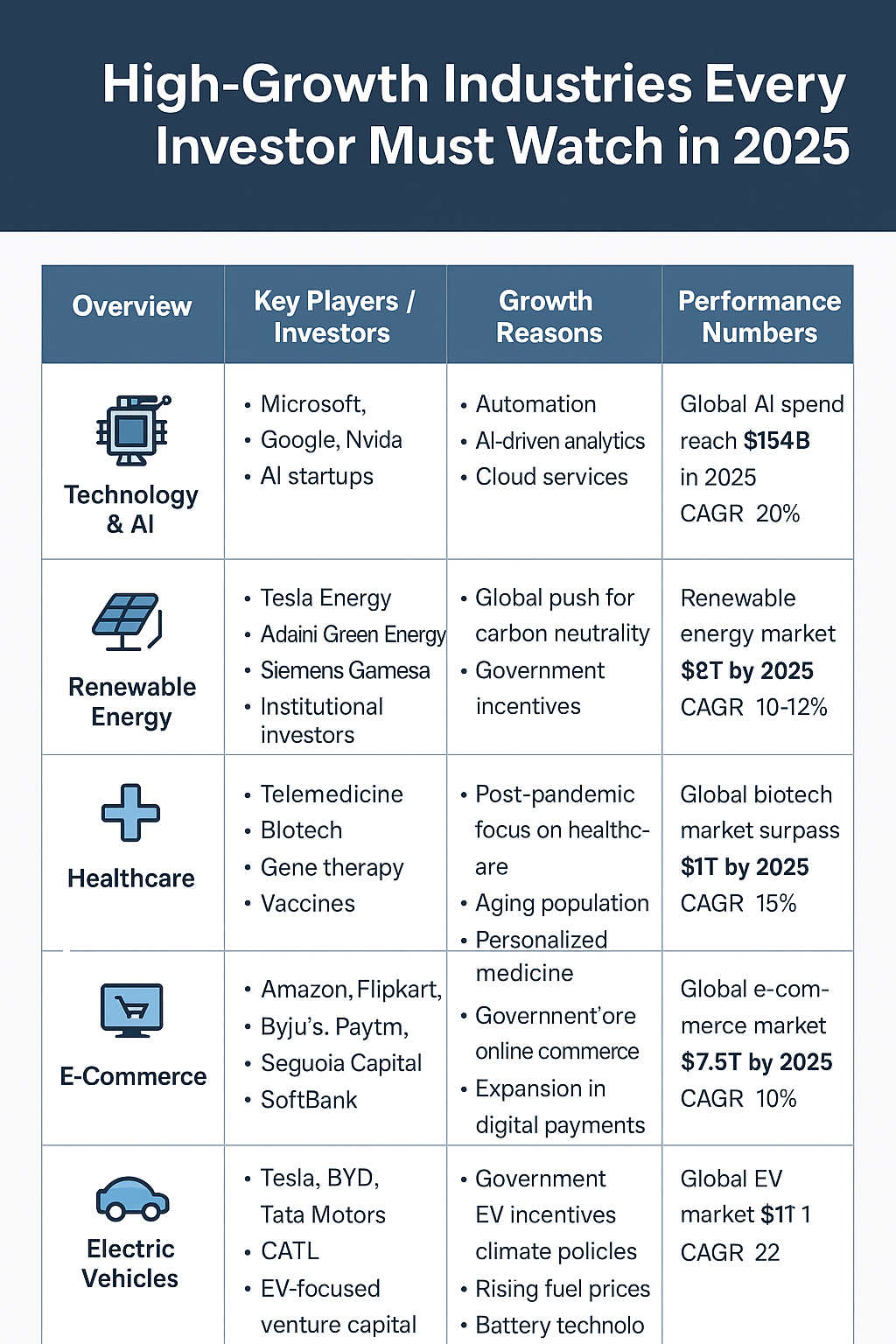
1️⃣ Technology & Artificial Intelligence (AI)

AI, cloud computing, cybersecurity, and software innovations are reshaping industries globally. Automation, analytics, and smart solutions are driving demand.

Increasing automation in enterprises Rising adoption of AI-driven analytics and cloud services High demand for cybersecurity solutions

CAGR of 20% (2022–2025)

2️⃣ Renewable Energy

file 00000000be686206be3371f2ae9a98d7

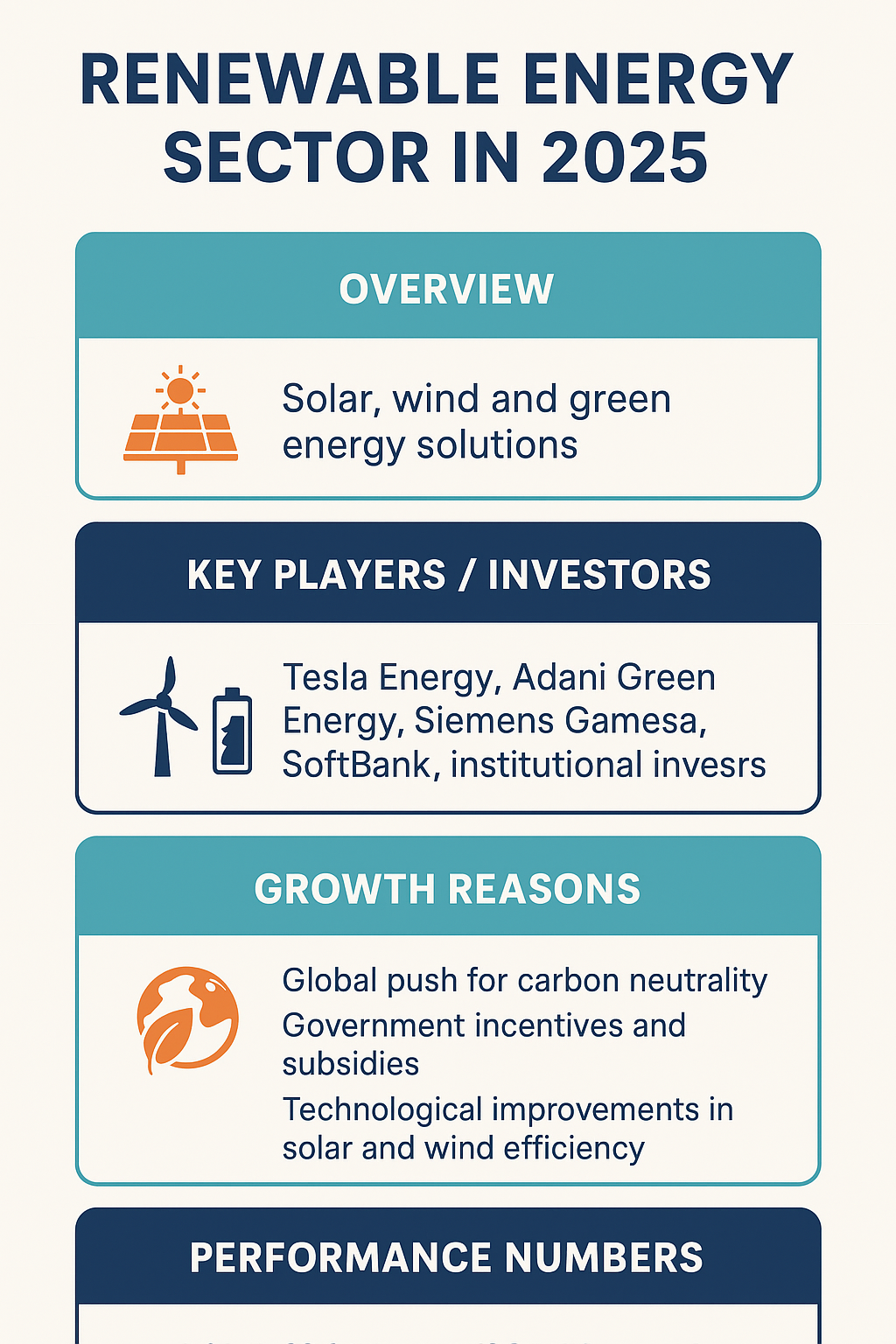
Tesla Energy, Adani Green Energy, Siemens Gamesa, SoftBank, and institutional investors.

Global renewable energy market projected at $2T by 2025CAGR: 10–12%Investment inflows: $500B+ globally in 2024

https://dhan.co/mutual-funds/mf-to-invest/renewable-energy-mutual-funds

/Top 5 Sectors That Can Give the Highest Mutual Fund Returns in 2025 — 🪔diwali

3️⃣ Healthcare & Biotechnology

3. Growth Reasons:

4. Performance Numbers:

4️⃣ E-Commerce & Digital Services

1. Sector Overview:

2. Key Players / Investors:

Amazon, Flipkart, Byju’s, Paytm, Sequoia Capital, and SoftBank.

3. Growth Reasons:

Shift from offline to online commerce Expansion in digital payments and subscription servicesRapid adoption in emerging markets

Performance Numbers:

Global e-commerce market projected at $7.5T by 2025CAGR: 10%Digital payment volume grew 25% YoY in India (2024)

Source: Groww https://share.google/Wb3lAEU2vWoSdzYJE 🏆 Top 7 Hedge Funds That Outperformed in the Last 3–5 Years

5️⃣ Electric Vehicles (EV) & Future Mobility

Sector Overview:

2. Key Players / Investors:

Tesla, BYD, Tata Motors, CATL, and EV-focused venture capital.

3. Growth Reasons:

Government EV incentives and climate policiesRising fuel prices and consumer demand for eco-friendly vehiclesBattery technology innovation reducing costs

4. Performance Numbers:

Conclusion

These 5 high-growth industries offer strong investment potential in 2025. By focusing on Technology & AI, Renewable Energy, Healthcare & Biotech, E-Commerce & Digital Services, and EVs, investors can capitalize on rapidly growing markets and make informed investment decisions. Always combine emerging sectors with stable investments for a balanced and profitable portfolio. 💡

These 5 high-growth industries offer strong investment potential in 2025. By focusing on Technology & AI, Renewable Energy, Healthcare & Biotech, E-Commerce & Digital Services, and EVs, investors can capitalize on rapidly growing markets and make informed investment decisions. Always combine emerging sectors with stable investments for a balanced and profitable portfolio. 💡