
How to Save Money When Income Is Low (Practical Guide for Beginners)

untitled design

INTRODUCTION

When your income is low, saving money feels impossible.You earn little, bills are many, and by the end of the month, nothing is left.I have been in this situation.

Here, you will learn how to save money when income is low, using simple habits, real-life thinking, and practical steps — no complex finance words.

📑 TABLE OF CONTENTS

1 Why Saving Money Is Hard with Low Income

The Biggest Mistake Low-Income Earners Make

How to Save Money When Income Is Low (Step-by-Step)

4 Simple Budget Method for Low Income Small Real-Life Example

5 Small Real-Life Example

6 One Habit That Changes Everything

7 Final Thoughts

untitled design

Why Saving Money Is Hard When Income Is Low

When income is low, problems are real:

Every rupee already has a purpose Emergency expenses break plans Motivation to save feels useless

But the real problem is not income.

EARN MONEY AS A STUDENT JUST A PHONE, NO INVESTMENTThe real problem is:No clear money system Emotional spendingWaiting for income to increase Saving is a behavior problem, not an income problem.https://www.iciciprulife.com/investments/how-to-save-money.h

The Biggest Mistake Low-Income Earners Make

paisakmao.de

The most common mistake is:“I will start saving when my income increases.”This thinking delays saving forever.

Why this is dangerous:

Habits don’t change automatically Higher income brings higher expenses No discipline = no savings

Saving must start first. Income comes later.https://www.investopedia.com/personal-finance/most-common-financial-mistakes/

How to Save Money When Income Is Low (Step-by-Step)

untitled design (1)

Tea / coffee Snacks Mobile recharge Online subscriptions

Small expenses look harmless, but they silently kill savings.http://7 Proven Ways for Students to Make Money ‣ paisakmao.de https://share.google/FxtRG31R1YD7EYeTq

Step 2: Save First, Spend Later

Do not wait for month-end.Even if it is:₹50₹100$1

Save it the moment income comes.This creates a saving habit.

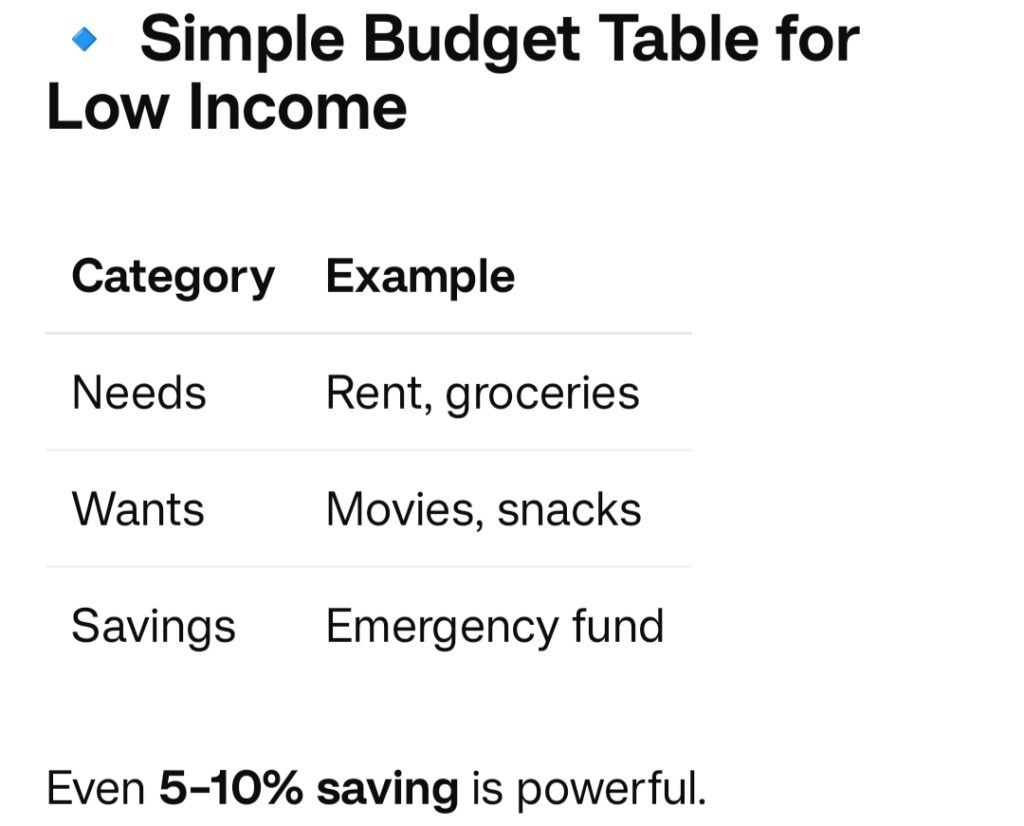
Step 3: Use the 3-Category Budget Method

Divide your money into:Needs – rent, food, transportWants – entertainment, eating outSavings – mandatory

Rule:Savings is not optional. Even small is okay.

Step 4: Cut Only One Bad Habit

Do NOT cut everything.Choose only one:

Online food Smoking Impulse shopping Paid apps

Cutting one habit is enough to start progress.

✅ Step 5: Increase Awareness, Not Pressure

Do not hate yourself for low income.Instead ask:

Why did I spend this?Was it emotional or necessary?Awareness builds control.

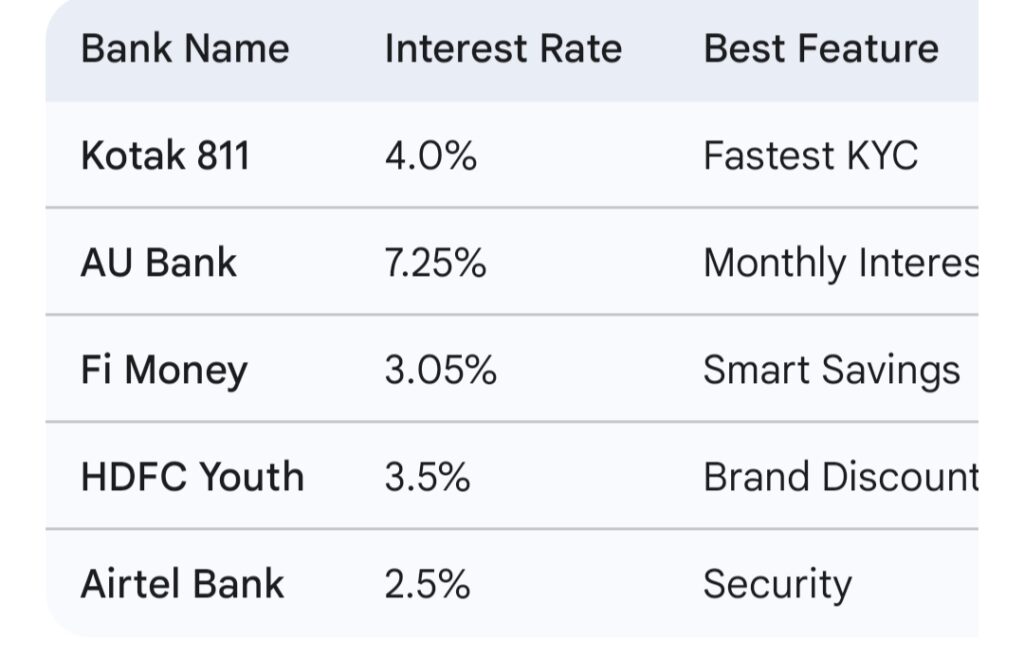
TABLE picture 🖼️
oplus 131072

🔹 A Small Real-Life Example

When my income was low, I saved only a small amount monthly.It did not change my financial status.

But it changed my thinking.

Later, when income improved, saving became automatic.The habit mattered more than the amount.

One Habit That Changes Everything

Ask this question before spending:“Do I really need this right now?”This one question saves more money than any app.

Final Thoughts

If your income is low, do not wait for a perfect time.Start smallStay consistentFocus on habitsSaving money is a skill, not a salary issue.

You don’t need a high income to start saving. Start small, stay consistent, and take control of your money from today.

Call To Action

👉 You don’t need a high income to start saving. Start small, stay consistent, and take control of your money from today.Click

ETF vs Mutual Fund: Which Is Better? (Complete 2026 Guide) 📊💡

1767899104644

1. Introduction: What Are ETFs & Mutual Funds?

Investing doesn’t have to be complicated — two of the most common ways to invest are ETFs (Exchange-Traded Funds) and Mutual Funds. Both pool money from many investors to buy a basket of securities like stocks or bonds, but how you buy them, cost, taxation, and flexibility vary significantly.https://www.britannica.com/money/etfs-vs-mutual-funds?utm_source=chatgpt.com technology thematic fund india best technology mutual fund top technology thematic fund

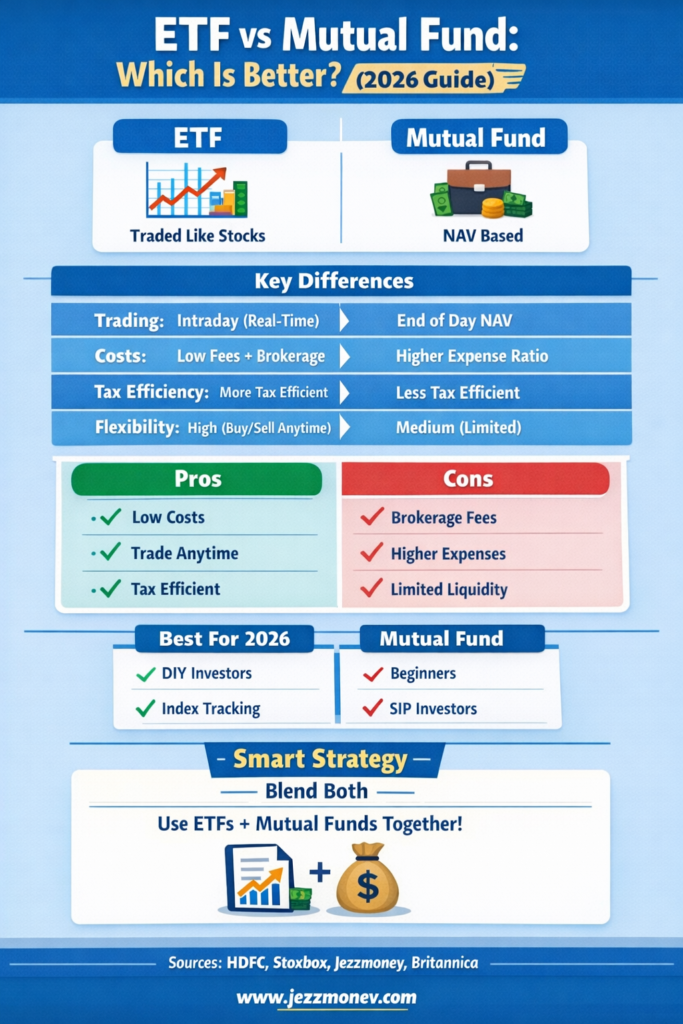
table picture 🖼️👇

1000053606

2. What Is an ETF? (Explained)

🔹 ETF stands for Exchange-Traded Fund.🔹 It’s like a stock that represents a basket of assets (index, stocks, bonds, commodity, etc.).

🔹 Traded on stock exchanges throughout the day — price keeps changing.🔹 Most ETFs track indices (e.g., Nifty 50, S&P 500). https://www.britannica.com/money/etfs-vs-mutual-funds?utm_source=chatgpt.com

Why ETFs exist:

Provide diversified investing without picking individual stocks.Combine features of stocks and mutual funds.https://cleartax.in/s/etfs-vs-mutual-funds?utm_source=chatgpt.comBest Saving Schemes for Middle Class Family (India)

3. What Is a Mutual Fund? (Explained)

AMutual Fund pools money from many people.🔹 A fund manager buys and sells assets based on a strategy.🔹 You buy/sell at NAV (Net Asset Value) — calculated once daily.https://www.hdfc.bank.in/blogs/mutual-funds Highest mutual fund returns 2025 Diwali

Types of Mutual Funds:

equity fund

debt fund

hybrit fund

Index Funds (passive like ETFs but not exchange-traded)https://www.axis.bank.in/blogs/mutual-funds/differences-between-etf-funds-vs-mutual-funds?utm_source=chatgpt.com

How They Work (Step-by-Step)

ETF (Example)

You place a buy order via broker/demat.It’s executed in real-time during market hours.Price moves with supply & demand.✔️ Like buying stocks.https://www.jezzmoney.com/blog/difference-between-etf-and-mutual-fund?utm_source=chatgpt.com

Mutual Fund (Example)

Place order anytime before market close.Purchase value calculated at end-of-day NAV.You get units per NAV price.✔️ More passive & systematic

5. Key Differences (Comparison Table)

Feature. ETF mutul fund 💹

Trading. Traded l. ike stocks (intraday)Only at NAV (end of day)

PriceMarket price = dynamic

CostsLower expense ratio, brokerage appliesHigher expense ratios

Minimum InvestmentPrice of 1 unitTypically higher (some Rs500+)

SIPNot in all brokersYes (popular)Tax Efficiency Generally more tax-efficientCapital gains distributed

ManagementMostly passiveActive or passiveFlexibilityHighMedium

6. Advantages — ETF vs Mutual Fund

ETFs

Low expense ratios → cost efficient 🔽https://www.hdfc.bank.in/blogs/mutual-funds

Trade anytime (intraday flexibility) ✔️https://www.britannica.com/money/etfs-vs-mutual-funds?utm_source=chatgpt.com

Tax efficiency — lower capital gains hithttps://www.britannica.com/money/etfs-vs-mutual-funds?utm_source=chatgpt.com

🔹 Mutual Funds

Professional active management (can sometimes beat market)https://www.axis.bank.in/blogs/mutual-funds/differences-between-etf-funds-vs-mutual-funds?utm_source=chatgpt.com

SIPs make disciplined investing easy ✔️https://stoxbox.in/financial-news-hotbox/etf/etf-vs-mutual-funds?utm_source=chatgpt.com

Fractional unit investing (makes small investments easierhttp://Fractional unit investing (makes small investments easierhttp://EARN MONEY AS A STUDENT JUST A PHONE, NO INVESTMENT

7. Disadvantages — ETF vs Mutual Fund

ETFS👇

Brokerage charges apply (buy/sell) 🧾https://stoxbox.in/financial-news-hotbox/etf/etf-vs-mutual-funds?utm_source=chatgpt.com

Bid-ask spread can reduce gains for low-liquidity ETFs 🧮https://stoxbox.in/financial-news-hotbox/etf/etf-vs-mutual-funds?utm_source=chatgpt.com

Requires demat + trading account 📈http://Requires demat + trading account 📈

⚠️ Mutual Funds

Higher expense ratios can eat returns 📉 �HDFC BankOnly once-a-day trading at NAV 🔄 �Encyclopedia BritannicaTax inefficiencies from internal security sales 🧾 �https://cleartax.in/s/etfs-vs-mutual-funds?utm_source=chatgpt.com.Best performing investment sector 2026

8. Which One Is Better for You in 2026?

🎯 Choose ETF if:

✅ You want lower cost & more control over timing. 🔍

✅ You’re okay with a demat + trading account.

✅ You prefer index-based investing (Nifty/S&P).

🎯 Choose Mutual Fund if:

✅ You’re a beginner & want automatic investing (SIP).✅ You trust active management to outperform.✅ You prefer simplicity over intraday decisions.

👉 Many smart investors use a blend:

ETFs for core low-cost holdingsMutual funds for systematic SIP & active diversification

Hidden Points Investors Often Miss

Not all ETFs are low risk — some are leveraged/sector-specific. �✅ ETFs can trade at a premium/discount to NAV — impacting returns if volume is low. �https://www.reddit.com/r/StartInvestIN/comments/1ii0ted/these_etfs_are_costing_you_a_bomb_heres_why/?utm_source=chatgpt.com

✅ SIP with ETFs is possible via some brokers now 🚀 �✅ Mutual funds can outperform only if the manager consistently beats the market. (rare statistically) �https://www.finideas.com/etfs-vs-mutual-funds-which-is-right-for-your-financial-goals/?utm_source=chatgpt.comHigh-Growth Industries Every Investor Must Watch in 2025

Conclusion + Action Steps

📌 Summary:ETFs = cheaper, tradable, tax-efficientMutual Funds = easy, professional, SIP-friendly💡 2026 Choice Tip:For most investors — index ETF + diversified mutual funds works best. Blend passive low cost with systematic planning.

, , ,

rating

Home » Scheme investment

Best 7 Performing Investment Sectors in 2026: High-Return Guide

1000053192

Investing successfully isn’t about chasing the latest stock tips—it’s about choosing the right sectors, understanding which companies are set to grow, and tracking the numbers that matter.

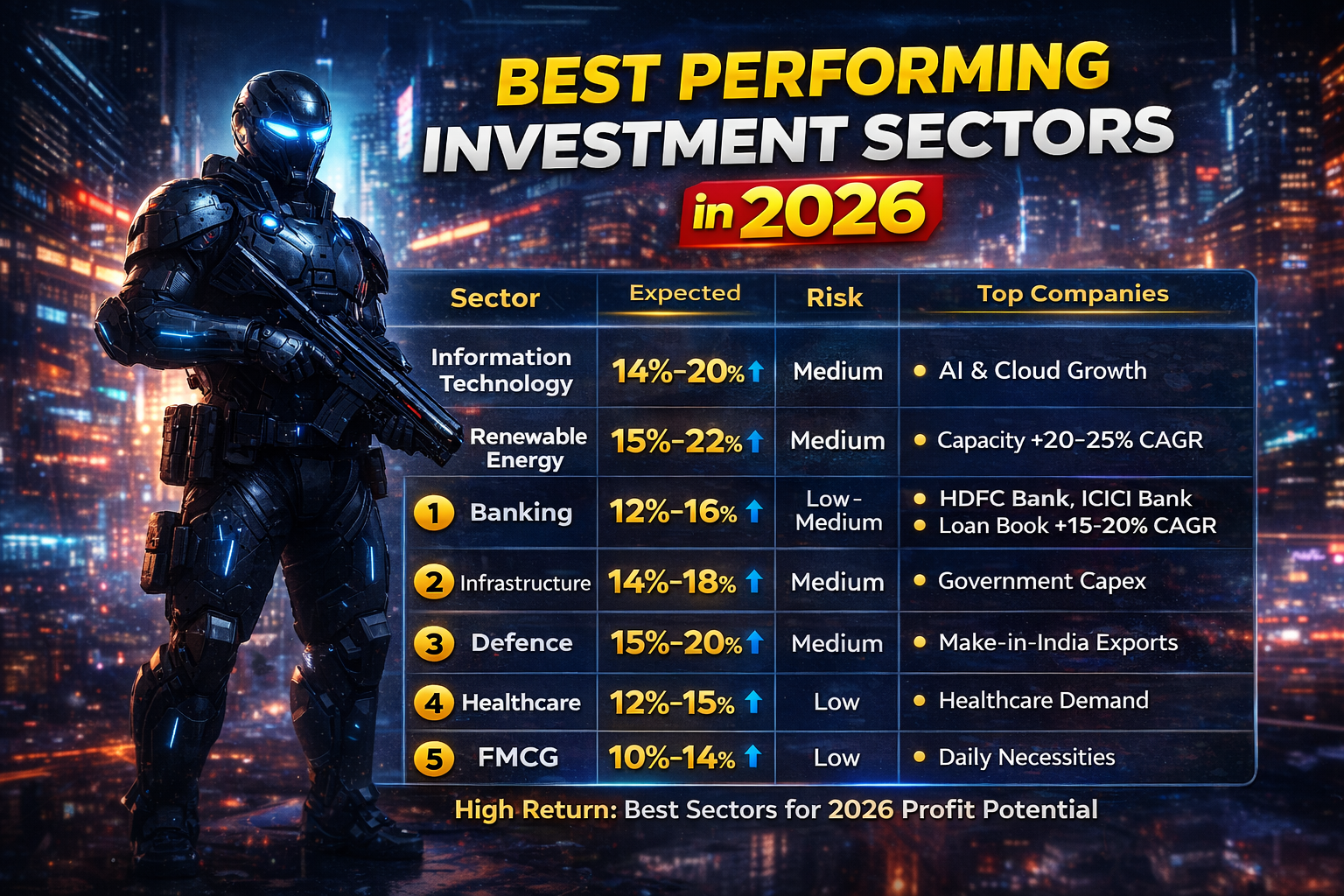
For 2026, analysts predict 7 sectors that could deliver 12%–22% returns, backed by strong growth drivers, government policies, and corporate expansion plans. This guide provides deep insights, top companies, growth projections, and key investor metrics.

1000053191

1️⃣ Understanding Investment Sectors

Why it matters:

Strong sectors lift most companies within them.Weak sectors can drag down even the strongest companies.Historical data shows 70–80% of sector-leading companies outperform during sector growth phases.

Investor Tip: Combine a strong sector with solid company fundamentals for best results.https://www.fundcalibre.com/3-minute-guide-how-to-understand-investment-sectors/Best Investment Options for Beginners in India (2025 Guide)

2️⃣ Information Technology (IT & AI)

Expected Return (2026): 14%–20%Revenue Growth: 12–18% CAGRRisk: Medium

IT is no longer just software services—it’s AI, cloud computing, cybersecurity, and enterprise automation. Global demand is growing exponentially.

Growth Drivers:

AI adoption across industries for automation & efficiencyCloud & SaaS adoption in global enterprisesContinued offshore outsourcing demand

https://m.economictimes.com/tech/technology/investments-in-ai-cloud-set-to-drive-it-spending-in-2026/articleshow/126236597.cmsBest Investment Options for Beginners in India (2025 Guide)

Top Companies & Numbers

1000053192

3️⃣ Renewable Energy (Solar, Wind & Green Power)

Expected Return: 15%–22%Capacity Growth: 20–25% CAGRRisk: Medium

Renewable energy is booming due to government policies, climate commitments, and rising EV demand.

4️⃣ Banking & Financial Services

Expected Return: 12%–16%Loan Book Growth: 15–20% CAGRRisk: Low–Medium

Banks are the backbone of any economy. In 2026, credit growth, digital banking, and better asset quality are expected to drive returns.

HDFC Bank16,000. 20,000 (+25%) Retail & digital lending ROE 15–18%, NPA <1%

ICICI Bank14,50018,000 (+24%)SME & digital services 18,000 (+24%)SME & digital servicesNPA ratio, Cost-to-income <40%

SBI45,000. 55,000 (+22%)Govt & retail loans Deposit growth, NPA

Axis Bank12,000 15,000 (+25%)Retail & corporate ROE, Loan growth %Source: Groww https://share.google/oB953RTol3a3GzuvG

Infrastructure & Capital Goods

Expected Return: 14%–18%Order Book Growth: 12–18% CAGRRisk: Medium

Infrastructure benefits from government Capex, urbanization, and industrial projects. Execution efficiency is key

Top Companies & Numbers

CompanyOrder Book 2025 (₹B)Target 2026–28StrategyMetrics

&T5,0006,500 (+30%)EPC & Smart Infra Execution efficiency, Cash flow Siemens India900 1,200 (+25%)Power & AutomationProject revenue ABB India700950 (+22%)Industrial automationOrder inflow, Revenue IRB500 750 (+25%)Roads & highways

Investor Tip: Track order book, project execution, and cash flows.http://Infrastructure & Capital Goods

Defence & Manufacturing

Expected Return: 15%–20%Order Growth: 10–15% CAGRRisk: Medium

Defence companies benefit from government budgets, Make-in-India initiatives, and exports.

Top Companies & Numbers

CompanyOrder Book 2025 (₹B)Target 2026–28StrategyMetrics

HAL450600 (+33%)Aircraft & AerospaceOrders & execution timeline BEL350500 (+42%)Electronics & Radars Bharat Forge300400 (+33%)Precision manufacturingOrders & Revenue Mazagon Dock280. 400 (+43%)ShipbuildingGovt Contracts & Execution

Investor Tip: Order inflow, execution timelines, and export orders.https://www.investindia.gov.in/sector/defence-manufacturing

7️⃣ Healthcare & Pharmaceutical

Expected Return: 12%–15%Revenue Growth: 10–15% CAGRRisk: Low

Healthcare is defensive, driven by aging population, rising healthcare spending, and exports.

Top Companies & Numbers

CompanyRevenue 2025 (₹B)Target 2026–28Strategy metirial

Sun Pharma150180–200 (+20%)Specialty drugs & US genericsNet Margin 15–18% 2 Dr Reddy’s
80
95–105 (+18%)
Global generics
Regulatory approvals

Cipla7085–90 (+20%)Market share, Revenue Apollo6080–85 (+33%)Hospitals & DiagnosticsOccupancy %, Revenue per bed Investor Tip: Track R&D, approvals, and hospital expansion.

🏁 Final Takeaway

Right Sector + Right Companies + Numbers + Patience = Higher Probability of Strong Returns.

Call To Action

Click here 🚀 Smart investors future dekh kar invest karte hain. Neeche full list aur analysis dekhiye – kaun sa sector aapke portfolio ke liye best hai?

👉 Planning to invest in 2026?
Explore these high-growth sectors, understand the numbers, and make informed investment decisions before the next market cycle begins.

hii

Post Office Saving Schemes for Middle Class – Complete Guide

file 000000008010720683b3c51a11bbd8e4

introduction

Post Office Saving Schemes for Middle Class – Complete GuideFor a middle-class family in India, the biggest financial priorities are safety, stable returns, and long-term security. Not everyone is comfortable with stock market risk or private investment products. This is where Post Office Saving Schemes become a trusted, government-backed solution.In this article, you will find all Post Office saving schemes explained in simple English, with their benefits, interest concept, tax rules, and which scheme is best for which financial goal.

What are Post Office Saving Schemes?

1000052495

Post Office Saving Schemes are investment and saving plans run by the Government of India through India Post. The main objectives of these schemes are:

Provide safe and secure investment optionsOffer fixed and guaranteed returnsHelp middle-class families plan for retirement, education, and emergencies

https://www.indiapost.gov.in/ Best Investment Options for Beginners in India (2025 Guide)

These schemes are not market-linked, so your money remains safe.https://www.indiapost.gov.in/

List of Post Office Saving Schemes for Middle Class

Below is a detailed list of the best post office saving schemes, explained in simple English.

1. Post Office Savings Account

Best for: Emergency fund and daily savings

The Post Office Savings Account works just like a regular bank savings account. It is suitable for people who want to keep their money safe and easily accessible.

Key Features:

Minimum balance: ₹500Interest rate: Around 4% per yearEasy deposit and withdrawalGovernment-backed security

Why choose this scheme?

Ideal for keeping emergency moneyVery low riskSimple and hassle-free

👉 Best for beginners and middle-class families who want liquidity with safety.

2. Post Office Recurring Deposit (RD)

Best for: Salaried and fixed-income earners

Post Office RD is perfect for people who want to save a small amount every month and build a lump sum over time.

Key Features:

Monthly deposit starts from ₹100Tenure: 5 yearsInterest rate: Around 6–7% per yearCompound interest benefit

Why choose this scheme?

Encourages regular saving habitAffordable for middle-class familiesGuaranteed returns

Best for short to medium-term goals like buying gadgets, travel, or emergency savings.

. Post Office Time Deposit

Best for: Fixed return seekers

This scheme is similar to a Fixed Deposit (FD) in banks.

Tenure Options:

1 year2 years3 years5 years

Key Features: Fixed interest rates5-year TD offers tax benefits under Section 80CSafe and predictable returns

Why choose this scheme?

No market riskSuitable for conservative investorsIdeal for surplus money

Best for people who want guaranteed returns with zero tension.https://www.bajajfinserv.in/investments/post-office-time-deposit-scheme releted schemeTop 7 Monthly Income Schemes to Earn Fixed 🙋Money 💰

. Post Office Monthly Income Scheme (MIS)

Best for: Regular monthly income

This scheme is popular among retired people and middle-class families who want a steady income every month.

Key Features:

Monthly interest payoutTenure: 5 yearsJoint account facility availableSafe and stable income

Why choose this scheme?

Fixed monthly incomeIdeal for managing household expensesLow risk

Best for parents, retirees, and conservative investors

5. Public Provident Fund (PPF)

Best for: Long-term wealth creation and tax saving

PPF is one of the most trusted long-term saving schemes in India.

Key Features:

Lock-in period: 15 yearsTax-free returnsTax deduction under Section 80CCompound interest advantage

Why choose this scheme?

Excellent for retirement planningCompletely tax-free maturityGovernment guarantee

Best for disciplined investors thinking long-term.

6. Senior Citizen Savings Scheme (SCSS)

Best for: Senior citizens (60+ years)

This scheme is specially designed for retired individuals.

Key Features:

High interest rateQuarterly interest payoutTax benefits availableTenure: 5 years

Best for senior citizens looking for secure income after retirement.

Which Post Office Scheme is Best for You?

Financial GoalBest SchemeEmergency fundSavings AccountMonthly savingRecurring DepositFixed returnsTime DepositRegular incomeMISRetirementPPF / SCSSTax savingPPF / 5-Year TD

Final Words

Post Office Saving Schemes are a perfect choice for middle-class families who value safety over risk. While returns may be moderate, the peace of mind and government guarantee make these schemes extremely reliable.If you want stable growth without market tension, post office schemes should be part of your financial plan.

Summary: Post Office Saving Schemes for Middle Class
Post Office Saving Schemes are safe, government-backed investment options designed especially for middle-class families in India. These schemes focus on capital protection, stable returns, and long-term financial security.
Since they are not market-linked, your money remains protected from stock market risks. That is why these schemes are ideal for people who prefer low risk and guaranteed returns.
Different post office schemes serve different financial goals:
Savings Account helps in managing emergency funds
Recurring Deposit (RD) builds savings through small monthly deposits
Time Deposit (TD) offers fixed returns similar to bank FDs
Monthly Income Scheme (MIS) provides regular monthly income
PPF and SCSS support long-term and retirement planning

💬 Quick Thought for Readers

“High returns are attractive, but safety keeps you stress-free.”That’s why millions of Indians trust Post Office Saving Schemes for their hard-earned money.

Call To Action

Click here to 🚀 Take Action Now
Saving money without a plan is risky.
Investing with a plan is powerful.
👉 Visit your nearest post office today or explore online options and start with even a small amount.
Remember:
Small savings done consistently can create big financial security.

Top High-Return Mutual Funds for 2026 (AI-Predicted Expert

1764484055967

Introduction

Investing in mutual funds is becoming Top High-Return Mutual Funds for 2026 (AI-Predicted Expertone of the smartest and safest ways to build long-term wealth in India. As we move towards 2026, millions of new investors are entering the market with the goal of achieving higher returns, lower risk, and stable long-term growth. But with so many mutual funds in the market, choosing the right ones can be confusing

To solve this, we have created a detailed, data-backed, AI-assisted list of the Top High-Return Mutual Funds for 2026. This list combines:https://m.economictimes.com/mf/analysis/top-10-mutual-funds-to-invest-in-november-2025/articleshow/125046363.cms

STRUCTURE Past performanceRisk managementFund manager reputationPortfolio structureHistorical returnsLong-term consistencyAI-based future trend analysis

Why 2026 Is an Important Year for Mutual Fund Investors

1764477280874

Before diving into the list, understand why 2026 is a strategic year for wealth building:

1. Indian Economy Is Expanding Rapidly

India is projected to become the third-largest economy in the world by 2027–28. This economic growth directly benefits equity mutual funds.

2. SIP Growth in India Is at an All-Time High

More than 7 crore SIP accounts exist.This shows investors are shifting toward long-term, stable, compounding-based wealth creation.

3. Market Corrections Create Better Buy Opportunities

Post-2024 and 2025 volatility, mutual funds in 2026 may offer excellent entry points for long-term investors.

4. IT, Banking, Pharma, and Manufacturing Sectors Are Strong

These sectors dominate many mutual fund portfolios — which creates long-term compounding potential.

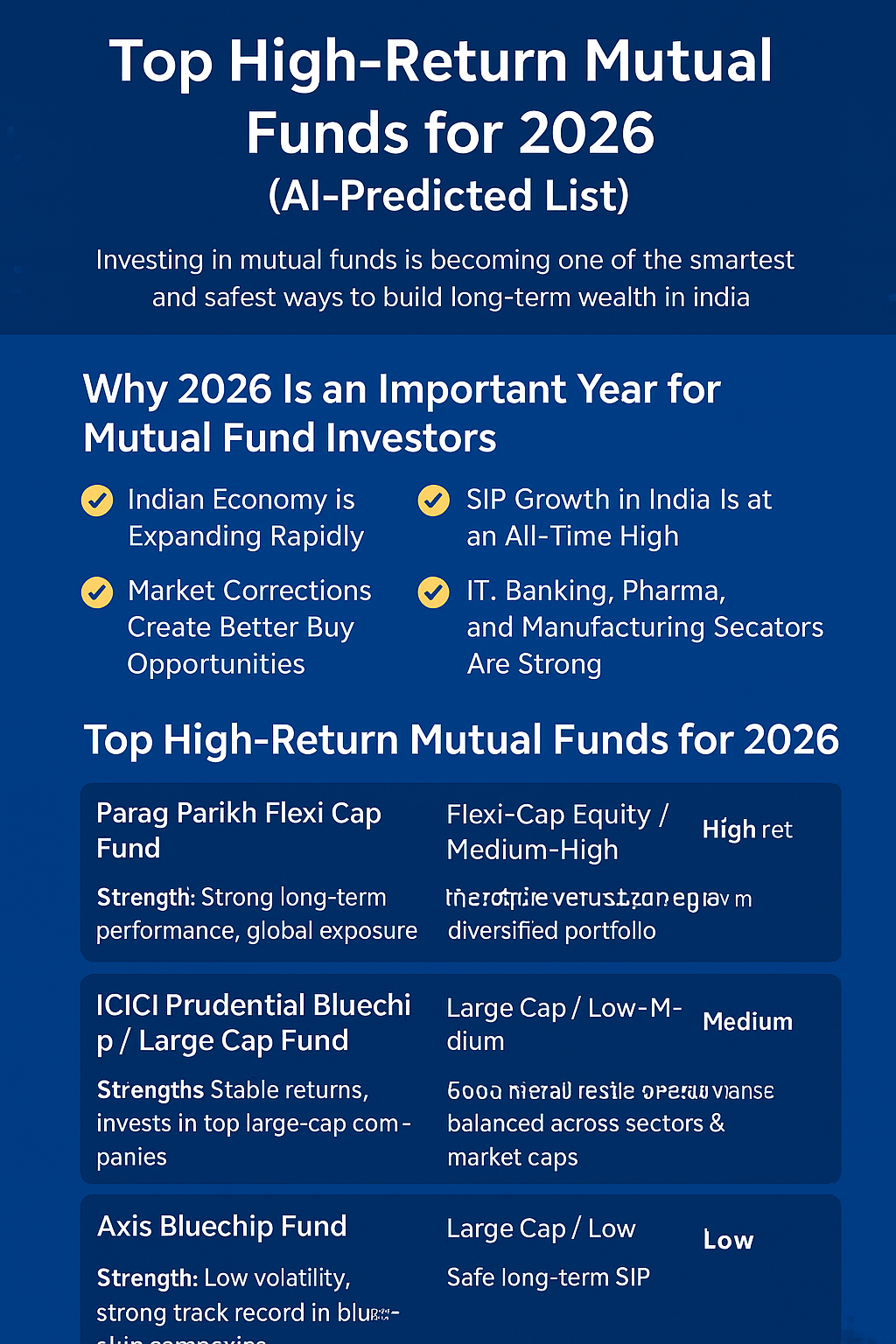
🔥 Top High-Return Mutual Funds for 2026 (AI Predicted List)

1000050976

Below are the top funds chosen based on 5+ strong parameters.

1️⃣ Parag Parikh Flexi Cap Fund

Category: Flexi-Cap Equity

Ideal For: Wealth creation, long-term SIP, low-income investors with long horizon

Why this Fund is Powerful for 2026

This is one of India’s most trusted wealth-building funds.

The fund invests in large-cap, mid-cap, small-cap, and global stocks.

Exposure to global giants like Alphabet (Google), Meta, Amazon, etc.Strong fund manager decisions even during market crashes.

Consistent long-term returns

Very strong downside protection

High-quality companies

Risk-managed investing

Why AI Predicts Strong Growth

Its global + Indian portfolio offers the best balance of stability and growth for 2026.technology thematic fund india best technology mutual fund top technology thematic fund

2️⃣ ICICI Prudential Bluechip / Large Cap Fund

Category: Large Cap. Risk Level: Low to Medium

Ideal For: Beginners, safe long-term returns

Why this Fund Works in 2026

Large-cap funds invest in top 100 Indian companies — safe, stable, and reliable.This fund has historically shown:

Low volatilitySteady returnsStrong downside protectionExcellent risk management

Who Should Invest

StudentsSmall investorsNew mutual fund investorsAnyone wanting slow but steady growth

Why AI Predicts Strong Returns

Indian large-cap companies will benefit massively from economic expansion by 2026–2027.

3️⃣ HDFC Flexi Cap Fund

Category: Flexi-Cap

Risk Level: Medium

Ideal For: Balanced growth + moderate risk investors

Why This Fund is Strong

HDFC is known for long-term compounding and strong fund management.Portfolio includes:

Leading private banksStrong manufacturing companiesIT leadersPharma giants

Strengths

Good historical returnsSmart diversificationStrong fund manager reputation

AI Growth Reason

The fund’s balanced portfolio is strong for long cycles like 2026–2030.

Source: Groww https://share.google/bJjHPchz2NfFg3dpRHow to Start Investing: Step-by-Step Beginner’s Guide to Grow Your Money🤑

4️⃣ Axis Bluechip Fund

Category: Large CapRisk Level: Low to MediumIdeal For: Safe long-term SIPWhy Investors Love This Fund

Axis Bluechip focuses on quality blue-chip companies with:

Low volatilityHigh stabilityPredictable growth

Suitable For

BeginnersLow-risk investorsAnyone wanting safe compounding for 5–10 years

Fund Name Category Risk Ideal For Strength
Parag Parikh Flexi Cap Flexi Cap Med-High Long-term Global + Indian mixICICI Pru Large Cap Large Cap Low-Med Beginners StabilityHDFC Flexi Cap Flexi Cap Medium Balanced investors DiversifiedAxis Bluechip Large Cap Low Safe SIP Low volatility
High risk investment symetick fund in india

How to Choose the Best Fund for Yourself

✔ If you want highest long-term returns →

Parag Parikh Flexi Cap✔ If you want safe, stable return

ICICI Prudential Large CapAxis Bluechip Fund

If you want balanced risk + growth →HDFC Flexi Cap

SIP Strategy for 2026 (Best Method)

1. Start Small: ₹500 – ₹1000 SIP

Even small SIPs grow big through compounding.

2. Invest for Minimum 5–7 Years

Short-term mutual fund investing doesn’t work.

3. Select 2 Funds Only

Too many funds = no focusBest combo:1 Flexi Cap + 1 Large Cap

4. Increase SIP Every Year

Even +10% yearly increase boosts wealth massively.

5. Don’t Stop SIP During Market Crash

Crash = discounted stocksThese periods give the highest future returns.

What Returns Can You Expect by 2026–2030

Fund Type Expected Return Range

Large Cap 10% – 14% per yearFlexi Cap 12% – 18% per yearMid Cap / Small Cap 15% – 25% per year (High Risk)

Beginner-Friendly Example (Perfect for Low Income)

Monthly SIP: ₹1000Duration: 10 YearsPossible Value: ₹2.5 – ₹4.8 LakhsThat’s the power of compounding.

Conclusion

The year 2026 is a golden opportunity for Indian investors.The mutual funds listed above — especially Parag Parikh Flexi Cap, HDFC Flexi Cap, Axis Bluechip, and ICICI Large Cap — are powerful wealth-building options for anyone who wants:

Long-term growthHigh returns with balanced riskReliable performanceStrong compoundingStress-free investing

If you start a SIP today, even a small amount, the next 5–10 years can transform your financial life.

Call To Action

✅ Top CTA Lines for Your Finance Blog1. Simple & Trust-Building CTA👉 Want to grow your money faster? Join our free weekly finance tips — start building wealth today!

💼 Ready to Start Investing?

Start small with SIPs and let compounding work for you. Choose reliable mutual funds and build steady wealth over time.

Start Investing Today

Simple Investing Habits Rich People Use to(2025 Guide)

simple investing habbit

Simple Investing Habits Rich People Use to(2025 Guide) more — it’s about managing, multiplying, and protecting money wisely.Rich people follow some simple, repeatable investing habits that help them stay wealthy for decades.In this guide, you’ll learn those exact habits, simplified for beginners in India.

Introduction

Most people think rich people follow complicated strategies, but in reality, wealthy people stick to simple, disciplined investment habits.These habits look small — but over time, they create huge financial advantage.Here are the 10 investing habits rich people consistently follow to stay wealthy.

oplus 131072

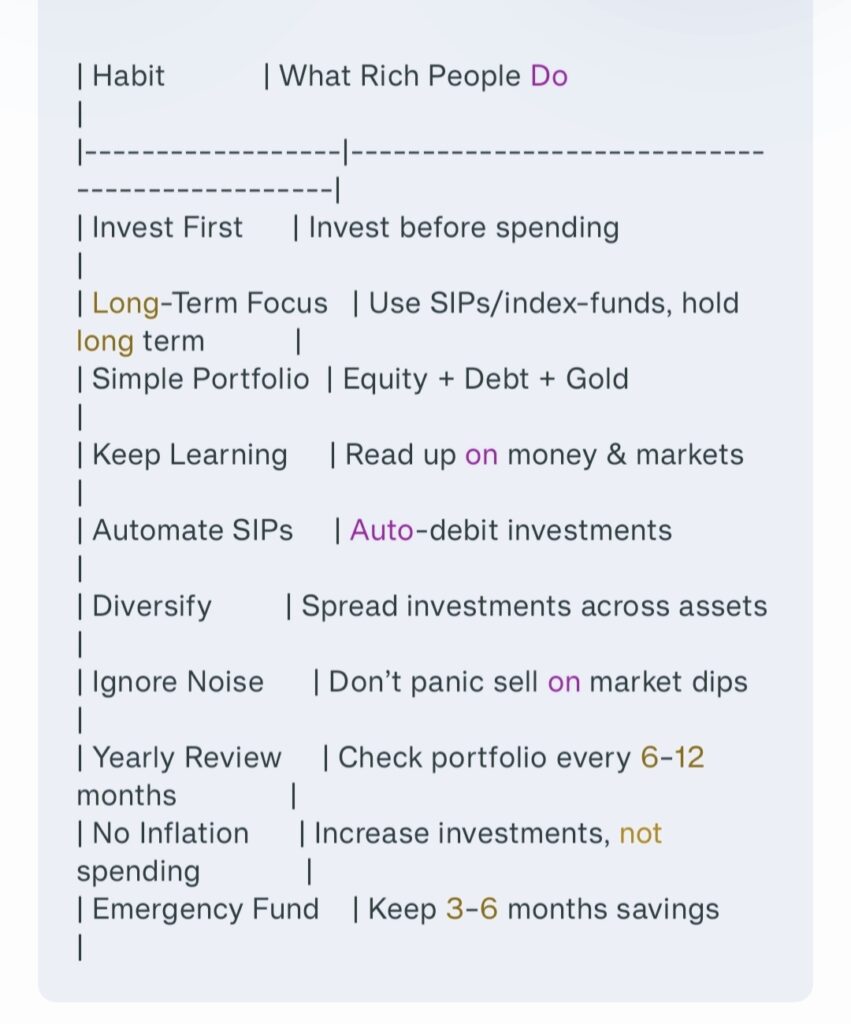
1. They Invest Before Spending (Pay Yourself First)

1000047057

Rich people never wait for “remaining money” to invest.They invest first, spend later.

Formula they follow:

Income → Investment → ExpensesNot: Income → Expenses → Investment (if anything left)

This single habit forces wealth creation automatically.Source: Groww https://share.google/1zt5qaLxqSsxXeAHX

2. They Choose Long-Term Investing Over Quick Profits

Rich people know the real game is long-term compounding.They avoid get-rich-quick schemes and focus on:

money 2696228 1280

Equity mutual funds

Index funds

Blue-chip stocks

Long-term SIPs

Wealth = Consistency × Time

3. They Keep Their Investments Extremely Simple

1000047056

Wealthy people don’t chase 100 different assets.They prefer simple portfolios:High risk investment symetick fund in india

50–60% Equity

20–30% Debt

10–15% Gold

5–10% Cash/REIT/Other assets

4. They Never Stop Learning About Money

Rich people actively learn about:

Finance

Market trends

New investment methods

Tax-saving strategies

They treat “financial literacy” like a skill. Simple Investing Habits Rich People Use

5. They Automate Investments (SIPs & Auto-Debit)

To stay consistent, rich people automate investing.

Why?Because “willpower” fails, but “automation” never forge

Even beginners can automate:

SIP

RD

gold sip

nps contribution

Automation builds wealth quietly.

6. They Diversify Properly

Rich people never put all money in one place.

They spread money across:

Stocks

Mutual funds

Gold

Real estate

Businesses

Cash reserves

Diversification = Risk control + Stable returns.

7. They Ignore Market Noise

Rich people don’t panic when:

Market drops

Finance news screams fear

Social media predicts crash

People say “Sell everything!”

They stay calm because they think long-term.

“If the business is strong, I stay invested.”

8. They Review Investments Every 6–12 Months

Wealthy people regularly review:

Portfolio performance

Asset allocation

SIP amounts

Financial goals

They don’t check the market daily — but they do check strategically.http://EARN MONEY AS A STUDENT JUST A PHONE, NO INVESTMENT

9. They Avoid Lifestyle Inflation

As income increases, the middle class increases expenses.Rich people do the opposite — they increase investments.

Simple Investing Habits Rich People Use to(2025 Guide

Their rule:

Income ↑ → Investment ↑Not: Income ↑ → Expenses ↑

This is why they keep getting richer.

10. They Always Keep Cash Reserves (Emergency Fund)

Rich people never invest 100% of their money.They keep at least 3–6 months of expenses as cash.

This protects them in situations like:

Job loss

Medical emergency

Business slowdown

Unexpected bills

A strong emergency fund = safer investing.http://7 Proven Ways for Students to Make Money ‣ paisakmao.de https://share.google/FxtRG31R1YD7EYeTq

ConclusionBecoming wealthy is not about luck or complicated formulas.It’s about simple habits repeated for years.If you follow even 3–4 of these habits, your financial life will start changing drastically.The real secret is:> Rich people don’t do extraordinary things.They do simple things extraordinarily consistently.

Early Retirement Planning in India: A Complete Guide (2025)

untitled design (2)
Early Retirement Planning in India: A Complete Guide (2025)

introduction

1000050508

Early retirement is no longer just a dream for the rich — it has become a clear and achievable financial goal for millions of Indians. With rising stress in corporate jobs, increasing awareness about financial independence, and the 💹 of smart investment options, more people now want to retire at 40 or 45, instead of waiting till 60https://www.iciciprulife.com/retirement-pension-plans/early-retirement-planning-tips..

But achieving early retirement in India requires one thing: a clear plan.You must know how much money you need, where to invest, how to grow your income, and how to protect your savings from inflation. The good news is that with the right strategy, even a middle-class person can retire early and live a peaceful, financially secure life.

1. What Is Early Retirement in India?

Early retirement means stopping regular job/work before the age of 60 and living fully from your savings, investments, and passive income.Today, many Indians aim to retire at 40–45 instead of 60.

. Why Early Retirement Is Becoming Popular

More freedom

Time for family

Time to build a business

Break from corporate stress

Financial independence

3. Calculate Your “Retirement Number”

Before planning, you must know: How much money do I need to retire early?

Formula:(Monthly expenses × 12) × 25

Example:

Your monthly expense = ₹25,000

Yearly = ₹3,00,000

Retirement Number = ₹3,00,000 × 25 = ₹75,00,000

https://groww.in/calculators/retirement-calculator

Means:If you invest and reach ₹75 lakhs, you can retire with 25k monthly expenses.

4. Understand Your FIRE Type

4.1. Lean FIRE

Minimum lifestyle with low expenses। Target investment: ₹40–60 lakhs.

4.2. Fat FIRE

Comfortable lifestyle, travel, shopping, luxury। Target: ₹1.5–3 crore.

4.3. Barista FIRE

Retire early but work part-time for fun.

4.4. Coast FIRE

5. How Much You Must Invest Every Month

Example (Goal: ₹1 Crore in 15 Years)

If expected return = If expected return = 12% (mutual funds), then:, then:

Start with ₹10,000/month → ₹45 lakhs

₹20,000/month → ₹90 lakhs

₹25,000/month → ₹1.1 crore

Conclusion:Start as early as possible.Time =

6. Best Investment Options for Early Retirement in India

6.1. Equity Mutual Funds (SIP)

Best for long-term wealth

12–15% return potential

Automatic compoundingPerfect for 10–20 year goals.How to Start Investing: Step-by-Step Beginner’s Guide to Grow Your Money🤑

6.2. Index Funds

Low risk

Low cost

Long-term stable Growth best for simple investing.

6.3. Stocks

High return potential

Requires knowledgeUse only 10–20% of your portfolio.

6.4. PPF (Public Provident Fund)

Very safe

Tax-free

Good for long-term stability

6.5. NPS (National Pension System)

Good for retirement

Low fees

Extra tax savingUse it as a secondary retirement tool.

Final Summary (Short & Powerful)

Early retirement means stopping

Before planning, you must know: How much money do I need to retire early?

Minimum lifestyle with low expenses। Target investment:

2025 Investors Mutual Fund: Your Essential Blueprint for Building wealth

1762924741291

2025 Investors Mutual Fund: Your Essential Blueprint for Building wealth In today’s dynamic financial landscape, simply saving 🤑 is not enough to stay ahead of inflation. Mutual funds have emerged as the premier vehicle for wealth creation, offering diversification and professional management to retail investors. This comprehensive guide cuts through the complexity, providing you with a clear, step-by-step blueprint to understand, select, and manage mutual funds effectively. By the end of this article, you will be equipped with the knowledge to make informed decisions that align with your unique financial goals.https://www.mnclgroup.com/long-term-investing-beginners-blueprint-for-wealth-building

1000050070

Understanding the Core Mechanics of a Mutual Fund

A mutual fund is essentially a financial intermediary—a trust that collects money from a large number of investors with similar investment objectives. This pooled capital is then invested in various assets by a professional fund manager. The Key Players in Your Investment

The Investor (You): The individual buying the fund units, aiming for growth or income.

Fund Manager: The expert who actively researches and decides what to buy and when to sell, based on the fund’s mandate.

Custodian: A separate entity that holds the fund’s securities safely, ensuring investor protection.

: How Returns are Generated

Your investment grows primarily through two mechanisms:

Capital Appreciation: When the value of the underlying stocks or bonds in the fund’s portfolio increases.

Income Distribution: Interest (from bonds) or dividends (from stocks) earned by the fund are distributed to the unit holders.

Top investor to investor industries to investNAV (Net Asset Value): The price of one unit, which reflects the daily market value of the fund’s assets minus its liabilities. Monitoring NAV is key to tracking your return.https://www.rbcgam.com/en/ca/learn-plan/investment-basics/five-principles-of-successful-investing/detail http://Investor

📈 : The Investor’s Blueprint: A 5-Step Strategy

1000050071

Successful investing is a journey, not a sprint. Follow this structured approach to ensure your mutual fund choices are robust and resilient.

3: Step 1: Goal Setting and Risk Profiling

This is the most crucial preliminary step. You must link every investment to a specific, quantified goal (e.g., ₹20 Lakh in 10 years for a child’s education).

Short-Term (1-3 years): Park funds in safer Debt Funds or Liquid Funds

Long-Term (7+ years): Allocate a higher percentage to Equity Funds to benefit from compounding.

Risk Tolerance: Determine your ability and willingness to see a temporary drop in value. Your risk profile (Conservative, Moderate, or Aggressive) dictates your final asset allocation (Equity vs. Debt ratio).http://7 Proven Ways for Students to Make Money ‣ paisakmao.de https://share.google/PPhbO3ZCdEqjUk76X

3: Step 2: Choosing the Right Asset Allocation

Do not put all your capital into one type of fund. Diversification across asset classes is the primary risk mitigation tool.

Equity Funds: Best for long-term growth and capital appreciation. Example: Index Funds, Large-Cap Funds.technology thematic fund india best technology mutual fund top technology thematic fund

Debt Funds: Ideal for capital preservation and stable income. Example: Liquid Funds, Corporate Bond Funds.

Hybrid Funds: Provide a mix of equity and debt for balanced growth. Example: Aggressive Hybrid Funds.

H3: Step 3: Direct Plan vs. Regular PlanAs a smart investor, always consider the impact of fees over time:

3: Step 4: Investment Methodology (SIP vs. Lumpsum)

Systematic Investment Plan (SIP): Recommended for salaried individuals. By investing a fixed amount regularly, you automatically practice Rupee Cost Averaging, buying more units when prices are low and fewer when prices are high, thereby reducing market timing risk.

Lumpsum: Best suited if you have a large sum of money and are confident the market is undervalued, or for debt https://corporatefinanceinstitute.com/resources/career-map/sell-side/capital-markets/investment-methods/instruments where market timing is less critical.

3: Step 5: Monitoring and Review

Your job doesn’t end after investing. Review your portfolio every 6-12 months.

Portfolio Rebalancing: Adjust your asset allocation back to its original target (e.g., if Equity has grown too large, sell some and move to Debt).

Performance Check: Compare your fund’s return against its Benchmark Index and its peer group. If it consistently underperforms the benchmark over 3-5 years, consider switching.

2: Due Diligence: What Makes a Fund a Good Investment?

3: Critical Evaluation Metrics

1•Expense Ratio: The lower the fee, the better. Always verify the expense ratio of the Direct Plan.

2:Fund Manager‘s Experience: Look for a manager with a long tenure and a proven track record of navigating both bull and bear markets. Stability is key.

3:Alpha and Tracking Error:Alpha: The excess return generated by the fund over its benchmark. A consistently positive Alpha shows the manager’s skill.

Tracking Error (Passive Funds): How closely an index fund tracks its index. Lower tracking error is better.

4:Tax Efficiency: Be aware of the tax implications (LTCG vs. STCG) before redeeming, especially for goal-based investments.

👇📄✍️Conclusion: Discipline is the Ultimate Fund Manager

Investing in mutual funds is a powerful strategy, but it requires patience and discipline. Start small, stay committed to your SIPs, and focus on the power of compounding over the long term. Remember, the goal is not to get rich quickly, but to get rich surely.

Post Summary (Concise)
The article serves as an essential blueprint for smart mutual fund investing. It outlines the strategic steps required to maximize long-term wealth while minimizing risk.

Key Takeaways:Foundation: Successful investing starts with linking capital to specific financial goals and correctly assessing your risk tolerance.

Efficiency: Always choose the Direct Plan over the Regular Plan to benefit from a significantly lower Expense Ratio and higher long-term returns.

Due Diligence: Evaluate a fund based on its consistent performance against its Benchmark, the manager’s track record, and the long-term tax implications (LTCG).

Call To Action

Click here to change this text. Lorem ipsum dolor sit amet, cok

“Top 7 Thematic Mutual Funds in India – 32% Returns in Last 5 Years (Outperforming)” ✅

1759424187499
, ,

Are you looking for investments that can truly outperform the broader market and deliver highly focused returns? If so, then understanding Thematic Mutual Funds in India 32% Returns in Last 5 Years (Outperforming)” is essential. These funds have proven their potential by targeting powerful, future-ready sectors, with many schemes delivering up to an astonishing 32% returns over the last five years. However, navigating the many available options can be a challenge. In this guide, we cut through the confusion to present the Top 7 Thematic Mutual Funds in India that have consistently beaten their peers, helping you answer three core questions:

earliar you shoud know 👉Best Performing FlexiCap Funds: 12–15% 5-Year Growth for Middle-Class Families

1. Theme-Based Investing – These funds focus on a specific sector or theme (like Technology, Banking, Energy, or Healthcare).

When the theme performs well, returns can shoot up to 30–35% CAGR, but the downside risk is equally high.

3. Best for 3–5 Years Horizon – Suitable

Limit exposure to 5–10% of your portfolio to capture growth while keeping risks under


1 :Technology Thematic Fund 🚀

1000047497

💡 Objective: Invests in fast-growing IT, cloud, AI, and digital businesses shaping the future.

1 Year: 8.5%3 Years: 15.7%5 Years: 21.3%

Long-term investors betting on India’s tech boomRisk-takers looking for high growth in Thematic Mutual Funds in IndiaThose comfortable with short-term volatility⚠️ Risks: Rapid tech disruptions • High volatility • Sector-only exposure

Best Investment Options for Beginners in India (2025 Guide)

2. Healthcare Thematic Fund 🏥

1000047498

1 Year: 6.2%3 Years: 12.9%5 Years: 18.5%

Investors wanting a defensive sector in their portfolioThose looking for steady growth in Thematic Mutual Funds in IndiaLong-term healthcare believers

3. Infrastructure Thematic Fund 🏗️

1000047499

💡 Objective: Focuses on roads, power, and India’s mega-development projects.

1 Year: 9.4%3 Years: 17.8%5 Years: 23.6%

👤 Who Should Invest:

Long-term wealth creators (5+ years)Investors betting on India’s growth storyThose seeking higher returns from Thematic Mutual Funds in India

4 Banking & Financial Services Fund 💳

1000047500

💡 Objective: Invests in banks, NBFCs, insurance & fintech companies.

1 Year: 7.1%3 Years: 16.2%5 Years: 22.4%

Those seeking growth + dividend potential Investors wanting core exposure to India’s financial backbone Thematic Mutual Funds in India lovers focusing on BFSI sector

https://www.utimf.com/mutual-funds/uti-banking-financial-services-fund

5. Consumption Thematic Fund 🛒

1000047057

💡 Objective: Invests in FMCG, retail & e-commerce.

📊 Annualised Returns:

1 Year: 5.6%3 Years: 13.2%5 Years: 20.1%

👤 Who Should Invest:

Conservative investors seeking stable growthThose betting on India’s rising middle class Investors who want long-term consumption exposure

6. Energy & Power Thematic Fund ⚡

1000044462

💡 Objective: Covers oil, gas, renewable & power businesses.

1 Year: 10.3%3 Years: 18.9%5 Years: 25.4%

👤 Who Should Invest:

Investors bullish on energy transitionThose seeking balance of traditional + renewable exposureLong-term players in Thematic Mutual Funds in India

7. ESG Fund 🌱

💡 Objective: Invests in companies that follow ethical & sustainable practices.

📊 Annualised Returns

1 Year: 6.8%3 Years: 12.5%5 Years: 19.6%

👤 Who Should Invest:

Investors wanting responsible investingLong-term believers in sustainabilityThose preferring diversified exposure in Thematic Mutual Funds in India

✅ Conclusion:
Thematic Mutual Funds allow investors to ride on specific megatrends like technology, healthcare, and infrastructure. They can deliver 32%+ returns over 5 years, but come with higher risk & volatility compared to diversified funds. Hence, investors should pick them as a satellite allocation (10–20% of portfolio), not as the core portfolio.

Call To Action

✅ Invest Smart, Grow Faster with Thematic Mutual Funds! 🚀
👉 Explore Top Thematic Funds Now 💹
🔎 Discover High-Risk, High-Reward Mutual Funds Today! 📊
📢 Don’t Miss – Top 7 Thematic Mutual Funds in India! 🌍